Do You Really Need to Change Transmission Fluid Often?
Yes, you usually should change transmission fluid by the maker’s interval, or sooner if the fluid is dark, smells burnt, leaks, or the transmission slips, shudders, or runs hot. Ignore it, and a simple service can turn into a repair bill. This guide shows when a fluid change is due, when a level check or top-off is enough, and when symptoms call for diagnosis before any service.
Do you really need to change transmission fluid?
The short answer: sometimes yes, sometimes not yet
Transmission fluid is not a one-time fill for life in every vehicle. Automatic transmission fluid works under heat, shear, and contamination, so its condition changes with age and use. That is why the right answer depends on fluid condition, service history, and drivability symptoms, not habit.
A common mistake is treating “change the fluid” as the only possible move. A low fluid level with clean fluid points one way. Dirty, burnt, or sludgy fluid points another. Delayed engagement or slipping points somewhere else entirely: diagnosis first.
Why the right answer depends on fluid condition, not habit
Old transmission fluid can cause trouble shifting, make a car sluggish, and contribute to stalling at stoplights. Those are drivability problems, not cosmetic ones. But fluid that is merely low and still clean may only need a top-off, while fluid that is discolored or sludgy usually needs replacement rather than more of the same.
📊 Transmission fluid is typically changed every 30,000–60,000 miles. Source: How to Change Transmission Fluid: 10 Steps (with Pictures).
Start with the owner’s manual
The owner’s manual is usually the first place to check, since transmission service intervals can vary by vehicle and transmission design. Some automakers list a service interval, while others distinguish normal service from severe use such as towing, heat, or stop-and-go driving. Generic mileage rules can miss those differences.
Why vehicle-specific guidance beats generic mileage rules
Many owners ask, “Do I need to change transmission fluid?” The better question is, “What does this transmission require?” A sealed unit, a manufacturer-specific transmission, or a unit with a different service procedure should follow vehicle-specific guidance instead of a universal mileage target.
That matters because automatic transmission fluid is the working fluid for a self-shifting transmission, and the service method can differ as much as the interval. Some vehicles call for periodic service; others specify inspection conditions before any fluid change is considered.
How service history changes the decision
If the fluid was changed recently and the vehicle shifts normally, another change may not be needed yet. If service history is unknown and the odometer is well past the listed interval, the case for inspection gets stronger. Neglected service is a common maintenance miss, and neglected service can be hard on transmission life.
How to tell what the fluid is saying
Fluid color, smell, and level give you the first clues. Clean fluid usually looks red or amber, while dark, burnt-smelling, discolored, or sludgy fluid suggests age, heat, or contamination. Those signs do not prove failure, but they do move the vehicle toward a drain-and-fill or a fuller service plan.
Using the transmission fluid dipstick to check level and condition
When equipped, the transmission fluid dipstick is usually red-handled and may show both hot and cold readings. Check the manual for the correct procedure, then read the level on the proper mark. A level check matters because low fluid can cause symptoms that resemble more serious problems.
Park the vehicle on a level surface before you work underneath it, and keep safety in mind if you must get beneath the vehicle. The dipstick tells you more than quantity. It also gives a quick look at fluid color and odor, which helps decide whether the fluid still has usable life.
What clean, dark, burnt, or sludgy fluid suggests
Clean fluid with a correct level usually points away from immediate replacement. Dark or burnt fluid points toward age and heat. Discolored or sludgy fluid is a stronger signal that the fluid needs changing, because old fluid can no longer do the job it was designed to do as well.
Say your sedan has 92,000 miles, a clean dipstick reading, and no shifting complaints. That is a different decision from a truck that tows often, smells burnt at the dipstick, and hesitates before moving into gear. Same fluid type. Very different next step.
When a top-off is enough
If the fluid is low but still clean, topping it off may be enough. That is the right first move when level is the issue and the fluid itself still looks serviceable. If the transmission starts acting up again after a top-off, look for a leak before assuming the fluid itself is the problem.
Low level plus clean fluid
Low fluid can cause delayed movement, erratic shifting, or slipping because the transmission depends on hydraulic pressure. If the dipstick shows the fluid is low but the fluid still looks clean, adding the correct fluid to spec is often the first step. Do not treat that as a substitute for leak finding if the level drops again.
When to stop and look for a leak first
A low level that returns after topping off suggests a leak at the pan, cooler lines, seals, or connections. In that case, the repair priority is leak inspection, not repeated refills. Topping off without finding the source can leave the transmission short on fluid again.
| Decision path | What you see | What to do next |
|---|---|---|
| Check level | No service history, no symptoms, unknown fluid level | Use the dipstick or approved check method first |
| Top off | Fluid is low but still clean | Add the correct fluid, then recheck for leaks |
| Drain-and-fill | Fluid is dark, discolored, or sludgy, but drivability is still normal | Service the fluid and inspect related parts |
| Get a diagnostic inspection | Slipping, harsh shifts, delayed engagement, abnormal noise, or stalling | Diagnose before changing fluid |
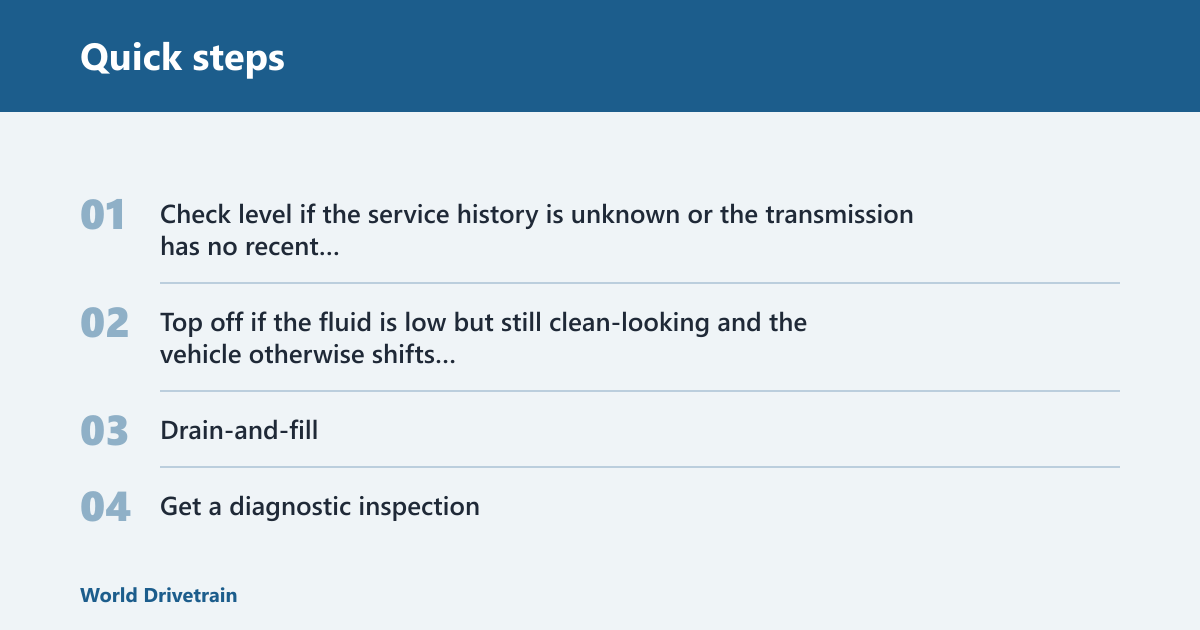
The four-path decision checklist
- Check level if the service history is unknown or the transmission has no recent inspection.
- Top off if the fluid is low but still clean-looking and the vehicle otherwise shifts normally.
- Drain-and-fill if the fluid is dark, discolored, or sludgy, even if the transmission still drives acceptably.
- Get a diagnostic inspection if the transmission slips, bangs into gear, delays engagement, or makes unusual noises.
When should you stop and get the transmission diagnosed?
Stop and inspect first when symptoms suggest more than just old fluid. Harsh shifts, slipping, delayed engagement, abnormal noises, or stalling at stoplights can signal a control, hydraulic, or mechanical issue. In that situation, a fluid change is not the first test because it may miss the real fault.
Symptoms that point to more than old fluid
Old fluid can cause trouble shifting and make a car sluggish, but not every symptom comes from fluid age alone. Delayed engagement means the vehicle takes longer than normal to start moving after you select drive or reverse. Slipping means engine speed rises without a matching increase in vehicle speed.
Harsh shifts are abrupt gear changes. Abnormal noises can include whining or grinding. Stalling at stoplights is a serious symptom, especially if it happens with other drivability changes. Those signs justify a diagnostic inspection before any fluid change.
Why harsh shifts, slipping, or delayed engagement change the plan
If the transmission already shows those symptoms, fresh fluid will not fix a worn clutch pack, a failing solenoid, a pressure problem, or a restricted valve body. Fluid condition still matters, but the service order changes. Diagnosis first, fluid service second.
What a fluid change may involve
A fluid change can be simple or more involved depending on the transmission. Some vehicles let you drain fluid through a drain plug in the pan. Others require removing the transmission pan entirely. Some also need the filter and gasket inspected when the pan is off.
Transmission pan, drain plug, and pan removal
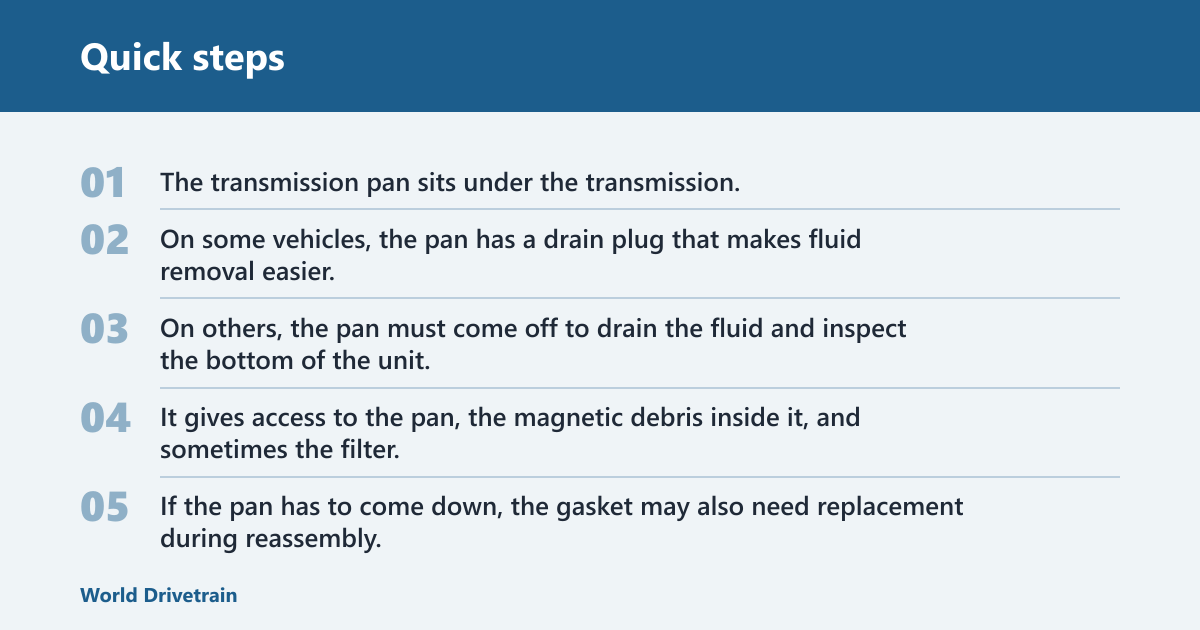
The transmission pan sits under the transmission, and it may be held on with six to eight bolts. On some vehicles, the pan has a drain plug that makes fluid removal easier. On others, the pan must come off to drain the fluid and inspect the bottom of the unit.
Pan removal is more than a fluid dump. It gives access to the pan, the magnetic debris inside it, and sometimes the filter. If the pan has to come down, the gasket may also need replacement during reassembly.
Filter and gasket inspection during service
The transmission filter may be inspected during pan removal, but it is not always part of a basic fluid change. A gasket may also be replaced when the pan is removed. Those parts matter because they affect sealing and fluid cleanliness, but they are not automatically required on every transmission service.
Why secure vehicle support matters
Any work under the vehicle needs secure support on jack stands, not guesswork. The vehicle should be parked on a level surface before you begin, then lifted and supported properly if access under the transmission is needed. Safety comes before access, even for a simple drain-and-fill.
How often do you need to change transmission fluid?
A common interval range is 30,000–60,000 miles, but that is not a universal rule and it should not replace the owner’s manual. Service needs vary by vehicle, transmission design, driving conditions, and prior fluid history. Use the manual first, then adjust based on fluid condition and symptoms.
When mileage matters less than condition
If the fluid is clean and the transmission is working normally, a mileage number alone should not force service. If the fluid is dark, discolored, or sludgy, condition matters more than the odometer. That is especially true for vehicles with unknown service history.
Sealed units and manufacturer-specific transmissions
Some transmissions have special service procedures or are marketed with limited routine service access. That does not mean “never service”; it means the correct interval and method are vehicle-specific. For those units, generic mileage rules can be misleading.
Is it necessary to change transmission fluid?
Yes, it is necessary when the manual calls for it, when the fluid is deteriorated, or when service history and condition point to overdue maintenance. It is not automatically necessary on every vehicle at the same mileage, and it is not the right first move for serious shifting problems.
When not changing fluid may be reasonable
If the vehicle has low mileage, recent documented service, and clean fluid at the proper level, immediate replacement may not be needed. The manual still controls, but a clean, full transmission with no symptoms does not need guesswork.
When delay becomes risky
Delay becomes risky when the fluid is old, dark, or burnt, or when symptoms start showing up. Old transmission fluid can contribute to rough shifting, sluggish operation, and stalling at stoplights. At that point, waiting longer can turn a service issue into a diagnostic one.
Is it bad to not change transmission fluid?
It can be. Skipping fluid service for too long increases the chance of contaminated or overheated fluid, which can lead to trouble shifting, sluggish response, and other drivability problems. The risk is highest when the manual specifies service and the fluid has clearly aged beyond use.
Why neglected service can shorten transmission life
Automatic transmission fluid does more than lubricate. It also helps carry hydraulic pressure and manage heat. When fluid degrades, the transmission can become less predictable. Neglected service may shorten transmission life, especially if the vehicle sees heat, towing, or heavy traffic.
What old transmission fluid can do
Old fluid can become discolored or sludgy, and that condition is a signal that replacement is due. It can also contribute to trouble shifting, a sluggish feel, and stalling at stoplights. Those are not abstract warnings. They are drivability symptoms you can feel.
Should you change your own transmission fluid?
You can change it yourself only if you can follow the vehicle’s service procedure, support the vehicle safely, and identify the correct fluid. If the pan must come off, if the transmission has a special fill method, or if symptoms suggest diagnosis, professional service is the safer path.
When DIY is reasonable
A straightforward drain-and-fill on a vehicle with a drain plug may be manageable for a skilled owner with the right tools. The dipstick, fluid type, and level-check procedure still need to match the manual. Use caution, because an incorrect fill or unsafe undercar setup can create more trouble than it solves.
When to leave it to a professional
Leave it to a professional if the vehicle needs pan removal, if the fluid is badly discolored or burnt, if the transmission slips, or if the service requires diagnosis before any fluid change. Those cases call for more than routine maintenance.
Can you just top off transmission fluid instead of changing it?
Yes, if the fluid is low but still clean, topping it off may be enough for now. No, if the fluid is dirty, burnt, or sludgy. Top-off fixes level. It does not restore fluid that has aged out or replace fluid that has broken down.
Use top-off as a level fix, not a cure-all
A correct level helps the transmission build pressure and operate normally. But a clean-looking top-off only makes sense when the fluid still appears healthy. If the fluid has turned dark or sludgy, the better move is a drain-and-fill or a fuller service plan based on the manual.
When should you follow the owner’s manual instead of mileage rules?
Follow the owner’s manual whenever it gives a specific interval, a severe-service schedule, or a transmission-specific procedure. Mileage rules are only rough guides. Vehicle design, fluid type, and service history can all shift the right answer away from a generic number.
Why the manual wins
The manual is built for that exact vehicle and transmission. It may account for sealed systems, fluid type, drain-and-fill intervals, or inspection-only schedules. Generic advice cannot do that. If the manual and a mileage rule disagree, the manual should lead.
do you really need to change transmission fluid
Usually, yes, if the manual says to do it or the fluid has aged, darkened, or gone sludgy. But “need” depends on what the fluid looks like, how the transmission shifts, and whether the vehicle has recent service history. The right move is condition-based, not automatic.
do you need to change transmission fluid
Often yes, but not always right away. If the fluid is low and still clean, a top-off may be enough. If it is dark or burnt, a change is due. If the transmission is slipping or delaying engagement, diagnosis should come first.
Frequently asked questions
Do you really need to change transmission fluid?
Usually yes, because automatic transmission fluid degrades with heat and use. The owner’s manual is the first place to check for interval guidance, but fluid condition matters too. Dark, sludgy, or burnt fluid points toward service, while clean low fluid may only need a top-off.
How often do you need to change transmission fluid?
A common service range is 30,000–60,000 miles, but that is not a universal rule. The owner’s manual should set the interval for your vehicle. Driving conditions, transmission design, and previous service history can all move the correct answer earlier or later.
Is it bad to not change transmission fluid?
It can be. Old fluid can cause trouble shifting, make a car sluggish, and contribute to stalling at stoplights. If the fluid is left in service too long, the transmission may run on degraded fluid that no longer protects or operates as intended.
What happens if transmission fluid gets old?
Old transmission fluid can darken, smell burnt, and turn sludgy. That fluid may no longer support smooth shifting, and the vehicle may start to feel sluggish or shift harshly. If symptoms appear, the fluid should be checked along with the transmission itself.
Can you just top off transmission fluid instead of changing it?
Yes, if the fluid is low but still clean, topping it off may be enough. That only solves a level problem, not worn-out fluid. If the fluid is discolored, sludgy, or burnt, topping off is not a replacement for a proper service.
Should you change your own transmission fluid?
Only if the vehicle’s procedure is straightforward and you can work safely under it with jack stands on a level surface. If the pan must come off, the filter or gasket needs inspection, or the transmission has symptoms, professional diagnosis or service is the better route.