How Much Does Transmission Fluid Leak Repair Cost?
Transmission fluid leak repair often costs about $150 to $500 for external fixes like a pan gasket, cooler line, or drain plug, and roughly $600 to $1,500+ when the leak is a seal that requires transmission removal. If the leak is ignored, the fluid level can drop enough to overheat the unit, cause slipping, and potentially turn a seal job into clutch or hard-part damage. This guide breaks down prices by leak location, labor access, and common quote traps for older cars like a 2004 Honda Civic.
How much does transmission fluid leak repair cost?
The usual range is about $150 to $500 for simpler external repairs, and roughly $600 to $1,500+ for leaks tied to internal seals or harder-to-reach components. The final bill depends on diagnosis, labor time, the fluid that must be refilled, and whether the shop has to remove major parts to reach the leak.
What changes the final bill
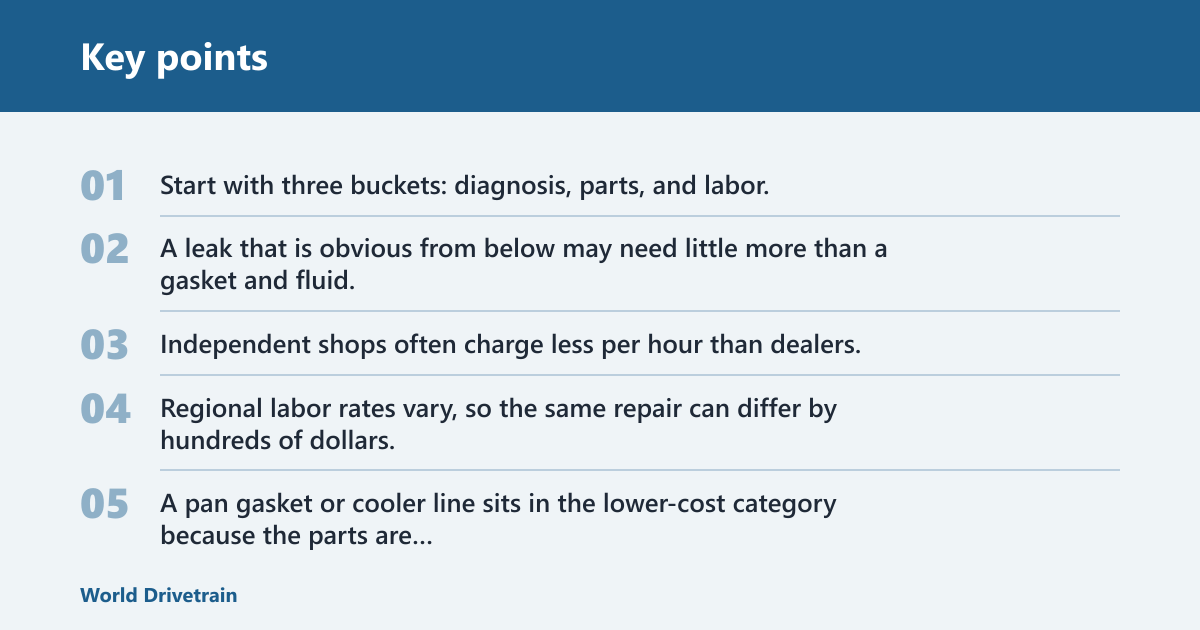
Start with three buckets: diagnosis, parts, and labor. A leak that is obvious from below may need little more than a gasket and fluid, while an unknown leak can add a dye or UV inspection fee before the repair even starts.
Labor rate matters as much as the part. Independent shops often charge less per hour than dealers, but a dealer may have faster access to model-specific procedures and the exact OEM-approved ATF the vehicle requires. Regional labor rates vary, so the same repair can differ by hundreds of dollars.
Which leak location is driving the price?
Leak location sets the repair path. A pan gasket or cooler line sits in the lower-cost category because the parts are external and usually reachable. An axle seal costs more when the axle must come out. A front pump seal or bellhousing leak is often the expensive case because the transmission may need to be removed.
| Leak location | Likely repair path | Labor intensity and access | Diagnostic clues | Typical cost range |
|---|---|---|---|---|
| Transmission pan gasket | Reseal pan, replace gasket, refill fluid, inspect filter | Low to moderate; usually accessible from below | Wet pan edge, drip from pan bolts or gasket seam | $150 to $400 |
| Transmission cooler line | Replace hose or hard line, secure fittings, refill ATF | Moderate; routing and clamps can add time | Wet line, spray pattern, fluid on subframe or radiator area | $150 to $450 |
| Axle seal | Replace seal, inspect axle shaft surface, refill fluid | Moderate to high; axle removal is usually needed | Drip near CV axle, fluid at trans output, one-side wetness | $250 to $700 |
| Bellhousing or front pump seal | Confirm source, often remove transmission, replace seal or related hard parts | High; access is difficult and labor heavy | Fluid inside bellhousing, drip from inspection cover, no external source found | $700 to $1,500+ |
| Filter service | Replace filter, pan gasket, and fluid | Low to moderate; service overlap with pan access | Maintenance-related seepage, dirty pan, service interval due | $150 to $350 |
Transmission pan gasket
A pan gasket is a common leak source and one of the lower-cost repairs. If the pan itself is straight and the bolt holes are not damaged, resealing is often enough. The parts cost is usually modest; the labor is the bigger share because the pan has to come off, be cleaned, and be sealed correctly.
Transmission cooler line
Cooler lines leak at the hose, flare fitting, crimp, or rusted hard line. The repair can be straightforward, but access is not always simple because the line runs between the transmission, radiator, and underbody. The job almost always needs a fluid refill, and low-fluid operation should be avoided.
Axle seal
An axle seal leak often shows up near the CV axle where it enters the transmission. The drip pattern helps: fluid may collect at the output housing and fling onto nearby parts. A shop should inspect the axle surface too, because a grooved or pitted shaft can damage a new seal and lead to a repeat leak.
Front pump seal and bellhousing leaks
These are higher-cost repairs because the leak is usually deeper in the transmission. Fluid at the bellhousing or inside the inspection cover often means the front pump seal, torque converter area, or another internal point. On many vehicles, transmission removal is the practical route, which is why the quote climbs fast.
Why labor rate matters as much as parts
Labor can dominate the bill when the leak is buried. A cheap seal can become an expensive repair if the transmission has to come out, the subframe must be lowered, or corrosion slows disassembly. Shops price that time differently, and dealer labor is commonly higher than independent shop labor.
Independent shop vs dealer pricing
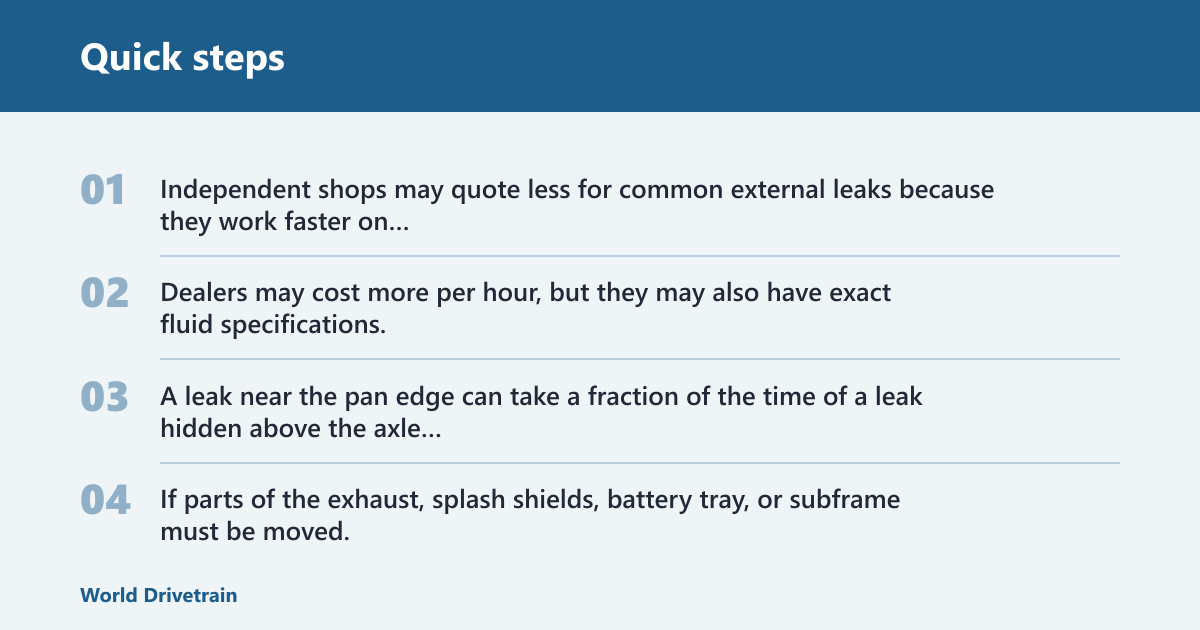
Independent shops may quote less for common external leaks because they work faster on routine access and use flexible labor rates. Dealers may cost more per hour, but they may also have exact fluid specifications, factory procedures, and parts availability for the specific transmission.
How access time drives labor hours
A leak near the pan edge can take a fraction of the time of a leak hidden above the axle or behind the bellhousing. If parts of the exhaust, splash shields, battery tray, or subframe must be moved, the labor quote rises even when the part itself is cheap.
How do you know whether the leak is minor or serious?
A minor leak usually leaves small spots and the transmission still shifts normally, while a serious leak can cause low-fluid symptoms, delayed engagement, slipping, or harsh shifts. If the fluid level is low enough to affect pressure, the issue becomes more urgent than the visible drip size suggests.
Low-fluid warning signs
Delayed drive engagement, shuddering, flare on shifts, a whining pump sound, or a slipping feel under acceleration can point to low transmission fluid. Heat builds fast when fluid drops, and heat can damage clutch packs or burn the transmission.
Dipstick and scan-based level checks
Some vehicles use a dipstick; others require a temperature-based scan procedure and a level check plug. The correct level matters because both low fluid and overfilling can cause problems. Overfill can foam the fluid, which reduces hydraulic performance and can push fluid out of seals or vents.
When to stop driving
Stop driving if the transmission starts slipping, refuses to engage, or leaves a large puddle after a short park. A small seep may allow a short trip to a shop, but a rapid leak needs towing or immediate repair. Top-off is a temporary step, not a cure.
What if the fluid is not transmission fluid?
Not every red or brown fluid is ATF. Engine oil, coolant, and power steering fluid can all be mistaken for a transmission leak, especially when fluid spreads along the underside of the vehicle. A shop should confirm the source before approving a transmission repair.
Engine oil, coolant, and power steering fluid mix-ups
Engine oil usually looks darker and feels slicker, coolant often has dye and a sweet odor, and power steering fluid can vary by vehicle. Fluid color alone is not enough. A leak from above can run down and mimic a transmission drip at the lowest point.
How dye or UV inspection confirms the source
If the source is unclear, diagnostic dye and a UV light can help trace the fluid path. This is especially useful when the underside has multiple wet areas or when the shop suspects the leak is engine oil rather than ATF. Diagnosis fees are separate from repair charges, so ask what the inspection includes.
Say your compact sedan leaves a red spot overnight, but the bellhousing is dry and the real leak is a cooler line spraying fluid onto the subframe. A quick visual check may miss that. Dye makes the source visible and can prevent an unnecessary transmission removal quote.
How much can a common car cost to fix?
A common benchmark is a 2004 Honda Civic, where a transmission leak can be relatively affordable if it is an external gasket or line, but much more expensive if the leak is tied to a seal that needs deeper access. The same model can still vary widely by transmission type and leak location.
2004 Honda Civic as a benchmark
For an older Civic, a pan gasket or service-related leak is often in the lower-cost range, while an axle seal or front seal repair can move the bill up fast. Age matters here because seals harden, fluid service histories vary, and corrosion can add labor time.
Why the same model can still vary by leak point
A small leak at the pan seam may need only resealing and fresh ATF. A leak near the bellhousing may require transmission removal. That gap explains why a quote for the same car can differ by several hundred dollars even before parts brand or dealer pricing enters the picture.
Can you drive with a transmission leak?
You can sometimes drive a short distance with a small seep if the fluid level is confirmed safe, but a driving decision should depend on leak rate, shift behavior, and whether the level can be checked correctly. If the transmission is already slipping or the fluid is low, driving can make the damage worse.
When top-off is only a short-term step
Top-off may buy time for a trip to a shop when the leak is slow and the vehicle still shifts normally. Use the correct OEM-approved ATF for the vehicle, not a random universal fluid, because compatibility matters. The wrong fluid can affect shift quality and seal life.
When the risk is high enough to park the vehicle
Park the vehicle if it loses fluid quickly, leaves a substantial puddle, or shows any slipping, harsh engagement, or warning messages. A leak that drops the level far enough to expose internal parts can create a much larger repair bill than the leak itself.
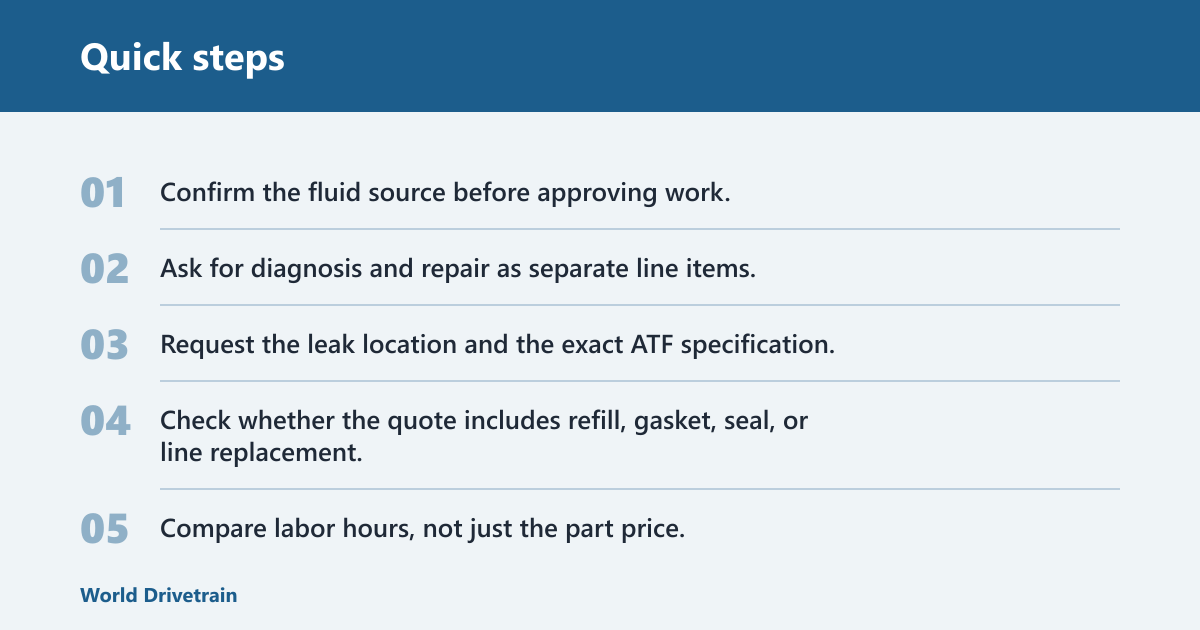
- Confirm the fluid source before approving work.
- Ask for diagnosis and repair as separate line items.
- Request the leak location and the exact ATF specification.
- Check whether the quote includes refill, gasket, seal, or line replacement.
- Compare labor hours, not just the part price.
A common first-timer mistake is approving a transmission repair after seeing a red puddle, then learning the fluid was engine oil or power steering fluid. A second mistake is ignoring a small leak because the car still drives. Low fluid can cause damage long before the leak looks dramatic.
Frequently asked questions
how much does a transmission fluid leak repair cost
Most external transmission leak repairs fall in the $150 to $500 range, while seal-related jobs can run $600 to $1,500+. Diagnosis, fluid replacement, labor access, and the need to remove the transmission are the biggest cost drivers. The source of the leak matters more than the puddle size.
how much does a transmission oil leak cost to fix
People often say transmission oil, but the repair cost depends on whether the leak is ATF, a cooler line, a pan gasket, or an internal seal. A simple external leak is usually cheaper, while a bellhousing or front pump seal often turns into a high-labor repair.
how much does transmission fluid leak cost to fix a 2004 honda civic
A 2004 Honda Civic can be inexpensive to repair if the leak is a pan gasket, drain plug, or external line. If the leak is an axle seal or a deeper transmission seal, the bill can rise quickly. Condition, mileage, and corrosion can change the labor time.
is a transmission leak expensive to fix
It can be, but not always. External leaks are often manageable, while internal or hard-to-access leaks can be expensive because labor rises sharply. The hidden cost is low fluid: if the transmission slips or overheats, the repair can grow beyond the original leak.
how much does it cost for a transmission leak
For a small external leak, the cost may stay near a couple hundred dollars. For an axle seal, cooler line, or gasket service with fresh fluid, expect more. If the leak is at the front pump or bellhousing, the repair often moves into four figures.
can a leaking transmission be fixed
Yes. Most leaks can be repaired once the source is verified. The key is matching the fix to the leak point: gasket, line, axle seal, or internal seal. If the source is unclear, dye or UV inspection helps prevent the wrong repair from being approved.