How Do You Know If Your Differential Fluid Is Low?
Your differential fluid is likely low if you see wet seepage or a drip at the cover, pinion, or axle seals, or if gear whine, growling, or chatter appears and the fluid is below the fill hole; if you hear grinding or see metal flakes, stop driving. Leave it alone long enough, and the gears overheat, bearings fail, and a small seal leak can turn into a costly differential rebuild. This guide shows the symptom patterns, leak checks, and stop-driving threshold that help you tell low fluid from worn gears or unrelated drivetrain noise.
Quick answer
Differential fluid lubricates gears, bearings, and limited-slip parts inside the housing. The correct gear oil depends on the axle and OEM spec, and the same vehicle can use different fluid in the front and rear units.
When the level drops, the moving parts lose their oil film. Heat rises fast. Noise often follows, but noise alone does not prove the fluid is low.
How do you know if your differential fluid is low?
The strongest signs are seepage at a seal or cover, noise that changes with throttle or deceleration, and a level that sits below the fill hole. Low fluid often makes a rear axle whine on acceleration or deceleration before it turns into harsher sounds.
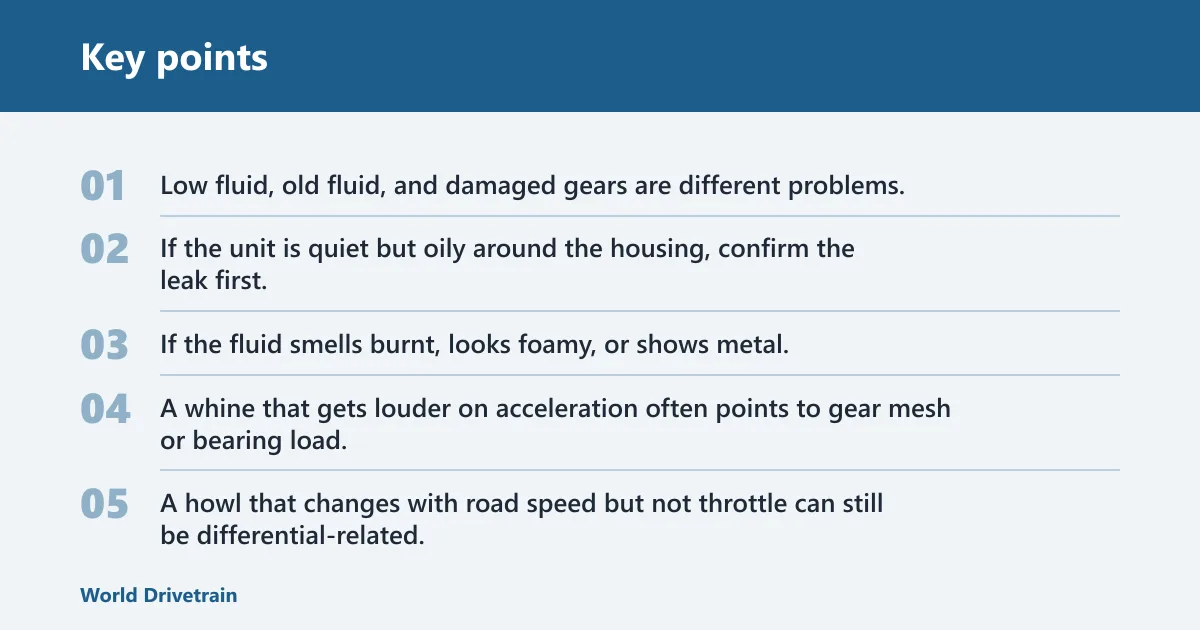
Low fluid, old fluid, and damaged gears are different problems. If the unit is quiet but oily around the housing, confirm the leak first. If the fluid smells burnt, looks foamy, or shows metal, the issue is more than a simple top-off.
Noise pattern matters
A whine that gets louder on acceleration often points to gear mesh or bearing load. A howl that changes with road speed but not throttle can still be differential-related, but tire noise and wheel-bearing noise can sound similar. Grinding or clunking raises the urgency.
Rear axles often make the clearest clue. Front differentials can be harder to isolate because road noise, CV joints, and transaxle parts may blur the sound.
Leak signs matter too
If the housing is dry except for dust, low fluid is less likely. If you see wet oil at the cover, pinion seal, axle seals, fill plug, or breather area, that is a likely path for fluid loss. Do not top off without checking the source first.
Suppose a rear axle starts to whine on light throttle at 35 mph and you find damp oil at one axle seal. That pattern fits a leak-and-low-level problem better than tire noise, which usually follows vehicle speed more than engine load.
Differential fluid diagnostic checklist
Use this checklist to separate low fluid, contaminated fluid, bearing wear, and tire-noise lookalikes. A fill check is only part of the diagnosis; symptom pattern and fluid condition matter too.
| Symptom | When it appears | Likely cause | Next step |
|---|---|---|---|
| Whine or howl | Changes with throttle, especially on acceleration or deceleration | Low fluid, worn gears, or bearing wear | Check level at fill hole and inspect for leaks |
| Grinding or rough growl | Present all the time or gets worse quickly | Severe bearing or gear damage | Stop driving and inspect immediately |
| Clunking | On takeoff, shift, or throttle changes | Backlash wear, damaged gear teeth, or driveline lash | Inspect soon; do not assume fluid alone is the issue |
| Dark fluid with burnt odor | During drain or plug inspection | Overheated or old fluid | Plan a fluid service and inspect hardware |
| Foam, shimmer, or metal particles | On the dipstick-like check, plug, or drained fluid | Aeration, contamination, or internal wear | Stop if metal is heavy; otherwise inspect soon |
| Noise that follows road speed only | Changes with vehicle speed, not throttle | Tire tread, wheel bearing, or axle issues | Compare tire wear and bearing play before blaming the differential |
How to inspect the housing
Start with the housing, not the noise alone. A differential housing may use a fill plug, a separate drain plug, or a rear cover with bolts that also lets you inspect fluid level. Sealed units and serviceable units need different access steps.
Use gloves, a drain pan, a ratchet and socket for the fill plug, a fluid pump or squeeze bottle, a torque wrench, and jack stands if the vehicle must be raised. Check the owner’s manual for the exact fill-plug spot and fluid spec before loosening anything.
- Park on level ground and let the unit cool enough to handle safely.
- Find the fill plug first. If you cannot remove the fill plug, do not drain the unit yet.
- Remove the fill plug and confirm whether fluid reaches about the bottom edge of the hole during inspection.
- Inspect the plug, threads, and housing for wet seepage.
- Look at the fluid for dark color, burnt odor, foam, shimmer, or debris.
- Check likely leak points: axle seals, pinion seal, cover gasket or RTV seam, fill plug seepage, and breather or vent overflow.
Sealed versus serviceable units
Some differentials are serviceable through a fill and drain plug pair or a cover gasket. Others sit inside an integrated transaxle or a sealed housing with limited access. Front differentials on AWD and 4WD layouts can be especially vehicle-specific.
A sealed design does not mean no service is possible. It means you need the exact procedure for that platform, not a generic rear-axle shortcut.
How do you know if your rear differential fluid is low?
Rear differential fluid is often low when the rear axle whines on acceleration or deceleration, the housing shows seepage at the cover, pinion seal, or axle seals, or the fluid level sits below the fill hole. Rear units often use hypoid gear oil, and they are a common source of drivetrain whine.
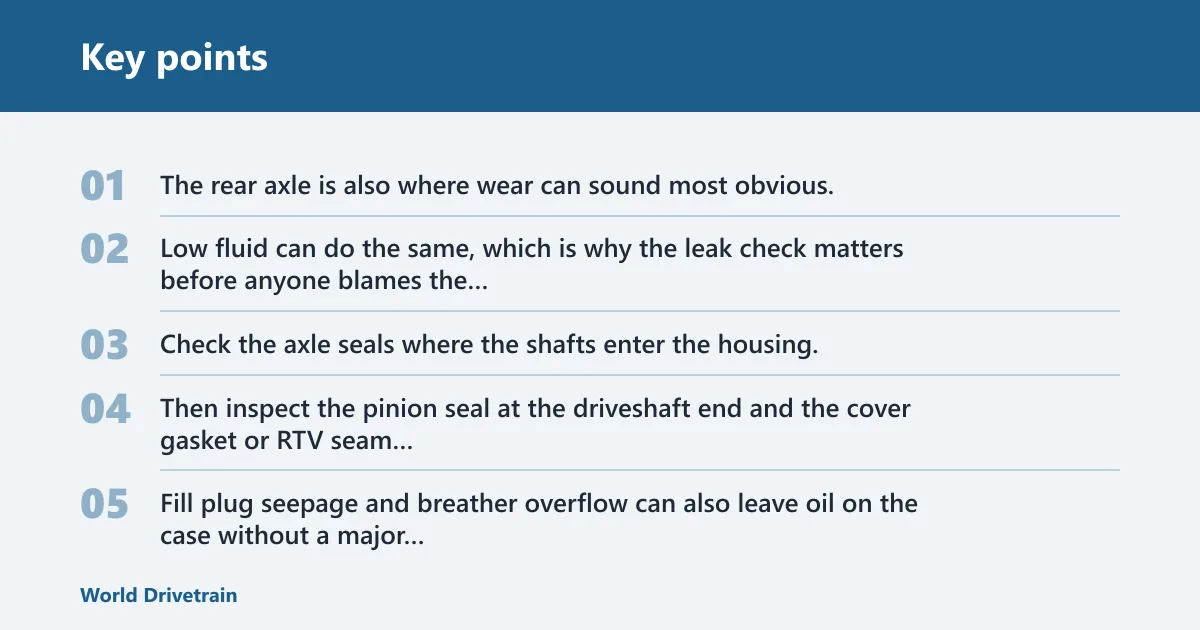
The rear axle is also where wear can sound most obvious. A worn pinion bearing can whine under load. Low fluid can do the same, which is why the leak check matters before anyone blames the gears.
Common rear leak sources
Check the axle seals where the shafts enter the housing. Then inspect the pinion seal at the driveshaft end and the cover gasket or RTV seam around the housing. Fill plug seepage and breather overflow can also leave oil on the case without a major external drip.
If you see oil mist near the vent, the housing may have pushed fluid out after overheating or overfill. That can point to a service issue, not only a leak.
When the rear axle needs service now
If the rear differential is grinding, clunking hard, or shedding visible metal, stop driving. If the whine grows quickly or the housing runs hot enough that you cannot briefly touch it after a short drive, it needs immediate attention.
A common first-timer mistake is topping off a rear axle that is already noisy without checking the drained fluid or plug. That can hide a failing bearing for a few miles, then the damage gets worse.
How do you know if your front differential is low?
Front differential fluid is likely low when an AWD or 4WD vehicle develops front-end whine, the noise grows louder with load, or oil appears at the front housing, seals, or vent. Some layouts integrate the differential with the transaxle, so access and fill procedure vary by vehicle.
Front noise is easier to misread because it can overlap with CV joints, wheel bearings, and tire roar. You need the level check and the fluid check together before deciding the differential is the cause.
AWD and 4WD inspection differences
Many AWD and 4WD vehicles place the front differential higher in the chassis or combine it with other drivetrain parts. That changes where the fill plug sits and whether you inspect through a separate housing, a transaxle case, or a service port.
If the manual specifies a special access method, follow it. Guessing at the fill point can lead to an underfill or an overfill.
What makes front noise easier to misread
Front tire cupping can sound like a front differential howl. A wheel bearing can add a low growl that changes with speed. A CV joint can click on turns, which is a different pattern from gear whine.
Pay attention to load. Differential noise often changes with throttle and lift-off. Tire noise usually stays closer to road speed and road surface.
What fluid condition tells you
Bad differential fluid often looks dark, smells burnt, foams, or carries metal shimmer or particles. Water contamination can turn the oil cloudy or milky. These signs point to fluid that no longer protects gears and bearings well.
Low fluid and bad fluid are not the same thing. A low axle can still have clean oil. A full axle can still have overheated or contaminated oil. Both need attention, but not always the same repair.
When topping off is not enough
If the fluid is burnt, foamy, or full of metal, topping off will not fix the cause. You may need a leak repair, fluid change, or internal inspection. Heavy metal debris means the gears or bearings may already be damaged.
If the oil looks clean and the level is only slightly below the fill hole, a top-off may be acceptable after you confirm the leak source and the correct spec.
What happens if differential fluid is low?
Low fluid can overheat gears and bearings, raise friction, and lead to wear that gets expensive fast. In a limited-slip unit, it can also affect clutch operation and create chatter. Ignore it long enough, and the differential can fail.
That failure may start as noise, then progress to vibration, metal debris, and loss of smooth driving. The earlier you catch the leak or low level, the better the odds of avoiding a rebuild.
What does low differential fluid sound like?
Low differential fluid often sounds like a whine, howl, or light growl that changes with throttle and deceleration. It may get louder as speed rises, but the clearest clue is load change rather than road speed alone.
Grinding is a worse sign. That usually means metal contact is already happening, and the vehicle should not keep driving until it is inspected.
Frequently asked questions
How do you know if your gear oil is low?
Gear oil is low when the housing leaks, the plug inspection shows a level below the fill hole, or noise appears with throttle changes. Dark or burnt oil may also point to overheated gear oil, which is a separate problem from low level.
How do you know if your front differential is low on fluid?
Front differential fluid may be low if an AWD or 4WD vehicle develops front-end whine that changes with load and the front housing shows seepage or vent overflow. Because front noise overlaps with bearings and CV joints, confirm the level before replacing parts.
How do you know if your differential fluid is bad?
Bad differential fluid usually looks dark, smells burnt, or shows foam, shimmer, or water contamination. Those signs mean the oil may no longer protect gears and bearings well. If you also find metal particles, the unit needs prompt inspection.