Transmission Fluid Change: Cost, Interval, DIY
Many automatics call for transmission fluid service somewhere between about 30,000 and 60,000 miles. Sealed automatics still need service at the listed interval, and a DIY drain-and-fill only makes sense when you know the fill procedure and the correct fluid spec. Wrong fluid, a bad level set, or skipped service can lead to shift flare, slipping, overheating, and repair bills that run from hundreds to several thousand dollars. This guide compares shop prices, drain-and-fill versus full service, real interval rules by transmission type, and the DIY mistakes worth avoiding.
Transmission fluid does more than lubricate. In an automatic, it also carries heat, controls clutch friction, and works as the hydraulic fluid that applies clutches and bands. In a manual gearbox, the fluid or gear oil mainly lubricates gears and bearings, though synchronizer action can change a lot with the exact viscosity and friction package.
That is why the service decision starts with transmission type, then moves to fluid spec, access, and symptoms. Dark fluid, a burnt smell, visible debris in the drain pan, or leaks at the pan, axle seals, or cooler lines can change the recommendation quickly.
What does a transmission fluid change actually include?
A transmission fluid change can mean anything from a simple drain-and-fill to a pan-drop service with a filter, gasket, and pan cleaning. The exact work depends on whether the transmission has a drain plug, a removable pan, a serviceable filter, and a dipstick or sealed level-check procedure. Refill quantity is usually only part of the total fluid volume.
Drain-and-fill versus pan-drop service
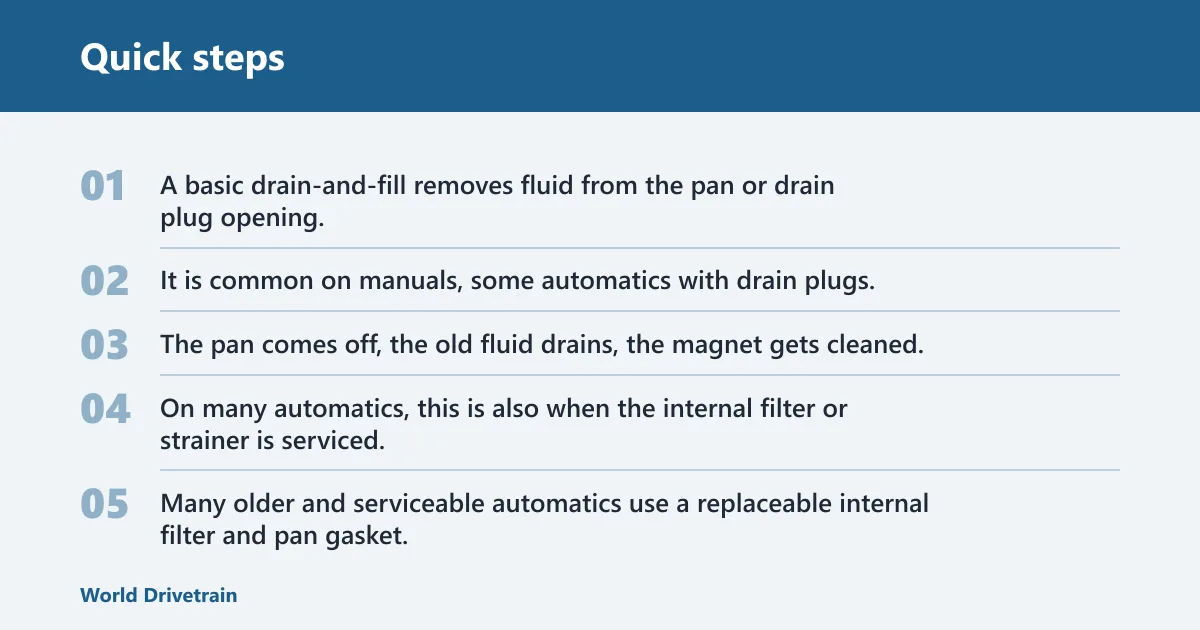
A basic drain-and-fill removes fluid from the pan or drain plug opening, then replaces roughly the same amount with fresh fluid that meets the OEM specification. It is common on manuals, some automatics with drain plugs, and many late-model units where a full pan drop is not part of routine service.
A pan-drop service adds labor. The pan comes off, the old fluid drains, the magnet gets cleaned, the pan is inspected for clutch material or metal, and the gasket is replaced or reused if the design allows it. On many automatics, this is also when the internal filter or strainer is serviced.
When the filter and pan gasket are part of the job
Many older and serviceable automatics use a replaceable internal filter and pan gasket. Some newer units use a strainer that is not always replaced during routine service, and others use an external cartridge-style filter. Some transmissions have no routine filter replacement at all, so a menu price that says “transmission service” may leave the filter out completely.
Pan gaskets vary too. Rubber or molded reusable gaskets can often go back in if they are undamaged and the maker allows reuse. Cork, paper, or crush-style gaskets are usually replaced. Bolt torque sequence matters because a warped pan rail or uneven clamping can cause leaks after service.
Why refill quantity is usually less than total capacity
A drain-and-fill does not empty the torque converter, cooler circuit, valve body, and every passage in the unit. That means the amount refilled after a standard service is often well below the transmission’s published total capacity. Shops that advertise a “full exchange” are describing a different service from a normal change.
Say your crossover drains 4 quarts from the pan but lists a much larger total system capacity in the service information. Refilling only the drained amount is correct for a standard change, while pouring in the full system number can overfill it and create aeration, slipping, or foaming.
How much does a transmission fluid change cost?
Typical shop pricing usually starts with manual-gearbox drain-and-fill rates, climbs for serviceable automatics with pan and filter work, and rises again for sealed automatics that need special fluid and a temperature-based level check. The biggest cost drivers are fluid type, quantity, pan or filter access, and labor time, not the word “transmission” by itself.
Typical price bands by transmission type
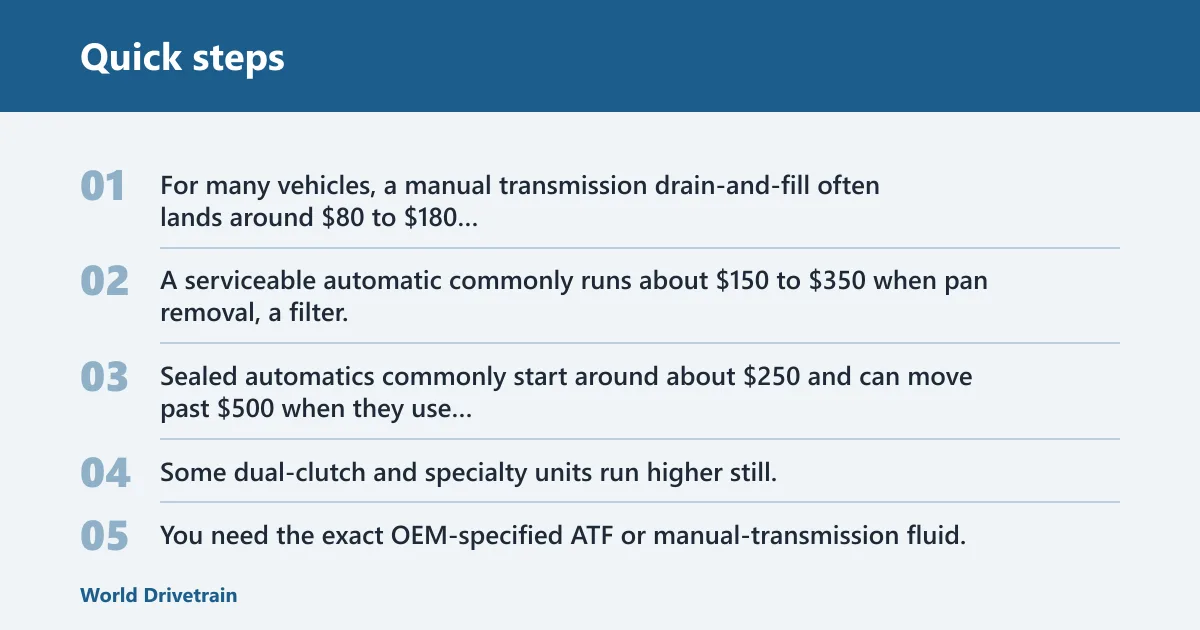
For many vehicles, a manual transmission drain-and-fill often lands around $80 to $180 at an independent shop because fluid quantity is modest and there is usually no filter or pan gasket. A serviceable automatic commonly runs about $150 to $350 when pan removal, a filter, and gasket work are included.
Sealed automatics commonly start around about $250 and can move past $500 when they use pricier OEM fluid, require underbody covers to come off, or need a scan tool to confirm fluid temperature before the final level check. Some dual-clutch and specialty units run higher still.
What moves the bill up or down
Fluid specification comes first. You need the exact OEM-specified ATF or manual-transmission fluid. The wrong fluid can alter shift timing, clutch friction behavior, synchronizer feel, and long-term wear. Vehicles that call for dealer-only or less common fluid usually cost more before labor is added.
Quantity comes next. A compact manual may need only a small amount of gear oil. A larger automatic can need several quarts even for a basic drain-and-fill, and more for a pan service or repeated drain-and-fills.
Access changes labor fast. A pan with two dozen bolts, crossmember interference, tight exhaust routing, or a buried fill plug adds time. A service that includes a filter also includes pan cleaning, magnet inspection, gasket handling, and torquing the pan evenly to spec.
Why some vehicles cost much more than menu pricing suggests
Sealed transmissions are the usual reason. If the level must be set through an overflow plug at a specific fluid temperature, the job can require a scan tool, a lift or carefully level support, and time spent cycling through gears before the final check. That is more than “drain and refill.”
Suppose a late-model SUV uses a standpipe overflow system and the service information calls for a narrow temperature window before the level plug comes out. The same fluid service now includes temperature monitoring, pump filling from below, and extra time if the fluid gets too hot and the check must be repeated.
Cost can look small next to repair. Dedicated transmission shops, including one in Herndon, Virginia that says it serves Northern Virginia customers, list separate repair, rebuilding, and replacement services and also state that they offer manufacturer-recommended service. If the unit is already failing, maintenance pricing stops being the real decision point. JASPER also offers remanufactured automatic and standard transmissions, says most popular models are in stock for immediate availability, and lists a standard warranty on popular models of 3 years/100,000 miles.
The cost of skipping your fluid change
Transmission fluid is not just lubrication; it is the hydraulic fluid that controls shift timing and the cooling medium that prevents internal overheating. When neglected, this fluid degrades chemically, losing the specific friction modifiers required for smooth clutch engagement. consequences of stale fluid detail how this breakdown leads to shuddering, hard shifting, and eventual slip. Understanding these progression stages is critical because it distinguishes simple maintenance from major rebuild costs, helping you identify exactly when a fluid change is the last opportunity to save the transmission. This matters because early symptoms are often manageable, but waiting for total failure typically results in a multi-thousand dollar repair rather than a routine service.
How often should you change transmission fluid?
Many maintenance schedules place automatic transmission service in about the 30,000 to 60,000 mile range or roughly every 3 to 6 years. Severe use shortens that schedule. The factory maintenance schedule for the exact make, model, engine, and transmission family should override any rule of thumb.
Mileage and time intervals by transmission type
Automatics generally need closer attention because the fluid handles lubrication, cooling, friction control, and hydraulic operation. A manual gearbox usually puts less thermal stress into its fluid, so the interval may be longer. Some makers publish mileage only; others also specify time because oxidation continues even when mileage stays low.
Some vehicles are sold with “lifetime” language in owner discussions, but that wording is not a universal service answer. The useful question is what the maintenance schedule or service information says for normal and severe use, and whether the fill-check procedure makes owner service realistic.
How severe service shortens the schedule
Severe service usually means towing, frequent stop-and-go traffic, high ambient temperatures, mountain driving, repeated short trips, or any use that keeps fluid temperatures elevated. Those conditions age fluid faster and can justify a shorter interval even if the vehicle seems to shift normally.
Heat is the enemy here. Automatic fluid loses friction stability and oxidation resistance over time, so a vehicle used in summer traffic or on grades with a trailer often needs service sooner than the same model used for steady highway commuting.
What to check between intervals
Condition signs matter. Dark fluid, a burnt odor, visible debris on the drain plug or in the pan, delayed engagement into drive or reverse, slip on acceleration, and leaks around pan rails or cooler lines all deserve attention before the next scheduled service date.
If symptoms are active, the right move may be inspection first, not an automatic fluid change. That is especially true when shifting faults, warning lights, or clear mechanical noises are already present.
Transmission service decision table
| Transmission type | Mileage/condition | Estimated labor complexity | Parts needed | DIY suitability | Red-flag symptoms: stop and inspect before changing fluid |
|---|---|---|---|---|---|
| Serviceable automatic | On-schedule, normal shifting, no warning lights, fluid aged but not burnt | Moderate if pan drop is required; lower if drain plug and dipstick are present | OEM-spec ATF, filter or strainer if applicable, pan gasket if replaceable, drain plug washer if used | Reasonable for an experienced DIYer who can torque the pan correctly and verify level | Slip, delayed engagement, heavy metal debris, burnt odor, repeated flare between gears |
| Sealed automatic | On-schedule, no active complaints, procedure available in service information | Moderate to high because fill and level check are often temperature-dependent | OEM-spec ATF, fill plug seal or washer where required, possible undertray fasteners | Limited; sensible only if the owner can keep the vehicle level, monitor fluid temperature, and follow the overflow procedure exactly | Hard shifts with faults stored, slip, burnt smell, overheated fluid, unknown previous fluid type |
| Manual transmission | Routine service, no grinding complaint, no major leaks | Low to moderate; usually drain and refill through side fill plug | Correct gear oil or manual-trans fluid, crush washers or seals if specified | Usually the best home-service candidate if fill access is clear and the vehicle can be kept level | Metal chunks on plug magnet, gear clash in multiple gears, noisy bearings, low fluid from active leaks |
| High-mileage neglected unit | Unknown service history, very dark fluid, overdue by years or many miles | High decision complexity even if labor is simple | Depends on inspection findings; fluid alone may not be the first step | Low; inspection first is the safer call | Slip under load, burnt odor, black fluid, debris in pan, no movement when hot, existing transmission codes |
| Shift-problem complaint case | Hard shifting, delayed engagement, flare, shudder, or warning light already present | High because diagnosis should come before maintenance | May need scan data, pressure checks, leak repair, or internal parts rather than fluid only | Poor candidate for first-time DIY service | Any worsening slip, limp mode, fault codes, metal debris, burnt odor, repeat complaint after warmup |
Transmission-specific maintenance intervals
Transmission service schedules vary significantly based on drivetrain type, operating conditions, and vehicle age. A single generic mileage number is rarely sufficient, so owners need a framework that matches their specific automatic, manual, or CVT system. transmission fluid change intervals breaks down these variations by use case.
This resource provides a detailed matrix comparing normal versus severe driving conditions, explaining why high-mileage vehicles or those without service records require shorter intervals. It also distinguishes between drain-and-fill methods and flushes, helping drivers identify when late shifts or increased heat signal that immediate service is necessary to prevent part failure.
What is the difference between a fluid change and a flush?
A fluid change usually means a drain-and-fill or pan service that replaces only part of the fluid. A flush usually means a machine-assisted exchange that pushes out more old fluid through the cooler circuit. They are different services, and a flush is not always the best first move on an older or troubled transmission.
How a machine-assisted exchange differs
With a standard change, the transmission loses only what drains from the pan or drain plug. With a machine-assisted exchange, the shop uses the transmission’s own pump or a dedicated machine to replace old fluid with new fluid as the system circulates. That can swap a larger share of the old fluid, but it also adds cost and procedure sensitivity.
When a flush is the wrong first step
On a neglected, high-mileage unit with unknown history, active slip, or burnt fluid, many technicians prefer inspection or a conservative drain-and-fill instead of an aggressive exchange. The concern is not that fresh fluid is bad by itself. The concern is that a failing unit may already have wear or debris issues that fluid service will not solve.
Some manufacturers do not call for a flush as routine maintenance, and some shops avoid it on symptom-heavy vehicles for the same reason. If the transmission already slips or delays engagement, diagnosis comes before any machine service.
Can you change transmission fluid at home?
Home service is realistic on many manuals and some serviceable automatics with clear fill access, a known fluid spec, and a straightforward level check. DIY becomes a poor bet when the transmission is sealed, scan-tool temperature data is required, or shift complaints are already present before service begins.
DIY-safe cases versus shop-only cases
The best DIY candidates are manual gearboxes with obvious drain and fill plugs, and automatics with a drain plug, a dipstick, and a documented procedure. Those jobs still demand care, but the chance of a level-setting error is lower.
Shop-only cases include sealed transmissions with overflow-plug procedures, units that need fluid temperature read live during the final level check, vehicles with active faults or limp mode, and anything with a leak that has not been identified yet.
Tools and supplies you need
A basic home setup usually includes:
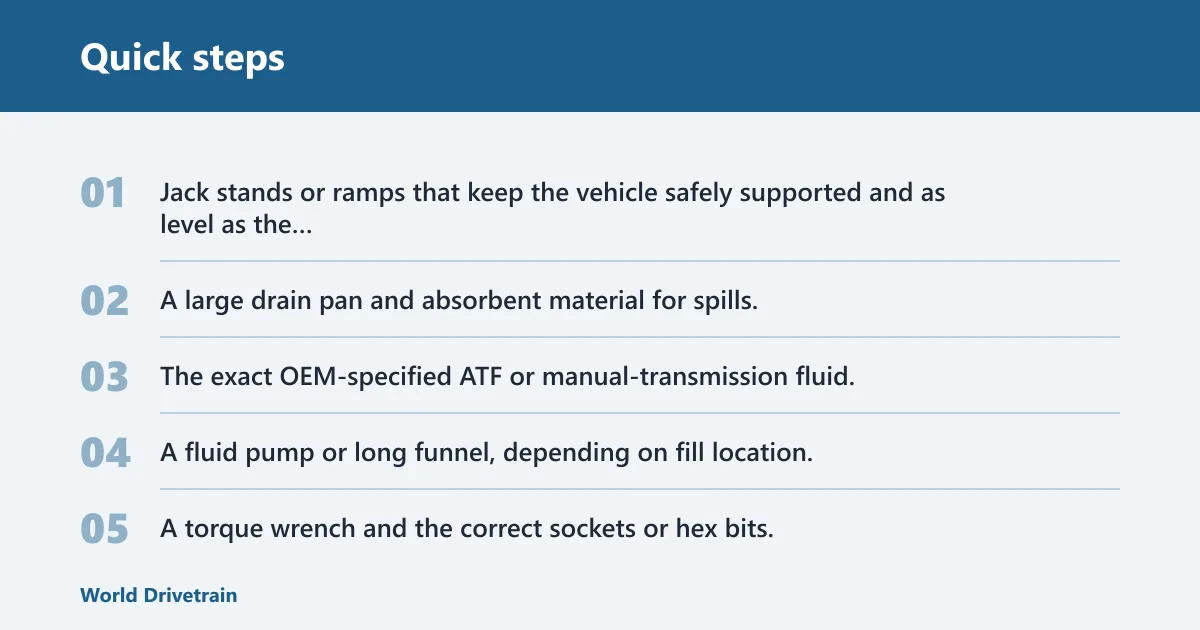
- Jack stands or ramps that keep the vehicle safely supported and as level as the procedure requires.
- A large drain pan and absorbent material for spills.
- The exact OEM-specified ATF or manual-transmission fluid.
- A fluid pump or long funnel, depending on fill location.
- A torque wrench and the correct sockets or hex bits.
- Replacement filter, gasket, plug washer, or seals if the service calls for them.
- Service information with torque specs, refill quantity guidance, and the level-check procedure.
Mistakes that create trouble
Wrong-fluid fills are near the top of the list. So are underfilling, overfilling, reusing a damaged gasket, overtightening pan bolts, and checking fluid at the wrong temperature. A common first-timer mistake is reading a sealed transmission as “full” because fluid dribbles from the overflow plug while the unit is still too cool, then driving away with an actual low level once the fluid warms and expands differently.
Time also matters. A straightforward manual gearbox can often be finished in about 1 hour. A serviceable automatic with pan and filter work may take 1.5 to 3 hours. A sealed automatic with a temperature-based level check can consume 2 to 4 hours, especially if undertrays, scan-tool setup, or repeated warmup cycles are involved.
How do sealed and serviceable transmissions differ?
Serviceable transmissions usually give you a dipstick or simple refill path, while sealed units often use a fill port plus an overflow or standpipe method. Sealed designs raise labor time because fluid level may need to be checked at a specified temperature with the vehicle level, sometimes using a scan tool for accuracy.
Dipstick checks versus fill-plug and overflow-plug procedures
Older serviceable automatics often let you add fluid through a dipstick tube and verify level on the stick after following the maker’s warmup sequence. That is simpler, though still not foolproof.
Many sealed automatics replace the dipstick with a side fill port and a lower check or overflow plug. The transmission gets filled until fluid reaches the standpipe level, then the final level is verified only within the specified temperature window. Too cold or too hot can give the wrong result.
Why temperature control changes the job
Fluid expands with temperature, so level checks on sealed units are often tied to a narrow range in the service information. Some vehicles can show that temperature through the instrument cluster service menu, but many require a scan tool reading transmission-fluid temperature directly.
That requirement is one reason sealed units cost more in a shop. The value is not vague peace of mind. It is the ability to set the level accurately, inspect for leaks while the underbody is open, and catch fault codes before a simple service turns into misdiagnosis.
Will a transmission fluid change fix hard shifting?
Sometimes, but only when old or degraded fluid is part of the cause. Fresh fluid of the exact spec and proper level can improve shift feel when the existing fluid is aged and the transmission is otherwise healthy. It is unlikely to cure worn clutches, solenoid faults, valve-body issues, internal damage, or a low-fluid condition caused by an active leak.
When fresh fluid can help
If shifts have become a little firmer over time, engagement is slightly delayed on cold starts, and the fluid is old but not burnt, correct fluid at the right level may improve operation. That is most plausible when the vehicle is simply overdue, not when it already slips under load.
When inspection should come first
Red flags include slipping, flare between gears, harsh engagement into drive or reverse, repeated delayed engagement, burnt-fluid odor, warning lights, and visible metal debris. Those symptoms point to wear or hydraulic faults more often than to routine fluid aging.
Picture a sedan that bangs into reverse only after a three-second pause, then shifts normally for ten minutes before flaring on the 2-3 upshift. That pattern is not a good candidate for a casual home drain-and-fill. It calls for fluid-condition inspection, code checks, and leak diagnosis first.
Why changing fluid can sometimes cause problems
Fluid service does not create wear, but it can expose an already failing transmission or make a level-setting mistake obvious right away. Problems after service usually trace to pre-existing damage, wrong fluid, incorrect level, poor gasket sealing, or a flush performed on a neglected unit that needed diagnosis first.
If the transmission is far beyond routine maintenance, repair may already be in play. Shops that focus on transmissions often separate maintenance from repair, rebuild, and replacement. On the replacement side, JASPER offers remanufactured automatic and standard transmissions, notes that most popular models are in stock for immediate availability, and offers an 18 month/100,000 mile warranty for off-road applications. JASPER also says its Premium Service Plan can cover fluids if a problem arises.
When fresh fluid can help hard shifts
Hard shifting is sometimes a fluid problem: old, burnt, low, or incorrectly specified transmission fluid can make shifts feel harsh, delayed, or inconsistent. In those cases, a proper service may improve drivability and prevent extra wear. But a fluid change is not a cure-all. If the issue comes from worn clutches, a failing solenoid, or valve-body damage, fresh fluid will not solve it.
This article explains how to tell the difference, when a service can help, and when a bad or incomplete service can make things worse. It also covers why the transmission fluid help question matters before you pay for repairs or keep driving with a problem that could get more expensive.
Frequently asked questions
Does a transmission fluid change include the filter?
Not always. Many serviceable automatics include a filter or strainer during a pan-drop service, but some transmissions use non-routine strainers, external filters, or no serviceable filter at all. Ask whether the quote includes pan removal, magnet cleaning, gasket handling, and the exact filter part, if one exists.
Why is a transmission fluid change so expensive?
The price rises when the transmission uses costly OEM fluid, needs many quarts, requires pan removal and filter work, or has a sealed level-check procedure tied to fluid temperature. Labor also goes up when undertrays, tight fill access, or scan-tool verification are part of the service.
How long does a transmission fluid change take?
A manual gearbox drain-and-fill can take about 1 hour. A serviceable automatic with pan removal and filter replacement often takes 1.5 to 3 hours. A sealed automatic that needs fluid-temperature monitoring and an overflow-plug level set can run 2 to 4 hours, depending on access.
Can changing transmission fluid cause problems?
It can if the wrong fluid is used, the level is set incorrectly, the pan leaks afterward, or a worn transmission was already failing before service. The safer rule is simple: if there is slipping, burnt odor, metal debris, or fault behavior, inspect first and service second.
Do I really need to change transmission fluid?
Yes, in most cases, because transmission fluid handles heat and friction, and many automatics also depend on it for hydraulic operation. The exact interval varies widely, so the real answer comes from the model-specific schedule and the vehicle’s use pattern, especially towing, traffic, heat, or mountain driving.