Transmission Slipping: Signs, Causes, and Fix Cost
A slipping transmission usually shows up as RPM climbing without matching road speed, delayed engagement into Drive or Reverse, or a shudder. If it slips in multiple gears, stop driving and tow it, because repairs can range from about a $150 fluid service to roughly a $2,500-$6,000 rebuild. Keep driving through active slip and heat can burn clutches, contaminate the valve body, and turn a small repair into a full replacement. This guide covers the signs, the likely causes from low to high cost, when it is safe to drive, and what repairs usually cost on automatics, CVTs, and manuals.
What does transmission slipping mean?
Transmission slipping means engine speed rises without the vehicle accelerating at the same rate, because the transmission is not sending power cleanly to the wheels. It may show up as a brief flare on an upshift, delayed engagement into Drive or Reverse, a shudder at steady speed, or a complete no-move condition.
Slip is a symptom, not a single failure
The key point is simple: slipping describes what the vehicle does, not which part failed. Causes that can produce the same complaint include low fluid, wrong fluid, degraded fluid, an external leak that drops pressure, a failed solenoid, valve body wear, worn clutch packs, a bad torque converter, an out-of-adjustment band, or a worn manual clutch.
That matters because the cheapest fix is usually found early. A transmission that slips because a leak lowered fluid level needs a very different repair than one with black fluid, debris, and repeat flare in several gears.
Slip versus delayed shift versus harsh shift
A delayed shift means the next gear comes in late. A harsh shift means it comes in hard. Slip is different: revs rise, the vehicle hesitates, then the gear may catch. In some cases, a slipping transmission can feel like it drops into neutral while you are driving.
Early slip often starts as a short flare on the 2-3 or 3-4 upshift. More serious slip can turn into delayed engagement from Park into Drive, no reverse gear, or loss of movement once the unit is hot.
What rev flare tells you
High RPM over 3500 is listed as a sign of transmission slipping. On a normal light-throttle upshift, RPM should fall into the next ratio. If RPM jumps first, then drops when the gear catches, the transmission is losing holding force or hydraulic pressure during that shift.
CVTs can feel different. Instead of a clean gear flare, they may show a rubber-band feel, ratio hunting, or engine speed rising faster than road speed. That still counts as slip, even though the hardware works differently.
What are the signs of transmission slipping?
The common signs are RPM climbing without matching acceleration, hesitation between gears, delayed engagement into Drive or Reverse, shudder, and weak pull under load. The check engine light may come on, difficulty shifting gears is a reported symptom, and a burnt smell or other unusual odor can point to transmission slip.
Acceleration, engagement, and gear-change clues
Acceleration delay is a classic clue. The engine responds, but the vehicle does not move with the same urgency. On an automatic, that may happen during an upshift or right after you select Drive.
No reverse gear is also listed as a symptom. So is difficulty shifting gears. If the complaint is limited to one range, such as Reverse or one forward gear, that points more toward a specific hydraulic or internal fault than a simple fluid top-off.
How slipping feels when accelerating
Under acceleration, slip usually feels like a pause between engine effort and wheel response. Revs rise, the vehicle feels soft or slow to answer, then the gear catches. Some drivers describe it as a surge after a delay.
Suppose a midsize SUV leaves a stoplight normally, then flares at 30 mph on the 2-3 shift and settles down. If that happens once when cold, fluid level and fluid condition move high on the list. If it happens on every warm drive, internal wear or a control fault becomes more likely.
Hot-only slip, shudder, and no-move conditions
Why does the complaint often appear after about 15 to 20 minutes of driving? Heat thins worn fluid and exposes pressure loss. Worn clutch packs, valve body wear, and torque converter lockup problems often act worse once the transmission is fully warm.
A torque converter can also cause slipping complaints. At highway cruise, it may produce a shudder as lockup applies and releases. In some cases, converter faults are tied to stalling when coming to a stop.
Burnt fluid may look black and smell like burnt toast. That smell points to overheating or clutch material breakdown, not a minor issue to watch later.
Is it safe to drive with a slipping transmission?
Sometimes you can drive a short distance to a nearby shop, but active slip is never low-risk. If it slips in multiple gears, loses Reverse, shudders hard at speed, or barely moves, stop driving and tow it, because heat can quickly turn a serviceable problem into internal damage.
Drive only to a nearby shop
A short, gentle trip may be reasonable when the transmission still engages cleanly, the slip is mild and occasional, no warning light is flashing, fluid is at the correct level, and there is no severe shudder or burnt smell.
That is a small window. The goal is diagnosis, not continued use. Continued slipping can overheat the fluid and damage clutches, so waiting usually raises the bill.
Stop driving and tow it
- It slips in more than one gear.
- Drive or Reverse engagement is badly delayed.
- The vehicle pops out of gear or feels like neutral while moving.
- There is a strong burnt smell, black fluid, or visible metal debris.
- The check engine light or transmission warning appears with severe symptoms.
- The transmission shudders hard at highway speed.
- The vehicle barely moves, then suddenly catches.
Why repeated slipping gets expensive fast
Slip creates heat. Heat breaks down fluid, lowers its ability to carry pressure, and spreads friction material through the unit. Once clutch debris circulates, the valve body, solenoids, and converter can all be affected.
Picture a compact sedan that starts with a small cooler-line leak and a mild 3-4 flare. Keep driving it for a week, fluid drops farther, and the same unit now slips hot in several gears. The repair path can move from a leak repair and service to a rebuild because the original pressure loss never got fixed.
Why does a transmission slip?
The cheapest likely causes are low fluid, wrong fluid, degraded fluid, or an external leak that drops hydraulic pressure. Next come control faults such as failed solenoids and valve body wear, followed by converter, band, clutch-pack, CVT, or manual-clutch failures that usually cost more.
Low or degraded automatic transmission fluid
Low fluid levels or a transmission fluid leak are identified causes. In an automatic, fluid is the hydraulic working medium. If the level drops, line pressure can fall and clutches or bands cannot hold as firmly as they should.
Fluid condition matters too. Red or pink generally indicates healthy fluid. Light brown suggests age. Dark brown can point to overheating. Black may indicate severe degradation. Milky or foamy fluid may suggest contamination or aeration.
Top up only with the exact specified fluid. Wrong fluid can change friction behavior, shift timing, and lockup operation. Do not top off blindly, and do not overfill.
Leaks, pressure loss, and failed solenoids
Common leak points include cooler lines, the pan gasket, axle seals, and, where equipped, radiator cooler failure. On some vehicles with sealed transmissions, there is no dipstick. The level check may require a specific fluid temperature, a fill-plug procedure, and a level standpipe, which makes this shop work for many owners.
Solenoid problems can cause slipping because the solenoid controls fluid flow and pressure to the clutch circuits. A failed transmission solenoid can also cause delayed shifts, wrong-gear starts, or trouble codes. That is one reason scanning for codes should come before guessing at hard parts.
Torque converter, bands, clutch packs, and manual clutch wear
Old or broken transmission bands are a possible cause on transmissions that use them. Bands hold rotating elements for certain gears. If they wear, go out of adjustment, or break, the result may be a flare or loss of one gear range.
Internal clutch wear is a common automatic-transmission cause once mileage and heat take their toll. In a manual, transmission slip usually points to the clutch assembly rather than the gearbox internals. Manual-transmission slip may be caused by clutch problems, especially if engine RPM rises in higher gears under load.
A bad torque converter can mimic internal transmission failure. Lockup shudder at steady cruise, excess heat, and stall complaints when coming to a stop can all point in that direction.
CVT-specific slip causes
CVTs deserve separate treatment. They do not shift like a conventional automatic, so slip often feels like ratio flare, delayed ratio change, or a stretched-rubber-band response. CVT fluid is very sensitive to the correct specification, and damage can get expensive once belt, chain, or pulley surfaces wear.
Dual-clutch units can also feel like slip, though the fault path may involve clutch adaptation, worn clutch packs, or mechatronic controls rather than low hydraulic pressure in the same way as a conventional automatic.
How do you diagnose transmission slipping?
Start by confirming exactly when the slip occurs, then scan for stored codes, inspect fluid level and condition with the correct vehicle procedure, check for leaks, and review service history. After that, road-test clues, adaptation data, line-pressure testing, and converter lockup checks separate serviceable faults from rebuild territory.
Start with warning lights and scan codes
The check engine light can come on with transmission slip. Even if the car still drives, scan it. Transmission and engine modules may store gear-ratio, pressure-control, solenoid, temperature, or converter lockup faults that narrow the problem quickly.
A transmission diagnostic test is the right next step when symptoms repeat, when the warning light is on, or when fluid level is not plainly the issue. Some competitors advertise a free diagnostic, but that is a shop-specific offer, not a standard industry rule.
Check fluid level and condition the right way
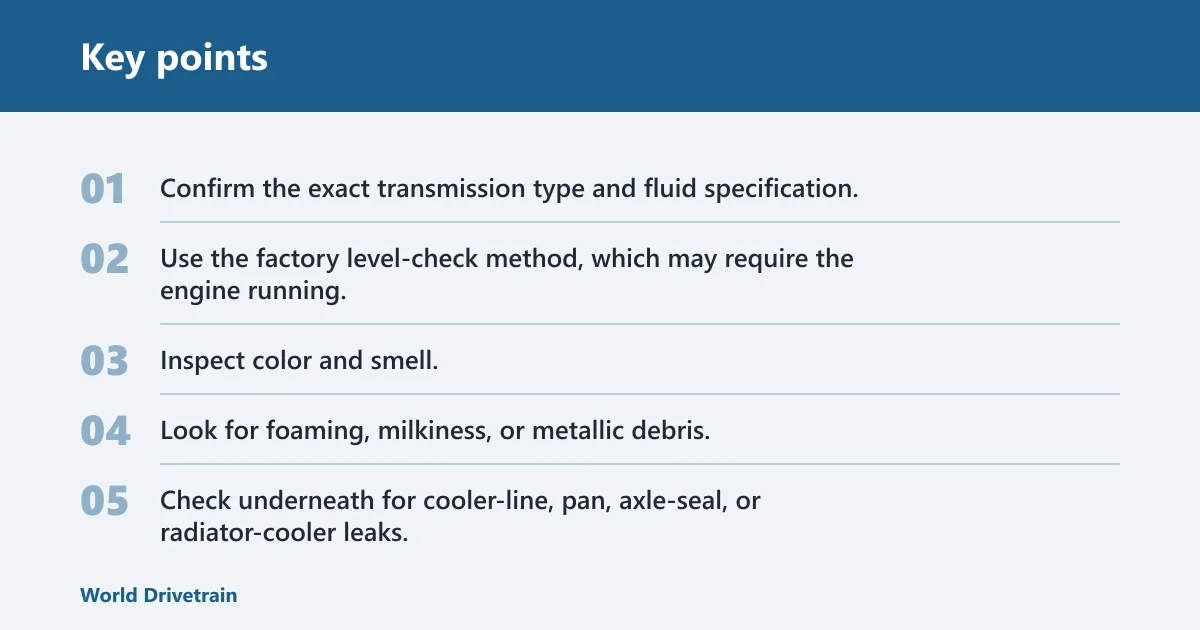
- Confirm the exact transmission type and fluid specification.
- Use the factory level-check method, which may require the engine running, about a set fluid temperature, and a level surface.
- Inspect color and smell.
- Look for foaming, milkiness, or metallic debris.
- Check underneath for cooler-line, pan, axle-seal, or radiator-cooler leaks.
On sealed transmissions, level checks are easy to get wrong. A common first-time mistake is reading a hot-fill transmission cold, then adding fluid until it is overfull. Aerated fluid can then create its own shift and slip complaints.
Road-test clues that separate likely causes
If the flare happens only on one shift, a band, clutch circuit, or solenoid problem becomes more likely. If it slips hot in several gears, expect a broader pressure-loss or clutch-wear issue. If it shudders lightly at steady 45-70 mph cruise, torque converter lockup moves up the list.
If the complaint is delayed engagement first thing in the morning and then normal operation after a few seconds, drain-back, worn seals, or low fluid deserve attention. If Reverse is missing but forward gears are present, the fault is less likely to be a simple additive fix.
When pressure testing or teardown is needed
A full diagnostic test may include scan-tool data, adaptation values, line-pressure testing, stall-speed or lockup evaluation, and a controlled road test. If fluid is black, smells burnt, or contains heavy debris, teardown or replacement discussion usually comes before repeated service attempts.
Start with the lowest-cost repairs that fit the evidence: correct fluid level, leak repair, fluid and filter service where appropriate, then electrical or hydraulic control repairs such as solenoids, valve body work, or a band adjustment. Replacement is not the first answer unless the transmission already shows widespread internal damage.
Correct fluid top-up and leak repair
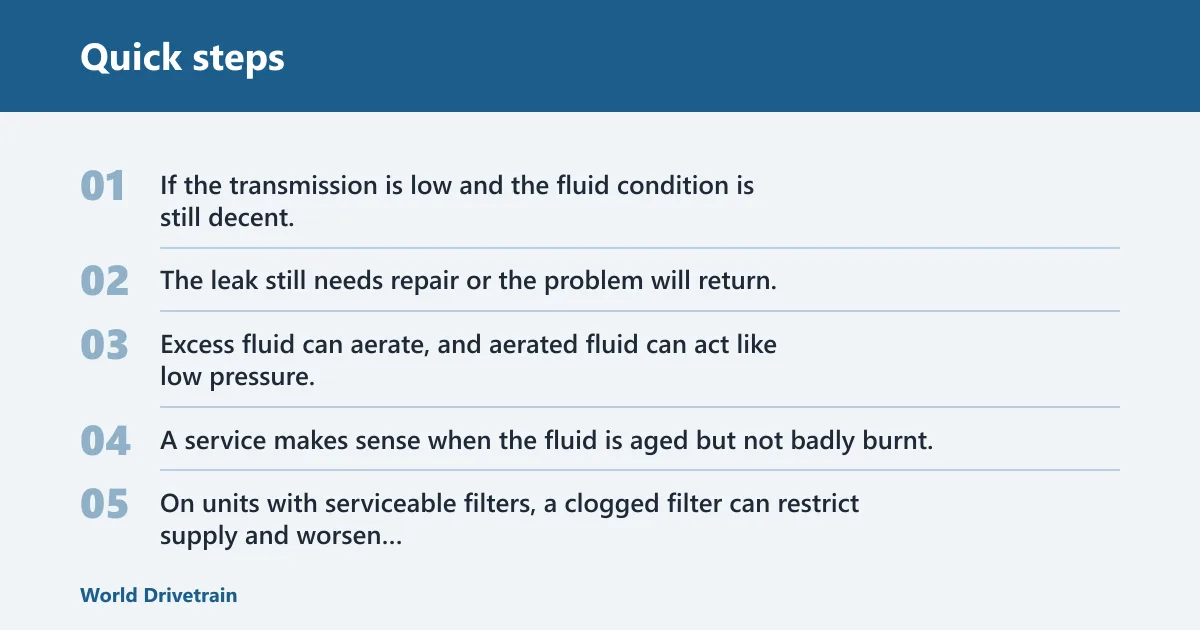
If the transmission is low and the fluid condition is still decent, restoring the proper level with the exact specified fluid may stop the slip. That is the exception, not a promise. The leak still needs repair or the problem will return.
Do not overfill. Excess fluid can aerate, and aerated fluid can act like low pressure.
Fluid and filter service when it still makes sense
A service makes sense when the fluid is aged but not badly burnt, there is no heavy debris, and the transmission still moves normally outside a mild slip or delayed shift complaint. On units with serviceable filters, a clogged filter can restrict supply and worsen pressure loss.
Fluid service is less convincing when the unit already has black fluid, severe shudder, no Reverse, or repeated flare after correct fill. At that point, service may freshen the fluid without fixing the failed friction elements behind the symptom.
Solenoid, valve body, band adjustment, converter, and clutch repair
Failed solenoids can often be replaced without rebuilding the whole unit. Valve body wear or sticking valves may also be repairable as a targeted job, depending on transmission design and contamination level.
Band adjustment is worth considering only on transmissions designed for it. If a band is broken, adjustment will not help. Torque converter replacement can solve lockup shudder or converter slip, but if debris from the converter or clutches has spread through the transmission, the valve body and cooler circuit also need attention.
For manuals, a slipping clutch assembly can often be repaired without touching the gearbox internals. That usually means a clutch, pressure plate, release bearing, and inspection of the flywheel surface.
Do additives help?
Additives may mask a minor seal-related symptom for a short time in limited cases. They do not fix worn clutches, damaged bands, converter failure, a bad solenoid, or low fluid caused by an external leak.
They are also risky in units that need a very specific friction package, especially CVTs and some late automatics. If the transmission already smells burnt, slips in several gears, or sets pressure-control codes, additive money is usually better spent on diagnosis.
Slipping transmission cost matrix
| Symptom pattern | Likely cause | First diagnostic step | Likely repair path | Estimated cost band |
|---|---|---|---|---|
| Mild flare after turns or on hills; level reads low; no burnt smell | Low fluid from minor leak or neglected level | Verify correct level-check procedure; inspect for external leaks | Correct-fluid top-up and leak repair | $20-$80 top-up only; $150-$400 with small leak repair |
| Occasional slip or delayed shift; fluid light brown; no heavy debris | Aged fluid, restricted filter, early pressure loss | Inspect fluid color and service history | Fluid service or fluid-and-filter service | $150-$350 |
| Slip with warning light, wrong-gear starts, intermittent harsh or delayed shifts | Solenoid or valve body control fault | Scan for transmission codes and review live data | Solenoid replacement or valve body repair | $250-$900 for solenoid work; $600-$1,500 for valve body repair |
| Shudder at steady highway cruise; heat-related slip; lockup complaints | Torque converter fault | Road test for lockup shudder; scan slip-speed data | Torque converter replacement, fluid service, cooler flush | $700-$1,800 |
| One specific gear flares or disappears on an older band-type automatic | Band out of adjustment, worn, or broken | Confirm which gear is affected; inspect adjustment spec where applicable | Band adjustment or internal band repair | $150-$350 adjustment; $1,000-$2,000 internal repair |
| Multiple-gear slip, burnt black fluid, delayed Drive and Reverse, debris present | Internal clutch-pack wear or widespread pressure loss | Fluid inspection, pressure test, teardown decision | Rebuild | $2,500-$6,000 |
| No-move condition, hard-part damage, severe contamination, failed CVT internals | Extensive internal failure | Confirm no-move, inspect for debris, quote complete unit | Replacement with reman or new unit | $4,000-$8,500+ |
How much does it cost to fix a slipping transmission?
Most slipping complaints do not start at rebuild money. Costs usually begin with fluid level correction or service, move through leak repair and control components, then jump sharply once the transmission has burnt fluid, multiple-gear slip, or metal debris. The financial breakpoint comes when targeted repairs approach rebuild cost without fixing the root failure.
Typical cost bands by repair path
The table above gives the practical breakdown many readers do not get elsewhere. A level correction may be small money. Service work is still modest. Solenoid and valve body jobs sit in the middle. Converter work costs more because labor rises fast. Rebuild and replacement are a separate tier.
Manual clutch repair belongs in the middle too. Depending on vehicle layout and flywheel condition, it often lands below a full automatic rebuild but above a simple fluid service.
What pushes the bill from repair to rebuild
Pricing changes with transmission type, fluid specification, labor rate, accessibility, OEM versus aftermarket parts, and how much contamination is inside the unit. Once clutch material or metal spreads through the valve body, cooler, and converter, one-part fixes stop making financial sense.
CVTs deserve extra caution here. A fluid issue caught early may be manageable. Once belt or pulley damage starts, the repair path often jumps straight toward replacement-level cost.
Rebuild versus replacement
If the transmission still has a serviceable case, no major hard-part damage, and a strong rebuilder supports that unit, rebuild can make sense. If the case is damaged, the internals are heavily contaminated, or a reman unit comes with better support, replacement may be the cleaner financial choice.
JASPER states its reman transmissions include a 3 year/100,000 mile warranty. Terms like that matter, especially when a rebuild quote is close to reman price.
As a working rule, piecemeal repairs stop making sense when the vehicle has repeated slip in multiple gears, burnt black fluid, and a quote for converter, valve body, and leak work is already approaching lower-end rebuild cost.
Frequently asked questions
How does transmission slipping feel when accelerating?
It usually feels like the engine responds first and the vehicle responds late. RPM rises, acceleration lags, and the gear may catch with a small surge. In a CVT, the same complaint can feel like a rubber-band effect, with engine speed climbing faster than road speed.
Why does my transmission slip when hot?
Heat thins old fluid and exposes pressure loss that may not show up cold. Worn clutch packs, valve body wear, weak seals, and torque converter lockup faults often act worse after warmup. If slip starts only when hot, fluid condition and line-pressure control move high on the checklist.
Why does my automatic transmission keep slipping?
Repeated slip usually means the root cause was not only low fluid, or the fluid loss was never fixed. Common repeat causes are leaks, wrong fluid, failed solenoids, valve body wear, converter problems, or worn clutch packs. If topping up helps only briefly, the diagnosis needs to go deeper.
What to do if your transmission is slipping
Stop hard driving, verify whether the vehicle can be moved safely, and scan for warning codes. Check fluid only if you are following the correct procedure for that transmission, especially on sealed units. If it slips in multiple gears, smells burnt, or barely moves, tow it rather than driving farther.
Do transmission additives help a slipping transmission?
Additives may offer brief symptom relief in narrow cases involving aging seals, but they do not repair worn clutches, broken bands, bad solenoids, converter faults, or external leaks. They are usually a poor bet when fluid is burnt, slip is repeated, or the transmission has stored fault codes.