Transmission Noise: What It Means and What to Do
A new transmission noise usually comes from one of four places: low or incorrect fluid, an internal bearing or gear problem, the pump or hydraulic system on an automatic, or a non-transmission source such as a wheel bearing, tire, or accessory drive. Start by identifying whether the sound follows engine speed or road speed, whether it changes with gear or clutch position, and whether fluid can be checked by the vehicle’s specified procedure. Ignore that pattern and you can turn a fluid service or mount fix into a transmission rebuild. This guide ties sound patterns to likely sources, quick checks you can do now, common false leads, and the point where outside service gives way to internal repair.
Start with the noise pattern
First 15 minutes: what to check before booking a shop visit
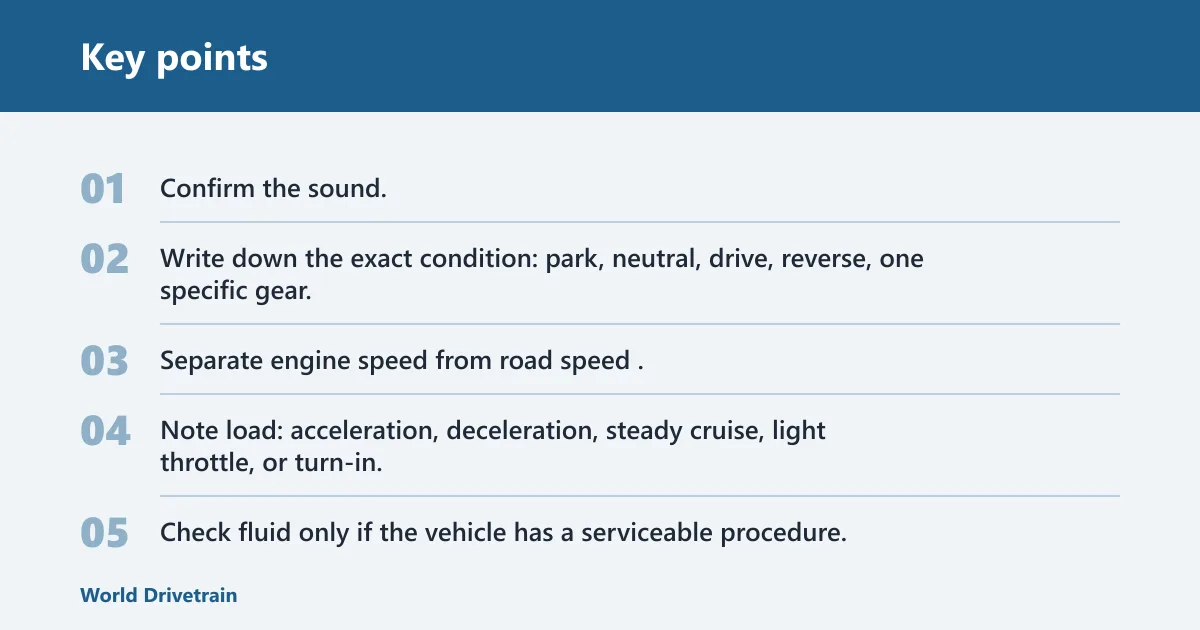
- Confirm the sound. Note whether it is a whir, whine, hum, growl, grind, clunk, or pump-like buzz.
- Write down the exact condition: park, neutral, drive, reverse, one specific gear, all gears, clutch pedal up, or clutch pedal down.
- Separate engine speed from road speed. A bearing issue often tracks speed more than throttle.
- Note load: acceleration, deceleration, steady cruise, light throttle, or turn-in.
- Check fluid only if the vehicle has a serviceable procedure. Many newer units use sealed checks with a temperature range and fill plug, not a dipstick, and OEM service procedures routinely require a narrow temperature window and level-setting sequence rather than a casual top-off (ACDelco DEXRON-VI guidance; Motorcraft MERCON ULV).
- If fluid is checkable, use the specified procedure only. On dipstick-equipped vehicles, check level on level ground under the required temperature and engine-running conditions; on sealed units, the level is typically set at the fill or level plug only within the specified temperature window. Look for low level, burnt smell, dark color, metallic shimmer, or obvious contamination.
- Do one short, gentle road test only if the sound is mild and there is no slipping, grinding, or warning for low pressure or overheating.
- Avoid repeated hard pulls, long highway runs, towing, or “see if it gets worse” testing. Those can turn bearing or pump wear into hard-part damage.
Engine speed or road speed
This split saves time. If the noise rises with vehicle speed no matter which gear is selected, the output side, differential section, wheel bearings, or tires are often worth checking first. If it changes with engine rpm while stopped in park or neutral, think pump, accessory drive, or manual input-side parts.
Pin down the pattern before you name the part. A noise that starts only in third, fades the moment you lift off, or returns at the same road speed in fourth tells you far more than calling it a “whine” or “hum.”
Shift position, clutch engagement, and load
Manual and automatic transmissions do not fail on the same sound map. In manuals, the input shaft, countershaft, and differential bearings are usual suspects. In automatics, the noise may come from the pump, planetary bearings, or the differential section.
If the sound occurs only with the clutch engaged and vanishes when you push the pedal, the input side is a strong candidate. If a smooth hum grows with road speed regardless of gear, the differential or a wheel bearing deserves equal attention.
What to write down before you visit a shop
- Cold only, hot only, or both
- One gear, several gears, or all gears
- Acceleration, deceleration, or steady speed
- Straight road only or worse while changing lanes
- Park or neutral noise versus in-gear noise
- Fluid status: correct spec confirmed, unknown, low, dark, burnt, metallic shimmer present
Walk in with specifics, not a label. “Steady whir at 30 to 40 mph in third and fourth, louder on light throttle, unchanged hot or cold, no noise in park, fluid spec unknown” gives a shop a real starting point and cuts down on bad guesses.
Picture a six-speed manual that is quiet with the clutch pedal down, then develops a steady whir as soon as the pedal comes up in neutral and in every driving gear. That single change points the first conversation toward the input side, not a random full-system rebuild quote.
What does a transmission whirring noise mean?
A transmission whir usually narrows by when it happens. In a manual, clutch position and which gears are noisy separate input shaft, countershaft, and differential bearings. In an automatic, a whine in park or neutral points more toward pump and pressure issues. A smooth hum that changes with lane shift may not be transmission-related at all.
Manual whir: input shaft, countershaft, and differential clues
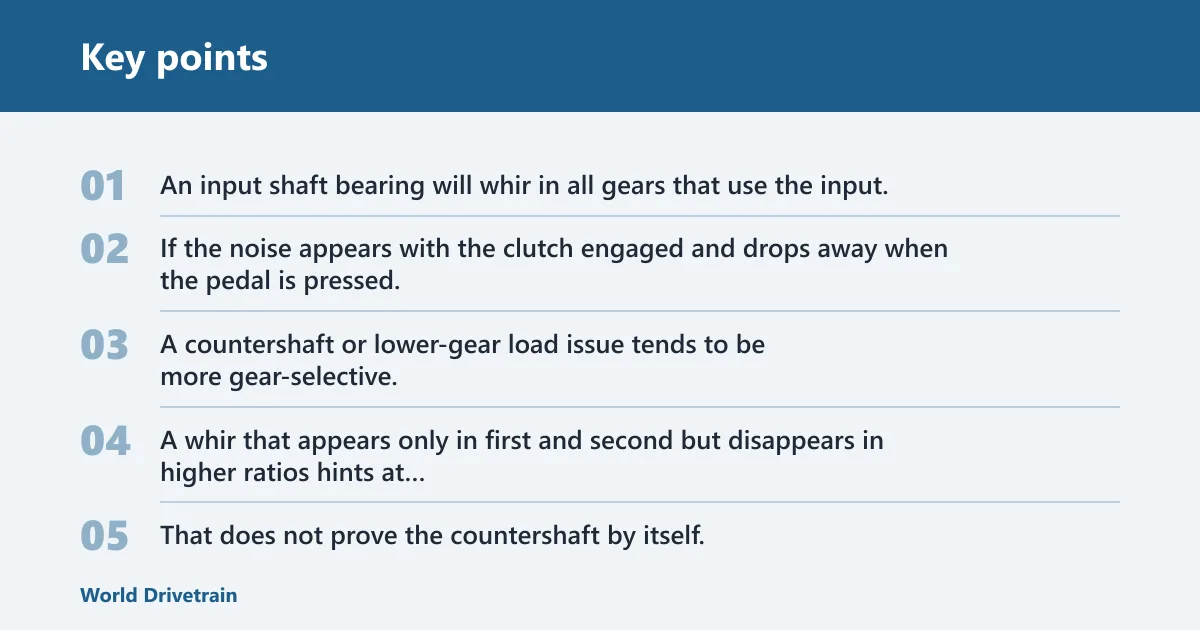
An input shaft bearing will whir in all gears that use the input. If the noise appears with the clutch engaged and drops away when the pedal is pressed, that is one of the cleaner manual-transmission patterns.
A countershaft or lower-gear load issue tends to be more gear-selective. A whir that appears only in first and second but disappears in higher ratios hints at lower-gear bearing load. That does not prove the countershaft by itself, but it is a better lead than “general transmission noise.”
A differential bearing typically grows with road speed regardless of gear. If the whir grows linearly with road speed in every gear, the differential or output section is likely. That is where owners often get sent the wrong way, because the same pattern can mimic a wheel bearing.
Automatic whine or whir: pump, pressure, and converter clues
Automatic pump noise is often reported as a high, steady hydraulic whine that changes with engine speed at idle and may remain present in park or neutral. Low or incorrect fluid can increase transmission noise, and wrong fluid spec can alter both pressure behavior and clutch apply feel. Fluid makers and transmission manufacturers are explicit that exact spec matters, not just “red ATF” or a broad multi-vehicle claim (ZF oil guide; AISIN ATF 0WS).
The pump matters because it feeds line pressure. If the sound is loudest in park, neutral, or right after a cold start, and fluid condition is poor, check the hydraulic side before blaming hard parts deeper in the unit. A pan inspection for debris and a pressure check help separate wear from a fluid-only problem. Pressure testing is a standard diagnostic step in transmission service literature because pump noise with unstable pressure is a different failure path than normal pressure with a downstream bearing noise (Sonnax hydraulic pressure testing).
Converter-related complaints can add confusion. A noise that changes near lockup speed or during light-throttle apply may need scan data to compare converter clutch slip with the sound event. That is different from a constant road-speed hum. For related drivability symptoms, compare transmission slipping with a pure noise complaint before anyone jumps straight to overhaul.
When a smooth hum points away from the transmission
Wheel bearings usually make a speed-dependent hum or growl, and the pitch often changes when the vehicle is loaded side to side in a lane shift. Tire pattern noise can do something similar, though it often changes more with road surface than throttle. Supporting references describe this load-sensitive, road-speed pattern as a key wheel-bearing clue (AA1Car wheel-bearing diagnosis; Timken wheel-bearing signs).
Engine accessory whine is another trap. If the noise follows rpm in park with no gear selected, the transmission is not the only candidate. Power steering pump whine can also mimic hydraulic transmission noise, especially during parking-lot turns.
When whirring moves from serviceable to internal-repair territory
A fluid issue is still plausible when the noise appeared after the wrong ATF or gear oil was installed, when the level is low, or when the sound changes quickly after correcting the spec. Internal repair becomes more likely when there is metallic shimmer in fluid, debris on the pan magnet, gear-specific whir that persists with proper fluid, or a road-speed whir that steadily worsens.
Can low transmission fluid cause noise?
Yes. Low fluid, the wrong viscosity, or the wrong friction package can affect pump sound, clutch apply behavior, and bearing lubrication. That said, fluid does not explain every noise. Burnt smell, dark fluid, metallic shimmer, or pan debris push the diagnosis away from “top it off and drive” and toward inspection for wear.
How fluid level and spec change the sound
Low or incorrect fluid can increase transmission noise. In automatics, aerated or low fluid can make the pump whine because pressure stability suffers. In manuals, the wrong gear-oil viscosity can alter bearing and gear mesh noise, especially when cold.
Correct fluid spec matters because additives do different jobs. ATF friction modifiers affect clutch engagement; viscosity affects pump feed and lubrication film. A unit filled with a fluid that “fits many applications” but misses the required spec can sound different long before it sets a code.
Burnt smell, dark fluid, and metallic shimmer
A burnt smell points to heat. Dark fluid alone is less precise, but dark fluid plus burnt odor plus harsh or delayed engagement is a bad combination. Metallic shimmer can be a more direct sign of wear in bearings, gears, bushings, or clutch-related hard parts.
On automatics with a removable pan, the magnet is a useful trigger point. A thin coating of fine gray paste can be normal wear over time; flakes, chips, or obvious glitter are different. Those findings support internal inspection rather than a simple drain-and-fill sales pitch.
When fluid service is reasonable, and when it is not enough
Fluid service and recheck make sense when the noise started soon after incorrect fluid was used, when the level is off, or when the sound is mild and there is no metallic shimmer, debris, slipping, or gear-specific grind. It is a weak bet when the noise tracks one bearing pattern cleanly or when pan debris confirms wear.
Suppose an automatic starts whining in park and during gentle takeoff two days after a quick-lube visit, with no prior complaint and no road-speed growl. Confirming the exact ATF spec and fluid level belongs at the top of the list, ahead of authorizing teardown.
Why is my transmission making noise when accelerating?
Noise on acceleration usually means load is exposing a weak part. In manuals, that may be an input, countershaft, or differential bearing. In automatics, it can be pump pressure, planetary bearing load, or differential-section wear. Deceleration noise points more toward gear-mesh or backlash patterns, so the accel-versus-decel split is one of the best first filters.
Load-sensitive manual and automatic patterns
Manuals often show themselves in a gear-by-gear pattern. If first and second are noisy under pull but higher gears calm down, lower-gear bearing load becomes a stronger lead. If all gears whir with the clutch engaged, the input side stays high on the list.
Automatics can get louder under throttle because pressure demand rises. A pump or pressure-control issue may become more obvious during launch or part-throttle acceleration. Planetary bearing noise can also increase under load, though a pressure test and scan data are needed to separate hydraulic causes from hard-part wear.
Acceleration versus deceleration
Acceleration loads one side of the gear train; deceleration loads another. If the sound fades on coastdown, that leans away from tire noise and toward load-related bearing or gear patterns. If it is loud on decel in a single gear, gear mesh or backlash deserves more attention than a fluid-only explanation.
Map the sound against gear, throttle, and speed. If it pulls hard in second and third, goes quiet on closed throttle, or appears at 45 mph in any gear, you already have a better diagnostic path than parts swapping.
Gear-by-gear mapping and road-speed traps
Write down exactly which gears make noise. That matters because a road-speed-driven sound can fool the driver into thinking “third gear is noisy” when the real issue is simply that third puts the vehicle at the problem speed most often.
Say your manual hums at 35 mph in third, then hums again at 35 mph in fourth with the same pitch. That pattern points away from a single gear set and toward the output section, differential, wheel bearing, or tires.
Noise triage table
| Sound type | When it happens | Likely source | Quick at-home checks | Likely shop test | Urgency |
|---|---|---|---|---|---|
| Manual whir or hum | All gears with clutch engaged; drops when pedal is pressed | Input shaft bearing | Confirm clutch-up versus clutch-down change in neutral and while rolling; check manual fluid spec and condition if serviceable | Road test by gear; case stethoscope on safely spinning drivetrain; fluid inspection for metallic shimmer | High if worsening; moderate if mild and fluid history is uncertain |
| Manual whir strongest in first and second | Under acceleration in lower ratios; reduced in higher gears | Countershaft bearing or lower-gear load pattern | Map noise by gear and accel versus decel; avoid hard pulls | Gear-by-gear road test; case listening; internal wear suspected if fluid contains metal | High |
| Manual or transaxle hum/growl | Builds with road speed in every gear | Differential bearings or output section | Check whether pitch is tied to speed rather than rpm; compare straight driving with gentle lane shift | Road-speed isolation; chassis-ear or stethoscope comparison between case and hubs | High |
| Automatic hydraulic whine | Park, neutral, and takeoff; often louder cold or at idle | Pump or pressure issue; low or wrong ATF possible | Verify exact ATF spec, level where procedure allows, smell, color, and any delayed engagement | Line-pressure test; scan data; pan and magnet inspection | Moderate to high; high if engagement is delayed or fluid smells burnt |
| Automatic whine with light-throttle lockup event | Near converter clutch apply speed; not usually present in park | Converter clutch or related hydraulic control issue | Note exact speed and throttle condition; check for shudder or rpm fluctuation | Scan data for converter clutch slip; pressure checks; fluid inspection | Moderate |
| Road-speed hum or growl | Changes with lane shift; little change with gear selection | Wheel bearing look-alike | On a safe road, note whether a gentle left or right load shift changes the sound | Hub inspection; wheel-bearing load test; compare hub noise to transmission case | High |
| Steady hum on specific pavement only | Changes with road surface more than throttle or gear | Tire pattern look-alike | Compare coarse and smooth pavement; inspect tires for cupping or uneven wear | Tire rotation or road-force diagnosis; road test on multiple surfaces | Low to moderate |
| Clicking on turns, not a whir | Tight turns under power | CV joint look-alike | Note whether the noise is rhythmic and turn-specific rather than gear-specific | CV joint inspection on lift; axle play check | Moderate |
How do you tell transmission noise from wheel bearing noise?
Use load and speed, not guesswork. Wheel-bearing noise usually follows road speed and often changes when the car is gently loaded left or right in a lane shift. Transmission noise is more likely to change with gear, clutch engagement, shift position, or a pressure-related condition in park, neutral, or takeoff.
The lane-shift load test
On a safe, empty road at steady speed, a gentle lane change shifts weight side to side. If the hum or growl changes noticeably as the vehicle loads one side, a wheel bearing moves up the list. If the sound stays tied to gear, clutch state, or in-park rpm, the transmission remains more likely.
This is a screening tool, not proof. Tires can also react to side load, and some differential noises can blur the picture.
Wheel-bearing hum or growl versus transmission whine
Wheel bearings more often produce a broad hum or growl that rises with speed and pays little attention to throttle. A transmission pump tends to make a cleaner hydraulic whine. Manual input-side issues often react strongly to clutch engagement, which a wheel bearing will not.
A bearing issue often tracks speed more than throttle. That fact applies to more than one bearing in the vehicle, which is why the lane-shift and gear-position details matter.
Other look-alikes worth screening
Tire pattern noise changes with road surface. Differential or final-drive noise can mimic a transmission output problem because it is part of the same speed path. CV joints click more than they hum. Engine accessory and power-steering noises can be heard at idle in park, where wheel bearings and tires cannot contribute.
A common first-timer mistake is authorizing transmission work because the sound gets louder at 50 mph. If the pitch stays the same in different gears at the same road speed and changes on a lane shift, hub or tire checks belong before transmission disassembly.
Why is my transmission noisy in park but quiet in gear?
If the noise is present in park or neutral, the transmission pump, fluid condition, or an engine-driven accessory become stronger suspects than differential or wheel-bearing parts. In a manual, clutch position changes can also expose input-side parts at idle. Line-pressure testing and careful rpm checks usually sort hydraulic noise from look-alikes.
Automatic pump noise at idle
Automatics can whine in park because the pump is running whenever the engine runs. If fluid is low, aerated, overheated, or the wrong spec, the pump may get noisy without any obvious shift complaint at first.
That is where line-pressure checks matter. If pressure is unstable or low when the noise appears, the case for a hydraulic source gets stronger. If pressure is normal and the sound comes from the front of the engine, move outward to accessories.
Manual clues with clutch pedal changes
A manual can make idle noise with the gearbox in neutral if the clutch is engaged and the input shaft is still spinning. Press the pedal and the input side slows or stops, which can change the sound sharply. That is a useful clue, though release-bearing and pilot-related noises can overlap depending on the clutch state.
Accessory and steering look-alikes at idle
Power-steering pump whine rises when the wheel is turned near full lock. Belt-driven accessories follow engine rpm in every shift position. Those noises can sound “transmission-like” to the ear, especially inside the cabin. The simple question is whether the sound exists before any gear is engaged.
How a shop confirms the source
Road-test logic: gear, throttle, load, and speed
A solid road test is a map, not a joyride. The technician notes gear-by-gear noise, acceleration versus deceleration, steady-state cruise, and whether the sound follows road speed or engine speed. If the same pitch appears at the same vehicle speed in multiple gears, output-side or wheel-end parts become stronger candidates.
Scan data, converter clutch slip, and line pressure
An automatic can be noisy with no code at all. Mechanical bearing wear and some hydraulic issues do not trip fault logic. When scan data is useful, it helps tie the event to converter clutch slip, commanded gear, turbine speed, or pressure-control behavior.
Line-pressure checks help separate internal mechanical noise from hydraulic weakness. A pump whine with poor pressure is a different repair path than normal pressure with an output bearing growl. Transmission service references commonly pair scan data with a pressure gauge because commanded pressure and actual hydraulic behavior do not always match the sound the driver hears (Sonnax hydraulic pressure testing).
Pan magnet, debris, and fluid inspection
Pan inspection is one of the best scope-setting steps on an automatic. Burnt smell suggests heat. Metallic shimmer suggests active wear. Debris on the magnet helps answer the expensive question: is this likely a fluid correction and recheck, or does the unit already show hard-part wear that makes internal repair more likely?
Case stethoscope on a safely spinning drivetrain
Shops may use a stethoscope or similar listening tool on the transmission case while the drivetrain is spun under controlled conditions. That can help compare front pump area, center case, and differential section noise. It is useful because the cabin often blends wheel-end, engine, and transmission sounds into one false source.
What to do next
When to stop driving now
Stop and arrange service if the noise is paired with slipping, delayed engagement, grinding, metal in fluid, a fresh fluid leak, or a rapid increase in volume over a short drive. Continued use can spread debris through the unit and turn a bearing job into a full overhaul.
When fluid service and recheck are reasonable
Service and recheck are most defensible when the fluid level or spec is wrong, the sound is recent and mild, and there is no metal, no gear-specific grind, and no road-speed growl that clearly tracks a bearing. Ask for the exact fluid spec used on the invoice.
When the pattern usually means internal repair
Repeated whir in all clutch-engaged manual gears, a road-speed hum from the differential section, heavy pan debris, or an automatic pump whine backed by poor pressure usually means more than maintenance. At that point, bearing replacement, internal repair, or rebuild discussion is reasonable. If shifts are also flaring or delayed, compare the symptom path on transmission slipping.
What evidence to ask for before approving work
- The road-test notes: which gear, what speed, accel or decel, hot or cold
- Fluid condition findings and whether the exact required spec was confirmed
- Pan magnet or debris photos on automatics with removable pans
- Pressure readings, if pump or hydraulic noise is suspected
- Scan data snapshots for converter clutch slip or related events, where relevant
- Whether wheel-bearing, tire, and accessory look-alikes were screened out first
Frequently asked questions
What does a bad transmission sound like?
A bad transmission can whir, whine, hum, grind, growl, clunk, or make a pump-like buzz, but the condition matters more than the label. Gear-specific whir, clutch-related change, road-speed growth in every gear, or pump noise in park all point to different faults and different repair scopes.
Can a transmission make noise without a check engine light?
Yes. Purely mechanical problems such as bearing wear, gear damage, or differential-section noise may never trigger a fault code. Some hydraulic issues also stay below the threshold for a warning light. That is why road-test pattern, fluid condition, pressure checks, and pan inspection matter so much.
What should I do first when I hear transmission noise?
Confirm the sound, then write down when it happens: gear, speed, throttle, clutch position, and shift range. Next, separate engine-speed noise from road-speed noise and check fluid condition only if your vehicle has a valid service procedure. Avoid hard testing before the source is narrowed.