Is It Safe to Drive with a Bad Clutch Until Replacement?
No, not if the clutch slips hard, grinds, or fails to release. Drive only if shifts are normal and the car moves without flare, shudder, or smell, and stop the trip if the problem gets worse. A failed clutch can leave the driver stranded and can turn a clutch job into flywheel, starter, or transmission damage.
The risk changes with distance, load, traffic, and hills. A mild slip on a flat road is different from a clutch that drags in traffic, grinds on every shift, or suddenly stops sending power to the wheels.
Mild versus severe slip: how far can you safely drive
The short answer for mild versus severe symptoms
A mildly slipping clutch may allow a short trip to a repair shop if the load stays light and the conditions that make the slip worse are avoided. Severe slip, no-disengagement, or sudden loss of drive often calls for a tow because the chance of secondary damage can rise quickly.
Clutch slip means engine revs rise without a matching increase in vehicle speed. It often brings a burning smell, and it usually shows up sooner under load, on hills, while towing, or during hard acceleration.
What changes the risk
Distance matters less than the driving pattern. Stop-and-go traffic, steep grades, freeway merging, towing, and heavy loads increase clutch heat and can turn a borderline clutch into a failed one before you reach the shop.
That is why a one-mile trip through city congestion can be worse than a five-mile calm drive on level roads. Heat and shift demand matter more than the odometer reading.
Bad clutch warning signs
The main warning signs fall into three groups: slipping, dragging, and hydraulic symptoms that can look like clutch wear. They do not carry the same urgency, and the right response depends on which one you have.
Clutch slipping symptoms
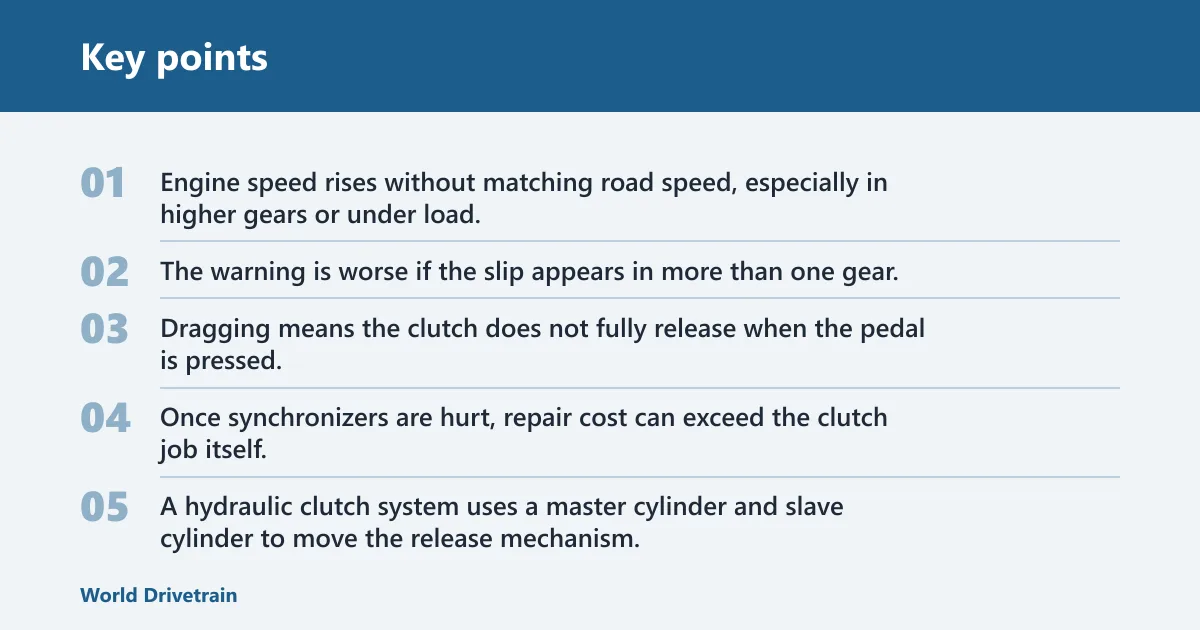
Engine speed rises without matching road speed, especially in higher gears or under load. You may also notice a hot, burning odor after acceleration, a clutch that feels weak on hills, or worse behavior while towing or merging hard onto a highway.
If the car still moves normally at light throttle but slips when you ask for power, the friction material is often near the end of its service life. The warning is worse if the slip appears in more than one gear.
Clutch dragging and no-disengagement symptoms
Dragging means the clutch does not fully release when the pedal is pressed. Shifts feel hard, the car may creep with the pedal fully depressed, and reverse or first gear may grind or refuse to engage.
This can be high-risk because repeated forced shifts can damage manual transmission synchronizers. Once synchronizers are hurt, repair cost can exceed the clutch job itself.
Hydraulic clues that can look like clutch wear
A hydraulic clutch system uses a master cylinder and slave cylinder to move the release mechanism. Low fluid, an external leak, or internal seal failure can change pedal feel, shift engagement point, and release travel in ways that mimic a worn clutch.
Soft pedal travel, a pedal that sinks, or a clutch that works better after pumping the pedal points toward hydraulics rather than friction material alone. That difference matters because hydraulics can fail quickly and leave the clutch unable to disengage.
When short driving is still possible
Short driving is only a limited option when the clutch is mildly slipping and the car still shifts normally. Keep the route flat, short, and low traffic, and stop the trip if the slip worsens or the odor appears.
Mild slip on flat, low-traffic routes
If the clutch only slips under hard acceleration, and only after you ask for more power than usual, a short drive may be acceptable. Keep speed steady, avoid quick throttle input, and use the highest practical gear without lugging the engine.
Say your car slips only when climbing a long hill in fifth gear, but it pulls normally on level streets. A gentle drive to a nearby shop on flat roads is a lower-risk choice than forcing the same hill again.
Why stop-and-go, hills, merging, and towing change the answer
Stop-and-go traffic makes the clutch work repeatedly at low speed, which adds heat. Hills, freeway merges, towing, and heavy loads increase the torque demand that exposes slip, so a clutch that seems usable on a calm side street can fail on the next ramp or incline.
Suppose the clutch is borderline in town but the route includes a steep on-ramp and a 20-minute crawl through traffic. That is a tow decision, because the added heat and load raise the chance of a roadside failure and further damage.
Clutch damage decision checklist
This table separates mild slip from severe failure modes and ties each one to the secondary damage risk. Use it as a go/no-go guide, not as a repair plan.
| Symptom tier | Risk level | Short driving acceptable? | Towing recommendation | Likely secondary damage |
|---|---|---|---|---|
| Mild slip | Low to moderate | Yes, for a short flat route with light load | Recommended if the route has hills, traffic, or highway merges | Flywheel heat spotting, early wear on clutch disc |
| Moderate slip | Moderate to high | Only if the car still moves cleanly and the route is very short | Safer choice if slip appears in multiple gears or under normal throttle | Flywheel scoring, possible dual-mass flywheel damage |
| Dragging / no-disengagement | High | No, forced driving can grind gears | Yes, tow it | Synchronizer wear, gear grind, hydraulic strain |
| Sudden failure | Critical | No | Immediate tow | Transmission damage, flywheel damage, roadside stranding |
What driving can damage next
Continuing to drive with a bad clutch can create a larger repair list than the clutch itself. The most common extra costs are at the flywheel, the release bearing, and the synchronizers inside the transmission.
Flywheel heat spotting and scoring
A slipping clutch generates heat. That heat can spot, glaze, or score the flywheel surface, which may force resurfacing or replacement during clutch service.
Dual-mass flywheels are a bigger concern on many modern manual-transmission vehicles. If a dual-mass unit is damaged or worn alongside the clutch, replacement cost can jump well beyond the clutch disc alone.
Throwout bearing noise and failure
The throwout bearing is a common wear item during clutch service. If it makes noise when the pedal is pressed, or if it fails to move the pressure plate correctly, disengagement problems can get worse fast.
A bad bearing can make shifting noisy or inconsistent. In severe cases, it can contribute to a clutch that will not release cleanly.
Synchronizer damage from repeated grinding
Manual transmission synchronizers match gear speed during shifts. When a clutch drags and you keep forcing shifts, the synchronizers take the abuse instead of the clutch doing its job.
Repeated gear grind can create a repair bill that exceeds the cost of the clutch replacement. That is why a dragging clutch is not just annoying; it is a transmission-side risk.
How to tell clutch trouble from hydraulic trouble
Hydraulic faults can mimic a worn clutch, but they change the risk profile. A worn friction disc usually gets worse with load and heat, while hydraulic problems often change pedal feel and release travel first.
Master cylinder and slave cylinder issues
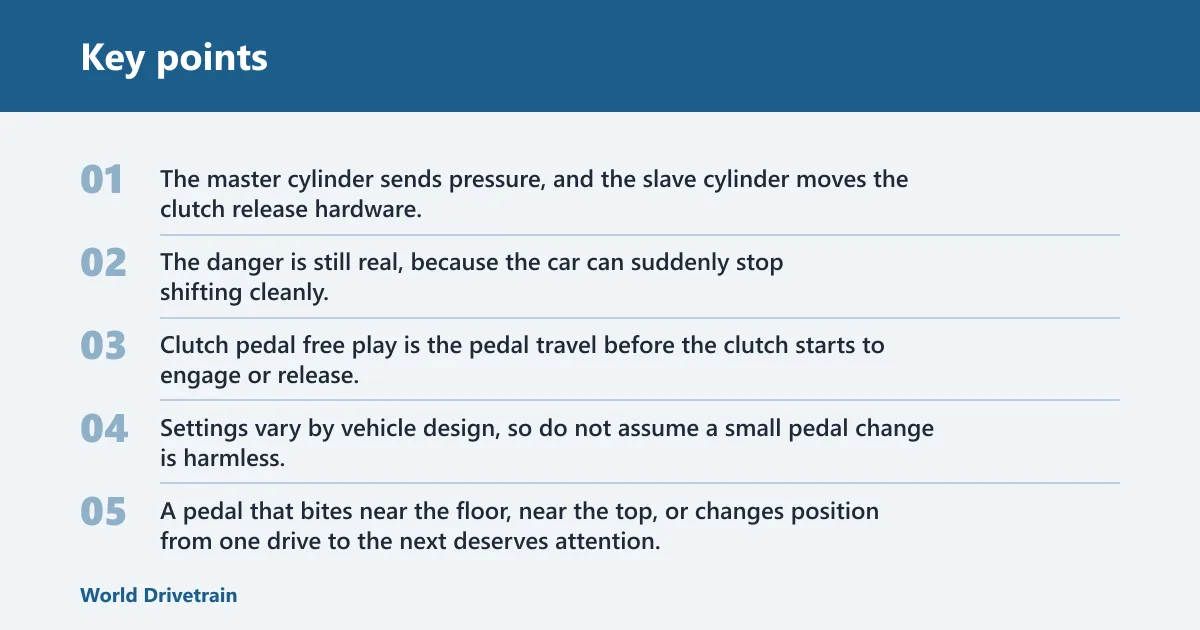
The master cylinder sends pressure, and the slave cylinder moves the clutch release hardware. If either one leaks internally or externally, the clutch may not disengage fully even though the disc is still serviceable.
That means a car can feel like it has a failed clutch when the root cause is fluid loss. The danger is still real, because the car can suddenly stop shifting cleanly.
Pedal free play and engagement-point changes
Clutch pedal free play is the pedal travel before the clutch starts to engage or release. Out-of-spec adjustment can cause slippage if there is too little free play, or dragging if there is too much or if the release travel is short.
Settings vary by vehicle design, so do not assume a small pedal change is harmless. A pedal that bites near the floor, near the top, or changes position from one drive to the next deserves attention.
Fluid loss and leak clues
Check for low clutch fluid if your vehicle uses a shared brake-clutch reservoir or a separate reservoir. A falling fluid level, damp lines, or fluid around the master or slave cylinder points toward a hydraulic issue rather than simple wear.
If pumping the pedal briefly improves shifting, that also points toward hydraulics. In that case, driving may still be risky because the system can fail without warning.
When to tow instead of driving it to the shop
Tow the car if the clutch slips hard, will not disengage, or produces gear grind during normal shifts. Towing is often cheaper than risking flywheel, synchronizer, or transmission damage, and it avoids a roadside breakdown at the worst possible time.
Severe slip or sudden loss of drive
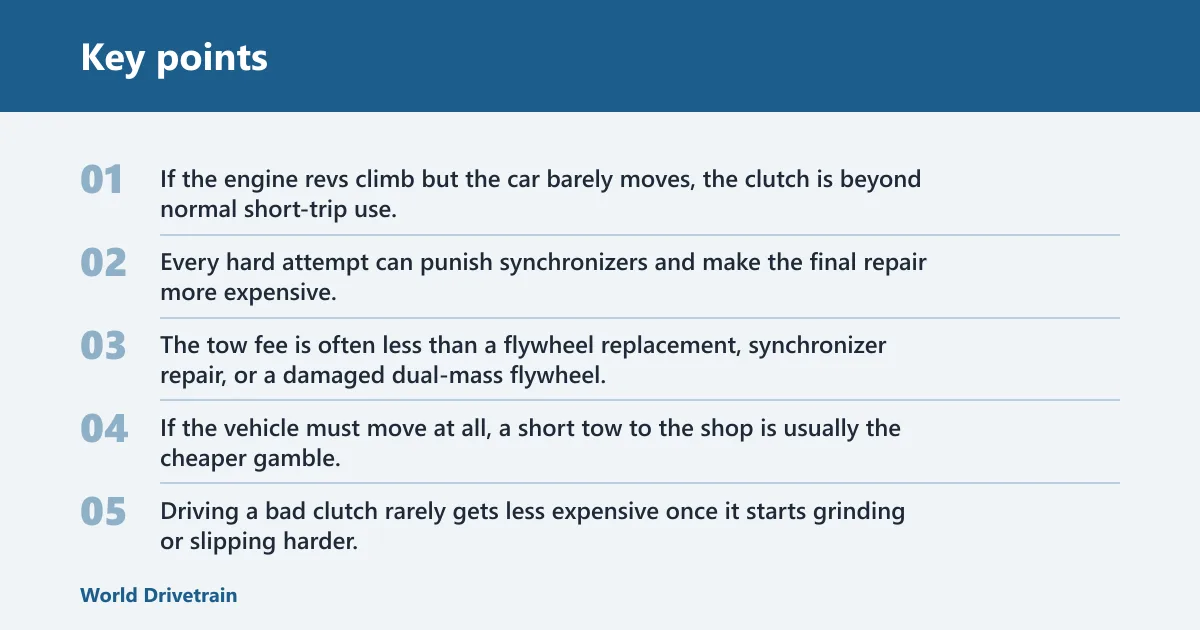
If the engine revs climb but the car barely moves, the clutch is beyond normal short-trip use. Sudden worsening, strong burning odor, or a clutch that only works part of the time means the remaining drive could be the one that finishes it.
No-disengagement and gear grind
If the transmission grinds, the car creeps with the pedal fully down, or reverse will not engage cleanly, do not keep forcing shifts. Every hard attempt can punish synchronizers and make the final repair more expensive.
Why towing can cost less than secondary repairs
A tow service is the safer choice when the clutch no longer releases properly or when the trip includes heavy traffic, steep grades, or a highway merge. The tow fee is often less than a flywheel replacement, synchronizer repair, or a damaged dual-mass flywheel.
If the vehicle must move at all, a short tow to the shop is usually the cheaper gamble. Driving a bad clutch rarely gets less expensive once it starts grinding or slipping harder.
Frequently asked questions
How long can I drive with a slipping clutch?
There is no safe mileage rule. A mildly slipping clutch may tolerate a short, low-load drive to a shop, but slip that appears on hills, under hard acceleration, or in multiple gears can worsen quickly and should be treated as tow-worthy if the route is not flat and simple.
What happens if I keep driving with a bad clutch?
Continued driving can heat-spot or score the flywheel, wear the release bearing, and make a dragging clutch grind the synchronizers. If the clutch is already slipping hard or failing to disengage, the risk includes roadside stranding and a repair bill that extends beyond the clutch kit.
Can a bad clutch leave me stranded?
Yes. A clutch can lose enough friction to stop moving the car, or it can fail to disengage and make the transmission impossible to shift safely. Either problem can leave you stuck in traffic, unable to move from a stop, or unable to get into gear.
Is it okay to drive short distances with a failing clutch?
Only when the symptoms are mild, the route is flat, and the vehicle still shifts cleanly. Avoid stop-and-go traffic, steep grades, towing, and heavy loads. If the clutch slips more with throttle, smells hot, or starts grinding, short-distance driving is no longer a good bet.
How do I know if my clutch is slipping or dragging?
Slip means engine revs rise faster than road speed. Drag means the clutch does not fully release, so gears are hard to engage, the car may creep with the pedal down, and shifts may grind. Slip points to friction wear; drag often points to release travel or hydraulic trouble.
Should I tow the car instead of driving it to the shop?
Yes if the clutch slips hard, will not disengage, or grinds when you shift. Towing is also the better call if the route includes hills, freeway merges, heavy traffic, or any load that will make the clutch work harder. That choice can prevent secondary drivetrain damage and a larger bill.