Cost of new transmission vs rebuilt: key differences
A new transmission often costs several thousand dollars more than a rebuilt one, so pick new only when fit, warranty coverage, or long-term ownership justify the extra spend. Skip that comparison, and you can pay dealership-level money for a repair that does not raise the vehicle’s value. This guide compares new, rebuilt, remanufactured, and used transmissions by cost, warranty, risk, and ownership value.
| Decision factor | Cost of new transmission | Rebuilt | Winner |
|---|---|---|---|
| Upfront cost | Highest; new transmission replacement is listed at $4,000–$7,000+ | Lower; passenger-car rebuilds are listed at $1,500–$3,200 | Rebuilt |
| Risk and wear history | Lowest wear risk because the unit is brand-new OEM | Higher than new because the case or core has already lived a prior life | Cost of new transmission |
| Warranty coverage | Often stronger, but varies by OEM and installer | Can be solid, but usually shorter and more limited than new | Cost of new transmission |
| Turnaround time | Often faster if the exact unit is in stock | Can take longer because the unit must be built or sourced | Cost of new transmission |
| Best-fit use case | Newer, high-value vehicles and owners planning to keep the car longer | Older vehicles and owners focused on total repair value | Tie |
What is the real difference between a new transmission and a rebuilt one?
A new transmission is a brand-new OEM unit with unused internal parts, while a rebuilt transmission is a previously used unit that has been torn down, inspected, and fitted with selective replacement parts. New usually costs more; rebuilt usually costs less, but the value depends on how much wear remains in the original core.
New transmission: what you are paying for
New usually means fewer unknowns. The parts are fresh, and the unit is built to the manufacturer’s specification, which matters when the vehicle uses tight electronic controls or exact model matching. On newer cars, a new unit may still need software reprogramming after installation.
Rebuilt transmission: what the shop is actually doing
A rebuild starts with teardown. A technician inspects hard parts, replaces worn items selectively, and often installs a transmission rebuild kit that includes gaskets, seals, and clutches. On automatic units, the torque converter is often inspected too, which can raise the bill if it needs replacement.
Why remanufactured and used units are not the same as rebuilt units
Remanufactured and rebuilt sound similar, but they are not identical. A remanufactured transmission is typically built to a factory standard and sold as a replacement option, often with warranty coverage. A used transmission comes from a salvage vehicle and has the lowest upfront price, but its wear history is unknown.
📊 New transmission replacement is listed at $4,000–$7,000+. Source: Transmission Rebuild vs Replacement Costs Guide: Comparison And ….
How much does each option usually cost?
Price depends on the vehicle’s design, how easy parts are to source, and local labor rates. Rebuilt units usually cost less than new replacements, but labor still drives a large share of the bill. For many jobs, installation time and shop rate matter as much as the transmission itself.
Replacement cost ranges
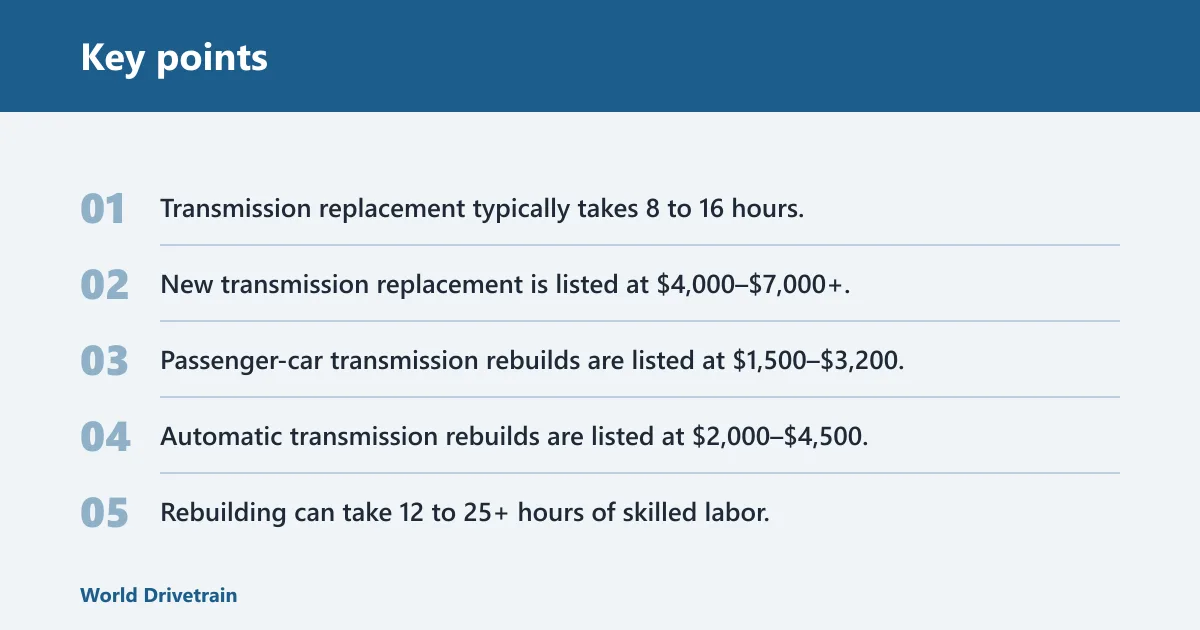
Transmission replacement typically takes 8 to 16 hours, and labor alone can cost $800 to $2,500. New transmission replacement is listed at $4,000–$7,000+, remanufactured transmission replacement is listed at $2,800–$5,500, and used transmission replacement is listed at $1,200–$3,000.
Rebuild cost ranges
Passenger-car transmission rebuilds are listed at $1,500–$3,200, while SUV and truck rebuilds are listed at $2,500–$4,500. Automatic transmission rebuilds are listed at $2,000–$4,500, while manual transmission rebuilds are listed at $1,200–$2,500. Rebuilding can take 12 to 25+ hours of skilled labor.
Parts and labor drivers
The rebuild kit is priced at $250 to $600, but that is only one part of the bill. A torque converter check on an automatic can add parts and labor, and vehicle make, model, and local labor rates can move the final price a lot. Manual units usually cost less because they have fewer internal parts.
Common cost examples
Say your 10-year-old sedan needs an automatic transmission and the case is still usable. A rebuild may fit the budget better than a new OEM unit, especially if the car’s market value is limited. Suppose the vehicle is a late-model truck with a high resale value and a complex electronic transmission; new or remanufactured may make more sense than a cheap used unit.
What extra charges can raise the replacement bill?
Replacement bills often grow because the transmission is only one part of the job. Torque converter work, programming, fluid, filters, mounts, and fit checks can add cost, especially on newer automatic vehicles. Those extras matter because a low quoted unit price can hide a much larger installed total.
Torque converter and related automatic parts
Automatic transmissions are more complex than manuals, and the torque converter is part of that complexity. Shops often inspect it during replacement or rebuild because a damaged converter can contaminate the new unit or shorten its life. Valve body issues can also affect the final repair path.
Software reprogramming and calibration
Software reprogramming is listed at $50 to $200. That is a small line item compared with the transmission itself, but it is common on newer vehicles and should not be skipped in the estimate. Some vehicles also need calibration or adaptation after installation so the transmission control module can work correctly.
Fluid, filters, mounts, and hardware
Fresh fluid, filters, mounts, gaskets, and small hardware items can add up quickly. These parts are easy to overlook when comparing only unit prices. A proper estimate should list them separately so you can compare installed cost, not just the parts price.
Why compatibility checks matter
Modern transmissions often depend on exact part numbers, electronics, and software versions. A mismatched used unit may not communicate correctly with the vehicle, and a replacement may require coding before it operates as intended. That is why fitment matters as much as the sticker price.
Why automatic transmissions usually cost more than manual ones
Automatic transmissions usually cost more because they contain more internal components and require more labor. Manual transmissions are simpler, with fewer parts to inspect, replace, and calibrate. That difference shows up in both rebuild and replacement pricing.
Automatic transmission cost pattern
Automatic transmission rebuilds are listed at $2,000–$4,500, and automatic transmission replacement is listed at $3,000–$6,000+. The extra cost comes from internal complexity, the torque converter, valve body work, and the need for more diagnostic and setup time.
Manual transmission cost pattern
Manual transmission rebuilds are listed at $1,200–$2,500, and manual transmission replacement is listed at $1,500–$3,000. Manual units usually have fewer internal parts and typically do not need the same level of reprogramming, which keeps both labor and parts costs lower.
CVT and dual-clutch variants
CVT and dual-clutch designs can change the cost pattern again. They are not simple manual boxes, and they are not always priced like a traditional automatic either. When those variants fail, the exact repair path depends heavily on the vehicle’s transmission architecture and parts supply.
When should you rebuild a transmission instead of replacing it?
Rebuild when the core is repairable, the vehicle is worth keeping, and total cost matters more than a factory-new unit. Rebuilds fit well when the damage is limited to wear items, the casing and hard parts are serviceable, and the vehicle is not worth a premium replacement.
Good rebuild candidates
A rebuild makes sense when the failure is internal but not catastrophic, the transmission has a solid core, and the vehicle still has useful life left. That often applies to older daily drivers, work vehicles with moderate mileage, and manual transmissions with straightforward mechanical wear.
Bad rebuild candidates
A rebuild is a poor choice when there is severe internal damage, repeated failure, or a fit problem that makes the original core hard to trust. If the case is cracked, metal contamination is widespread, or electronics are deeply damaged, replacement can be the safer route.
How ownership horizon changes the answer
If you plan to keep the vehicle only a short time, the cheapest reliable fix often wins. If you plan to keep it for years, a better warranty and lower risk can justify more money up front. That is where new or remanufactured units may beat a rebuild on value.
Are remanufactured and rebuilt transmissions the same thing?
No. A rebuilt transmission is repaired by replacing worn parts as needed, while a remanufactured transmission is generally built to a factory standard and sold as a replacement unit. Remanufactured units often cost more than used or rebuilt options, but less than a brand-new OEM unit.
Where remanufactured fits
Remanufactured units usually land between used and new on price. They are a good middle ground when you want more confidence than a salvage unit can offer, but you do not want to pay for a brand-new OEM transmission. Warranty coverage is often part of the package.
Where used fits
Used transmissions are the lowest upfront-cost option, usually listed at $1,200–$3,000 for replacement. The trade-off is the unknown wear history. That makes used units better for low-value vehicles or short-term ownership, not for buyers who want predictable long-term reliability.
Choose a rebuilt transmission if… / choose a new transmission if…
Choose a rebuilt transmission if the original core is repairable, the vehicle is older, and you care most about lowering installed cost while keeping the car dependable. Choose a new transmission if the vehicle is newer, expensive to replace, or likely to stay in service long enough to justify the added warranty and lower wear risk.
Choose a rebuilt transmission if…
- The vehicle has lower market value and you want to control repair cost.
- The failure is repairable without major case damage or total internal destruction.
- You are comfortable with a shorter warranty than a new OEM unit may provide.
- The transmission is a manual or a simpler automatic with good parts support.
Choose a new transmission if…
- The vehicle is newer and uses electronic controls that demand exact compatibility.
- You plan to keep the vehicle for the long term and want the lowest wear risk.
- The original unit has repeated failures or severe damage that makes rebuilding a poor value.
- A longer warranty is worth the price difference to you.
Decision matrix: which option fits which vehicle and owner?
The best choice depends on age, value, mileage, and how long you plan to keep the vehicle. A new transmission is not automatically the best answer, and a rebuilt unit is not automatically the lowest total-cost choice. The right option is the one that fits the car’s condition and your ownership horizon.
| Scenario | Best option | Why it fits |
|---|---|---|
| Older vehicle, lower market value, short ownership horizon | Used or rebuilt | Lower installed cost matters more than maximum life expectancy |
| Newer vehicle, high value, long ownership horizon | New or remanufactured | Compatibility, warranty, and lower wear risk are worth paying for |
| Severe internal damage or repeated failure | New or remanufactured | A rebuild may not be cost-effective if major hard parts are damaged |
| Core is repairable and total cost matters most | Rebuilt | Selective parts replacement keeps cost below a full new-unit swap |
A simple rule of thumb
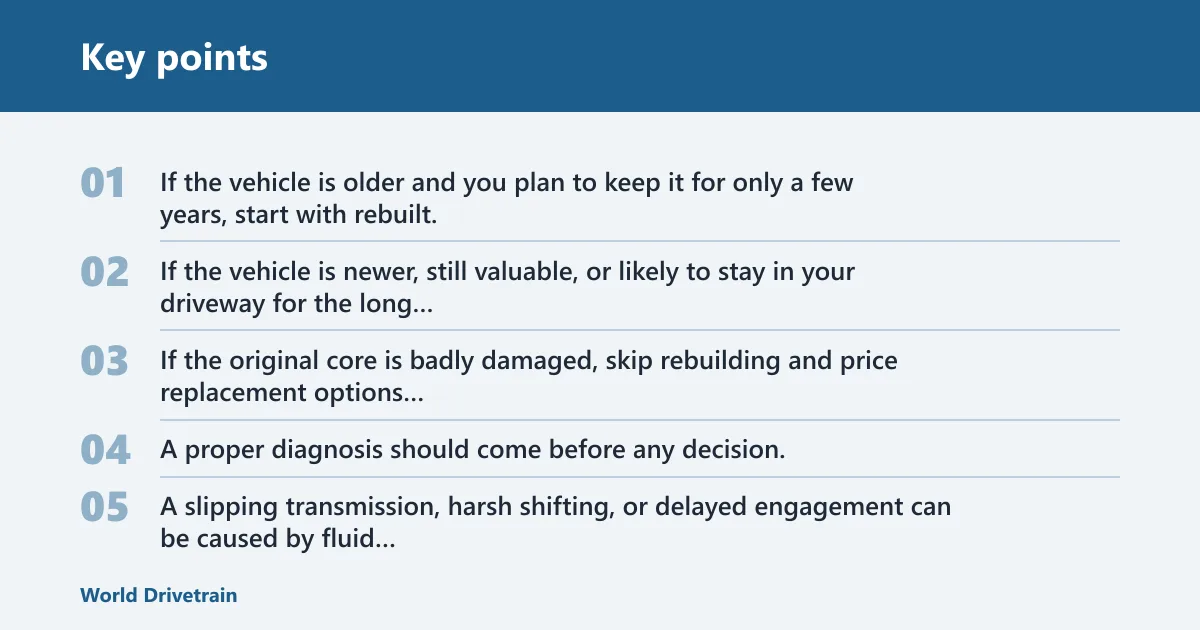
If the vehicle is older and you plan to keep it for only a few years, start with rebuilt, remanufactured, or used. If the vehicle is newer, still valuable, or likely to stay in your driveway for the long haul, new becomes easier to justify. If the original core is badly damaged, skip rebuilding and price replacement options first.
Do not skip diagnosis
A proper diagnosis should come before any decision. A slipping transmission, harsh shifting, or delayed engagement can be caused by fluid condition, electrical faults, solenoids, or a control issue, not only by a failed hard part. If the root cause is unclear, a rebuild can be the wrong fix.
Frequently asked questions
Is a rebuilt transmission cheaper than a new one?
Yes, a rebuilt transmission is usually cheaper than a new one. Passenger-car rebuilds are listed at $1,500–$3,200, while new transmission replacement is listed at $4,000–$7,000+. The gap is wider on many automatic applications because labor, diagnostics, and supporting parts also add cost.
How much does it cost to replace a transmission versus rebuild it?
Transmission replacement is commonly more expensive than a rebuild. Replacement is listed at $1,500–$3,000 for manuals and $3,000–$6,000+ for automatics, while rebuilds are listed at $1,200–$2,500 for manuals and $2,000–$4,500 for automatics. Final price still depends on labor and vehicle design.
How long does a transmission rebuild or replacement take?
Transmission replacement typically takes 8 to 16 hours. Rebuilding can take 12 to 25+ hours of skilled labor because the unit has to be removed, disassembled, cleaned, measured, reassembled, and tested. Parts availability and programming can add more time on newer vehicles.
What extra costs come with transmission replacement?
Extra costs often include labor, fluid, filters, mounts, torque converter inspection, and software reprogramming. Software reprogramming is listed at $50 to $200. Those add-ons matter because a unit price by itself does not show the true installed cost of the job.
Does a warranty matter when choosing rebuild vs replacement?
Yes. Warranty coverage can change the value equation, especially on newer or higher-value vehicles. A stronger warranty can justify paying more for a new or remanufactured unit, but only if the coverage length and exclusions match the repair risk and your ownership plans.