How Much Should a Transmission Rebuild Cost?
A fair transmission rebuild quote often lands around $2,500 to $4,500 for many mainstream vehicles, but the right price depends on teardown findings, unit type, and the parts list. A vague quote can hide missing hard parts, extra labor, or a weak warranty that costs more later. This guide shows you how to check a rebuild estimate line by line and compare it with repair or replacement quotes.
What a transmission rebuild includes
A rebuild means the transmission comes apart, gets cleaned and measured, and gets new wear parts before it goes back together. The goal is to restore the unit’s internal condition, not to replace the whole transmission housing. A proper quote should show diagnosis, removal, teardown, parts, labor, fluids, and warranty terms.
Core steps in teardown and inspection
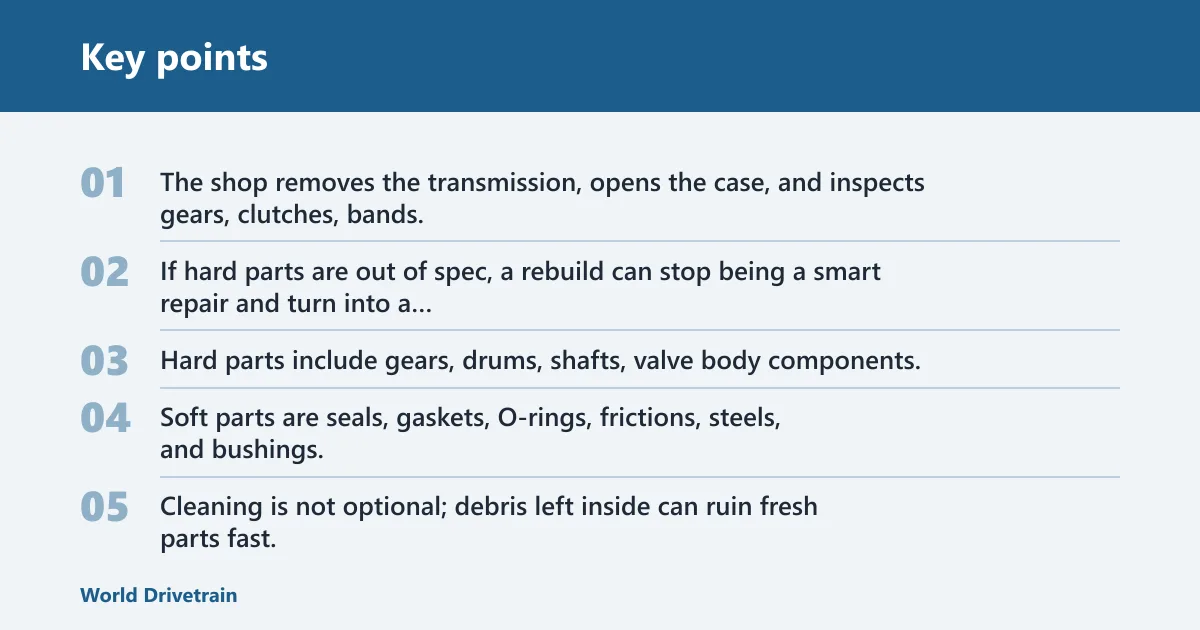
The shop removes the transmission, opens the case, and inspects gears, clutches, bands, bearings, seals, bushings, valve body parts, and the torque converter where applicable. Measurements matter. If hard parts are out of spec, a rebuild can stop being a smart repair and turn into a replacement decision.
Hard parts, soft parts, and cleaning
Hard parts include gears, drums, shafts, valve body components, and other metal pieces that can be reused only if they pass inspection. Soft parts are seals, gaskets, O-rings, frictions, steels, and bushings. Cleaning is not optional; debris left inside can ruin fresh parts fast.
How rebuilds differ from simple repairs
A repair may solve one fault, such as a solenoid, sensor, leak, or fluid issue. A rebuild addresses wear across the unit. That difference matters because a transmission with one bad part and clean internals is a very different bill than one with burnt clutches, scored drums, or metal in the pan.
How much should a transmission rebuild cost?
For many passenger vehicles, a rebuild quote commonly lands around $2,500 to $4,500, though some jobs come in lower and others higher. CVTs and complex automatics can cost more because of parts, programming, and specialty labor, while manual transmissions usually sit lower than automatics. The quote should show why.
Typical price bands by transmission type
Manual units often cost less because the internal design is simpler. Many automatic rebuilds run higher due to the valve body, torque converter, and fluid requirements. CVT rebuilds are often the most sensitive to parts availability and specialized components, which can push the total up fast.
Labor versus parts share
Removal and reinstallation often take a large share of the bill. On many jobs, labor can rival or exceed parts cost because the transmission must come out before the true damage is known. Parts become the bigger share when hard parts fail or a torque converter and valve body are added.
Why quotes vary so widely
Two estimates can differ by thousands of dollars and both can be honest. One may include only soft parts and labor to remove the unit, while another includes hard parts, converter, fluids, programming, and a better warranty. A low quote is not always a bargain if it leaves major items out.
What changes the price the most?
Vehicle layout, damage severity, and local labor rates change most of the spread. Front-wheel-drive units often take longer to remove than some rear-drive layouts. If the transmission has heat damage, metal contamination, or a failed hard part, the cost can rise sharply. Parts sourcing matters too.
Vehicle layout and drivetrain access
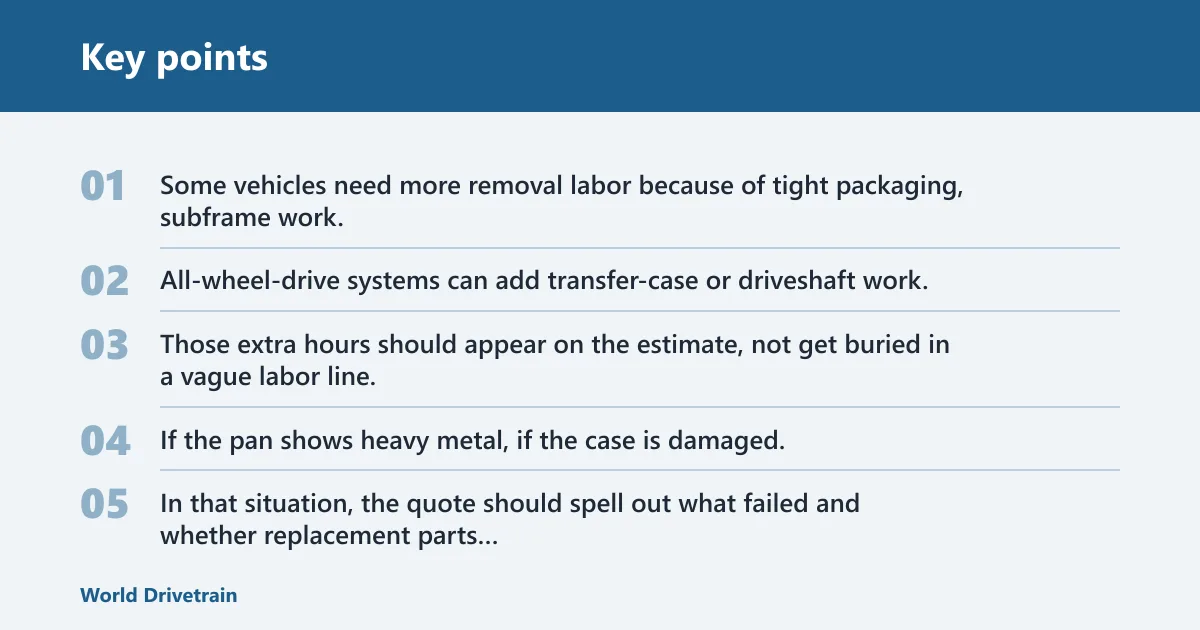
Some vehicles need more removal labor because of tight packaging, subframe work, or extra components in the way. All-wheel-drive systems can add transfer-case or driveshaft work. Those extra hours should appear on the estimate, not get buried in a vague labor line.
Damage severity and hard-part failure
If the pan shows heavy metal, if the case is damaged, or if the gear train or clutch drums are scored, the rebuild may need costly internal parts. In that situation, the quote should spell out what failed and whether replacement parts are available. A rebuild without that detail is incomplete.
Shop labor rate and parts sourcing
Independent shops and dealers often price labor differently, and specialty transmission shops may charge more for deeper diagnostics. Part sourcing also matters. Aftermarket kits, OE parts, remanufactured components, and used hard parts each change the bill and the risk profile.
Say your 2016 crossover has a harsh 2-3 shift and a clean fluid sample, but teardown finds burnt clutches and a worn pump. The estimate should change after inspection. If the shop still quotes a flat number with no parts list, that number is not useful.
Automatic, manual, and CVT cost differences
Automatic rebuilds usually cost more than manuals, and CVTs can be the hardest to price because internal parts and repair paths vary by model. The transmission family matters as much as the vehicle badge. A fair quote should name the unit type and the parts it needs.
Automatic transmission rebuild factors
Automatic units add complexity through the valve body, hydraulic circuits, torque converter, and fluid-type requirements. Valve body problems can mimic internal failure, so diagnosis should verify the fault before teardown. If the converter is contaminated or failing, replacing it is often part of the job.
Manual transmission rebuild factors
Manual transmissions are generally simpler internally, but they can overlap with clutch work. Worn bearings, synchronizers, seals, and gear damage are the usual rebuild items. If the clutch, flywheel, or release parts are due soon, a smart quote may bundle that work to avoid repeat labor.
CVT rebuild risk and parts limits
CVT rebuilds are often more specialized because the belt or chain and pulley system needs exact parts and setup. Some units have limited parts supply or fewer rebuild options, which raises risk and cost. In some cases, a remanufactured or replacement unit is the cleaner financial decision.
Transmission rebuild quote checklist
Use the estimate as a checklist, not a single number. Every major line item should tell you what the shop plans to diagnose, remove, replace, and warranty. If the estimate skips a major category, ask before approving the work.
| Line item | Typical inclusion | Red flags | Questions to ask the shop |
|---|---|---|---|
| Diagnosis | Road test, scan, fluid check, pressure or stall checks, and fault verification before teardown | Flat rebuild quote with no diagnosis fee or no failure verification | What testing led you to this conclusion, and is the fee applied to the repair? |
| Removal and reinstall | Transmission removal, reinstallation, mounts or subframe labor if needed | “Rebuild” price with no remove-and-install labor listed | How many labor hours are included for removal and reinstallation? |
| Teardown | Disassembly, inspection, measurement, and cleaning | No teardown charge despite a claim that internal damage is confirmed | What did teardown show, and which parts failed inspection? |
| Hard parts | Gears, shafts, drums, valve body components, or other reusable metal parts as needed | “Rebuild kit” only, with no allowance for damaged hard parts | Which hard parts are priced now, and what happens if more damage appears? |
| Soft parts | Seals, gaskets, O-rings, clutches, steels, bushings, filters, and wear items | Old seals or a generic kit with no filter line item | Are all friction and sealing parts new, and is the filter included? |
| Torque converter | Inspect, flush, rebuild, or replace as needed on automatic units | Converter omitted from an automatic rebuild estimate | Is the converter being replaced or cleaned, and why? |
| Fluids | Correct ATF or gear oil to the manufacturer spec, plus refill after repair | Generic fluid listed without specification | Which fluid spec will you use, and how many quarts are included? |
| Programming | Reset, relearn, adaptation, or module programming where required | No mention of electronic relearn on newer automatics or CVTs | Does this vehicle need a relearn or programming after the rebuild? |
| Warranty | Time and mileage terms, labor coverage, and what is excluded | Warranty language missing or limited to parts only | What is covered, for how long, and who pays labor if a covered part fails? |
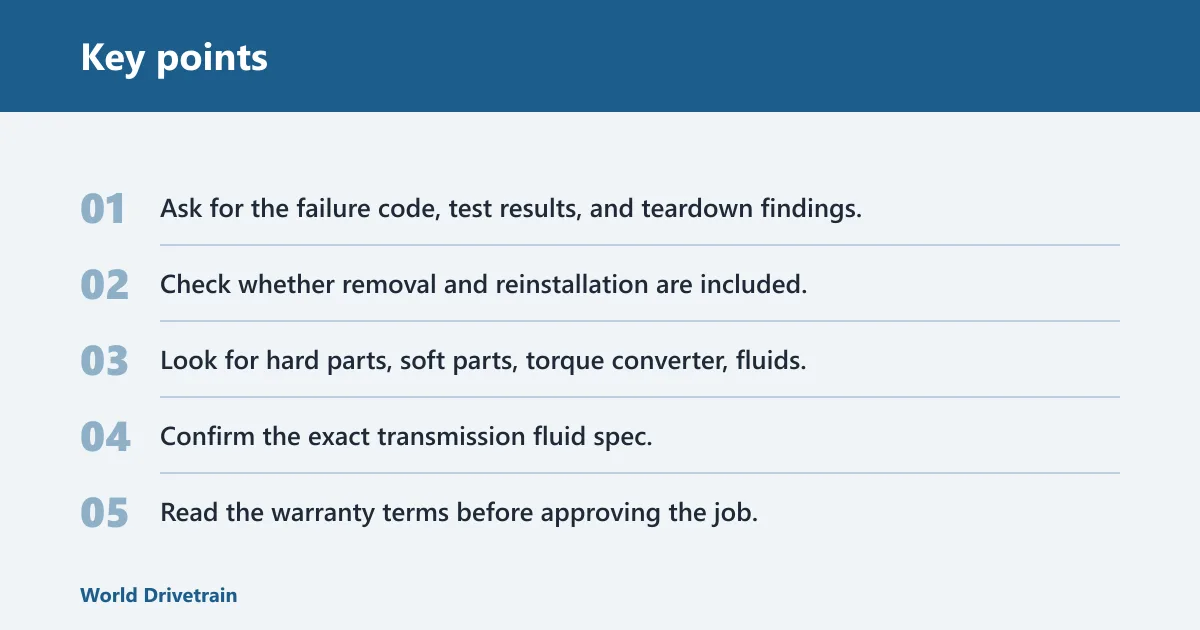
- Ask for the failure code, test results, and teardown findings.
- Check whether removal and reinstallation are included.
- Look for hard parts, soft parts, torque converter, fluids, and programming on separate lines.
- Confirm the exact transmission fluid spec.
- Read the warranty terms before approving the job.
Is rebuild or replacement the better value?
Rebuilding makes sense when the case and core hard parts are salvageable and the parts supply is healthy. Replacement can be better when the unit has severe damage, a bad parts shortage, or repair labor that approaches the price of a remanufactured unit. Compare total out-the-door quotes, not labels.
When rebuilding makes sense
If the transmission has a known wear issue, normal fluid contamination, or a repairable valve body problem, rebuilding may return good value. It also fits better when the vehicle is otherwise worth keeping and the quote includes a solid warranty.
When replacement may cost less overall
If hard parts are scarce, if the CVT has limited rebuild support, or if the case is damaged, a replacement unit can be cheaper once labor is counted. Replacement can also cut uncertainty when the shop cannot guarantee all internal wear is addressed inside the old unit.
Picture a high-mileage sedan with a slipping automatic, a noisy pump, and a converter full of debris. If the estimate for a rebuild climbs near a remanufactured unit after teardown, replacement may be the cleaner value even if the sticker price looks higher at first.
How long should a rebuild take?
Many rebuilds take several days, and a longer wait is common if hard parts must be ordered or machine work is needed. A small, straightforward manual can move faster than a complex automatic or CVT. Turnaround matters because a rushed job can hide incomplete cleaning or missed damage.
Typical turnaround window
A common window is about three to seven business days for a straightforward job once parts are on hand, though that is not a guarantee. Diagnostic time, teardown findings, and reassembly checks all affect the schedule. Ask the shop when the clock starts and stops.
Parts delays and machine work
If the valve body, converter, or a hard part is backordered, the job can stretch. Machine work, case repair, or specialized CVT components can add more delay. Ask whether the quote assumes parts availability or whether it already accounts for likely delays.
Why turnaround affects your total cost
Longer jobs can mean higher labor if the estimate was written loosely, but time also affects your transport costs and downtime. A clear estimate should state whether extra diagnostics, special-order parts, or updates to the quote require approval before the price changes.
Frequently asked questions
How much does a transmission rebuild cost?
The answer depends on what the estimate includes. A complete quote should typically cover diagnosis, removal and reinstall, teardown, soft parts, hard parts if needed, fluids, and warranty. A low number can be incomplete if it leaves out the torque converter or programming.
How much does an automatic transmission rebuild cost?
Automatic rebuilds usually cost more than manual rebuilds because of the valve body, torque converter, electronic controls, and fluid requirements. On many vehicles, the total often lands above a manual job and can rise quickly if the converter or hard parts need replacement.
How much does a manual transmission rebuild cost?
Manual transmission rebuilds are often less expensive because the internals are simpler. The quote should still address bearings, synchronizers, seals, and any clutch overlap. If the clutch or flywheel is due, the total can move closer to an automatic repair than expected.
How much does a CVT transmission rebuild cost?
CVT rebuild costs vary widely because belt or chain systems, pulley components, and parts availability differ by model. Some units are repairable, but others become poor candidates for rebuilding if parts are scarce or if the damage reaches beyond the wearable components.
Is it cheaper to rebuild or replace a transmission?
Neither choice is always cheaper. Rebuilding can save money when the core case and hard parts are usable, but replacement can win when damage is severe, parts are scarce, or the rebuild quote keeps growing after teardown. Compare the full estimate line by line.
How much does a transmission rebuild cost 4l60e?
A 4L60E rebuild often lands within the broader automatic range, but the final price depends on condition, converter needs, and whether the shop finds hard-part damage. Because it is a common unit, parts availability is often better than for many specialty transmissions, which can help control cost.