What Is Included in a Transmission Replacement Cost Estimate?
A transmission replacement cost estimate usually includes the replacement unit, labor, fluid, seals, gaskets, programming, diagnostics, shop supplies, and sometimes a core charge. Anything found only after teardown often becomes a separate line item. If those details are missing, a quoted price can climb fast before the job is done. This guide explains each line item, what is optional, and what usually appears only after the transmission is opened.
Why diagnosis and labor drive the bill
A useful estimate is a line-item document, not a single lump sum. It should show the diagnosis, the replacement unit, removal and installation labor, fluids, seals, and any electronic work needed to make the transmission operate correctly in your vehicle.
Diagnostic inspection before a firm quote
A diagnostic inspection matters before anyone gives a firm quote. It can show whether the transmission is actually at fault, whether the problem is electrical, or whether another system is causing the symptoms. That step helps avoid an unnecessary replacement and gives the shop a sound basis for the estimate.
A common first-timer mistake is approving a replacement from a brief phone quote alone. If the complaint is harsh shifting, a warning light, or a no-move condition, the shop may still need scan data, fluid checks, and road testing before it can separate a transmission issue from a wiring or engine issue.
Removal and installation labor
Labor is a major part of the bill because replacement takes many steps and a lot of time, especially on automatic units. AutoMD.com lists 60 steps for replacing an automatic transmission. That work time can differ sharply by vehicle layout, driveline type, and the unit being installed.
For a quote to be complete, labor should usually appear as separate removal and installation time, or as a flat replacement labor line. If the estimate hides labor inside a single total, it becomes harder to compare shops or spot a low number that leaves out part of the job.
Replacement unit, fluid, and related parts
The estimate should identify the replacement unit type and note whether the price is for a rebuilt, remanufactured, or used transmission. It should also list transmission fluid, filter, seals, gaskets, and any cooler flush or adapter parts needed for the vehicle.
Vehicle make, model, age, and transmission electronics all affect the quote. Older vehicles may have more used-unit options. Newer electronically controlled units can need programming or adaptation work that changes the final total.
Rebuilt, remanufactured, or used?
The unit type changes both the quote and the risk. Rebuilt, remanufactured, and used transmissions can all get a vehicle back on the road, but they do not carry the same scope, warranty language, or price structure.
Rebuilt transmission scope and common limits
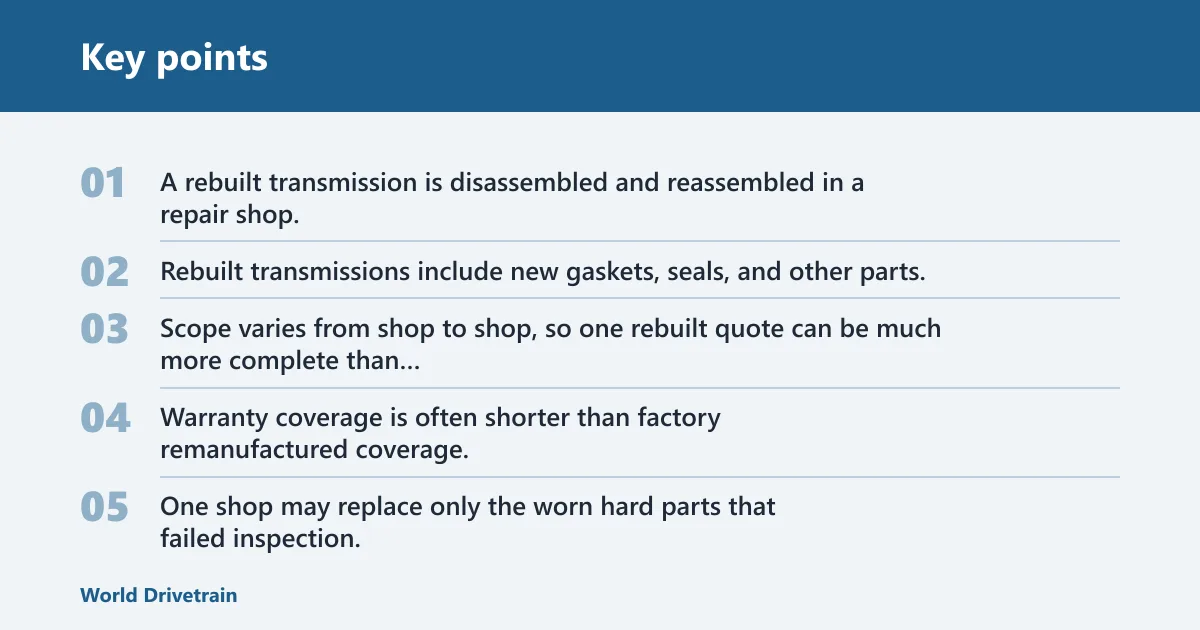
A rebuilt transmission is disassembled and reassembled in a repair shop. Rebuilt transmissions include new gaskets, seals, and other parts. Scope varies from shop to shop, so one rebuilt quote can be much more complete than another. Warranty coverage is often shorter than factory remanufactured coverage.
That variation matters. One shop may replace only the worn hard parts that failed inspection. Another may include a broader refresh. The estimate should say what is being replaced and what is excluded, rather than assuming every rebuilt unit is built to the same standard.
Remanufactured transmission scope and warranty length
A factory remanufactured transmission is typically disassembled and reassembled in a factory, and vital parts are usually replaced. Those units typically carry a longer warranty and usually cost more than a rebuilt unit. Factory remanufactured transmissions typically carry a 75,000-100,000 mile warranty, and may include a warranty of two to three years.
That longer coverage should show up in the estimate in writing. If two quotes are close in price, the warranty language may be the deciding factor. A quote that does not state mileage and time coverage is hard to compare fairly.
Used transmission tradeoffs and fitment risk
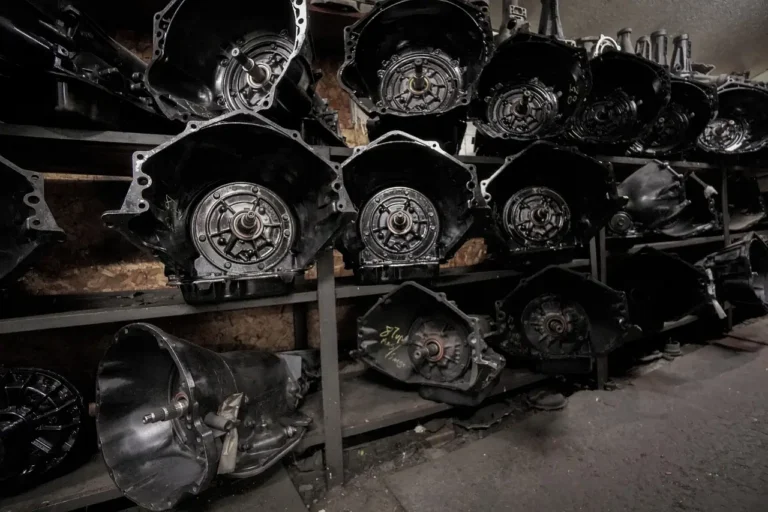
A used transmission usually comes from a salvage-yard or junk-yard source. It has the lowest upfront part cost, but condition and mileage are uncertain. On modern computerized systems, compatibility risk also rises because the unit may not match the vehicle’s calibration needs.
Used transmission estimates can be as low as $200-$600 for the part alone. That number does not mean the installed job will stay at that level. Labor, fluids, programming, and any mismatch discovered after inspection can raise the final bill quickly.
Say your 2017 front-wheel-drive sedan needs a replacement CVT. A salvage unit may look cheap on paper, but the shop may need additional programming or adaptation work before the car drives correctly. That can make the lowest estimate the least useful one.
Why labor changes the quote
Labor changes with access, drivetrain layout, and whether the unit is automatic or manual. The same transmission family can cost very different amounts to install in a compact front-wheel-drive car versus a rear-wheel-drive truck or AWD crossover.
Front-wheel-drive, rear-wheel-drive, and AWD access differences
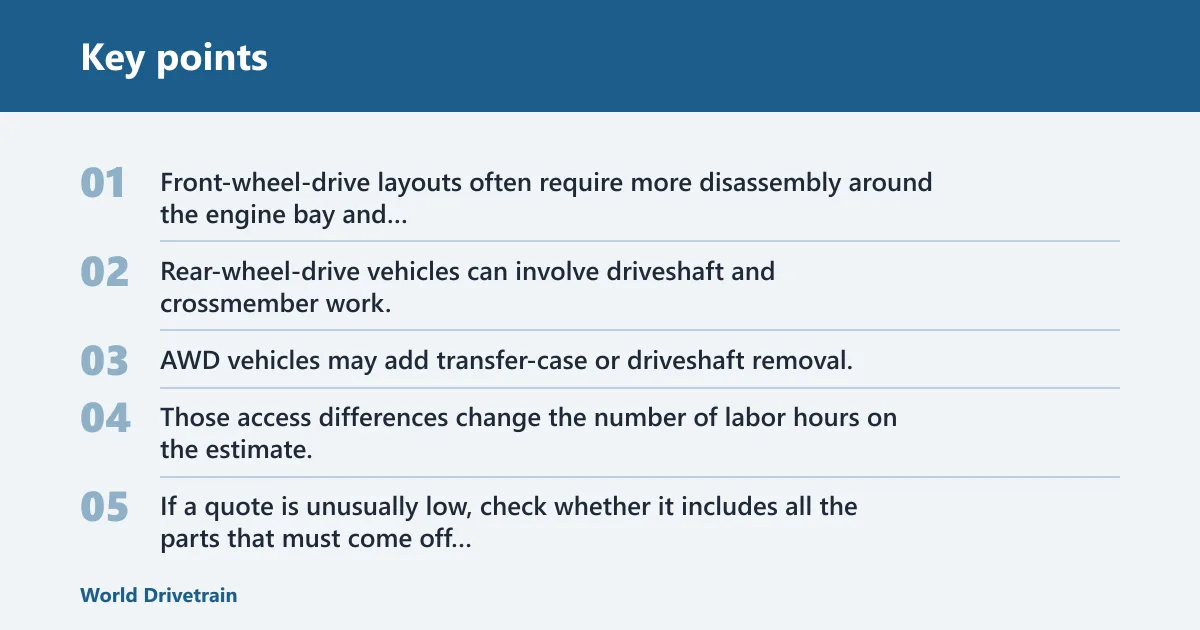
Front-wheel-drive layouts often require more disassembly around the engine bay and subframe area. Rear-wheel-drive vehicles can involve driveshaft and crossmember work. AWD vehicles may add transfer-case or driveshaft removal. Those access differences change the number of labor hours on the estimate.
If a quote is unusually low, check whether it includes all the parts that must come off to reach the transmission. A missing subframe, axle, transfer-case, or driveshaft labor line can hide a real cost until the job is underway.
Manual versus automatic replacement differences
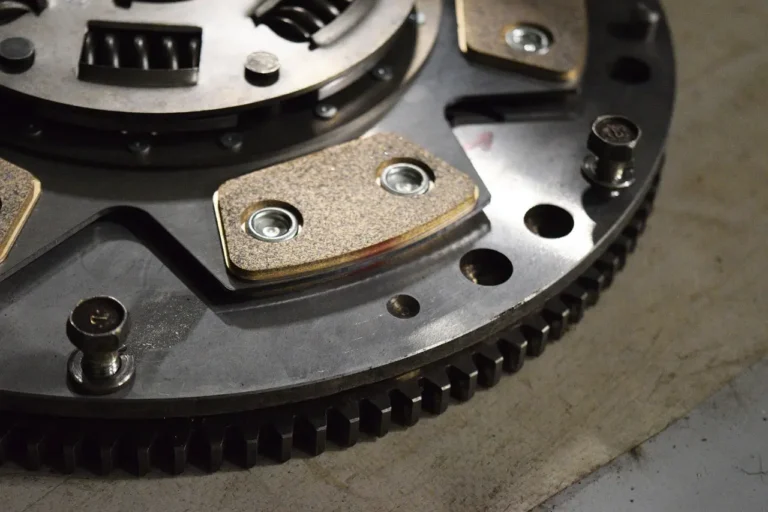
Manual and automatic replacements are not priced the same way. Automatic transmission replacement is described as a long and complicated process with extensive labor costs. Manual jobs can be simpler in some vehicles, but they still require clutch-related inspection when the transmission is out.
That difference is practical, not theoretical. A manual quote may include less programming, but it can still need a clutch kit, pilot bearing, or flywheel work depending on vehicle design and wear. The estimate should say whether those items are included or treated as extras.
Why teardown can change the final bill
A ballpark estimate can change after the shop opens the transmission up. Once the unit is out and inspected, the technician may find hard-part damage, contamination, or internal wear that was not visible from outside the case.
Suppose a pickup arrives with slipping gears and dark fluid. The estimate may start with a rebuild, then shift to a remanufactured unit after teardown shows major case damage. The first number was not wrong; it was incomplete because the full condition was still unknown.
What extra fees can appear?
Extra fees often appear when the shop moves from diagnosis to installation. Some are predictable and should be listed early. Others depend on teardown findings or on the vehicle’s electronics and cooling system.
Programming and adaptation charges
Modern transmission issues can require programming or adaptation work. That can mean software updates, relearning procedures, or module calibration after the replacement is installed. If the quote does not mention those charges, ask whether they are included or billed separately.
Cooler flush, seals, filter, and fluids
Cooler flushing is often recommended when a failed transmission has sent debris through the system. Seals, filter, and fluid should also be itemized. If these are missing from the estimate, the price may be missing the parts needed to finish the job correctly.
Taxes, shop supplies, and disposal fees
Taxes, shop supplies, and disposal fees can also appear on the final invoice. These are often small compared with labor, but they still matter when you compare quotes. A clean estimate should identify them instead of burying them in a generic subtotal.
Why quotes change after teardown
Quotes change after teardown because the shop can finally see what failed inside the case and around it. Hidden damage, contamination, or a different root cause can all change the plan from repair to replacement, or from one unit type to another.
Damage found during inspection
Internal inspection can reveal broken hard parts, heat damage, or worn clutches that were not obvious during initial testing. If the estimate was built before that inspection, the shop may need to revise parts and labor once the findings are clear.
Hidden contamination or hard-part failure
Fluid contamination can point to bigger problems than the first quote assumes. A failed cooler, metal debris, or burned fluid may mean the system needs more than a basic swap. That is where cooler flush work, extra seals, or a different unit choice can enter the estimate.
When another fault caused the symptoms
Can a bad transmission estimate be caused by another problem? Yes. A transmission problem may actually be an engine problem, according to Consumer Reports. Modern transmission issues can sometimes be caused by corrosion on the battery terminals. Those faults can mimic transmission failure and should be ruled out before replacement.
Diagnostic inspection helps prevent that mistake. If the engine is missing, the battery connection is poor, or the control module is not receiving correct input, the transmission may seem defective when it is reacting to a different fault.
How warranty terms should read
Warranty language belongs in the estimate, not just on the invoice after the repair. You need to know the mileage and time coverage, what parts are protected, and whether labor is covered if the unit fails again.
Mileage and time coverage
Factory remanufactured transmissions typically carry a 75,000-100,000 mile warranty and may include a warranty of two to three years. Rebuilt transmission warranties are often much shorter, from 30 days to one year. Those numbers should be stated plainly on the quote.
What parts and labor are covered
Some warranties cover only the replacement unit. Others cover labor for a limited period, but not fluid, towing, or damage caused by overheating or abuse. The estimate should say exactly what is included so you know what a claim would actually pay for.
Why apples-to-apples comparison matters
Two quotes can look similar until the warranty terms are compared line by line. A cheaper rebuilt unit with a 30-day warranty is not the same offer as a factory remanufactured unit with multi-year coverage. Price alone does not tell you which estimate is the better value.
Transmission estimate checklist
Use this checklist to compare quotes before approving work. The goal is not to find the lowest number. The goal is to see whether each estimate names the same parts, labor, and warranty terms.
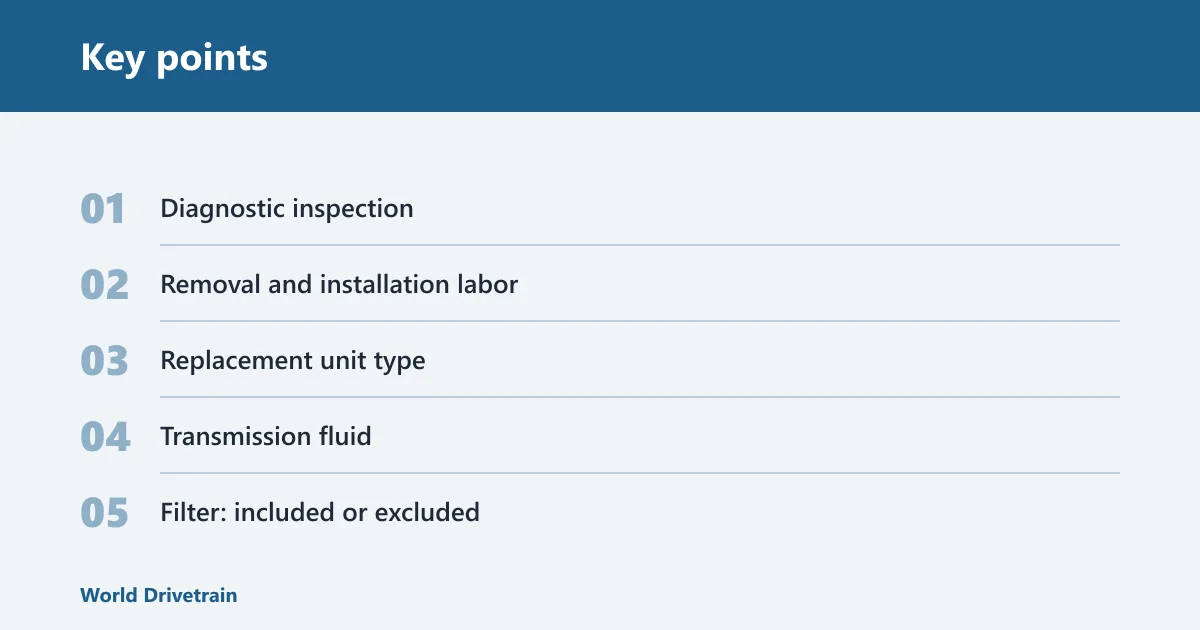
- Diagnostic inspection: included or billed separately
- Removal and installation labor: listed separately or as a flat replacement labor charge
- Replacement unit type: rebuilt, remanufactured, or used
- Transmission fluid: type and quantity listed
- Filter: included or excluded
- Seals and gaskets: included or excluded
- Cooler flush: included, recommended, or omitted
- Programming/adaptation: included or extra
- Taxes and shop supplies: shown clearly
- Warranty terms: mileage, time, and coverage stated
- Core charge: listed if applicable
| Line item | Included / not included | Common add-on | Red-flag omissions |
|---|---|---|---|
| Diagnostic inspection | Often included before a firm quote, sometimes credited later | Scan test, road test, fluid check | No diagnosis before replacement recommendation |
| Removal and installation labor | Usually included as a major cost item | Extra time for AWD or tight access | Labor hidden inside a vague total |
| Replacement unit | Included, but type must be named | Rebuilt, remanufactured, or used unit | No unit source or rebuild level listed |
| Fluid | Sometimes included | Vehicle-specific fluid type | No fluid type or quantity stated |
| Filter | Often included on rebuild or install package | Additional service kit parts | Filter omitted from a transmission job |
| Seals and gaskets | Commonly included with a rebuilt unit | Axle seals, cooler seals, pan gasket | Leaks likely if seals are not listed |
| Cooler flush | Vehicle- and failure-dependent | Debris removal, line cleaning | No flush after a failure that spread debris |
| Programming/adaptation | Often required on modern units | Module coding, relearn procedure | Electronic work left out of the quote |
| Taxes and shop supplies | Sometimes listed as separate fees | Disposal, clamps, small hardware | Final invoice larger than the estimate with no explanation |
| Warranty terms | Should always be written out | Mileage and time coverage | No coverage period, no labor language, no claim rules |
- Ask the shop whether the quote is for a rebuilt, remanufactured, or used transmission.
- Confirm whether diagnostic inspection is included and whether it can be credited toward repair.
- Check that labor, fluid, filter, seals, and programming are listed separately or clearly included.
- Ask what teardown findings could change the price.
- Compare warranty mileage, time, and covered parts before approving the repair.
How much can a used transmission estimate vary by vehicle? Quite a lot. Used transmission estimates can start low, but fitment, mileage uncertainty, and electronic compatibility can push the total up fast on newer vehicles. Older vehicles usually have more salvage options, while newer models can narrow the usable inventory.
What should you ask before approving the repair? Ask what is included, what is excluded, and what happens if teardown reveals more damage. Also ask whether the estimate includes labor, fluid, seals, programming, cooler service, and a warranty you can compare line for line with other quotes.
Frequently asked questions
What is included in a transmission replacement cost estimate?
A complete estimate usually includes diagnosis, removal and installation labor, the replacement unit, fluid, seals, gaskets, programming or adaptation if needed, and shop fees. It should also list warranty terms and note any items that are only needed after teardown or inspection.
Does a transmission estimate include labor and parts?
It should, but the estimate should show them separately or state clearly that they are bundled. Labor is often a large share of the bill, and parts can include the unit itself, fluid, seals, gaskets, and any electronic setup needed after installation.
What extra fees can show up in a transmission replacement quote?
Programming, adaptation, cooler flush service, taxes, shop supplies, disposal fees, and a core charge can all appear. Some are predictable, while others depend on the vehicle and the failure. If those items are missing from the quote, the final bill may be higher.
What warranty details should be on a transmission estimate?
The estimate should state mileage coverage, time coverage, and what is covered. Factory remanufactured transmissions typically carry a 75,000-100,000 mile warranty or two to three years. Rebuilt units often carry much shorter coverage, from 30 days to one year.
Should a shop inspect the vehicle before giving a firm quote?
Yes. A diagnostic inspection helps confirm that the transmission is the real problem and not an engine, electrical, or battery issue. It also gives the shop better information about the needed unit type, labor time, and whether teardown may change the price.