How Often Should Transmission Fluid Be Changed?
Change automatic or CVT fluid about every 30,000–60,000 miles in severe use, 60,000–100,000 miles in normal use, and use the shorter interval if the transmission has high mileage or no service record. Waiting too long can leave you with late shifts, extra heat, and worn parts that fail before any warning light appears. This guide gives a mileage-by-use matrix, transmission-specific intervals, and signs that mean service is due now.
Transmission fluid interval matrix
Use the owner’s manual first, then place the vehicle in the matrix below. Transmission type matters. Driving severity matters. So does fluid specification, because automatic transmission fluid, CVT fluid, and manual fluid do not follow the same service logic.
| Transmission type | Normal use | Severe use | Service sooner if |
|---|---|---|---|
| Automatic transmission | 60,000–100,000 miles | 30,000–50,000 miles | Fluid is dark, smells burnt, shifts feel harsh, towing or stop-and-go use is common, or service history is unknown |
| Manual transmission | 30,000–60,000 miles or more | About 30,000 miles in heavy use | Shifting gets notchy, gear oil looks dirty, the vehicle sees repeated steep grades, or the manual calls for earlier service |
| CVT | Model-dependent, often within the 60,000-mile range | Often shorter than a conventional automatic | Fluid is not CVT-specific, the owner’s manual lists a narrower window, or the vehicle sees heat, short trips, or towing |
This matrix is a decision aid, not a substitute for the maintenance schedule. If the manual gives a different interval, the manual wins.
How often should you change it?
Start with the owner’s manual maintenance schedule and the exact fluid specification. Mileage alone does not settle the question, because the same transmission can wear very differently in highway commuting, mountain roads, or traffic that keeps you crawling and stopping. If the schedule gives an inspection interval, follow that first, then service at the listed drain-and-fill or replacement point.
Use the shorter end of the range when the fluid is old, the transmission has high mileage, or the service history is missing. Clean-looking fluid does not erase a due interval. A vehicle can look acceptable on the dipstick and still be overdue by miles, time, or operating severity.
Say your sedan has a conventional automatic, sits in daily traffic jams, and tows a small trailer on weekends. Even if the fluid still looks amber, the severe-use window is the better fit because heat and load shorten fluid life.
- Check the owner’s manual for the interval and exact fluid spec.
- Identify the transmission type: automatic, manual, CVT, or DCT if equipped.
- Match the vehicle to normal use or severe use.
- Inspect fluid condition if the vehicle has a dipstick or inspection procedure.
- Choose service now if you are near the severe-use limit, have symptoms, or do not know the service history.
Automatic, manual, and CVT intervals
Automatic transmission fluid does more than lubricate. It also supports hydraulic pressure, cooling, and smooth gear engagement. That is why ATF is often serviced more often than manual fluid, and why heat is such a problem. Motorist Care places severe driving at 30,000 to 50,000 miles and normal driving at 60,000 to 100,000 miles, while Carsymp notes modern automatics can go up to 100,000 miles under normal driving.
Automatic transmission fluid
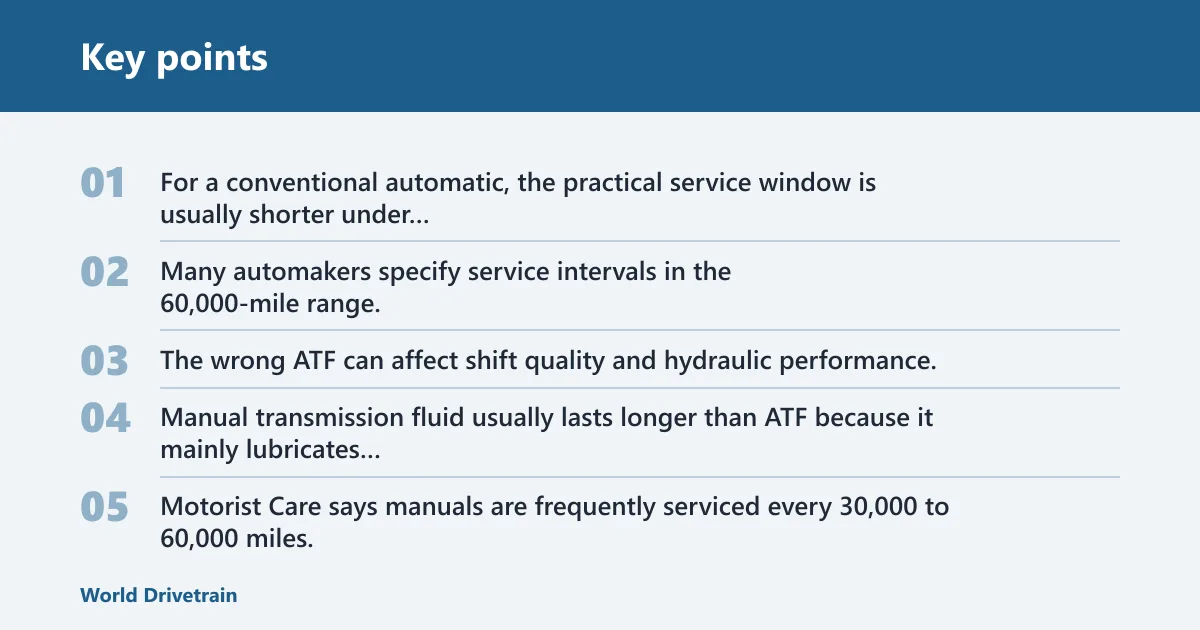
For a conventional automatic, the practical service window is usually shorter under severe use and longer under normal use. Many automakers specify service intervals in the 60,000-mile range, but the manual can call for earlier inspection or replacement. Use exact OEM- or spec-matched fluid. The wrong ATF can affect shift quality and hydraulic performance.
Manual transmission fluid
Manual transmission fluid usually lasts longer than ATF because it mainly lubricates gears and bearings. Motorist Care says manuals are frequently serviced every 30,000 to 60,000 miles, and Carsymp notes severe-service manuals can be every 30,000 miles. Some manuals can go longer, but only if the owner’s manual says so.
CVT fluid
CVT fluid has a narrower, model-dependent window. The same source notes that CVTs often require specific fluids and narrower service windows. That point matters because CVTs rely on the correct friction characteristics and hydraulic behavior, not generic ATF. If the manual calls for CVT-specific fluid, use that exact spec.
A common first-timer mistake is treating every “transmission fluid” listing as interchangeable. It is not. A Honda, Toyota, Subaru, or Nissan may all need different fluid specs even when the mileage target looks similar on paper.
What counts as severe use?
Severe use means the transmission sees more heat, more load, or more repeated shifting than normal commuting. Traffic that keeps you stopping and starting, towing or hauling heavy loads, mountain roads, extreme heat or cold, and frequent short trips all shorten fluid life. That is why a schedule that looks generous on paper may still be too long for your driving pattern.
Stop-and-go traffic
Frequent stop-and-go traffic keeps the transmission cycling through low gears and heat buildup. The same source lists this as severe use. If that describes most of your driving, use the severe-service side of the matrix even if the vehicle rarely leaves pavement.
Towing and hauling
Towing or hauling heavy loads raises fluid temperature and stress. A vehicle that tows “only sometimes” still needs the shorter interval if those trips are regular. One long summer tow can matter more than many short highway drives.
Heat, cold, and mountain driving
Extreme temperatures and repeated steep grades shorten intervals because they increase thermal stress and load. Mountain roads often combine braking, climbing, and low-speed torque demand. That combination is hard on ATF and CVT fluid in particular.
Short trips
Short trips can be severe because the transmission may never reach a stable operating temperature long enough to evaporate moisture and stabilize the fluid. If the vehicle is used for school runs, errands, and cold-start trips all week, treat that as severe service unless the manual says otherwise.
Drain-and-fill or flush?
A drain-and-fill replaces only the fluid that drains out of the pan or service point. A flush uses equipment to circulate new fluid through more of the system and exchanges more old fluid. Neither method is automatically right for every transmission, and the owner’s manual may favor one approach over the other.
What a drain-and-fill replaces
A drain-and-fill is less aggressive. It changes a portion of the fluid and is often the better choice on higher-mileage units or when the service history is unclear. It is also a common first step when you want to refresh fluid without shocking an older transmission with a more forceful exchange.
What a flush changes
A flush is more complete. It can exchange a larger share of the old fluid, but it is not always recommended for every transmission. If the manual does not call for it, do not assume it is necessary. Some transmissions are best served by the manufacturer’s specified drain-and-fill or inspection schedule.
Why higher-mileage units often get a drain-and-fill
Higher-mileage units often benefit from the gentler approach because you are replacing degraded fluid without changing the service strategy more than needed. That does not mean a flush is wrong in every case. It means the transmission design, age, and manual should decide.
Suppose a 140,000-mile automatic has unknown service history but still shifts normally. A drain-and-fill that uses the exact spec fluid is usually the safer first service than jumping straight to a full flush, unless the manual or a qualified transmission procedure says otherwise.
What the fluid condition tells you
Fluid condition helps you decide whether to service now or wait, but it should not override the schedule. Dark color, a burnt smell, sludgy or dirty fluid, or metallic particles point toward overdue service or internal wear. If the fluid looks clean but the transmission is at a severe-use threshold, the schedule still wins.
Dark or burnt fluid
Dark fluid or a burnt smell usually means the fluid has spent too long under heat. That is a service-now signal, not a “check again next year” signal. Heat is one of the main reasons automatic transmission fluid fails early.
Sludge or contamination
Sludgy fluid, dirt, or visible contamination suggests the fluid is no longer doing its job well. That can affect lubrication, hydraulic pressure, and smooth shifting. If contamination is present, inspect the transmission according to the manual before deciding on the service type.
Metallic particles
Metallic particles indicate wear inside the transmission. A small amount of fine material may appear in normal service, but obvious glitter, flakes, or repeated contamination should not be ignored. In that case, fluid service may help, but it does not replace diagnosis.
Dipstick checks and hot or cold readings
Many vehicles still use a transmission fluid dipstick. Some require the check to be done hot, others cold, and the level marks are not interchangeable. A low reading on the wrong temperature scale can mislead you, so follow the manual’s checking procedure exactly.
Transmission fluid intervals in km
If you read maintenance schedules in kilometers, the common mile ranges convert to practical service windows. Use these as planning figures, then match them to your manual and driving severity. They are not a replacement for the factory schedule.
| Miles | Kilometers | How to use it |
|---|---|---|
| 30,000 | 48,280 km | Common severe-service mark for some automatics and manuals |
| 60,000 | 96,560 km | Common normal-service target and a frequent manual-service point |
| 100,000 | 160,934 km | Upper end of some normal-service automatic intervals |
For quick conversion, 30,000 miles is about 48,280 km, 60,000 miles is about 96,560 km, and 100,000 miles is about 160,934 km. If a service reminder is written in miles, these values make it easier to compare with a kilometer-based maintenance book.
Frequently asked questions
How often should transmission fluid be changed in a car?
There is no universal interval for every car. Transmission type, fluid spec, and driving severity all change the service window.
How often should transmission fluid be changed automatic?
Because ATF also supports hydraulic function and cooling, heat matters. Use the exact OEM or specification-matched fluid listed by the manufacturer.
How often should transmission fluid be changed in a cvt?
CVT service intervals tend to be model-dependent and are often narrower than those for conventional automatics. Many CVTs need CVT-specific fluid and a shorter, manual-listed window. If the owner’s manual gives an inspection, drain-and-fill, or replacement interval, follow that instead of using a generic automatic-transmission rule.
How often should transmission fluid be changed in a manual?
Manual transmission fluid is often serviced less often than ATF, commonly around 30,000–60,000 miles or more. Under severe use, some manuals need service closer to 30,000 miles. The exact interval depends on the gearbox design, lubricant spec, and whether the manual recommends inspection first.
How often should transmission fluid be changed in km?
Use those figures only as a conversion guide. The owner’s manual and the vehicle’s transmission type still decide the actual service point.
How often should I change my transmission fluid?
Change it according to the owner’s manual, then shorten the interval if you tow, drive in traffic, live in extreme temperatures, or make frequent short trips. If the fluid is dark, burnt, sludgy, or contaminated, service is due sooner. Clean fluid does not cancel the schedule.
How often should transmission fluid be changed honda crv?
A Honda CR-V should follow the maintenance schedule specified for its transmission, since Honda schedules can vary by year and transmission type. For many Honda automatics and CVTs, the manual often calls for specific fluid and a defined interval rather than a one-size-fits-all number. Check the schedule before choosing a service type.
How often should transmission fluid be changed toyota?
Toyota intervals also depend on model year and transmission design. Some Toyota automatics and CVTs use a service schedule that appears in the manual, not a generic mileage rule. The correct Toyota fluid spec matters as much as the interval, so match both before any drain-and-fill or flush.
How often should transmission fluid be changed subaru forester?
A Subaru Forester may use a CVT or another transmission design depending on year and trim, so the schedule must come from the owner’s manual. CVT-specific fluid and the correct service interval are essential. Do not use a generic ATF rule for a transmission that calls for CVT fluid.
How often should transmission fluid be changed honda?
Honda service intervals depend on the model, the transmission type, and the exact fluid specification. Some Honda vehicles use automatic fluid, others use CVT fluid, and the schedule can differ even within the same model line. Start with the maintenance schedule and follow the listed fluid spec exactly.