Is It Normal for Transmission Fluid to Leak?
A small seep can be normal for a short time after a transmission service, but a steady drip, growing spot, or fluid loss is not normal and needs inspection. Ignoring it can burn clutch packs, overheat the transmission, and turn a simple seal issue into an expensive rebuild. This guide shows how to tell post-service residue from expected wear and from a leak that needs attention now.
What a transmission fluid leak means
What ATF does in the transmission
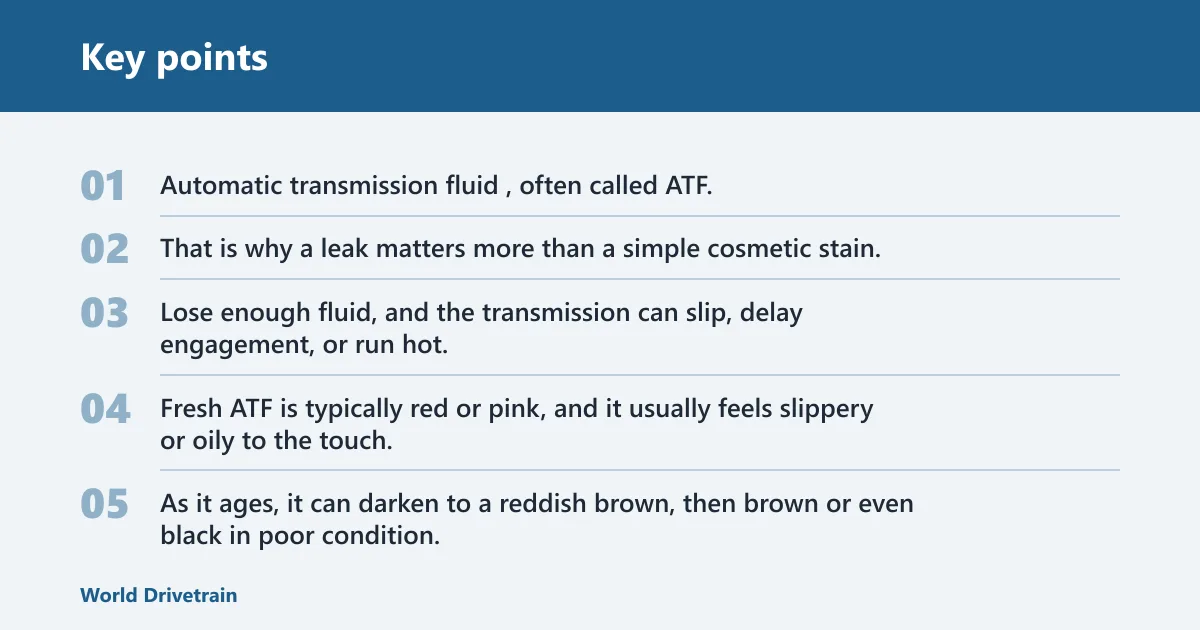
Automatic transmission fluid, often called ATF, does three jobs at once: it lubricates moving parts, cools the transmission, and provides hydraulic pressure for shifting. That is why a leak matters more than a simple cosmetic stain. Lose enough fluid, and the transmission can slip, delay engagement, or run hot.
How fresh ATF looks and feels
Fresh ATF is typically red or pink, and it usually feels slippery or oily to the touch. As it ages, it can darken to a reddish brown, then brown or even black in poor condition. Color alone does not prove a leak source, but it helps identify the fluid on the driveway or on cardboard.
Why even a small loss matters
Transmission fluid normally runs around 175°F to 200°F. Above 220°F, it starts to break down, and prolonged exposure above 260°F can cause severe internal damage. A small leak can turn into low fluid, and low fluid can quickly become heat, slipping, and wear that is much harder to reverse.
Is it normal for transmission fluid to leak?
An ongoing transmission-fluid leak is generally not normal, though a small amount of residue after service can be. The line between acceptable and abnormal depends on pattern, location, and whether the spot grows. A light film from recent work may clear up; active dripping, a larger spot, or repeated loss is generally not considered normal.
Normal residue after service
After a fluid change, pan removal, seal replacement, or line service, a little fluid may remain on the case, crossmember, or pan edge. That leftover film can drip once or twice and then stop. If the spot stays the same size and does not reappear after cleanup, it may be residue rather than an active leak.
Minor seepage versus an active leak
Seepage means wetness or a damp film. A leak usually means fluid is moving beyond that point and leaving drops, streaks, or a puddle. A small spot with normal shifting may be okay for a short drive to a shop, but a leak that leaves a puddle after a few hours is treated as more serious.
What changes the answer
Location matters. Wetness at a recently serviced pan may point to leftover fluid or a slightly weeping gasket. Wetness near the bellhousing, a cooler line rupture, or a seal that sprays fluid while driving is different. If the fluid level is falling, the answer changes from “watch it” to “inspect it now.”
Is it normal for transmission fluid to leak after replacement?
A light residue from spilled fluid or a brief seep after fresh service can be normal, but continued leakage after replacement is not. If the spot keeps growing, appears at the same place every time, or starts after a repair that should have fixed the issue, treat it as a problem, not a normal settling period.
Spilled fluid that was not cleaned off
Service work can leave fluid on the case, pan rail, cooler fittings, or underbody panels. That leftover fluid may drip for a short time and make it look like the repair failed. If the source area is dry after cleaning and the spot stops returning, the issue may have been spilled fluid rather than a bad part.
Fresh gasket or seal settling
Some gaskets and seals can settle slightly after installation, especially if the fasteners were torqued unevenly or the mating surface was not perfectly clean. That should not produce a steady drip. If the leak persists after a short drive cycle and a recheck, the repair needs attention.
Signs the replacement was not done correctly
Repeated wetness at the same edge, drips from a loose line fitting, or fresh fluid around a new seal can point to installation error, damaged sealing surfaces, or a pre-existing wear issue that was not fixed. A new part that still leaks is not “normal.” It needs a closer look before fluid loss gets worse.
Transmission leak triage table
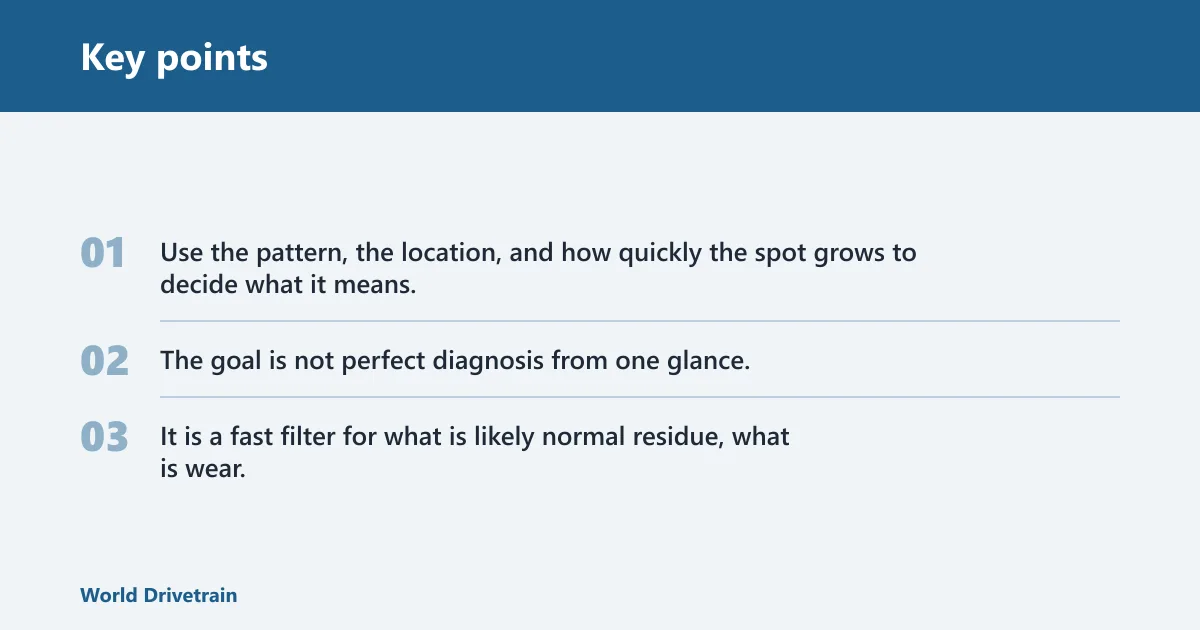
Use the pattern, the location, and how quickly the spot grows to decide what it means. The goal is not perfect diagnosis from one glance. It is a fast filter for what is likely normal residue, what is wear, and what needs immediate inspection.
| Leak pattern | Likely meaning | Action |
|---|---|---|
| Post-replacement residue | Leftover ATF from recent service or cleanup, not necessarily an active leak | Wipe clean, recheck after one drive cycle, and monitor for new wetness |
| Pan seep | Transmission pan gasket wear or uneven sealing at the perimeter | Inspect the pan edge; repair is often about $150 to $400 |
| Cooler-line drip | Corrosion, a pinhole, a crack, or a loose connection in a metal or rubber cooler line | Do not ignore it; cooler line replacement can also cost $150 to $400 |
| Axle-seal sling | Axle seal wear near the CV axle entry point; fluid may sling outward while driving | Look for wet marks under the vehicle and note the exact place they land; schedule inspection soon |
| Bellhousing drip | Front pump seal or torque-converter area problem, often more involved labor | Fast inspection; this can point to a stop-driving condition |
| Overfill or vent overflow | Fluid level too high, foaming, or venting after service | Check level correctly and correct the overfill before driving further |
| Burnt-smelling fluid | ATF has overheated or aged badly; internal wear may already be present | Inspect immediately; do not keep driving if shifting changes or the level is low |
| Active puddling after parking | Ongoing leak with meaningful fluid loss, not normal residue | Treat as urgent; do not drive if the fluid is dropping fast |
| Wet selector shaft area | Selector shaft seal wear at the shift linkage connection | Monitor closely and plan repair before the leak spreads |
| Dipstick tube base wetness | Dipstick tube seal or O-ring leak on older vehicles with a dipstick | Inspect the tube base; repair often falls in the $100 to $250 range |
Where the fluid is coming
The leak source tells you more than the color alone. Pan-perimeter wetness usually points lower on the case. Cooler-line fluid often appears along the line route or near fittings. Bellhousing wetness, axle sling, and a wet selector shaft each point to different parts that wear in different ways.
Transmission pan gasket
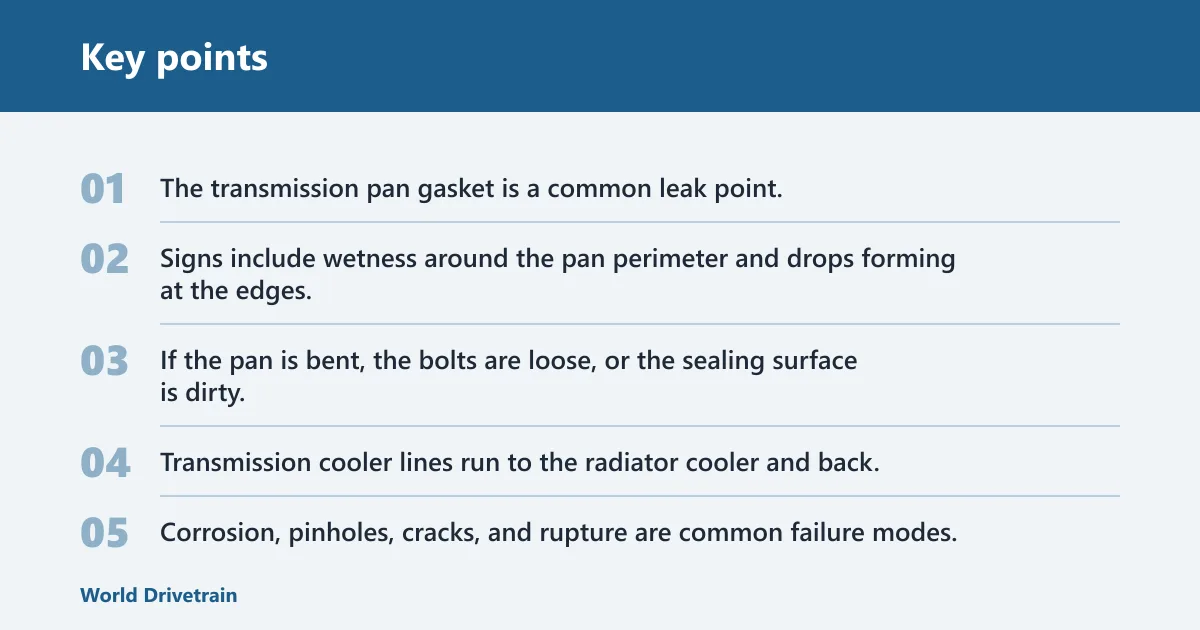
The transmission pan gasket is a common leak point. Signs include wetness around the pan perimeter and drops forming at the edges. Repair cost is often about $150 to $400. If the pan is bent, the bolts are loose, or the sealing surface is dirty, the gasket can seep even when the rest of the transmission looks dry.
Transmission cooler lines
Transmission cooler lines run to the radiator cooler and back, and they may be metal or rubber. Corrosion, pinholes, cracks, and rupture are common failure modes. Because the lines carry fluid under use, even a small split can turn into a steady drip. Shop replacement commonly costs $150 to $400.
Dipstick tube seal, selector shaft seal, axle seal, and bellhousing area
Older vehicles with dipsticks can leak at the dipstick tube base if the O-ring hardens or shifts. Selector shaft seals often leave wetness near the shift linkage connection. Axle seals are common on front-wheel-drive and many AWD vehicles, and they can sling fluid outward while driving. A bellhousing drip near the front of the transmission often points to the front pump seal or torque-converter area and deserves fast inspection.
Suppose a front-wheel-drive car leaves a reddish streak on the inside of one front wheel after about a 15-minute drive. That pattern is more consistent with axle-seal sling than a pan leak, because rotating parts can throw fluid outward. A pan gasket usually stains lower and closer to the transmission case.
A common first-timer mistake is to assume a red puddle near the driveway is always just transmission fluid, even when it could be from another vehicle system. A damp pan edge, a line drip, and a bellhousing puddle are not equivalent. Location changes the likely cause, the urgency, and the repair path.
What causes transmission fluid to leak?
Wear, corrosion, cracks, overfill, and front-seal problems are the main reasons ATF escapes. The specific cause depends on where the wetness starts and how it moves. A leak that appears after service may be a sealing issue; one that develops over time may be simple age or corrosion.
Wear, corrosion, and cracks
Rubber hardens. Metal lines corrode. Gaskets flatten. Seals wear at moving shafts. Those changes are normal aging, but they are not harmless. A worn pan gasket may seep at the perimeter. A corroded cooler line can fail suddenly. A selector shaft seal may slowly wet the case and then start leaving drops.
Overfill and vent overflow
Too much fluid can foam and push out through a vent or other opening. That is not a normal leak pattern. It often appears after service, after a fluid change, or after a level check done the wrong way. Overfill can also create shifting issues, so the level needs to be corrected, not ignored.
Front seal or torque-converter problems
A leak at the front pump seal or torque-converter area is more serious because the labor is often more involved and the source is harder to reach. Fluid may show up near the bellhousing, but the actual point of failure sits inside the transmission case. If this area is wet and the vehicle is losing fluid, fast inspection is the right call.
How to check the leak safely
Start with a clean, level surface and a simple overnight test. Park on level ground, place cardboard under the vehicle, and note where the drops land. Then check the fluid the correct way for the vehicle, because many newer vehicles use sealed transmissions with no dipstick.
Cardboard test overnight
Cardboard makes the leak pattern easy to see. Put it under the center of the vehicle and mark the spots that collect fluid. A single spot after service may be leftover residue. A fresh spot that grows, or a line of drops that continues, points to an ongoing leak.
Level-ground inspection
- Park on a level surface.
- Let the vehicle sit long enough for the fluid to settle.
- Look for wetness at the pan, lines, axle seals, selector shaft, and bellhousing.
- Note whether the spot is a stain, a drip, or a puddle.
- Check whether the fluid looks red, pink, reddish brown, or dark brown and whether it smells burnt.
Dipstick check where applicable
If the vehicle has a dipstick, check the fluid on a warmed vehicle with the engine running and in park where applicable. Read the level only in the manner specified by the manufacturer. A low reading with visible wet spots means the loss is real. A high reading after service can point to overfill rather than a missing seal.
Picture a sedan that leaves about a dime-sized spot after a transmission filter change, then nothing for two days after the area is wiped clean. That pattern can fit harmless residue. Now picture the same car leaving a larger spot every morning and starting to hesitate into gear. That is no longer normal and needs inspection.
How serious is it based on seep versus drip?
Severity comes down to growth, location, and symptoms. A light seep with normal shifting is less urgent than an active drip. A puddle after a few hours is serious. Slipping gears, delayed engagement, or burnt-smelling fluid means the vehicle should not be treated as safe for normal driving.
If the fluid is low, the transmission can slip and overheat before the driver notices a major change. That is why a small leak can become an expensive failure. Drive only far enough for a short trip to a shop if the spot is small and shifting is still normal. Tow it if the leak is active or the gears slip.
Frequently asked questions
Is it bad for transmission fluid to leak?
Yes. ATF lubricates, cools, and supplies hydraulic pressure. If the level falls, the transmission can slip, run hot, and wear out faster. A small seep is less urgent than active dripping, but every leak deserves attention before it becomes a low-fluid problem.
Is it common for transmission fluid to leak?
Leaks are commonly reported at age-related wear points such as the pan gasket, cooler lines, axle seals, and selector shaft seal. It is not common for a healthy transmission to keep losing fluid after service. Common does not mean normal or safe to ignore.
What does it mean when transmission fluid is leaking?
It means the transmission is losing fluid somewhere in the system. If the fluid is fresh red or pink and the spot is small, the issue may be an external seep. If it is dark, burnt-smelling, or forming a puddle, the problem is more serious and needs fast inspection.