Is It Bad to Drive with a Slipping Transmission?
Yes. If the transmission is slipping, treat it as urgent: stop driving if it bangs, revs flare without movement, or the gear light flashes; only creep to a nearby shop when fluid is low and the slipping is mild. Driving through it can overheat clutches and can quickly spread metal and friction debris. You get a simple rule here for drive, limp, or tow decisions, plus the symptoms that point to low fluid or internal damage.
Recognising a slipping transmission and its risks
Yes. A transmission that revs before the vehicle accelerates is not a problem to “drive and see what happens.” Slip makes more heat and debris the longer it runs under load, and that can turn a fluid issue that could still be fixed into internal damage. The safe response depends on the symptom pattern, not the mileage left on the trip.
What slipping feels like on the road
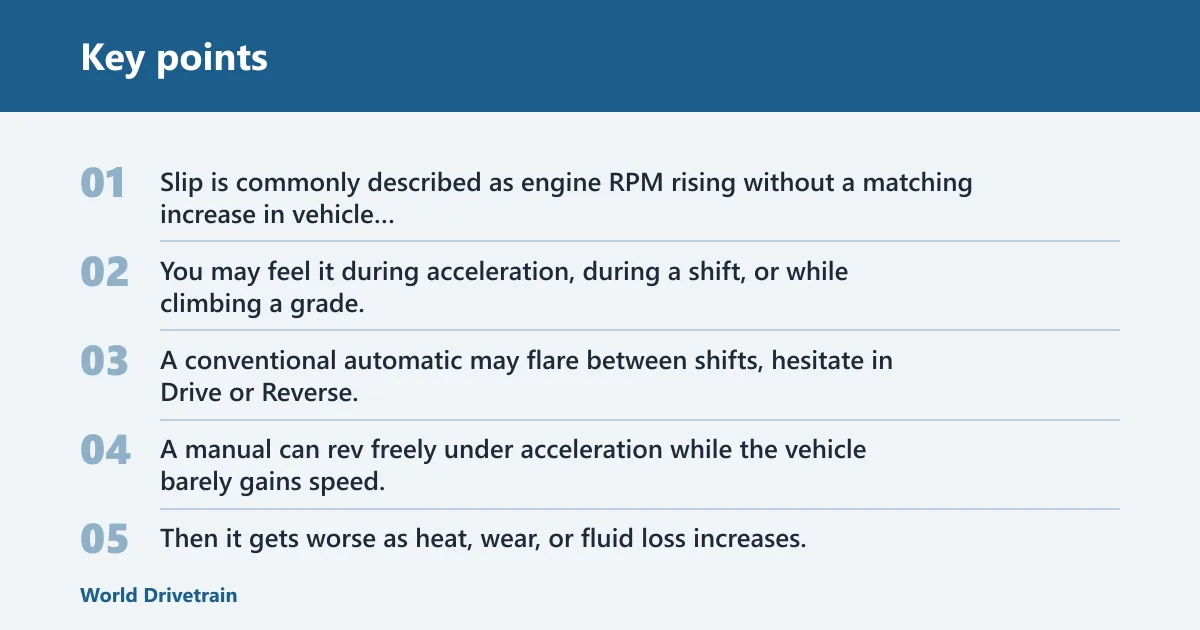
Slip is commonly described as engine RPM rising without a matching increase in vehicle speed. You may feel it during acceleration, during a shift, or while climbing a grade. A conventional automatic may flare between shifts, hesitate in Drive or Reverse, or lose pull on a hill. A manual can rev freely under acceleration while the vehicle barely gains speed.
That feeling can start off irregular. Then it gets worse as heat, wear, or fluid loss increases. Occasional slip on a hill is not the same as a unit that slips every time it changes gear or every time you ask for power.
Why continued driving adds heat and wear
Slip is a pressure and friction problem. Low fluid can mean low pressure, and low pressure means slip. Burnt or dirty fluid also carries less of the pressure and cooling the unit needs. Once the unit starts slipping under load, heat rises quickly and friction material sheds debris into the transmission.
That debris can move through the valve body, clutch packs, solenoids, pump passages, and torque converter. Continued driving risks total failure, especially when the transmission is already hot or the vehicle is working hard.
The short answer on drive, limp, or tow
Use this rule: if the slip is mild, cold-only, and the fluid level is low enough to check safely, drive only directly to a nearby shop. If the slip happens hot, under load, or with any warning light, stop driving and arrange a tow. If reverse is delayed or the vehicle will not hold gear, do not try to “nurse” it long distances.
| Symptom pattern | Likely severity | What to do next |
|---|---|---|
| Cold-only slip | Possible low fluid or a temporary pressure issue | Check fluid if the vehicle allows it, then drive directly to a shop if the slip stays mild |
| Hot-only slip | Higher risk of wear or fluid breakdown | Stop driving immediately and arrange a tow if it worsens after warm-up |
| Slip under load | Likely internal wear or low pressure | Tow if it loses pull on hills or during hard acceleration |
| Delayed reverse | Possible valve body, solenoid, or internal clutch issue | Do not keep driving far; arrange a shop visit or tow |
| Burning smell | Urgent heat damage warning | Stop driving immediately and tow |
| Visible leaks | Fluid loss can become a sudden failure | Stop driving immediately, check level only if safe, and tow |
| Warning lights | Stored fault or control problem | Drive directly to a shop only if the vehicle still moves normally; otherwise tow |
| Shudder at highway speed | Possible torque converter lockup problem | Drive directly to a shop if mild; tow if the shudder is strong or accompanied by slip |
What symptoms point to low fluid or a minor issue?
Cold-only slip and a brief delay before engagement can point to low fluid, wrong fluid, or a pressure issue that may show up before the unit warms up. If the slip is light, intermittent, and disappears after a fluid-level check or short warm-up, it may be less severe than a hot, load-dependent slip. It still needs diagnosis soon.
Cold-only slip
Cold-only slip often shows up on the first few shifts after startup. It may settle down once fluid thins and pressure stabilizes. That does not make it normal. It can mean the level is low, the fluid is dirty, or the unit is beginning to wear. Check the fluid level and condition if the vehicle design allows it.
Delayed engagement before the vehicle warms up
A long pause before Drive or Reverse engages can come from low fluid, a sticking valve, or a solenoid that is not directing pressure correctly. If the delay improves after warm-up and no warning light is on, you may be able to drive directly to a shop. If the delay grows longer, stop using the vehicle.
Fluid level and condition checks
Look for dark brown, black, or burnt-smelling fluid. That is a warning sign. Visible leaks are also a stop-and-check warning because low fluid can quickly turn a minor slip into a major one. CVTs need the correct fluid spec, so a “top off” with the wrong fluid can make the problem worse.
- Park on level ground if the check procedure requires it.
- Check the level only by the method the vehicle uses.
- Inspect the fluid color and smell.
- Look under the vehicle for fresh leaks.
- If the fluid is dark, black, or burnt, stop guessing and get it checked.
Say your automatic slips only on the first cold shift out of your driveway, then feels normal for the rest of a 6-mile trip. That points more toward fluid level or pressure behavior than a hard failure, but it still deserves a shop visit before the next long drive.
What symptoms mean you should stop driving?
Hot-only slip, slip under load, a burning smell, visible leaks, or a flashing transmission warning light move the problem into the stop-driving zone. Those signs point to heat damage, low pressure, or active internal wear. If the vehicle loses pull, shudders badly, or will not engage Reverse cleanly, arrange a tow instead of extending the trip.
Hot-only slip
If the transmission behaves when cold but slips once it heats up, the unit may be breaking down under temperature. Heat speeds fluid breakdown and friction wear. Towing, hills, traffic, and heavy load increase the risk. That is the pattern that often gets worse after a few more miles, not better.
Slip under load
Slip that shows up on a hill, during hard acceleration, or while merging is a strong warning. Worn clutch packs or clutch plates can slip when load rises, and that usually means internal wear rather than a simple top-off fix. A conventional automatic may lose pull on a hill; a manual may rev freely while speed barely climbs.
Burning smell, visible leaks, or warning lights
A burnt smell means the fluid has been overheated. Visible leaks mean the level can drop fast enough to damage the unit in one trip. A gear warning light, check-engine light, or transmission message tells you the control system has seen a fault, even if the vehicle still moves. Stop driving if the slip is getting worse or the light flashes.
Suppose a CVT starts shuddering at 65 mph and then flares on a long incline. That is not a “keep testing it” situation. CVTs need specific fluid, and the wrong fluid or a lockup issue can turn a drivability complaint into debris spread through the unit.
Shudder at highway speed
Shudder at cruising speed often points to torque converter lockup trouble rather than a simple shift problem. The converter can mimic transmission slip at steady speed, and debris contamination can move through the transmission. If the shudder is mild and the vehicle still shifts cleanly, drive directly to a shop. If it worsens, tow it.
What causes a slipping transmission?
Slip can come from low, dirty, burnt, or wrong-spec fluid, but it can also come from worn clutch packs, solenoids, a worn valve body, a torque converter problem, or heat damage. Those causes do not all fail the same way. The symptom pattern tells you whether the issue is fluid-related, electrical, hydraulic, or internal wear.
Worn clutch packs or clutch plates
Clutch packs and clutch plates are friction parts inside many automatics and some CVT-related assemblies. When they wear out, the transmission can slip more under load and often worse when hot. That is usually not fixed by adding fluid. It points to internal wear.
Solenoids and valve body faults
Solenoids are electrically controlled valves that direct fluid pressure. A bad solenoid can cause delayed or wrong gear engagement and may set diagnostic trouble codes. The valve body is the hydraulic control center of the transmission; wear, debris, or sticking valves can cause slipping or delayed shifts. Many cases need professional diagnosis, and some require rebuild work.
Torque converter problems
The torque converter can cause shudder or slip-like symptoms at cruising speeds. A lockup problem can feel like a transmission slip even when the gears themselves are not the main issue. If converter debris enters the fluid, the contamination can move through the unit and complicate the repair.
Heat damage and contamination
Heat makes everything worse. It breaks down fluid and friction material, and it can follow towing, hills, traffic, or heavy load. Once the fluid is burnt, the transmission may keep slipping even after the vehicle cools. That is why a slipping unit should not be pushed.
Can you drive it to a shop?
Sometimes, yes, but only for a short direct trip when the symptom is mild and the vehicle still moves normally. If the slip is cold-only, intermittent, and not getting worse, a cautious drive to a nearby shop may be reasonable. If the slip is hot, load-based, or paired with warning lights or burnt fluid, tow it instead.
When to limp only a short distance
Limp only when the vehicle still engages cleanly, the slipping is light, and there is no burnt smell, major shudder, or visible leak. Keep speed low, avoid hills and hard throttle, and go straight to repair. Do not use the vehicle for errands, commuting, or towing while it is slipping.
When to arrange a tow instead
Tow the vehicle if reverse is delayed badly, if the transmission loses pull on hills, if the gear light flashes, or if the fluid smells burnt. That also applies when the slip gets worse as the unit heats up. A tow is cheaper than turning a repairable fault into a failed transmission.
How CVT symptoms change the decision
CVTs need the correct fluid spec and can fail differently from geared automatics. A CVT that shudders, flares, or feels like it is “hunting” for ratio under load should get conservative treatment. If the fluid is wrong, burnt, or unknown, do not assume a top-off will solve it. A CVT complaint often deserves a tow sooner than a conventional automatic with a mild fluid-level issue.
What do codes P0894 and P0730 mean?
Codes help narrow the problem, but they do not name the failed part by themselves. P0894 is linked to component slipping, and P0730 is linked to incorrect gear ratio. Those codes tell you the transmission control system sees a mismatch. They do not prove whether the cause is fluid, a solenoid, the valve body, a clutch pack, or the torque converter.
How codes guide diagnosis
A shop will usually scan codes, inspect the fluid, and check for pressure problems. It may also road test the vehicle and watch data during the shift or under load. A code plus burnt fluid points in a different direction than a code plus low fluid and no debris.
Why a code does not name the failed part
The same code can appear with different root causes. A slipping transmission can set a code because the control module sees a ratio problem, but the underlying issue may be mechanical or hydraulic. That is why codes are clues, not proof.
Will fluid service fix slipping?
Fluid service may help when low, dirty, burnt, or wrong fluid is the main issue. It will not fix worn clutch plates, a damaged valve body, or a failed torque converter. If the fluid is dark brown, black, or burnt-smelling, the problem is already beyond a simple top-off. Wrong-spec fluid is a particular risk in CVTs.
When fluid service may help
If the unit is low on fluid and the slip is mild, restoring the correct level can improve pressure and reduce slip. Fresh fluid can also help when the fluid is simply old and contaminated, provided the transmission is otherwise healthy. That still calls for a proper diagnosis, not guesswork.
When it will not fix internal wear
Once clutch packs are worn, the valve body is sticking badly, or the torque converter is failing, fluid service will not reverse the damage. A flush or additive is not a fix for worn internal parts. In a damaged unit, forcing more miles can create more heat and debris.
Why wrong-spec fluid is a problem in CVTs
CVTs rely on the correct friction behavior and pressure control. Wrong-spec fluid can change how the unit grips and how it regulates pressure. That can worsen slip, shudder, or ratio control problems. If the fluid type is unknown, do not assume any transmission fluid is acceptable.
Frequently asked questions
Is it bad to drive with a slipping transmission?
Yes. Even a mild slip can turn into more heat, more debris, and more wear if you keep driving under load. If the slip is only cold and light, a direct trip to a shop may be reasonable. If it is hot, burning, or getting worse, stop and tow it.
Is it okay to drive with a slipping transmission?
Only in a narrow case: the slip is mild, the fluid may be low, and you are driving straight to a nearby shop. It is not okay for normal use, long trips, or heavy throttle. If the transmission loses pull, shudders hard, or flashes a warning light, do not keep driving.
Is it safe to drive with a slipping transmission?
Not as a general rule. Safety depends on how severe the slip is and whether the vehicle still engages and moves predictably. A brief, cold-only slip may allow a short drive to repair. Slip under load, hot-only slip, or a burnt smell makes it unsafe to continue.
Can I drive with a slipping transmission?
Can you? Sometimes, for a short distance. Should you? Only if the symptom is mild and you are heading directly to service. If reverse is delayed, the slip is worse when hot, or the fluid is leaking, arrange a tow instead of trying to stretch the trip.
How long can you drive on a slipping transmission?
There is no safe universal distance. Some cases last a few miles before worsening; others fail quickly once heat builds. The correct question is whether the slip is mild enough for a direct shop visit or severe enough to tow. Do not use time or mileage as the only rule.
What happens if you keep driving with a slipping transmission?
Heat rises, friction material wears faster, and debris spreads through the unit. That can damage clutches, solenoids, the valve body, and the torque converter. A problem that might have been fluid-related can become a full rebuild or replacement if you keep loading it.