Why Does My Automatic Transmission Keep Slipping?
An automatic transmission usually slips because the fluid is low, worn, or overheated, or because a sensor, solenoid, or control issue sends the wrong shift command; check the fluid level first if the fluid sits low, looks dark, or smells burnt. Ignore it and the clutch packs can burn, debris can move through the unit, and a repair can jump from a service job to a rebuild. This guide shows how to tell fluid, heat, and electronic causes apart before you spend on major transmission work.
What transmission slip feels like
Slip usually feels like engine speed rises without a matching increase in road speed. It can also show up as delayed engagement, harsh upshifts, gear hunting, or trouble backing up. If the symptom appears only when hot or under load, that detail matters because it often points to fluid pressure loss or heat-related wear.
Rev flare without matching acceleration
High RPMs with weak acceleration are a classic sign of slipping, and the transmission may briefly “flare” between gears as engine speed jumps before the vehicle catches up. That is different from a normal downshift on a hill, which raises RPM because the transmission is intentionally changing ratio.
Delayed engagement, harsh upshifts, and gear hunting
A delayed drive engagement after shifting into gear can point to low fluid, a restricted filter, or a control fault. Gear hunting means the transmission keeps changing gears when it should hold steady. Harsh or late shifts can come from the same pressure problem, but they can also appear when a solenoid or valve body command is off.
Slip that shows up only when hot or under load
Intermittent slip that appears after warm-up often points to fluid thinning and pressure loss. Heat can make transmission fluid thin out and lose pressure. Tow loads, long grades, and stop-and-go traffic can raise the heat load, so a problem that seems minor in the morning may become more obvious after about 20 minutes in traffic.
📊 Bad transmission fluid goes bad every 100,000 miles. Source: Wikihow.
Automatic transmission slip triage
Start with the symptom, not the repair estimate. A few fast checks can separate a fluid problem from an electronic fault or a worn internal part, and that order matters because topping off fluid or reading codes costs far less than opening the transmission.
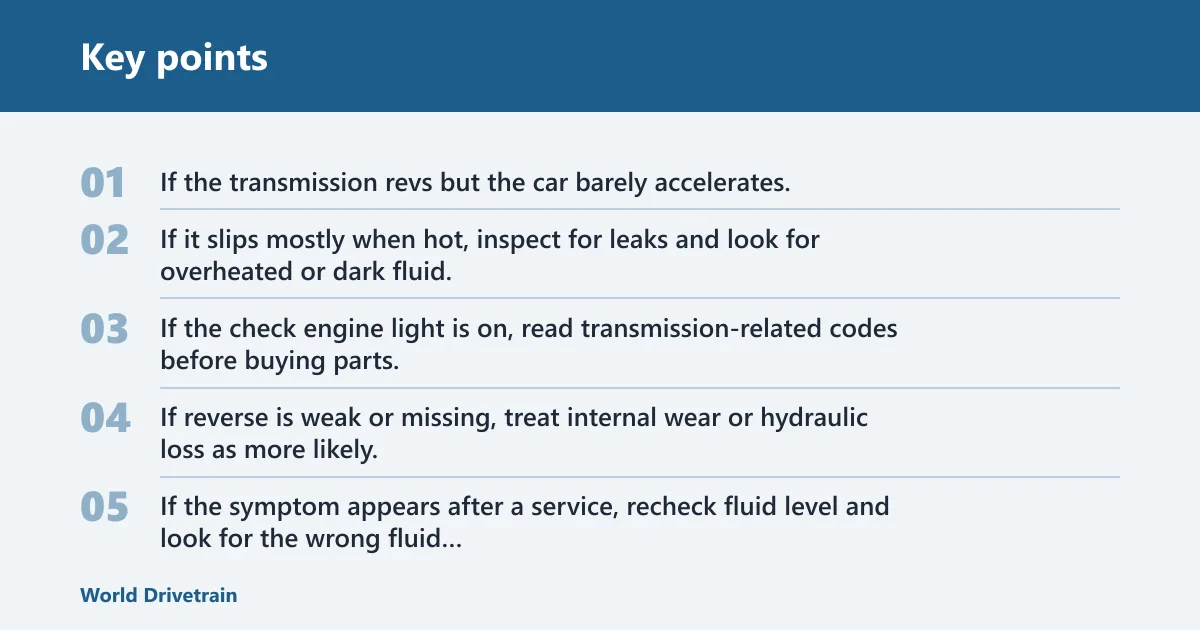
Decision tree: symptom, likely cause, first check, next action
- If the transmission revs but the car barely accelerates, check fluid level and color first.
- If it slips mostly when hot, inspect for leaks and look for overheated or dark fluid.
- If the check engine light is on, read transmission-related codes before buying parts.
- If reverse is weak or missing, treat internal wear or hydraulic loss as more likely.
- If the symptom appears after a service, recheck fluid level and look for the wrong fluid type or a filter issue.
- If slipping comes with a harsh shift and code, inspect solenoids and related wiring.
- If there is a burnt smell or dark fluid, avoid driving far until the fluid condition is confirmed.
- If fluid and codes do not explain the symptom, move toward internal wear diagnosis.
Quick table: symptom, likely cause, quick check, urgency
| Symptom | Likely cause | Quick check | Urgent or not urgent |
|---|---|---|---|
| High RPMs with weak acceleration | Low fluid, worn clutch packs, torque converter wear | Check fluid level and color, then look for leaks | Urgent if the slip is frequent |
| Delayed drive engagement | Low fluid, clogged filter, control fault | Check fluid level and scan for codes | Urgent if delay gets longer |
| Inability to reverse | Internal wear, hydraulic loss, band or clutch damage | Check fluid condition and any fresh leak spots | Urgent |
| Slip only when hot | Overheating, thin fluid, pressure loss | Inspect cooling and fluid condition after warm-up | Urgent |
| Slip with check engine light | Solenoid, sensor, or control fault | Read fault codes first | Urgent enough to scan soon |
| Burning smell or dark fluid | Overheated fluid, internal wear | Inspect fluid color and smell | Urgent |
| Pink or purple fluid | Coolant contamination | Check for cross-contamination and overheating signs | Urgent |
| Red or brownish-red spots under the car | Transmission leak | Trace the leak points around pan, lines, and seals | Urgent if level is low |
How to use the triage before paying for repair
Work in this order: fluid, leaks, cooling, then scan data. Say your sedan only slips after 15 minutes in traffic and the fluid shows dark color with a burnt smell. That points to heat and fluid breakdown before you assume the transmission is finished. Suppose reverse is weak and you also see red spots on the driveway. That makes a leak far more likely than a random shift issue.
Is low fluid the first thing to check?
Yes. Automatic transmission fluid does more than lubricate. It creates hydraulic pressure, helps move power, and carries heat away from internal parts. Low fluid often causes delayed engagement, slip under load, and noisy operation, so it is the first check when the symptom sounds like a pressure problem.
How automatic transmission fluid moves pressure and heat
Automatic transmissions rely on fluid pressure to apply clutches and bands, and they rely on fluid movement to control heat. Automatic transmissions rely on the torque converter to transfer power. If fluid is low, dirty, or aerated, the hydraulic system cannot hold pressure well enough to keep gear changes firm.
What low, dark, or burned fluid suggests
Good transmission fluid is often red, but OEM fluid colors can vary, so color alone is not a pass-or-fail test. Burnt or dark fluid points to heat and wear. Pink or purple fluid may be normal for some ATFs, so it should not automatically be treated as coolant contamination without checking the vehicle-specific specification and looking for other signs. (Wikihow)
Leak points and why topping off is not the whole fix
A transmission fluid leak may appear as red or brownish-red spots on the driveway. Common leak points often include the pan gasket, cooler lines, axle seals, and cooler fittings. Topping off a low unit may restore pressure for a while, but if the leak is not fixed, the slip will return. A clean refill without leak repair is a short-term answer.
The transmission filter matters here too, although not every automatic uses a straightforward serviceable filter. Some units use internal filters or strainers that are not simple routine service items. If fluid is dirty, restricted flow can still become part of the problem, which is why service timing matters when the fluid is old or contaminated.
Could heat be causing the slip?
Heat can absolutely cause slipping, especially if the problem appears only after the transmission warms up. Overheating is tied to low or dirty fluid, and hot fluid loses pressure faster. That can create a slip that seems intermittent in cool weather and obvious during towing, climbing, or slow traffic.
Stop-and-go traffic, towing, and hill driving
Stop-and-go driving keeps the transmission working and heating the fluid with limited airflow. Towing adds load, and long hills keep the converter working harder. Those conditions can push a marginal system into visible slip, especially if the fluid is old or the cooler is restricted.
How overheating breaks down fluid and raises slip risk
When fluid overheats, it thins out and loses hydraulic pressure. That reduces the force available to apply clutch packs and hold gears. Heat also accelerates oxidation, which is why dark fluid and a burnt smell matter. Once the fluid breaks down, slip can spread from a single gear to broader shift problems.
What to do if the problem appears only after warm-up
Start with a level check, then inspect the fluid color and smell after the transmission is fully warm. If the problem only appears hot, look for a clogged cooler path, low fluid, or dirty fluid before assuming the internal hard parts have failed. If the symptom worsens on long drives, limit driving until the cause is known.
What does a scan tell you?
A scan can tell you whether the transmission control system sees a fault, but it cannot replace a fluid check. The check engine light is a warning, not a diagnosis. If it is on, scan the codes first, then match them to the fluid condition and the driving symptom before choosing a repair path.
Check engine light and transmission-related fault codes
The check engine light may appear with transmission-related codes for solenoids, sensors, or ratio errors. That light does not prove the transmission is failing internally. It does mean the control system has noticed something outside its expected range, so scan data should be part of the diagnosis.
Shift solenoids, speed sensors, and other electronic clues
Shift solenoids are automatic-only electronic control parts that route hydraulic pressure to the right circuits. A damaged solenoid pack can cause slipping in an automatic transmission. Speed sensors and related wiring can also confuse shift timing. These problems often create codes, which makes a scan useful before any major teardown.
Why scan data should follow the fluid check
Scan data helps narrow the fault, but a code alone does not tell you if the root cause is low fluid, heat, or an internal wear problem. Visual inspection and fluid checks should come first because they can confirm a simple leak or severe fluid breakdown. After that, the code list becomes much more useful.
Transmission repair decision guide
Repair choice depends on what the first checks show. A fluid service may help if the fluid is low or badly degraded, but it will not fix worn bands, clutch plates, or a failing torque converter, and on some failing units a flush or service can be the wrong next step. The earlier you separate those paths, the better the cost decision.
When a fluid service may be enough
If the fluid is simply low or overdue, and there is no major code history or internal noise, a service may restore normal function. That includes correcting the level and repairing the leak. If the fluid is dirty, service alone may not be enough, because the underlying problem may already be more than fluid condition.
When a filter, solenoid, or seal repair is more likely
If the symptom comes with a code, a harsh shift, or intermittent behavior, the fault may be in a solenoid, sensor, or seal rather than the entire unit. Transmission bands are internal metal bands that help hold gear elements in place; wear or breakage can affect gear engagement and usually moves the repair toward internal work rather than a quick service. A reverse problem also raises the odds of a deeper repair.
When rebuild or replacement starts to make sense
Worn clutch plates are a cause of automatic slipping, and torque converter wear can also create slip under acceleration. If the fluid is burnt, reverse is gone, and slip is present in multiple gears, the unit may need a rebuild or replacement. As a rough decision rule, if the problem involves hard-part damage rather than fluid or control failure, repair costs can climb fast enough that rebuild or replacement becomes the more economical path.
Frequently asked questions
What causes an automatic transmission to slip?
Low fluid, dirty fluid, overheating, worn clutch plates, a worn torque converter, damaged bands, and electronic faults can all cause slip. In an automatic transmission, pressure and control matter as much as the hard parts. That is why fluid condition and scan data should come before any major repair decision.
What makes an automatic transmission slip?
Anything that drops hydraulic pressure or prevents the transmission from applying the correct clutch or band can make it slip. That includes a low level, a clogged filter, a damaged solenoid pack, or heat-related fluid breakdown. If the symptom is worse when hot or under load, pressure loss is a strong suspect.
How do I stop a transmission from slipping?
Start with the basics: check fluid level, inspect fluid color, look for leaks, and scan for codes if the light is on. If the fluid is low, fix the leak before topping off. If the fluid is burnt or the transmission slips only hot, avoid long drives until the cause is diagnosed.
How do I fix a slipping transmission?
Fixes range from a fluid and filter service to solenoid, seal, band, or rebuild work. The right repair depends on whether the problem is hydraulic, heat-related, or electronic. If reverse is gone, fluid is burnt, or the unit slips in several gears, internal damage becomes more likely.
How do I know if my transmission is slipping in drive?
In drive, slip usually shows up as rising engine speed without a matching increase in vehicle speed. You may also feel delayed acceleration or a flare between shifts. If it happens only on hills or only after warm-up, that timing helps point to pressure loss or heat rather than a normal shift.
Does transmission stop slip work?
These products may sometimes thicken fluid enough to change symptoms briefly, but they do not repair worn clutch plates, damaged solenoids, or a bad torque converter. They can also hide the problem long enough for more damage to occur. If the fluid is burnt, low, or contaminated, skip additives and diagnose the cause first.
What can cause a transmission to slip?
Low or dirty transmission fluid, overheating, a clogged filter, worn bands, worn clutch plates, torque converter wear, and solenoid or sensor faults are the main causes to check. A slipping transmission may also show inability to reverse or delayed acceleration, which usually means the issue is more than a minor shift feel.
What makes an automatic transmission slip?
Automatic transmissions slip when fluid pressure falls or when the control system applies the wrong gear element at the wrong time. That can happen from leaks, heat, worn internal parts, or bad electrical input. A scan, fluid check, and leak inspection together usually tell you more than any single symptom.