Can a Clogged Transmission Filter Cause Hard Shifting?
A clogged transmission filter can cause hard shifting, delayed engagement, whining, slipping, and even limp mode, as it may restrict pump flow and line pressure. Ignore it and the transmission may burn clutches or keep setting pressure-related faults. This guide traces the pressure loss from pickup to apply circuit, then shows how to separate filter trouble from low fluid, solenoid, valve body, and pump faults.
How a clogged filter starves transmission pressure
A restricted filter can starve the pump, which can lower line pressure and delay the hydraulic apply of clutches and bands. The result can be a firm, late, or abrupt shift. The same symptom can also come from low fluid, a sticking valve body, or a shift solenoid fault.
What the filter does in the hydraulic circuit
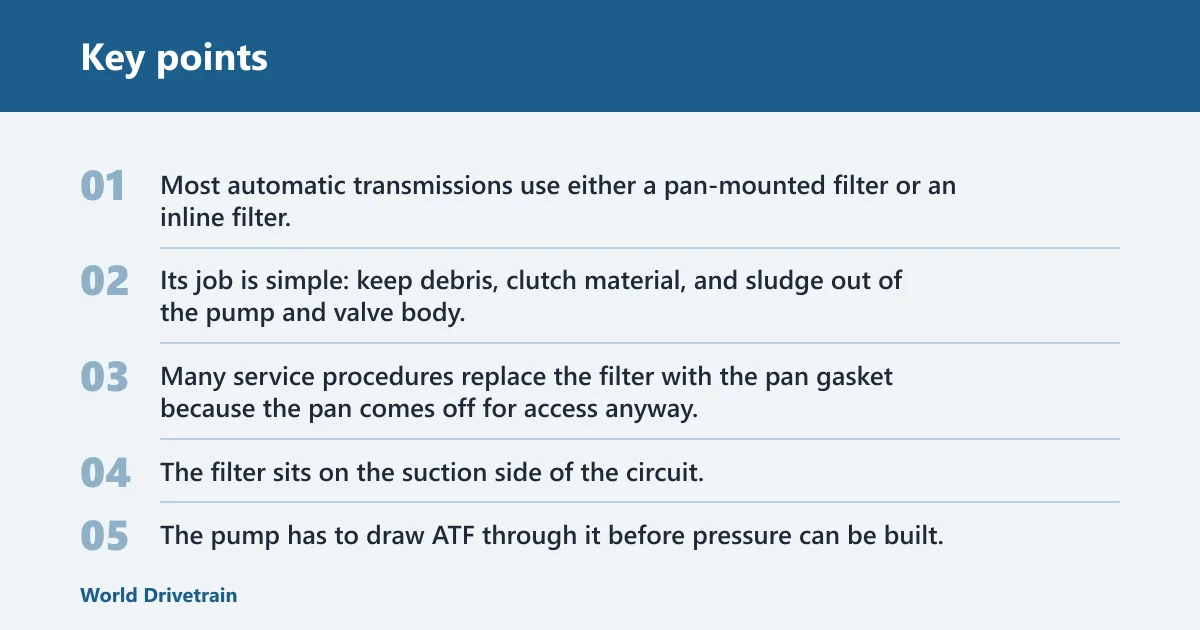
Most automatic transmissions use either a pan-mounted filter or an inline filter. Its job is simple: keep debris, clutch material, and sludge out of the pump and valve body. Many service procedures replace the filter with the pan gasket because the pan comes off for access anyway.
The filter sits on the suction side of the circuit. The pump has to draw ATF through it before pressure can be built. When the filter loads up with debris, flow drops first. Pressure follows.
How restriction turns into pressure loss
Line pressure is the hydraulic pressure that applies clutches and bands. If the pump cannot get enough fluid through the filter, it can cavitate or simply fail to build the pressure the transmission needs. That pressure loss can create delayed shifts, hard shifts, or both, depending on how the control system reacts.
A common first-timer mistake is blaming the transmission itself as soon as shifts feel harsh. If the pump is starving on the suction side, the symptom may show up only during certain gear changes or only at low engine speed. That pattern matters more than guesswork.
What symptoms point to a filter problem?
A clogged filter usually creates a pressure-related pattern: hard shifts, delayed engagement, whining, or hesitation that changes with temperature and engine speed. It does not always turn on a warning lamp. The clue is the combination of symptoms, not a single harsh shift by itself.
Hard shifts on cold start versus after warm-up
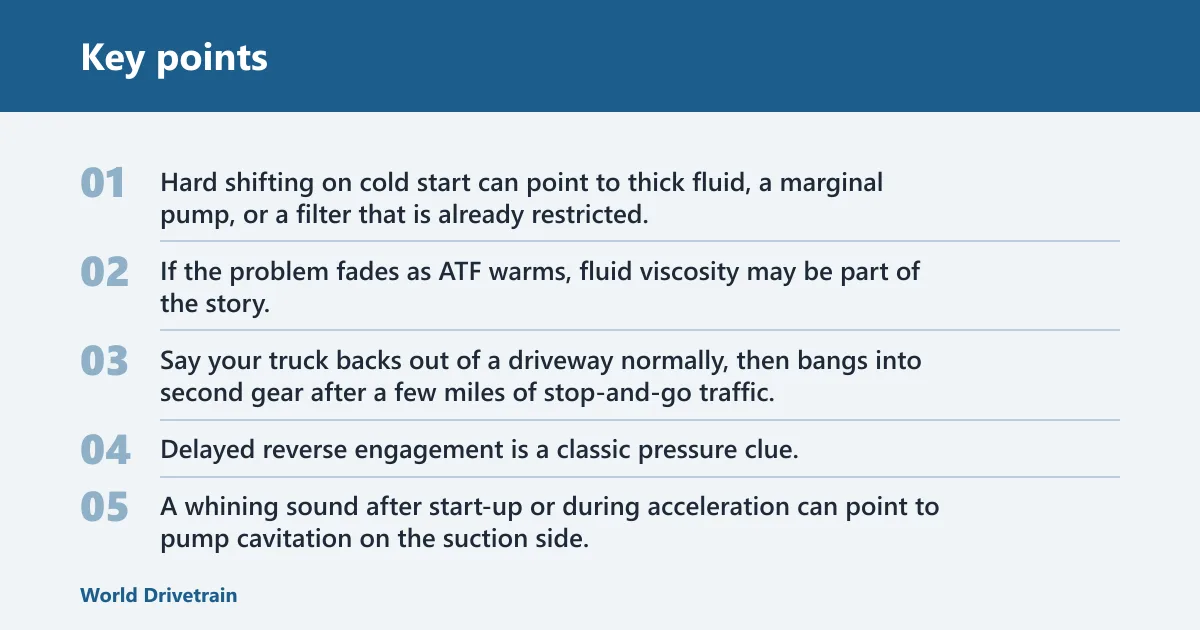
Hard shifting on cold start can point to thick fluid, a marginal pump, or a filter that is already restricted. If the problem fades as ATF warms, fluid viscosity may be part of the story. If the shifts get worse after warm-up, a valve body or solenoid issue becomes more likely than a simple cold-flow restriction.
Say your truck backs out of a driveway normally, then bangs into second gear after a few miles of stop-and-go traffic. That pattern is less like a fixed mechanical failure and more like a pressure or control problem that changes with temperature, fluid condition, or valve movement.
Delayed reverse engagement and whining on acceleration
Delayed reverse engagement is a classic pressure clue. Reverse needs prompt line pressure, so a restricted filter, weak pump, or very low ATF level can make the gear take a second or two to apply. A whining sound after start-up or during acceleration can point to pump cavitation on the suction side.
Whine after start-up matters because it often appears before obvious driveability complaints. If the noise fades as RPM rises, the pump may be struggling to pull fluid through a restriction rather than suffering a direct gear failure.
When limp mode is more likely
Limp mode is more likely when the transmission control module sees a serious pressure, ratio, or solenoid problem, not from a mild restriction alone. A clogged filter can contribute if the pressure drop is severe enough to trigger fail-safe logic. More often, limp mode involves a coded electrical fault, a stuck valve, or major pump wear.
Do not treat limp mode as the default outcome of a dirty filter. A transmission can shift hard for a long time before it falls into fail-safe, especially if the issue is partial restriction rather than complete starvation.
Filter diagnostic table
| Symptom pattern | Likely filter-related clue | Likely non-filter cause | Next check |
|---|---|---|---|
| Hard shifting on cold start | Shifts improve after warm-up or after a short drive | ATF outside spec, stiff valve body, adaptive shift logic | Check fluid level at the specified temperature and verify the service history |
| Hard shifting only after warm-up | Noisy pump or pressure drop grows as ATF thins | Valve body wear, solenoid sticking, internal clutch leak | Scan for codes and review live line-pressure or commanded-gear data |
| Delayed reverse engagement | Delay is worse after sitting or during low-RPM takeoff | Low fluid, pump wear, worn reverse clutch circuit | Check ATF level and look for suction-side noise after start-up |
| Whining on acceleration | Whine starts as soon as the pump loads | Low fluid, aeration, pump wear, fluid pickup leak | Inspect for aerated ATF, leaks, and a restricted pickup path |
| Limp mode | Harsh fixed gear plus pressure-related or ratio codes | Shift solenoid fault, wiring issue, valve body failure | Read transmission codes and live data with an OBD-II scan tool |
Check fluid before you blame the filter
Low, dirty, oxidized, or aerated ATF can affect line pressure just as a restricted filter can. The correct ATF specification matters more than generic fluid. Checking level at the wrong temperature or with the wrong procedure can send the diagnosis in the wrong direction.
ATF level and condition checks
- Verify the check procedure. Use the owner’s manual or service information for the exact ATF temperature, engine-running state, selector position, and dipstick or fill-port method. Many transmissions use a specific temperature window for a hot check, often around 80 to 95 degrees Celsius, though the exact value is vehicle-specific.
- Inspect the fluid condition. Healthy ATF is usually clear red or amber, depending on type. Dark fluid, burnt odor, visible debris, or foam suggests heat, wear, or aeration, any of which can affect line pressure and shift quality.
- Confirm the level. Low fluid can mimic a clogged filter because the pump pulls air instead of a solid fluid column. Overfilled fluid can aerate and create the same problem, so the mark must be read exactly as the manufacturer specifies.
Why fluid specification and temperature matter
Correct ATF is not interchangeable with any fluid that “fits.” Friction characteristics and viscosity affect clutch timing, seal behavior, and pressure response. A fluid change with the wrong specification can create new shift complaints, which is why “change the fluid” is not enough as advice.
Suppose a vehicle starts shifting hard right after service. If the level was checked cold when the transmission needed a hot check, the reading may be wrong. If the wrong ATF was added, the complaint may persist even though the level looks fine.
What else can mimic a clogged filter?
Valve body faults, shift solenoid problems, pump wear, and aeration can all look similar to a clogged filter. The distinction is whether the fault is hydraulic restriction, electrical control, or internal leakage. That split matters because the repair path is different for each one.
Valve body faults
The valve body routes hydraulic fluid to shift circuits. Debris can stick valves, score bores, or make a spool hang up. That can create shift timing and firmness complaints that feel very similar to a filter issue, especially when the symptom changes with temperature or load.
If the filter is only mildly restricted but the valve body has worn passages, replacing the filter alone will not solve the problem. The symptom may improve for a short time and then return.
Shift solenoid problems
Shift solenoids electrically control fluid routing. A sticking or failed solenoid can coexist with a dirty filter, so the presence of debris does not rule out an electrical fault. Solenoid problems often show up in transmission or powertrain codes, even when the filter is also dirty.
Pump wear and aeration
The transmission pump draws fluid through the filter. If the pump is worn, or if the pickup path leaks air, the pump can whine, delay engagement, or create harsh shifts because it cannot maintain stable pressure. That is why a suction-side noise after start-up is such an important clue.
How to use a scan tool for diagnosis
An OBD-II scan tool helps separate electrical from hydraulic causes. It reads transmission and powertrain codes, and live data can show slip, commanded gear, and solenoid activity. That makes it easier to decide whether the fault is control-related or pressure-related.
Reading codes and live data
- Pull stored and pending codes. Look for transmission codes first, then check related powertrain codes. Solenoid and ratio codes often point you toward electrical control or slippage, while pressure or gear ratio faults can support a hydraulic diagnosis.
- Review live transmission data. Compare commanded gear with actual behavior, and watch for slip or solenoid state changes during the complaint. If the scanner shows normal command changes but the transmission still shifts hard, hydraulic restriction becomes more likely.
- Match data to the symptom. A fault that appears only after warm-up may point to a sticking valve or a pressure leak that opens as the fluid thins. A fault present immediately after start-up can point more toward low fluid, aeration, or suction-side restriction.
When should you replace the transmission filter?
Replace the transmission filter according to the vehicle’s service schedule, not a generic mileage number. Severe use shortens fluid and filter life, especially towing, stop-and-go driving, frequent hills, commercial duty, and neglected maintenance. Many services pair the filter with the pan gasket because the pan has to come off anyway.
Service intervals and severe-use vehicles
Owner’s manuals and service schedules are the right source for interval timing. Some vehicles call for longer intervals under normal use and shorter ones under severe use. High-mileage, towing, and neglected-service vehicles are the ones most likely to benefit from closer inspection of the pan, magnet, and filter media.
Why filter replacement often pairs with fluid service
A clogged filter often develops alongside dirty or oxidized ATF, not separately from it. Replacing the filter without correcting old fluid can leave sludge and wear material in the system. Replacing fluid without changing the filter can leave the suction side restricted. The service needs both parts when contamination is present.
Frequently asked questions
Can a bad transmission filter cause hard shifting?
A bad or restricted filter can reduce pump feed, lower line pressure, and make shifts feel late or harsh. But the same complaint can come from low ATF, a sticking valve body, or a solenoid fault, so the filter should be treated as one possible cause, not the only one.
Can a clogged transmission filter cause shifting problems?
It can cause delayed shifts, hard shifts, hesitation, and in more severe cases slip or limp mode. The key clue is a hydraulic pattern that changes with load, temperature, or engine speed. That points toward restriction or pressure loss rather than a simple gear selection issue.
Can clogged transmission filter cause problems?
A clogged filter can lead to pump starvation, whining, pressure loss, poor shift quality, and accelerated clutch wear. If the restriction lasts long enough, the transmission may keep operating with low line pressure and damage internal parts. That is why diagnosis should happen before more driving.
Can a clogged transmission filter cause limp mode?
It can, but usually only when the restriction is severe enough to trigger pressure or ratio faults. Mild restriction more often causes hard shifting or delayed engagement first. Limp mode is more commonly tied to a solenoid fault, wiring issue, or major hydraulic failure that the control module detects.
Can dirty transmission fluid cause shifting problems?
Yes. Dirty or oxidized ATF can change friction behavior, create varnish, and affect line pressure stability. Fluid that is low or aerated can do the same thing. The correct specification and the proper level-check procedure matter, because the wrong fluid or wrong reading can hide the real fault.
Why does my transmission shift hard after a fluid change?
That can happen if the fluid specification is wrong, the level was checked at the wrong temperature, or debris was disturbed during service and moved into the filter or valve body. A service-related complaint should be checked against the exact procedure for that transmission before assuming the fluid change caused the problem.