Why Is My Transmission Hard Shifting With No Light?
Hard shifting with no check engine light usually points first to low or degraded fluid, a solenoid or valve-body control issue, or a sensor problem; if the fluid level or condition is wrong, fix that before buying a transmission. If you ignore it, a fluid or control fault can turn into clutch damage and a much larger repair bill. This guide gives a no-warning-light diagnosis ladder that separates fluid, electronic, and mechanical causes.
Diagnostic Codes and Initial Fluid Checks
An automatic transmission can shift hard with no lamp because many faults do not request a check engine light, and some codes stay pending until the fault repeats. Transmission control modules may also adapt around a problem for a while, which delays a warning even while shift quality gets worse.
Pending codes, stored codes, and why the lamp may stay off
Scan tools can show pending codes, stored codes, and live transmission data even when the dash is quiet. A transmission-related fault may set a code without turning on the MIL if it does not affect emissions criteria, if it is intermittent, or if the TCM has not seen the failure enough times.
Hard shifting versus slipping, flare, and normal cold behavior
Hard shifting feels like an abrupt, firm gear change. Slipping feels like engine speed rises without a matching road-speed change. Flare is a brief rise in rpm during the shift. Cold oil can make some shifts firmer, but harshness that persists after warm-up is not something to write off.
Start with the fastest checks
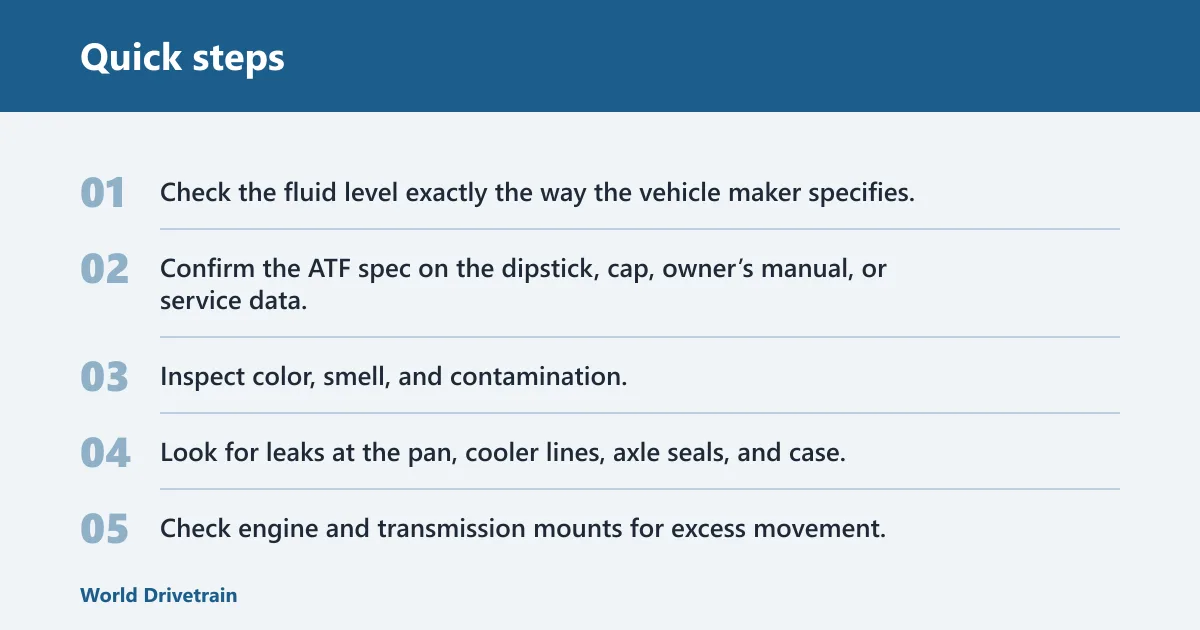
Before expensive transmission work, inspect fluid level, fluid condition, external leaks, and mounts. That order matters. A low-fluid or wrong-fluid complaint can mimic valve body trouble, solenoid trouble, or even an internal clutch problem.
- Check the fluid level exactly the way the vehicle maker specifies.
- Confirm the ATF spec on the dipstick, cap, owner’s manual, or service data.
- Inspect color, smell, and contamination.
- Look for leaks at the pan, cooler lines, axle seals, and case.
- Check engine and transmission mounts for excess movement.
What does the shift feel tell you?
The symptom pattern helps separate a cold-fluid issue from an electrical fault or internal wear. Cold-only harshness often points to fluid viscosity, valve sticking, or adaptive shift strategy. Intermittent harsh shifts suggest an input, solenoid, or wiring problem. Persistent harsh shifts or delayed engagement raise the odds of pressure or wear faults.
Cold-only harsh shifts
If the transmission is hard only for the first few miles, start with fluid condition, fluid level, and manufacturer-specific ATF spec. Thickened fluid, aeration, or a valve body that sticks when cold can make the first 1-2 shifts feel rough, then improve as temperature rises.
Intermittent harsh shifts
Random hard shifts often point to a sensor input, a shift solenoid that sticks only sometimes, or a TCM strategy issue. A scan tool becomes important here because pending codes, freeze-frame data, and live PIDs can show whether the transmission is being commanded to raise line pressure or change shift timing.
Persistent harsh shifts or delayed engagement
If every drive feels bad, or if reverse and drive take too long to engage, think higher on the severity scale. Persistent trouble can come from pressure faults, a restricted filter, valve body wear, or internal clutch wear. If reverse is lost or gears drop out, stop driving and diagnose immediately.
Could fluid or a clogged filter be the cause?
Yes. Low fluid, dirty fluid, the wrong ATF, or a restricted filter can all change hydraulic pressure and shift timing. These problems overlap with solenoid and valve-body symptoms, so they should be checked first. A fluid service helps only when the root cause is actually fluid-related.
Low fluid, aeration, and pressure loss
Low transmission fluid can cause harsh, delayed, or slipping shifts because the pump pulls in air instead of a solid fluid column. Aerated fluid cannot hold stable pressure. That can make clutch apply feel erratic and can also trigger delayed engagement after start-up or after a hard stop.
Burnt fluid, contamination, and restricted filter flow
Burnt-smelling ATF means heat and friction have been at work. Dark fluid, debris, or metal sheen points to wear or contamination. A clogged transmission filter can restrict flow to the pump and valve body, which may create both hard shifts and delayed engagement. The filter can overlap with other problems, so symptoms alone do not prove it.
Why fluid service is not a cure-all
Fresh fluid will not fix a worn valve body, a bad solenoid, or a damaged clutch pack. It also will not correct a transmission filled with the wrong specification ATF. Many manufacturers list specific fluids because friction characteristics affect shift feel and clutch operation, not just lubrication.
Say your compact SUV begins slamming 2-3 shifts every January morning, then feels normal by lunch. That pattern points you toward cold-fluid behavior, the correct ATF spec, and a valve-body or adaptive issue before you start pricing a rebuild.
Which electronic inputs can change shift quality?
Shift quality depends on more than fluid. The TCM or PCM commands shift solenoids, adapts line pressure, and reads engine-load inputs to decide when and how firmly to shift. A bad input can make a healthy transmission feel bad, especially when the lamp is still off.
Shift solenoids and valve control
Shift solenoids are electrical valves that route fluid for gear changes. They can fail open, short, or stick mechanically. A scan tool may command and test them, but not every fault sets a lamp right away. That is why pending codes and live data matter.
TCM or PCM adaptive logic and software updates
The TCM or PCM learns shift timing and line pressure over time. If a battery issue, repair, or software bug disrupts that learning, shifts can feel wrong. Some vehicles also need a software update to correct harsh shift behavior or commanded line pressure strategy.
Throttle, coolant temperature, and MAF or MAP signals
Engine load inputs affect how the transmission shifts. Bad throttle position, coolant temperature, MAF, or MAP signals can make the module think the engine is under more or less load than it really is. That can raise line pressure or delay shifts, even when the transmission itself is still mechanically sound.
Could the problem be inside the transmission?
Yes, especially if harsh shifting is persistent, fluid service does not change it, and scan data does not point to a sensor or solenoid issue. Internal wear usually shows up as pressure control trouble, sticking valves, delayed engagement, or loss of one or more gears.
Valve body wear and sticking valves
The valve body routes fluid through precision passages. Wear, varnish, or debris can make valves stick, which changes pressure regulation and shift timing. That often creates either harsh shifts or delayed shifts, and it may come and go with temperature.
Line pressure that is too high or too low
Too much line pressure can make shifts feel abusive. Too little can cause soft, delayed, or slipping shifts. A pressure test matters when symptoms are severe or when the scan tool suggests the module is commanding pressure that does not match the result. Pressure data helps separate an electrical command issue from a hydraulic one.
When internal wear becomes likely
Internal wear becomes more likely when you have burnt fluid, metal in the pan, no reverse, multiple missing gears, or hard shifting that rapidly worsens. At that point, the problem is no longer a simple fluid service. Continuing to drive can finish off clutches that were still partly usable.
Use this no-warning-light diagnostic table
This table gives a practical order: symptom pattern, first test, likely subsystem, and when to stop driving. The first test is intentionally cheap and specific, because many hard-shift complaints come from fluid level, ATF spec, a mount, or a control input rather than a failed transmission.
| Symptom pattern | First test | Likely subsystem | When to stop driving |
|---|---|---|---|
| Cold-only harsh shifts for 5-10 minutes | Check ATF level, ATF spec, and cold fluid condition | Fluid, filter restriction, valve body, adaptive strategy | Stop if reverse is delayed, fluid is burnt, or gears drop out |
| Intermittent hard shifts with no lamp | Scan pending codes, freeze-frame data, and transmission PIDs | Shift solenoid, TCM/PCM input, wiring, sensor signal | Stop if limp mode appears or multiple gears act up |
| Persistent harsh shifting every drive | Fluid check, then pressure test if fluid is correct | Valve body wear, pressure control fault, internal wear | Stop if burnt smell, slipping, or no reverse is present |
| Clunk when selecting reverse or drive | Inspect engine and trans mounts for excess movement | Mounts, drivetrain lash, shift timing | Stop if the clunk comes with delayed engagement or grinding |
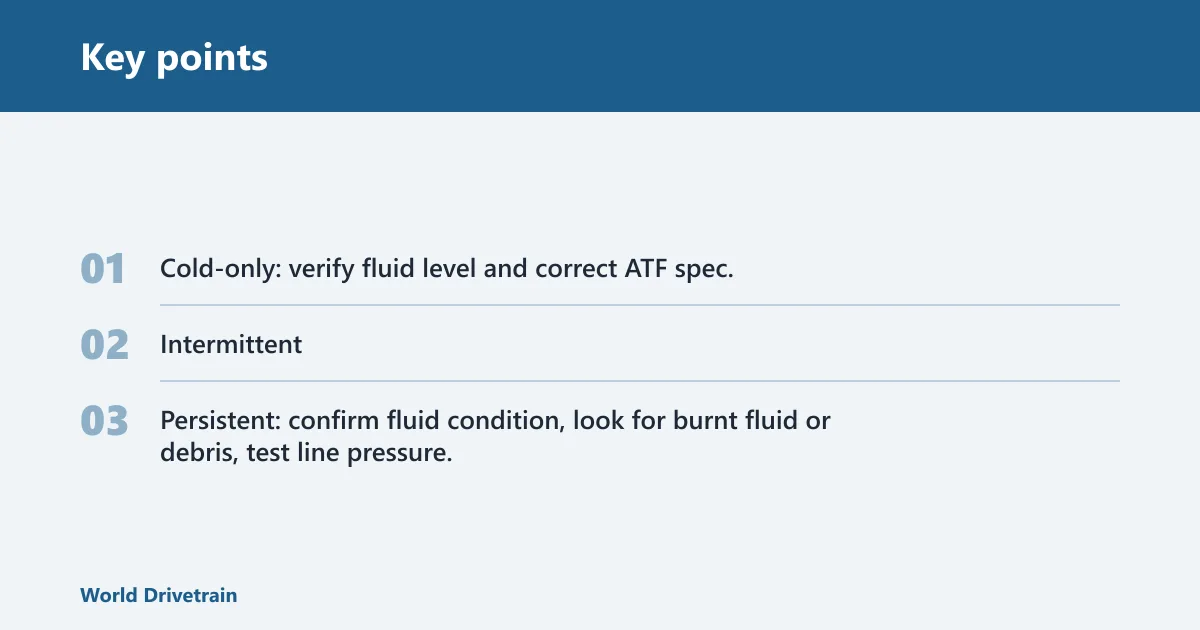
Simple 3-step flow for cold-only, intermittent, and persistent hard shifts
- Cold-only: verify fluid level and correct ATF spec, then check for restricted filter or valve-body behavior before assuming internal wear.
- Intermittent: scan for pending codes, transmission PIDs, and freeze-frame data; then check solenoids, engine-load inputs, and wiring.
- Persistent: confirm fluid condition, look for burnt fluid or debris, test line pressure, and stop driving if reverse, multiple gears, or limp mode are involved.
Picture a full-size pickup that shifts hard only from park to reverse after sitting overnight, then does it again after every grocery stop. If the fluid is correct and the mounts are torn, the clunk may be drivetrain movement, not a failing transmission. If reverse also delays, the diagnosis changes fast.
Why is my transmission hard shifting with no check engine light?
A no-light hard shift often means the fault has not crossed the threshold for a warning lamp, or the issue may be in a transmission-only system that does not immediately trigger one. Low fluid, the wrong ATF, a sticky valve body, solenoid issues, or bad input data can all cause harsh shifts first.
How the diagnosis ladder should work
Start with fluid level and condition. Then inspect mounts and leaks. Next, scan for pending codes, live data, and freeze-frame records. Only after those checks should you move to pressure testing, valve-body diagnosis, or internal inspection. That sequence helps avoid spending on transmission work that was never the real fix.
Can a transmission be bad even if there’s no check engine light?
Yes. A transmission can have worn clutches, a damaged valve body, low pressure, or a restricted filter without turning on the lamp. The light is not a mechanical health meter. If you have burnt fluid, slipping, no reverse, or multiple gear problems, the transmission can be seriously worn even with no warning light.
What causes hard shifting when the transmission light is off?
The most common causes are low or wrong fluid, a filter restriction, a sticking solenoid, a valve body problem, or bad engine-load input data. The light can stay off because the fault is pending, intermittent, or not an emissions-related code. That is why scan data and symptom pattern matter.
Is it safe to keep driving if my transmission shifts hard but no code is showing?
Short trips may be acceptable only if the problem seems mild, the fluid looks normal, and reverse and all forward gears still work normally. Stop driving if the fluid smells burnt, the transmission enters limp mode, engagement is delayed, or any gear starts slipping or disappearing.
Could low transmission fluid cause hard shifting without a warning light?
Yes. Low fluid can cause hard shifting, delayed engagement, or slipping without immediately setting a light. The pump may draw air, which lowers pressure and disturbs clutch apply. If the level is low, fix the leak and refill to the correct ATF spec before pursuing deeper transmission repairs.
Can a bad shift solenoid cause hard shifting with no check engine light?
Yes. A shift solenoid can stick, open, or short and still avoid an immediate lamp if the failure is intermittent or not yet confirmed by the control module. A scan tool can often command and monitor transmission solenoids, which makes it one of the better early tests after fluid checks.
Why does my car shift hard only when cold?
Cold-only harsh shifting often means the fluid is thick, low, contaminated, or not the correct ATF spec for the transmission. It can also point to a sticky valve body or a control strategy that raises pressure until temperature comes up. If the harshness remains after warm-up, treat it as abnormal.
Why does my transmission shift hard from park to reverse?
Hard engagement from park to reverse often points to low fluid, delayed pressure build, a valve-body issue, or worn mounts that let the drivetrain move too much. If the delay gets longer, or reverse starts slipping or disappearing, stop driving. That pattern can signal a pressure or internal wear problem.
Can a clogged transmission filter cause hard shifting?
Yes. A clogged transmission filter can restrict fluid flow, starve the pump, and upset line pressure. That can overlap with solenoid, valve-body, and clutch symptoms. Filter restriction is especially important when hard shifts come with delayed engagement or burnt fluid, because those signs suggest the transmission is being starved or overheated.
How do I tell hard shifting from slipping?
Hard shifting feels like an abrupt gear change, often with a clunk or firm jolt. Slipping feels like the engine revs without matching acceleration, or like the shift never fully completes. If rpm rises but road speed lags, that is a slipping concern, and it needs faster attention than a simple harsh-shift complaint.