Why Does My Transmission Slip When Hot?
Hot-only transmission slip usually points to pressure loss that shows up after fluid thins, so check fluid level and condition at operating temperature before you blame the whole transmission. If you ignore it, clutches can burn, heat can spike, and a low-cost seal or sensor fault can turn into a rebuild. This guide shows how to sort warm-up slip, delayed engagement, flare, shudder, and near-loss of drive by symptom pattern and likely cause.
Why does my transmission slip when hot?
Hot slip usually means the transmission holds pressure when the fluid is thick, then loses apply force once the fluid warms and thins. That can expose low fluid, wrong-spec fluid, leaks in the valve body, weak pump output, solenoid faults, or worn clutch packs.
How to separate slip, flare, delay, and shudder
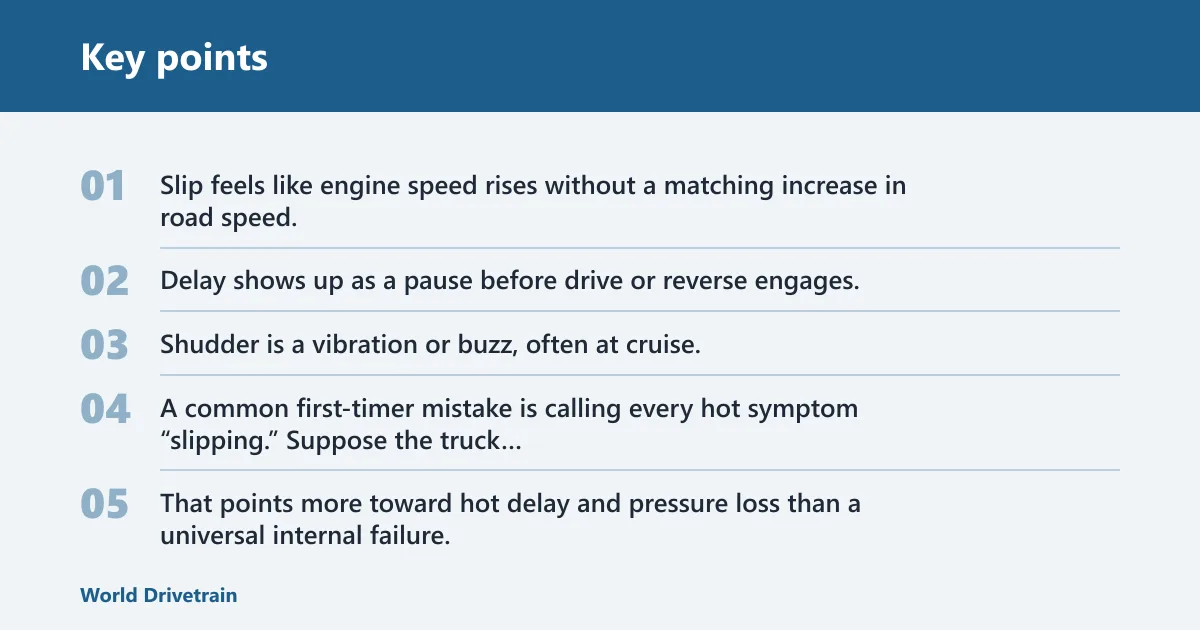
Slip feels like engine speed rises without a matching increase in road speed. Flare is a brief rpm jump between shifts. Delay shows up as a pause before drive or reverse engages. Shudder is a vibration or buzz, often at cruise, and often points toward the torque converter clutch.
A common first-timer mistake is calling every hot symptom “slipping.” Suppose the truck backs out of a driveway normally cold, then after 20 minutes in stop-and-go traffic it hesitates for two seconds before reverse catches. That points more toward hot delay and pressure loss than a universal internal failure.
When the symptom is urgent
Stop driving and arrange a tow if the transmission barely moves, loses drive on hills, or slips badly in more than one gear after warm-up. That pattern can mean pressure is falling far enough to damage clutch packs, and every mile adds heat and debris.
Hot-slip triage table
| When it happens | What you feel | What fluid condition suggests it | What code families fit it | First step |
|---|---|---|---|---|
| After 10–30 minutes | Delayed engagement, flare, or a brief slip after warm-up | Low, dark, burnt, foamy, or wrong-spec ATF | Pressure-control or solenoid codes | Top-off or service only if the level is correctable and there is no severe slip |
| Highway cruising | Shudder, rpm hunt, or lockup slip at steady speed | ATF may smell burnt after sustained heat | P0741, P0742, P0743 | Scan and road-test for torque converter clutch behavior |
| Uphill or under acceleration | Gear slip when loading the transmission | Dark or gritty fluid points to wear debris | Pressure-loss or gear-ratio codes | Pressure test and inspect for internal wear |
| Stop-and-go traffic | Hot delay, flare, or worsening slip after repeated shifts | Foamy fluid or overheated ATF | Solenoid, valve body, or overheat-related codes | Check cooling, then scan live data |
| Only in one gear | Slip in 2nd, 3rd, or reverse while other gears feel normal | Fluid may look normal or slightly dark | Gear-ratio or specific clutch circuit codes | Do not guess; move to pressure test and mechanical diagnosis |
Heat, ATF, and pressure loss
Automatic transmission fluid changes with temperature. Cold fluid is thicker and can hide worn clearances, weak seals, and marginal pump output. As it heats up, it thins, and a borderline hydraulic circuit may no longer apply clutches and bands with enough force.
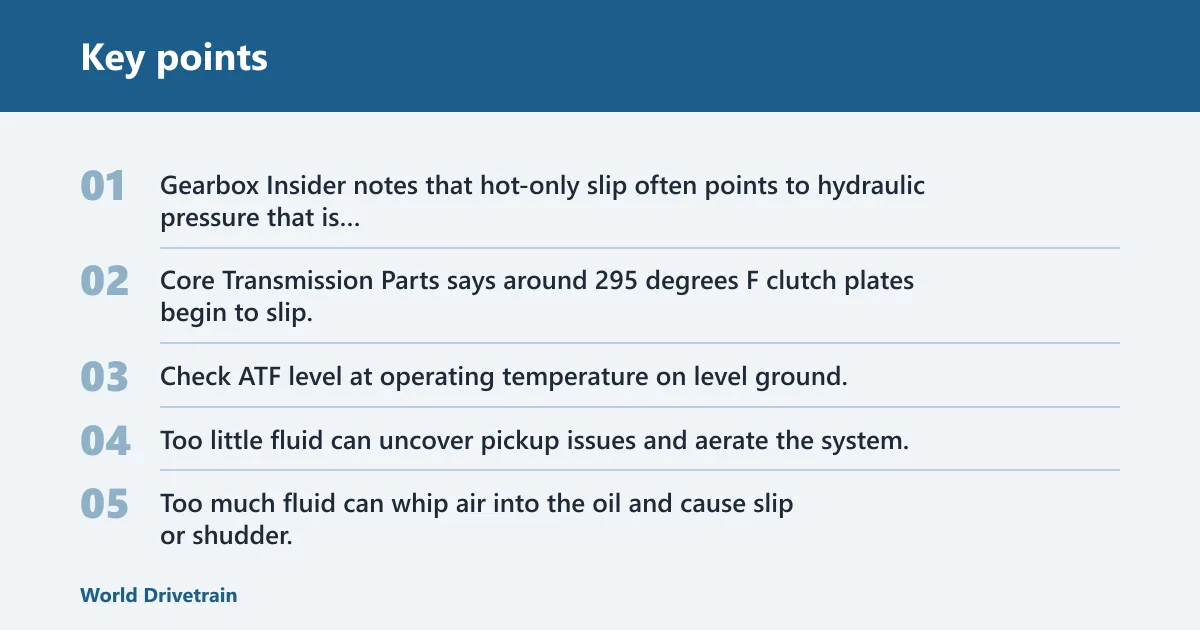
Gearbox Insider notes that hot-only slip often points to hydraulic pressure that is marginal to begin with, and it lists 175 to 225 degrees F as the ideal ATF operating range. Core Transmission Parts says around 295 degrees F clutch plates begin to slip, which is why overheating can move a small problem into a major one.
Why fluid level and condition matter first
Check ATF level at operating temperature on level ground, using the procedure for the vehicle. Too little fluid can uncover pickup issues and aerate the system. Too much fluid can whip air into the oil and cause slip or shudder. Wrong-spec fluid can do the same thing, especially in units that need a very specific friction behavior.
Dark fluid and a burnt smell are warning signs. VehicleRuns groups those clues with a likely worsening condition, not a harmless color change. Gritty fluid means wear debris may already be moving through the unit.
VehicleRuns also advises checking fluid level and condition first, then scanning for stored transmission codes. That order matters because a code alone does not tell you whether the issue is low fluid, a solenoid, a cooler problem, or internal wear.
What if it slips only after warming up?
Warm-up-only slip usually means the transmission is close enough to working when cold, then loses the margin once heat thins the fluid. That pattern often points to low ATF, pressure loss, worn valve body passages, a weak pump, or clutch wear that only shows up once apply pressure drops.
Operating-temperature fluid checks
Check level with the transmission hot, on level ground, and with the engine running if the manufacturer requires that method. If the fluid is low, find the leak source before adding more. If the unit calls for a specific fluid, use that exact spec. Guessing here can create a new problem.
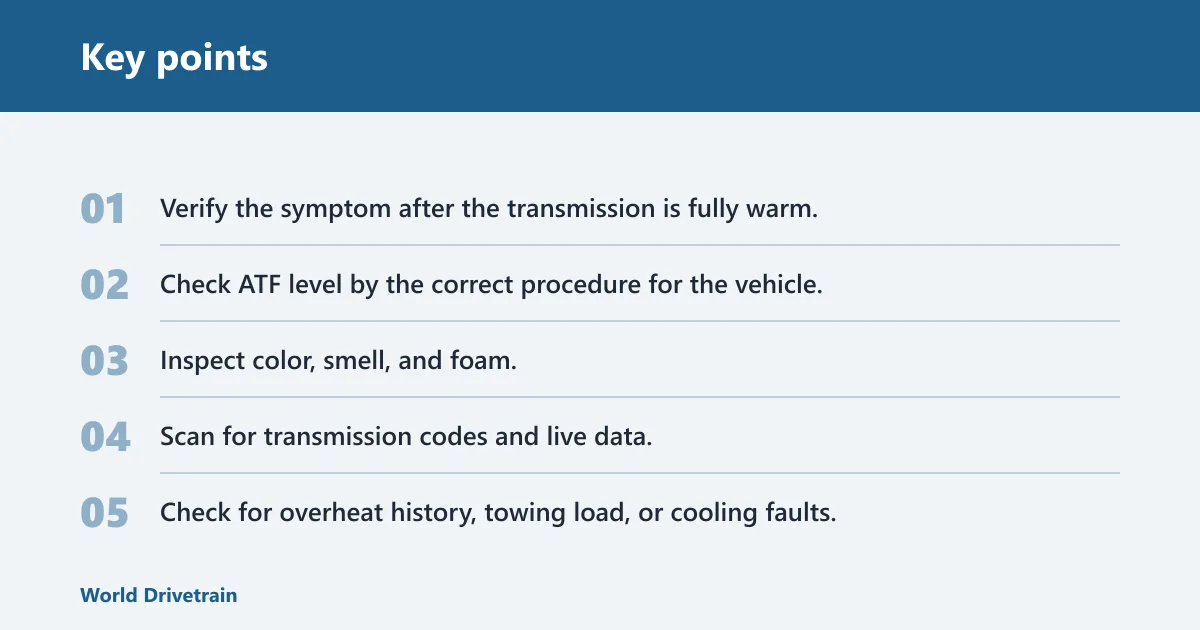
- Verify the symptom after the transmission is fully warm.
- Check ATF level by the correct procedure for the vehicle.
- Inspect color, smell, and foam.
- Scan for transmission codes and live data.
- Check for overheat history, towing load, or cooling faults.
- Move to pressure testing if the symptom persists.
Symptoms that point to internal wear
If hot slip gets worse under acceleration, on hills, or in multiple gears, clutch-pack wear rises on the list. Clutch packs are the friction elements that hold the gearset. Once they are worn enough, they can grab cold and slip hot, especially under load.
F1: slipping only after the vehicle warms up and then acting normal again after cooling overnight is a classic clue that the fault is temperature-sensitive, not random. That does not prove a rebuild, but it does mean the margin is small.
When a fluid service still makes sense
A fluid service can be reasonable when the level is low, the fluid is dirty but not full of debris, and the transmission still shifts normally cold and only shows early hot symptoms. The Motor Guy says five of nine hot-slip causes cost under $400 if caught early, and it lists low or degraded fluid as the #1 cause it sees. It also gives a top-off or drain-and-fill range of about $100 to $250.
Hot shudder or slip at highway speed?
Highway-speed shudder or slip often points to the torque converter clutch rather than a gearset problem. The TCC locks the converter at cruising speed, so a fault there can feel like a mild slip, a vibration, or an rpm rise that appears only at steady road speed.
Torque converter clutch symptoms
Common signs include shudder at lockup, a light buzz around cruise, or slip that comes and goes as speed changes. A gear slip usually changes with throttle and load in lower gears, while a TCC fault often shows up at steady highway speed.
Codes such as P0741, P0742, and P0743 often fit TCC problems. They do not prove the converter itself is bad, but they do point you toward lockup control, apply pressure, and converter operation instead of chasing a random clutch pack first.
Torque converter replacement is often listed at about $800 to $1,500. That is cheaper than a full rebuild, but only after the diagnosis separates a converter fault from a solenoid, valve body, or fluid problem.
Pressure, solenoids, and valve bodies
Hydraulic line pressure is the force that applies clutches and bands. If it drops when hot, the transmission can slip even though it looked fine when cold. A scan tool may show commanded pressure, but that is not the same as actual pressure. Actual pressure needs a mechanical gauge.
Shift solenoid and pressure-control solenoid faults
A shift solenoid controls fluid routing for gear changes. Heat can change coil resistance and response, which can cause delayed or flared shifts. A pressure-control solenoid regulates line pressure, and when it drifts or sticks as temperature rises, the unit may command too little apply pressure.
These faults are often found through transmission codes and live data, but live data is only part of the picture. If the scan data looks normal and the slip persists, pressure testing is the next step.
Valve body wear and hot leakage
The valve body routes hydraulic pressure through the transmission. Worn bores can leak more as fluid gets hot and thinner. That can create a hot flare, delayed shift, or slipping under load. In some cases, the valve body can be repaired without a full rebuild, which is why early diagnosis matters.
VehicleRuns notes that some symptoms can be diagnosed by whether the slip affects one gear or several. That distinction matters here: one-gear symptoms often point to a specific circuit, while several gears suggest a broader pressure issue or internal wear.
Transmission cooling problems
Cooling faults can make a transmission act weak only when hot weather, towing, traffic, or highway driving pushes fluid temperature up. Overheat history is a key clue. If the unit was already marginal, extra heat can create the first obvious slip event.
Towing, traffic, and hot weather
Stop-and-go traffic can keep the converter working hard and reduce airflow across the cooler. Towing adds load and heat. Hot outside temperatures reduce the cooling margin further, which is why some vehicles only show symptoms in summer or on grades.
Suppose a crossover feels normal on short errands, then starts slipping after a long uphill pull with a trailer attached. That pattern puts cooling and pressure loss ahead of random parts replacement. If the fluid also smells burnt, the urgency rises fast.
Restricted coolers and poor airflow
A restricted cooler, clogged cooler line, blocked grille, or failed cooling fan can push ATF into the danger zone. When that happens, the symptom may look like internal failure even when the root cause is heat management. Fixing the cooler path can restore normal operation if the damage has not gone too far.
F7: a hot-only slip often points to a problem that gets worse as fluid heats up and thins out. That is why cooling problems matter so much. They can mimic worn clutches and make a repair decision too early.
Frequently asked questions
Why does my transmission slip when warm?
When the symptom appears as the vehicle warms up, the fluid is likely crossing the point where a weak circuit can no longer hold pressure. That pattern often points to pressure loss, not a completely failed transmission. If it goes away cold and returns warm, start with fluid, codes, and cooling.
Can hot transmission fluid cause slipping?
Yes. Hot ATF is thinner, so it can expose worn seals, marginal pumps, and pressure leaks that a cold fluid film was masking. If the fluid is low, burnt, foamy, or wrong-spec, slipping can show up soon after warm-up and get worse under load or in traffic.
Why does my transmission slip only when it gets hot?
That pattern usually points to a temperature-triggered pressure problem. Cold fluid can cover clearances and help weak components hold. Once hot, the transmission may lose apply force in one gear, several gears, or at highway lockup. The symptom pattern helps separate a TCC issue from gear slip.
Is it safe to keep driving if it only slips when hot?
Usually not for long. If the slip is mild, you may have time for a fluid check and scan, but worsening hot slip can burn clutches and spread debris through the unit. If it barely moves, loses drive on hills, or slips in multiple gears, stop driving and tow it.
Why does my transmission slip when it’s hot outside?
Hot outside air reduces the cooling margin, so ATF can run hotter in traffic, on grades, or while towing. Once fluid temperature rises, a marginal system may start slipping even though it seems fine in cooler weather. That points you toward cooling checks, fluid condition, and pressure testing before replacement parts.