What Are the Signs of Transmission Slipping?
Transmission slipping usually shows up as engine rpm rising without a matching increase in speed, a delay before the vehicle moves cleanly, gear flare, or a burned odor; if it happens in more than one gear or under light throttle, treat it as a fault. Ignoring it can turn a fluid-level issue into clutch or internal damage that costs far more to fix. This guide explains the symptom patterns, what is normal on hills, and what to check next.
What you’ll need
- Owner’s manual or service information for the exact transmission fluid specification
- Paper towel or clean white cloth
- Flashlight
- Gloves
- Level ground and enough space to inspect safely
- Basic tools only if your dipstick or fill access requires them
📊 The page says transmission fluid goes bad every 100,000 miles. Source: Wikihow.
What does a transmission slip feel like?
It usually feels like the engine revs climb first, then the vehicle catches up later. You may also notice delayed acceleration when you press the gas, a pause before a shift completes, or a flare between gears where rpm jumps and speed does not.
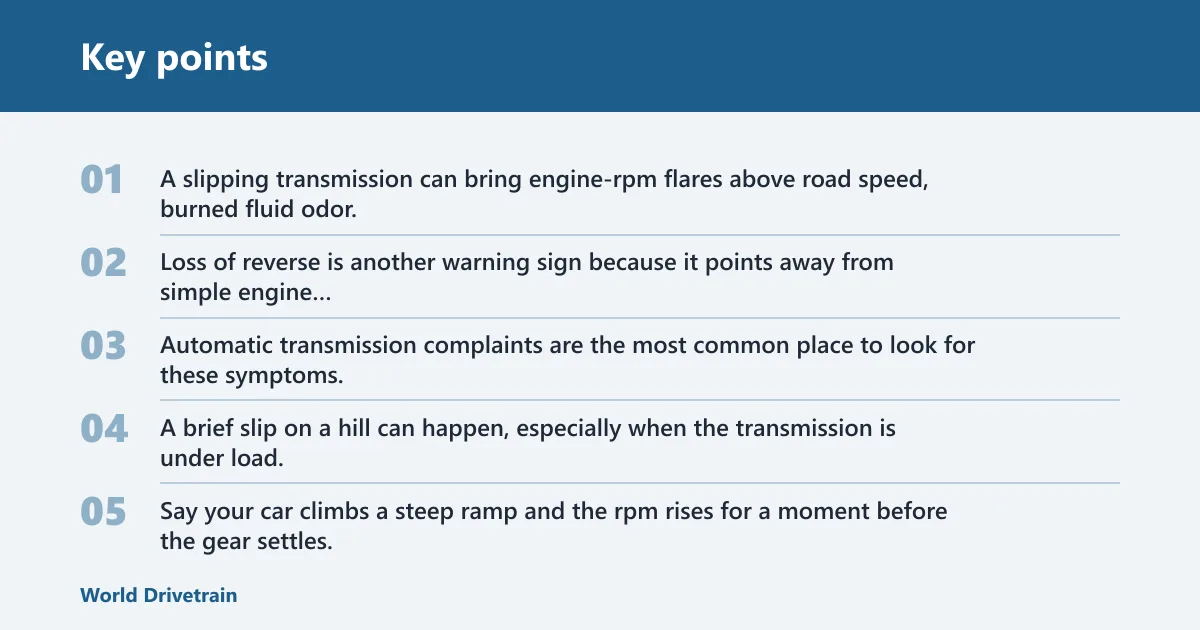
Noise and smell matter. A slipping transmission can bring engine-rpm flares above road speed, burned fluid odor, or a harsh shift that feels different from normal behavior. Loss of reverse is another warning sign because it points away from simple engine hesitation and toward a transmission-side problem.
Common symptom patterns
Automatic transmission complaints are the most common place to look for these symptoms. A brief slip on a hill can happen, especially when the transmission is under load, but repeated slip on level ground, during light throttle, or in more than one gear is a different matter.
Say your car climbs a steep ramp and the rpm rises for a moment before the gear settles. That can be normal. If the same flare happens again on flat roads after a gentle pedal input, that pattern points toward a fault rather than a hill-only load issue.
Transmission slip symptom table
| Symptom pattern | Likely seriousness | Next step |
|---|---|---|
| High RPM with delayed shift | Moderate to serious | Check fluid level and condition, then schedule inspection if it repeats |
| Slipping only when hot | Moderate | Inspect for low fluid, leak points, or fluid breakdown |
| Loss of reverse | Serious | Limit driving and book a mechanic inspection soon |
| Burnt smell | Serious | Stop hard driving, check fluid color, and plan diagnosis |
| Brief hill slip versus repeated slip | Brief slip can be normal; repeated slip is not | Track load, speed, and gear; repeated slip needs inspection |
How do you check the fluid?
Start with the dipstick if the transmission has one. Low transmission fluid is a common cause when the level sits below the warm hash mark, and the right fluid must match the specific make, model, and transmission. Wrong fluid can create new shift problems fast. (Wikihow)
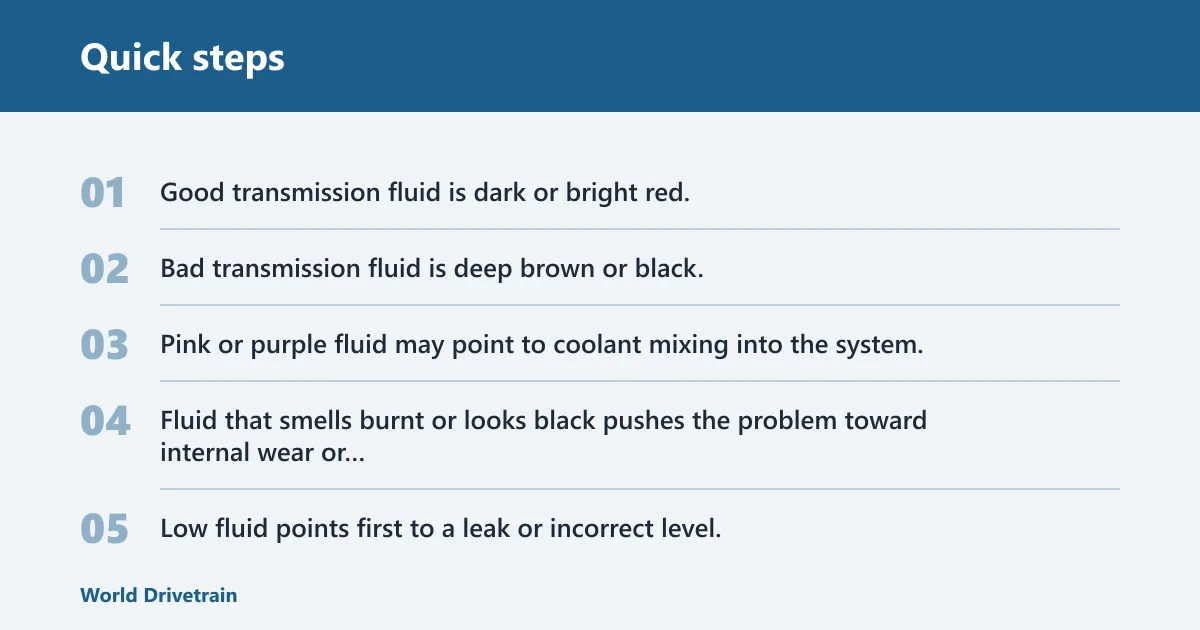
Good transmission fluid is dark or bright red. Bad transmission fluid is deep brown or black. Pink or purple fluid may point to coolant mixing into the system, which is a contamination problem rather than a simple top-off issue.
Fluid clues that change urgency
Fluid that smells burnt or looks black pushes the problem toward internal wear or overheating. Low fluid points first to a leak or incorrect level, but topping off is only a short-term step if the level keeps dropping. Most issues beyond that need a mechanic.
Suppose the dipstick shows fluid below the warm hash mark and the color is still red. That points more toward a level problem. If the same car shows dark brown fluid and a burnt odor, the chance of internal damage rises and a simple refill is unlikely to solve it.
Which problems can mimic slip?
Engine misfire or fuel delivery trouble can feel like slipping because the car hesitates, but the transmission may be fine. CVT shudder and torque converter shudder can also feel like a flare or shake under load, while a manual transmission with clutch slip tends to raise rpm without clean road speed, often when the clutch is engaged.
How to separate them quickly
- Engine hesitation: rpm may stumble or surge, but reverse usually still works and shift timing may be normal.
- CVT shudder: the feel is often a steady vibration or rubber-band-like flare under light acceleration.
- Torque converter shudder: the vibration often shows up at a steady speed rather than during every gear change.
- Manual clutch slip: rpm rises, speed lags, and the clutch point may feel high or vague.
What are the signs of transmission slipping?
The main signs are high rpm, delayed acceleration, burnt fluid odor, odd noises, and no reverse. In an automatic transmission, the driver may notice the vehicle not shifting smoothly when changing gears, especially under light throttle or when the same symptom appears in more than one gear.
Low transmission fluid is a common cause, and worn transmission bands or a failed solenoid can create the same feel. Because those internal issues need diagnosis, the pattern matters more than one symptom by itself.
What should you do next?
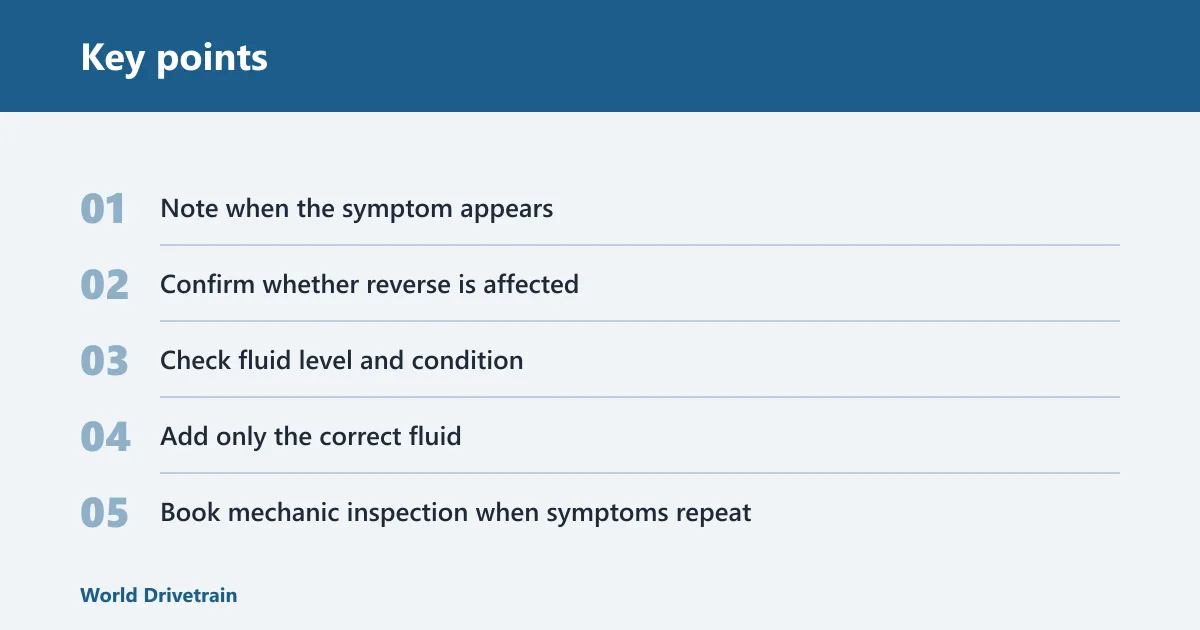
- Note when the symptom appears. Record cold start, hot driving, uphill load, and light throttle, because the trigger often separates a load issue from a real fault.
- Confirm whether reverse is affected. Loss of reverse is a warning sign that usually moves the problem out of the “keep driving” category.
- Check fluid level and condition. Use the dipstick on level ground and look for the warm hash mark, then read color and smell.
- Add only the correct fluid. Use the correct fluid for the make, model, and transmission, and add about 0.5 quart or less before rechecking if the level is low.
- Book mechanic inspection when symptoms repeat. Repeated slip, burnt fluid, contamination, or no reverse points to leak diagnosis, solenoid testing, or internal inspection.
If that didn’t work, try this next
First, inspect for leak evidence under the vehicle and around cooler lines, pan edges, and seals. Next, have the shop scan transmission codes and test the solenoid circuit if the fluid level is correct but the slip remains. If the fluid is burnt or black, internal wear is more likely.
Worn transmission bands can produce slipping symptoms, and they are not a simple external adjustment on most vehicles. Solenoid failure can mimic slip too, but it usually takes diagnostic testing to separate electrical control trouble from mechanical wear.
Common mistakes
Treating every hill slip as failure is the biggest mistake. Brief slip on a hill can be normal, but repeated slip on level ground, in several gears, or during gentle acceleration is a different signal.
Another mistake is adding the wrong fluid. Use the exact type for the transmission, not a close match. A final mistake is driving past burnt fluid or lost reverse, which can turn a repairable fluid issue into a much larger internal repair.
Cost and time expectations
A basic fluid level and condition check can take a few minutes. Diagnosis at a shop often takes longer because the technician may need to verify level, scan codes, inspect for leaks, and road test under load. If the fluid is contaminated or the transmission has internal wear, the visit can turn into a deeper repair estimate.
Frequently asked questions
What are the symptoms of transmission slipping?
Common symptoms include high rpm with little speed gain, delayed shifts, burnt fluid odor, odd noises, and no reverse. In an automatic transmission, the vehicle may feel like it hesitates before catching the next gear. If the symptom repeats, treat it as a fault.
How do I know if my transmission is slipping?
Watch for repeated rpm flare during acceleration, a delay before the car moves cleanly, or a shift that feels weak instead of firm. Check whether reverse still works and whether the problem happens hot, cold, or only on steep hills. That pattern tells you more than one event.
What are the first signs of transmission problems?
Early signs often include delayed engagement when shifting from park or reverse, a light flare between gears, and a change in fluid smell or color. If the level is low below the warm hash mark or the fluid is dark brown or black, act quickly.
Can a slipping transmission be caused by low fluid?
Yes. Low transmission fluid is a common cause, especially if there is a leak or the level sits below the warm hash mark. Top off only with the correct fluid for the exact make, model, and transmission, then recheck. If the level falls again, a leak is likely.
Is it bad to drive with a slipping transmission?
It can be risky, especially if the fluid smells burnt, looks contaminated, the problem repeats, or reverse is gone. Limited driving to a shop may be reasonable for a mild symptom that appears once on a hill, but repeated slip calls for prompt inspection.
What are the signs of automatic transmission problems?
Automatic transmission problems are often reported as delayed acceleration, harsh or late shifts, high rpm without matching speed, and burnt fluid odor or odd noises. A brief hill-related slip can be normal, but the same behavior on flat roads, under light throttle, usually points to trouble.