What Are the Symptoms of a Bad Transfer Case?
A bad transfer case can show gear noise under load, clunks during range changes, shudder on throttle, binding in tight turns, warning lamps, delayed engagement, or leaks. If shifting problems come with low fluid, dark fluid, a burnt smell, or metal in the oil, internal wear becomes more likely. Ignored, it can damage the transmission, front differential, driveshafts, or leave the vehicle stuck in one drive mode. This guide maps symptoms to mechanical, fluid, actuator, sensor, and module faults so you can narrow the cause.
What a bad transfer case feels like
A failing transfer case usually changes how the vehicle sounds or moves before it quits outright. The clues often fall into three groups: noise while driving, harshness when shifting between modes, and binding or shudder when torque is sent front and rear. Warning lights can appear with or without a drivability change.
Noise, shudder, and clunk patterns
Grinding, rattling, or a slapping sound under acceleration can indicate chain stretch, gear wear, or a bearing problem inside the transfer case. A sharp clunk during throttle tip-in or when shifting into 4HI, 4LO, or AWD can come from backlash in the transfer case, but it can also come from worn driveshaft joints or differential mounts.
Shudder under load is another common complaint. If it happens mostly when the front axle is engaged, the transfer case may be struggling to split torque smoothly. If it happens in every gear and speed range, transmission or tire issues move higher on the list.
Binding in turns and mode-change trouble
Binding in tight turns is a classic driveline complaint on part-time 4WD systems, but it is not proof by itself that the transfer case is bad. It can also come from mismatched tire sizes, a stuck front axle actuator, or a system that is not fully disengaging. Difficulty shifting modes often points more strongly to the transfer case actuator, shift motor, encoder motor, or range position sensor.
Suppose a truck shifts into 4HI but then feels like it is pushing through corners on dry pavement. That can be a transfer case issue, but it can also be a front axle that stayed locked or a control system that did not complete the shift.
When a warning light is the only symptom
4WD, AWD, or service drivetrain lights can appear before any noise or binding. In that case, the fault may be electrical rather than mechanical. A bad transfer case control module, relay, fuse, range sensor, or actuator can set a lamp while the vehicle still drives normally.
Transfer case symptom matrix
This matrix separates what you feel from the most likely source. It is not a substitute for a scan tool or inspection, but it helps you decide whether the problem sounds mechanical, fluid-related, or electrical.
| Symptom pattern | Likely source | First check | Urgency |
|---|---|---|---|
| Grinding or rattling in a straight line, worse on acceleration | Transfer case chain stretch, gear wear, or bearing failure | Check fluid level and look for metal in the oil; listen for play at the rear output | High |
| Clunk when shifting into 4HI, 4LO, or AWD | Shift motor, actuator, encoder motor, or worn internal backlash | Scan for codes and verify the case actually reaches the commanded range | Medium to high |
| Binding or hopping in tight turns | Transfer case not disengaging, front axle issue, mismatched tire circumference | Check tire sizes and front axle operation before condemning the case | High on pavement, medium off-road |
| Shudder under acceleration, especially in AWD | Low or contaminated fluid, worn chain, clutch pack wear on some systems | Inspect fluid condition and scan live data for slip or position errors | Medium |
| Service 4WD or AWD light with normal drivability | Control module, relay, fuse, range sensor, connector fault | Pull codes and inspect power, ground, and connectors | Medium unless shifting is lost |
| Stuck in 4HI, 4LO, or Auto | Shift motor, actuator, encoder motor, range position sensor | Confirm fuse health and commanded versus actual position | High |
| Leak at the case with rising noise | Low fluid leading to wear or overheating | Check seals, case seams, and fill level | High |
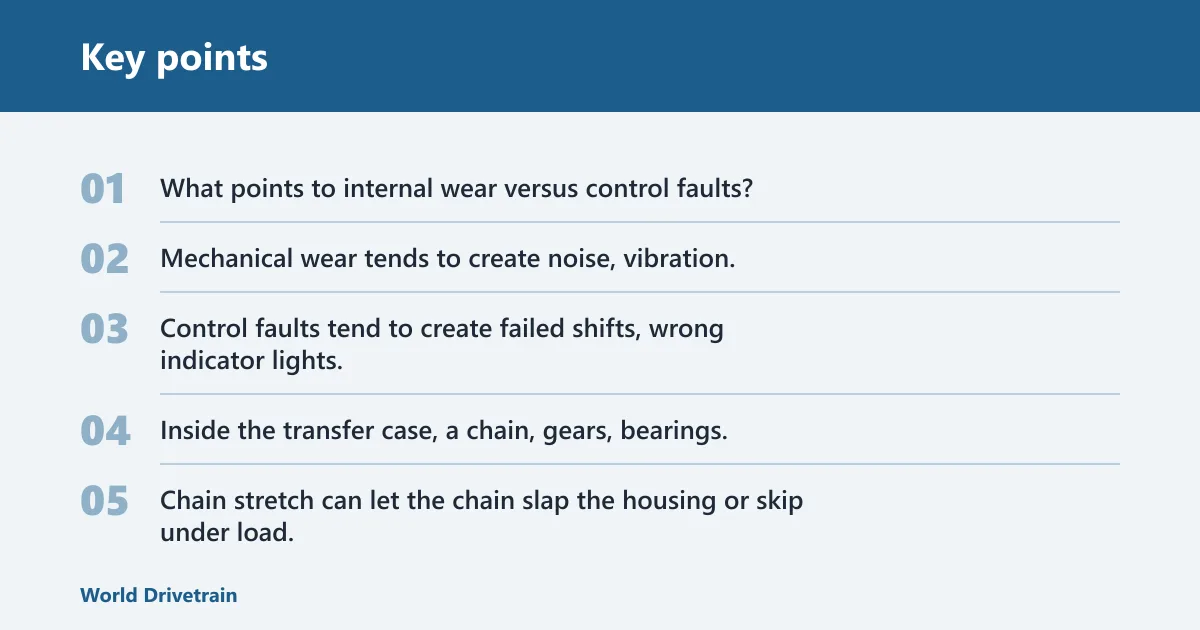
What points to internal wear versus control faults? Mechanical wear tends to create noise, vibration, or binding that changes with load and speed. Control faults tend to create failed shifts, wrong indicator lights, or a case that stays in one mode even though the drivetrain itself still feels normal.
Why the symptoms happen
Inside the transfer case, a chain, gears, bearings, and oil all work together to send torque front and rear. Chain stretch can let the chain slap the housing or skip under load. Gear wear can create backlash, and worn bearings can add a growl that rises with road speed or load.
Low, dirty, or overheated transfer case fluid can speed internal wear. Transfer case fluid does not last forever, and the service interval varies by vehicle. If the fluid is low or dark with a burnt smell, the case may already be running hotter than it should. Over time, heat breaks down the oil film and accelerates bearing and chain wear.
A common first-timer mistake is hearing a rumble and blaming the transfer case before checking the front differential, driveshaft U-joints, or tire wear. Those parts can create very similar symptoms, so the diagnosis has to follow the pattern, not the guess.
Could the actuator or motor be the problem?
Yes. On many AWD and 4WD systems, the transfer case actuator or shift motor is what moves the range selector and locks or unlocks the internal mode components. When that hardware fails, the vehicle can act as if the transfer case is broken even when the geartrain is still serviceable.
Transfer case actuator symptoms
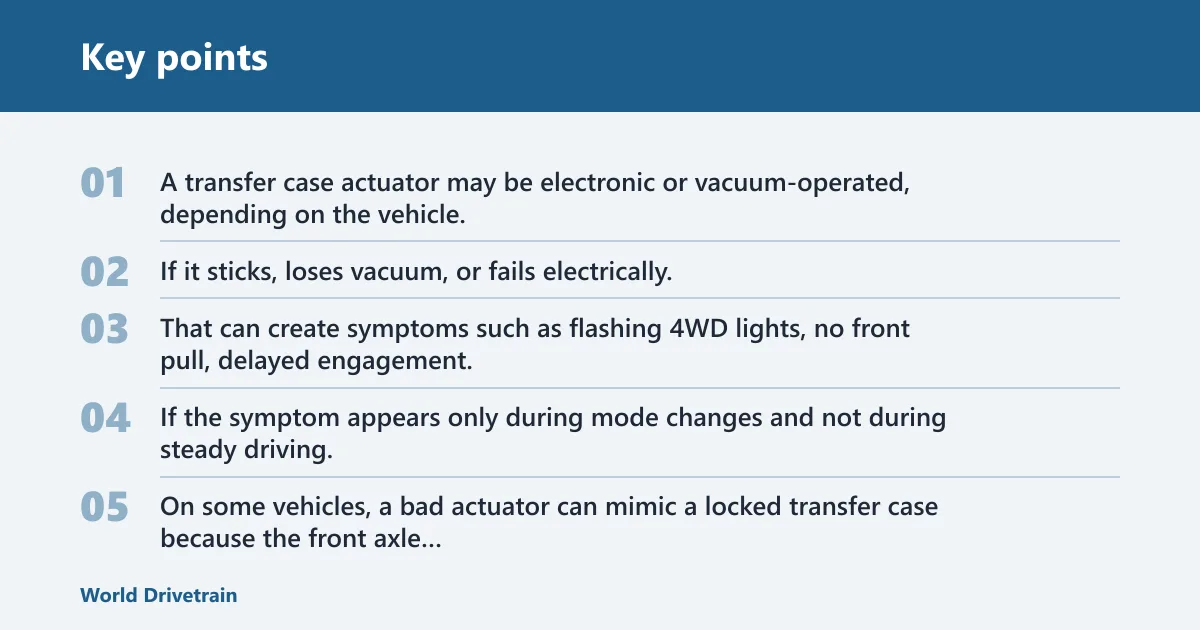
A transfer case actuator may be electronic or vacuum-operated, depending on the vehicle. If it sticks, loses vacuum, or fails electrically, the front axle or range mechanism may not engage or disengage correctly. That can create symptoms such as flashing 4WD lights, no front pull, delayed engagement, or binding after a mode change.
If the symptom appears only during mode changes and not during steady driving, the actuator moves higher on the list than the case internals. On some vehicles, a bad actuator can mimic a locked transfer case because the front axle never fully releases.
Transfer case shift motor symptoms
The shift motor is the electric motor that moves the selector into 2HI, 4HI, 4LO, or Auto. A failed motor can leave the vehicle stuck in one mode, make a clicking or buzzing sound, or trigger a service 4WD message without any major mechanical damage inside the case.
If the dash command changes but the range never actually changes, the motor, its wiring, or the position feedback circuit becomes the likely fault line. That is especially important when the problem happens only after cold starts or after rain, which can point to an electrical issue.
Encoder motor and range sensor faults
Some GM-style systems use an encoder motor with position feedback. If the encoder cannot report position correctly, the module may stop the shift early or keep commanding a mode that the case has already left. A bad transfer case range position sensor can create the same effect by feeding the module the wrong position signal.
These failures can create false symptoms. For example, the dash may claim the system is in 4HI when the case is actually in 2HI, or it may refuse to shift because the module cannot trust the signal.
Could the control module or relay be at fault?
Yes. Some vehicles use a dedicated transfer case control module that reads drivetrain sensors and commands the actuator or shift motor. If that module, its relay, a fuse, or a connector fails, the system can light warning lamps and block shifts without any internal transfer case damage.
Transfer case control module symptoms
A bad transfer case control module can set service 4WD, AWD, or drivetrain warnings and prevent mode changes. The key clue is that drivability may stay normal while the warning stays on. That makes the fault look serious, but it may be electrical rather than mechanical.
Scan tool data matters here. A code reader can confirm that the module sees a fault, but it cannot by itself prove the transfer case is worn out. Live data showing an impossible range position, missing inputs, or failed communication helps separate a module issue from an internal case problem.
Relay, fuse, and connector checks
A bad transfer case relay can interrupt power to the shift motor or module and produce intermittent symptoms. A blown fuse, corroded connector, or damaged ground can do the same. These are simple checks, but they matter because they can look exactly like a failed actuator or motor from the driver’s seat.
- Check the transfer case and 4WD fuses first.
- Inspect connectors at the case, actuator, and module for corrosion or loose locks.
- Look for harness damage near the frame, exhaust, and crossmember.
- Compare commanded mode with actual mode on a scan tool if possible.
Warning lights without drivability changes
When the only symptom is a warning lamp, the problem often sits in the electrical side of the system. That can include the module, the range sensor, the relay, or a communication fault. A scan tool can confirm codes and sometimes show live position data, but it cannot tell you by itself whether the case gears are worn.
What to check before repair
Start with the checks that can separate a transfer case failure from a front-end or tire problem. The goal is not to prove the repair. The goal is to avoid replacing the wrong part.
Fluid level, condition, and leaks
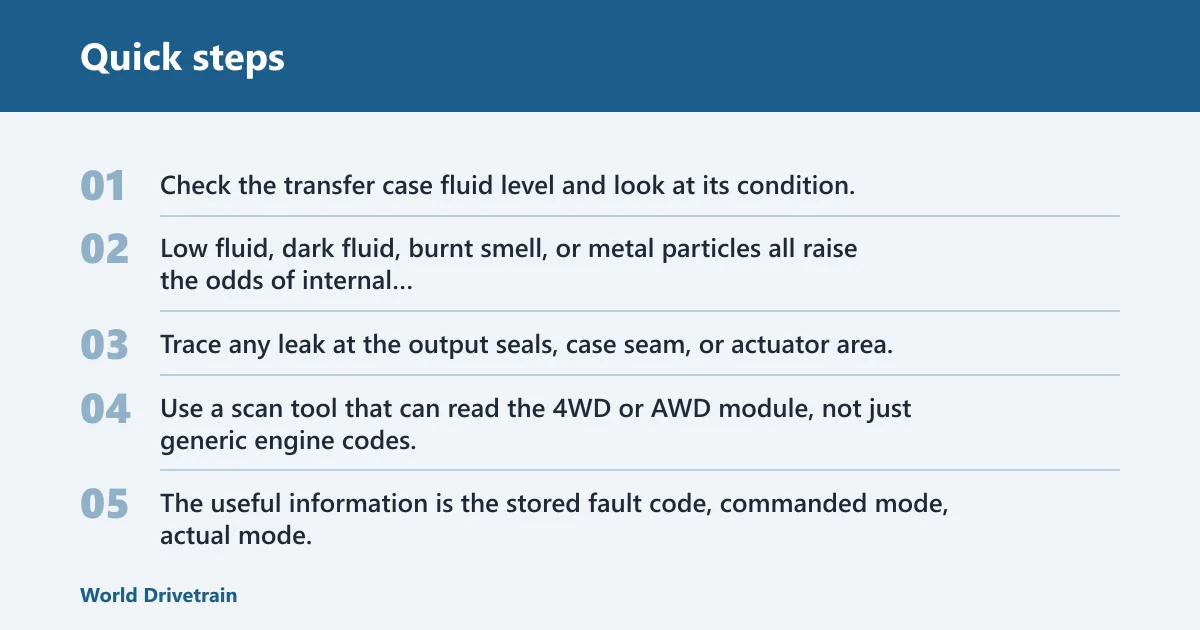
Check the transfer case fluid level and look at its condition. Low fluid, dark fluid, burnt smell, or metal particles all raise the odds of internal wear. Trace any leak at the output seals, case seam, or actuator area, because low fluid can create noise long before the case fails completely.
Scan codes and live data
Use a scan tool that can read the 4WD or AWD module, not just generic engine codes. The useful information is the stored fault code, commanded mode, actual mode, sensor readings, and whether the module sees a communication problem. That can point toward the transfer case control module, encoder motor, or range sensor.
Tire size, driveline play, and axle clues
Check that all four tires match in size and wear closely enough for the system to tolerate. A tire circumference mismatch can cause binding and transfer-case-like shudder on AWD systems. Also check for loose driveshaft play, worn U-joints, front axle noise, and wheel bearing growl, because these can mimic transfer case symptoms very closely.
Say your BMW xDrive warns of drivetrain malfunction, but the car still drives normally and no binding appears in turns. That pattern leans toward control-side faults, wear in the transfer case actuator, or a sensor issue rather than a fully failed case. A different path opens if the warning comes with shudder during acceleration and transfer case fluid that looks burnt.
Picture a 96 Chevy Silverado that clunks into 4HI but then feels fine on the highway. On that platform, the front axle actuator, transfer case shift control, or range switch can be at fault before the internal gears are. A scan for system codes and a check of the case oil give a faster answer than guessing from the dash light alone.
What are the symptoms of a bad transfer case?
The most common symptoms are gear noise under load, clunking, vibration, binding in turns, delayed or failed shifting between drive modes, fluid leaks, and 4WD or AWD warning lights. The exact pattern matters. Noise under load points more toward internal wear, while warning lights with normal drivability often point to sensors, relays, or the control module.
Frequently asked questions
What are the symptoms of a bad transfer case control module?
A bad transfer case control module often sets service 4WD or AWD warnings, stores communication or range codes, and blocks mode changes even when the vehicle still drives normally. The module may misread sensor inputs or fail to command the actuator, so the symptom can look mechanical when it is actually electrical.
What are the symptoms of a bad transfer case motor?
A bad transfer case motor commonly causes clicking, buzzing, or no movement when you request 4HI, 4LO, or Auto. The vehicle may stay stuck in one mode, flash a warning light, or shift only after several tries. If the motor cannot move the selector, the case may still be internally sound.
What are the symptoms of a bad transfer case on a BMW?
BMW xDrive complaints often include drivetrain malfunction warnings, shudder or hesitation during acceleration, tight-turn binding, and erratic all-wheel-drive behavior. Those symptoms can come from the transfer case actuator, gear wear, or fluid condition, but they can also come from tire circumference mismatch or a sensor fault.
What are the signs of a transfer case going bad?
The signs usually include noise that rises with load, hard or delayed mode shifts, binding in turns, shudder, leaks, and warning lamps. The pattern matters more than any single symptom. If the transfer case is the source, the symptoms usually worsen with heat, load, or repeated shifting.
What happens when a transfer case fails?
When a transfer case fails, the vehicle may lose AWD or 4WD function, stay locked in one mode, or make enough noise and vibration that driving becomes unsafe. In severe cases, internal damage can spread to the transmission, driveshafts, or front differential, especially if the case runs low on fluid.
What is the symptoms of a bad transfer case relay?
A bad transfer case relay usually causes intermittent no-shift complaints, a service 4WD message, or a system that works one time and fails the next. Because the relay affects power supply, the vehicle may have no mechanical symptoms at all. Checking the fuse, relay, and connector is a fast first step.