Can You Drive with the AWD Light On? Signs and Next Steps
Yes, you can often keep driving briefly with an AWD light on if the vehicle feels normal and the warning is steady, but treat any flashing light, loss of traction, grinding, or drivetrain warning as a stop-now problem. Ignoring the wrong symptoms can leave you with disabled AWD, damaged transfer-case or coupling parts, and a much larger repair bill. This guide tells you when to continue carefully, when to head straight to a shop, and when to park and tow.
Steady vs. Blinking: When to Stop and Get Towed
Usually, yes for a short, careful trip to service, but not as a blanket rule. The AWD light usually means the all-wheel-drive system has a fault and should be diagnosed soon. Depending on the model, the vehicle may still operate in two-wheel drive, which keeps it moving but reduces traction protection.
When the answer is yes, but only carefully
If the light is steady, the vehicle drives normally, and there is no noise, vibration, shudder, or binding, the safest choice is often to drive gently to a shop. Keep speeds down, avoid hard acceleration, and stay off roads that demand extra traction. The point is to cut load, not keep driving as normal.
When the answer is no and you should stop
Do not keep driving if the light is blinking, the driveline feels rough, or the vehicle suddenly loses grip or drive mode behavior. A blinking indicator often signals a more urgent or severe fault than a steady light. If the drivetrain starts making grinding or clunking sounds, treat it as a tow-now condition.
What the AWD warning light usually means
The AWD warning light is a fault indicator, not a general reminder. It may mean AWD is limited or disabled, and some vehicles may default to two-wheel drive. Because meanings vary by model, the owner’s manual comes first. It is the only source that tells you what that exact symbol or message means on your vehicle.
Solid light vs blinking light
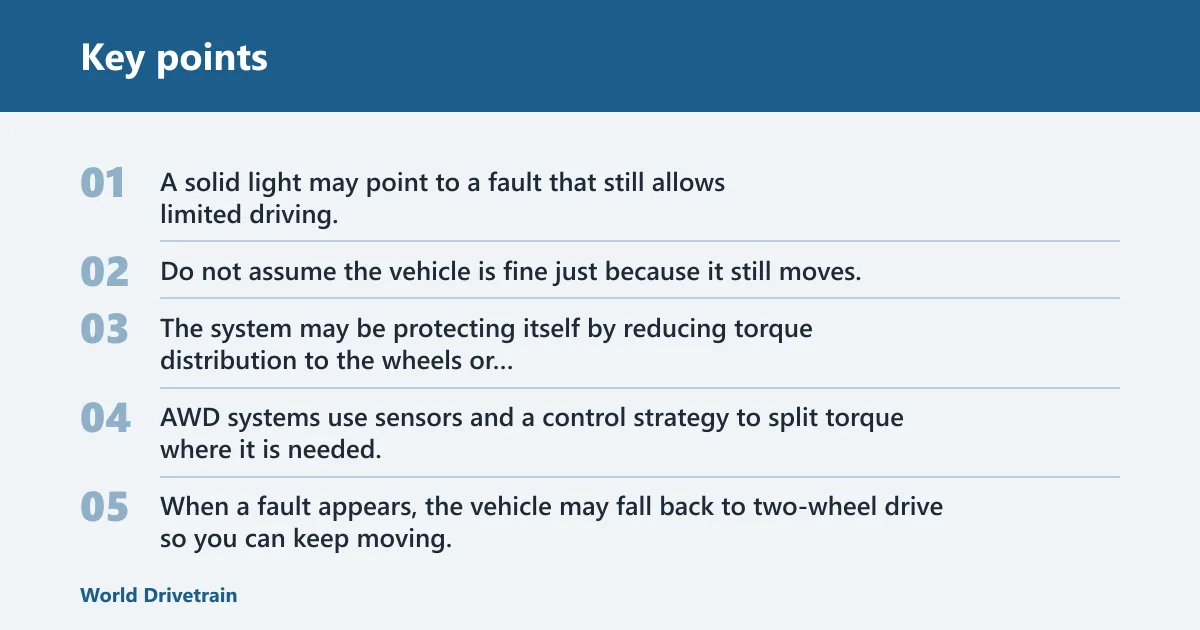
A solid light may point to a fault that still allows limited driving, while a blinking light usually suggests something more urgent. Do not assume the vehicle is fine just because it still moves. The system may be protecting itself by reducing torque distribution to the wheels or shutting parts of AWD down.
Why the system may fall back to two-wheel drive
AWD systems use sensors and a control strategy to split torque where it is needed. When a fault appears, the vehicle may fall back to two-wheel drive so you can keep moving. That fallback can preserve mobility, but it also means less traction help on slippery roads and a higher chance of wheel spin.
Why the owner’s manual comes first
Some brands use different wording for the same basic fault. SH-AWD, service AWD, and service 4WD messages can point to different system logic or fault groups. The manual tells you whether the light is advisory, whether the system has disabled itself, and whether the vehicle is allowed to keep moving.
What changes the answer: road conditions and symptoms

Road surface matters as much as the warning itself. Dry pavement usually gives you more margin than rain, snow, or ice. Symptoms matter too. Noise, vibration, shudder, binding, a burning smell, or loss of traction can shift the situation from “drive gently” toward “stop now.”
Dry pavement
On dry roads, a steady AWD light with no other symptoms is often a short-drive situation. You can usually get to a repair shop if the vehicle feels stable and there are no drivetrain noises. Keep the drive boring: no towing, no steep grades if you can avoid them, and no aggressive throttle.
Rain, snow, and ice
In rain, snow, or ice, reduced or unavailable AWD can increase the risk of wheel spin. If the light is on and traction is already marginal, do not treat the vehicle like a normal daily driver. Slow down, leave extra space, and avoid travel unless the trip is necessary to reach safety or repair.
Noise, vibration, shudder, binding, or traction loss
These symptoms change the diagnosis from warning light to possible damage in progress. Binding while turning, shudder during acceleration, or a new hum or grind can point to transfer case, differential, or coupling trouble. If the vehicle fights your steering or driveline feels locked up, stop and arrange a tow.
AWD triage checklist: keep going, get off the road, or tow now

Use this as a stoplight decision guide. It is not a repair diagnosis. It helps you decide whether to continue gently to a shop, leave the road to avoid a hazard, or stop driving and call for a tow.
| Bucket | Light behavior | Road conditions | Symptoms | Driving decision |
|---|---|---|---|---|
| Green | Steady AWD or service AWD light | Dry pavement, light traffic | No noise, no vibration, no binding, no traction loss | Drive gently to a shop soon |
| Yellow | Steady light, or message-based warning with limited AWD | Rain, snow, or ice, or a route with steep hills | Mild shudder, reduced confidence, or a system that feels limited | Drive only to avoid a hazard or reach a safe place |
| Red | Blinking light, repeated warnings, or multiple drivetrain messages | Any road surface | Grinding, clunking, binding, burning smell, severe vibration, or loss of drive | Stop driving and arrange a tow |
Green: ok to drive gently to a shop
This bucket fits a steady light with no drivability change. Use the shortest practical route, keep speeds moderate, and avoid weather that raises traction demand. A common first-timer mistake is treating “still moving” as “safe to keep using”; those are not the same thing.
Yellow: drive only to avoid a hazard
This is for the vehicle that still moves but should not be used freely, especially in bad weather. Suppose your AWD light comes on during a heavy rainstorm and the car feels normal, but you must get off a fast-moving shoulder or out of a flood-prone area. Drive only far enough to reach a safer place.
Red: stop driving and arrange a tow
Any blinking light with harsh drivetrain symptoms belongs here. If the vehicle shudders hard on turns, emits a grind, or seems to bind as the wheels rotate at different speeds, continued driving can turn a repair into a larger mechanical failure. Park it and have it towed.
What can cause an AWD or service AWD warning
Common fault sources include the control module or wiring. Transfer-case or differential problems can affect power distribution to the wheels. Fluid issues can include low or degraded transfer-case or differential fluid. Not every warning means a major mechanical repair, but every warning deserves a real diagnosis.
Sensors, wiring, and corrosion
Wheel-speed sensor faults, damaged wiring, connector corrosion, and water intrusion can all confuse the AWD system. These are often electrical or signal problems, which is why the vehicle may still drive but lose proper torque management. That is also why a scan and visual inspection both matter.
AWD control module faults
The AWD control module receives sensor data and commands torque transfer. If it cannot read signals correctly, or if it stores fault codes from a related circuit, the system may restrict AWD operation. The module is not the only possible culprit, but it is a common fault area.
Transfer case, differential, and fluid problems
The transfer case and differential are mechanical parts that help route power to the wheels. Low or degraded fluid can lead to heat, wear, and abnormal noise. If ignored, these problems can create drivetrain damage risk rather than just a warning light.
What to do right now if the light is on
Pull over safely if you can do so without creating a hazard, then note whether the light is solid or blinking. Check for other warning lights and any change in how the vehicle shifts, steers, accelerates, or corners. Then decide whether the next move is a short trip to service or a tow.
- Note the exact message or icon.
- Check whether the light is steady or blinking.
- Listen for new noise, vibration, shudder, or binding.
- Look for traction loss, harsh shifts, or a burning smell.
- Consult the owner’s manual for model-specific meaning.
- Plan an OBD-II code scan before more driving if symptoms persist.
Read codes and plan the next repair step
An OBD-II code scan helps a technician narrow the fault path. Share the codes, the light behavior, and the conditions when the warning appeared. That information can separate a sensor or wiring fault from a transfer case or differential problem much faster than a guess can.
How a technician diagnoses the problem
A proper diagnosis starts with an OBD-II code scan and live data, then moves to fluid checks and wiring inspection. The technician may inspect transfer-case and differential fluid condition, check connectors and corrosion, and verify whether the AWD control module is reading sensor inputs correctly.
OBD-II code scan and live data
Stored codes tell the shop which circuit or subsystem complained first. Live data helps confirm whether wheel-speed signals, module commands, or torque requests make sense. Without that step, repairs can turn into parts swapping instead of problem solving.
Fluid checks for the transfer case and differentials
Low, contaminated, or overheated fluid can be a direct clue. A technician will check level and condition, then look for leaks, metal debris, or heat damage. That is especially important when the warning is paired with growling, whining, or binding.
Wiring, connectors, and module checks
Because common AWD fault sources include the control module or wiring, inspection usually includes harness routing, connector fit, moisture, and corrosion. A loose or contaminated connector can create an intermittent warning that looks more serious than the repair actually is.
Can you drive with the SH-AWD light on?
Sometimes, but treat it the same way you would any AWD warning: check the manual first, note whether the light is steady or blinking, and look for drivability changes. SH-AWD is a specific system, so the message can have model-specific meaning and may still allow limited driving in two-wheel drive.
What makes SH-AWD different
SH-AWD is still an all-wheel-drive system, but the warning can point to a brand-specific control issue, sensor fault, or torque-distribution problem. Do not assume it is identical to every other AWD light. A steady message with normal driving may allow a short trip to service; blinking or noisy behavior does not.
Can you drive with service AWD light on?
Often only briefly, and only if the vehicle feels normal. “Service AWD” usually means the system found a fault that needs diagnosis, not that the vehicle is fine to ignore. If the road is dry and the warning is steady, drive carefully to a shop rather than postponing the repair.
Why “service” still matters
The word service means the fault is not just informational. The AWD system may be disabled, limited, or running in a fallback mode. That can be manageable for a short distance, but it should not be treated as a routine reminder light.
Can I still drive with service 4WD light on?
Sometimes, but the same caution applies: this warning can mean the system has limited or disabled four-wheel-drive operation. If the truck or SUV still moves normally on dry roads, a short trip to service may be reasonable. If there is noise, binding, or a blinking light, stop and tow.
Why 4WD warnings are not the same as AWD warnings
4WD systems and AWD systems use different hardware and control logic. A service 4WD message may point to shift motor, encoder, transfer case, or related electronic faults. Use the owner’s manual to confirm the message before deciding how far to drive.
Is it safe to drive in rain or snow with the AWD light on?
It is less safe than driving in dry weather because reduced or unavailable AWD can increase the risk of wheel spin. If you must drive, slow down and keep the trip short. If the light is blinking, or if the vehicle already feels unstable, stay off slippery roads and get help.
Road conditions change the risk fast
Dry pavement can hide an AWD fault for a short period. Rain, snow, and ice expose it quickly because the system’s traction advantage matters more. If the warning appears during bad weather, the safest choice may be to move to a safer location first, then stop driving.
When should I pull over if the AWD light is blinking?
Pull over as soon as it is safe if the AWD light is blinking and especially if the vehicle adds noise, vibration, shudder, or binding. A blinking indicator often signals a more urgent or severe fault than a steady light, so continuing to drive can make the problem worse.
Do not keep “testing” the vehicle
One short acceleration burst can be enough to reveal whether the drivetrain is slipping, but repeated testing is a bad idea. If the warning is flashing and the driveline feels wrong, stop, park, and arrange a tow rather than trying to nurse it home.
Frequently asked questions
How long can you drive with AWD light on?
Only long enough to reach a safe place or repair shop when the symptoms are mild. There is no single distance or time that fits every model, since the owner’s manual and the vehicle’s behavior matter. If noise, vibration, or traction loss appears, do not continue.
What does it mean when the AWD light comes on?
It usually means the all-wheel-drive system has a fault and may be limited or disabled. Some vehicles may still operate in two-wheel drive, so the car can keep moving even though traction management is reduced. That is why a code scan and manual check matter.