What Does a Transfer Case Do in a Car or Truck?
A transfer case splits engine torque between the front and rear axles in 4WD or AWD. Low range usually multiplies torque by about 2:1 to 4:1, which is commonly used for slow, controlled movement on climbs, ruts, and recoveries. Use the wrong range on the wrong surface, and driveline bind, poor traction, or heat buildup can follow. This guide explains how transfer cases work, how 4WD differs from AWD, and when to use each range.
What does a transfer case do?
A transfer case sends engine torque to both ends of the vehicle when the drivetrain needs power at the front and rear axles. In many trucks and SUVs, it sits behind the transmission and feeds the front driveshaft and rear driveshaft. In AWD systems, it may also meter torque automatically instead of relying on a driver-selected mode.
That job matters because axle speed needs change with surface grip. On dry pavement, the rear axle often handles propulsion in 2H. On loose dirt, snow, mud, or ice, the transfer case can engage the front axle so the vehicle has more tire contact working for grip.
Body-on-frame trucks usually place the transfer case in a straight line behind the transmission. Crossovers may package the same basic function in a transaxle-based layout, so the hardware can look different even though the torque-management job is similar.
Where it sits in the drivetrain
The transfer case usually bolts to the transmission output or sits directly behind it. From there, the rear driveshaft sends torque to the rear axle, while the front driveshaft sends torque forward when the front axle is engaged. CV axles then carry power from the front differential to each front wheel in many AWD and independent-front-suspension designs.
Why 4WD and AWD use it differently
Part-time 4WD transfer cases usually give the driver fixed ranges such as 2H, 4H, 4L, and Neutral. Full-time AWD layouts may use a center differential or a clutch pack inside the case to vary front-to-rear torque on the fly. The part name stays similar, but the control strategy is not the same.
How does a transfer case work?
A transfer case changes how torque leaves the transmission. Inside, many units use chains, gears, or planetary sets to drive the front output shaft, rear output shaft, or both. The selected range changes whether the case sends power straight through, splits it, or multiplies it for low-speed work.
Modern units often move through ranges with a shift motor or actuator. Depending on the vehicle, that actuator may be electric, vacuum-operated, or controlled electronically by a module. The driver may command the shift with a manual shift lever or an electronic selector labeled 2H, Auto, 4H, 4L, or Neutral.
In 2H, the case usually sends torque to the rear axle only. In 4H, it couples the front axle for high-range four-wheel drive, which generally keeps road speed close to normal while adding traction. In 4L, an internal reduction set multiplies torque at the wheels and lowers vehicle speed for crawling, steep grades, and recovery work. Neutral disconnects the drivetrain so the outputs can spin without driving the wheels.
What changes inside the case
The key change is not engine output. It is the ratio and path after the transmission. A chain-driven case may route power through a chain to the front output. A gear-driven or planetary unit may lock, freewheel, or reduce speed through a set of gears. The selected range decides how much torque reaches each axle and how fast the outputs turn.
Transfer case vs transmission and differential
The transmission changes the engine’s speed and torque before power reaches the transfer case. The transfer case then splits or routes that power between axles. The differential changes speed difference between wheels on the same axle, which is why the front and rear differentials are separate jobs from the transfer case.
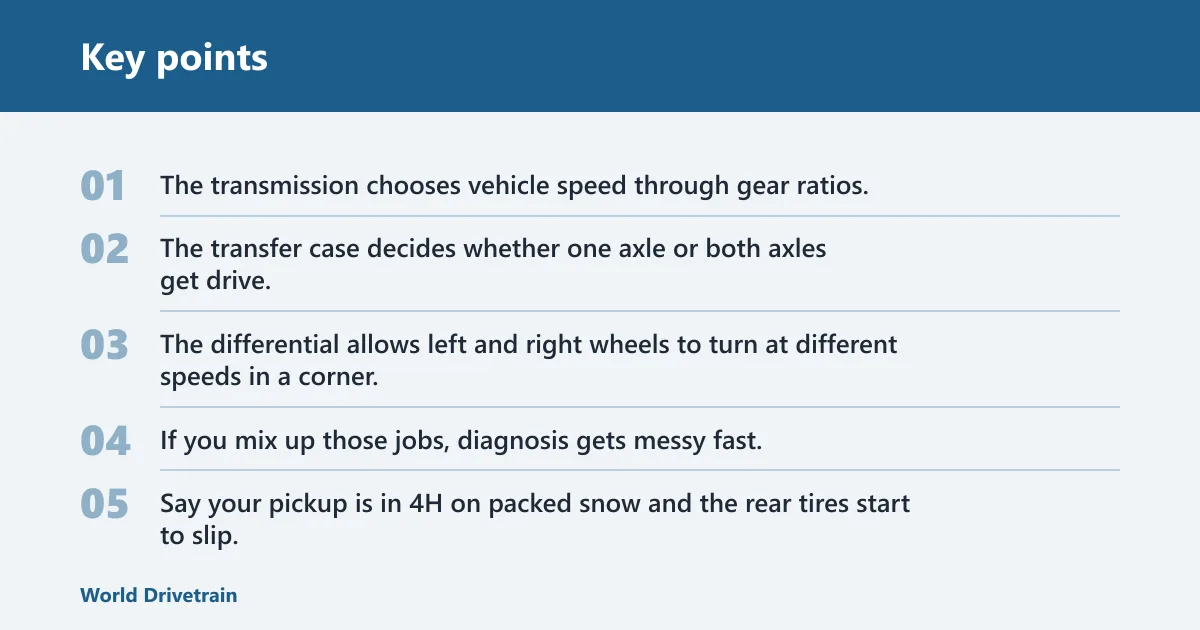
That division matters on slippery roads. The transmission chooses vehicle speed through gear ratios. The transfer case decides whether one axle or both axles get drive. The differential allows left and right wheels to turn at different speeds in a corner. If you mix up those jobs, diagnosis gets messy fast.
Why each part has a different job
Say your pickup is in 4H on packed snow and the rear tires start to slip. The transfer case is what brings the front axle in. The differentials still handle left-right speed difference at each axle, so the truck can turn without fighting itself as long as the surface allows some slip.
| Mode | Surface type | Typical speed range | Torque split behavior | Common driver mistake |
|---|---|---|---|---|
| 2H | Dry pavement, normal commuting | Any legal road speed | Rear axle drive only in most part-time systems | Leaving it in 4WD on dry roads |
| Auto | Mixed grip, changing weather | Any legal road speed | System varies torque automatically through a clutch or control logic | Assuming it behaves like fixed 4H on all surfaces |
| 4H | Snow, slush, gravel, light mud | Road speed, not crawling speed | Front and rear axles are coupled at high range, often near a fixed split | Using it on dry high-traction pavement |
| 4L | Deep snow, steep grades, slow trail work, recovery | Low-speed driving only | Front and rear axles are coupled through a reduction set that multiplies wheel torque | Trying to drive normal road speed in low range |
| Neutral | Towing setup, flat-tow preparation if the manual allows it | Vehicle should not be driven under power | No drive to the axles | Putting the vehicle in Neutral and expecting it to move normally |
When should you use 4H or 4L?
Use 4H when you need extra traction but still want normal road-speed behavior. It suits slippery roads, snow-covered roads, gravel, and light off-road use. Use 4L when you need slow, precise control and extra torque at the wheels, such as crawling over rocks, climbing a steep loose grade, or easing a stuck vehicle out of a rut.
4H keeps gearing close to normal road speed, so throttle response stays familiar. 4L drops output speed and raises wheel torque, which helps the vehicle move slowly without overworking the engine or slipping the clutch on a manual-transmission setup. The gain is control, not top speed.
When not to use 4L
Do not use 4L for ordinary street driving, freeway speeds, or dry pavement. Do not use it when the road is grippy enough that the drivetrain cannot relieve binding through tire slip. Do not use it just because the vehicle has it. If the manual says 4L is for low-speed operation only, treat that limit as strict.
Picture a full-size SUV on a paved driveway after a snowstorm. The driver shifts to 4L, then tries to roll out at neighborhood speed. The result is jerky throttle response and unnecessary stress on the driveline. 4H would fit that situation better because it adds traction without forcing the vehicle into crawl gearing.
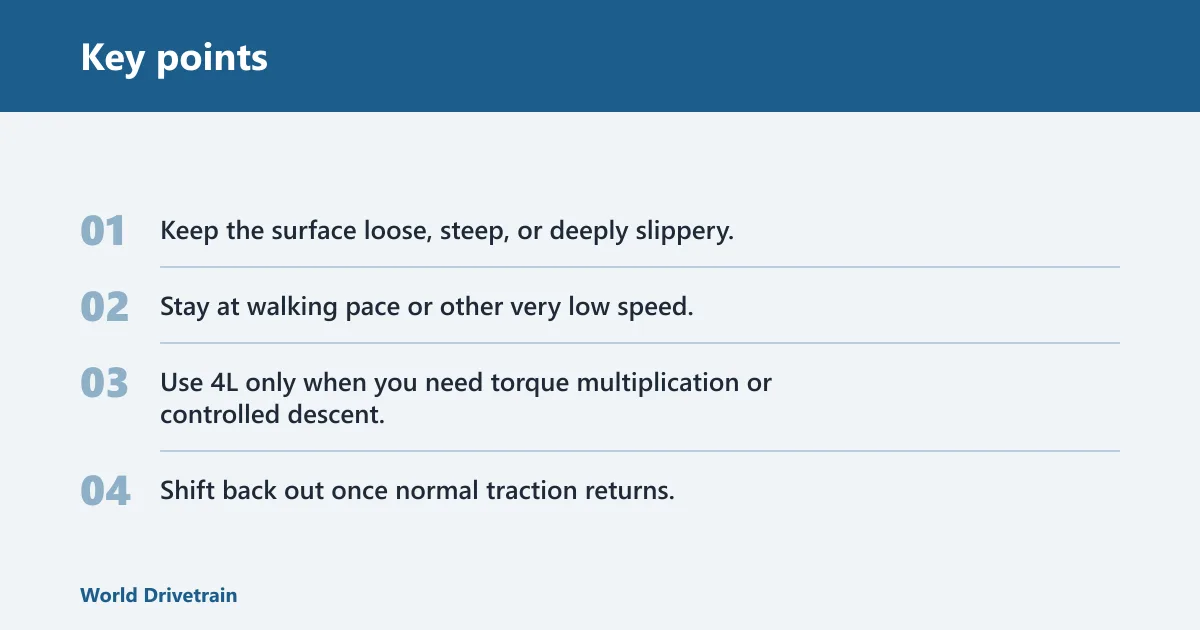
- Keep the surface loose, steep, or deeply slippery.
- Stay at walking pace or other very low speed.
- Use 4L only when you need torque multiplication or controlled descent.
- Shift back out once normal traction returns.
Does every 4×4 truck have a transfer case?
Most part-time 4WD trucks do, because the transfer case is the part that splits drive between the front and rear axles. But not every vehicle with driven front and rear wheels uses the same hardware. Some AWD crossovers use a coupling, clutch pack, or center differential package that performs a similar job with different control logic.
That difference explains a lot of owner confusion. A pickup with 2H, 4H, and 4L is usually built around a traditional transfer case. A crossover with Auto AWD may send torque through a coupling that changes torque distribution without a separate low-range gear set. The driver sees a 4WD badge, but the internal layout can be very different.
Part-time 4WD, full-time AWD, and couplers
Part-time 4WD systems are usually happiest when the driver chooses the mode. Full-time AWD systems often stay engaged all the time and move torque as grip changes. Some crossovers also use electronic rear-drive couplers, which can send more or less power rearward without a selectable low range. That is why the same “all-wheel drive” label can hide very different parts.
What happens if a transfer case fails?
A failing transfer case can create grinding, whining, popping out of range, delayed engagement, or a warning light on vehicles with electronic controls. You may also notice the vehicle stuck in one mode, a shudder while accelerating, or a front axle that does not engage when selected. Those symptoms need inspection by a technician.
Low fluid or the wrong fluid can damage the gears, bearings, chain, or clutch components inside the case. Transfer case fluid lubricates those parts and helps carry away heat. Service intervals vary by manufacturer and use, so towing, deep water exposure, and frequent low-speed off-road work can justify earlier service than normal street driving.
Fluid and control issues
On electronically shifted systems, the shift motor or actuator can fail, or the control module may refuse a shift if inputs do not match the requested range. A worn seal can lower fluid level. A damaged chain can allow slop between outputs. Each of those failures changes how the torque manager behaves, which is why symptoms should not be ignored.
A common first-timer mistake is treating a transfer case like a sealed lifetime part with no maintenance. Many are not. Check the owner’s manual for the exact fluid spec and service interval, then inspect for leaks after off-road use, water crossings, or repeated towing.
Frequently asked questions
What is a car transfer case?
A car transfer case is the drivetrain unit that sends torque to the front and rear axles in AWD or 4WD layouts. It usually sits behind the transmission or is integrated with it, and it may use gears, chains, or a clutch-based coupling depending on the vehicle design.
What is the difference between a transfer case and a transmission?
The transmission changes engine speed and torque through gear ratios for vehicle speed control. The transfer case takes that output and routes it to one axle or both axles. In simple terms, the transmission chooses how fast the engine load turns; the transfer case chooses where that torque goes.
What is the difference between a transfer case and a differential?
The transfer case splits torque between front and rear axles or changes the range before the axles. The differential splits torque between left and right wheels on the same axle and allows them to turn at different speeds in a corner. They work together, but they do different jobs.
What is a transfer case in automobile?
In an automobile, the transfer case is the component that distributes drive to multiple powered axles. It appears in many 4WD trucks and some AWD systems. Depending on design, it may offer 2H, Auto, 4H, 4L, and Neutral, plus electronic or manual control.
What does a transfer case do in a car or truck?
It manages torque flow after the transmission. In a truck, that usually means engaging the front driveshaft and rear driveshaft together when traction is poor, then using low range when slow control matters. In AWD vehicles, it may vary that split automatically instead of waiting for the driver.