What Causes Transfer Case Failure? 7 Root Causes and Signs
Transfer case failure usually starts with low or dirty fluid, then heat, bearing or chain wear, or an encoder/motor or module fault that stops 4WD engagement. Ignore it, and you can destroy gears, lose drive, or get stuck in one range. This guide shows how to separate fluid, mechanical, and electronic causes by symptom.
What causes transfer case failure?
Transfer case failure usually begins as a chain reaction: fluid loss or bad fluid raises heat, heat cuts lubrication, and metal parts wear faster. In part-time and full-time 4WD systems, the transfer case has to route torque through chains, gears, bearings, seals, a shift fork, and an actuator, so one fault can trigger several more.
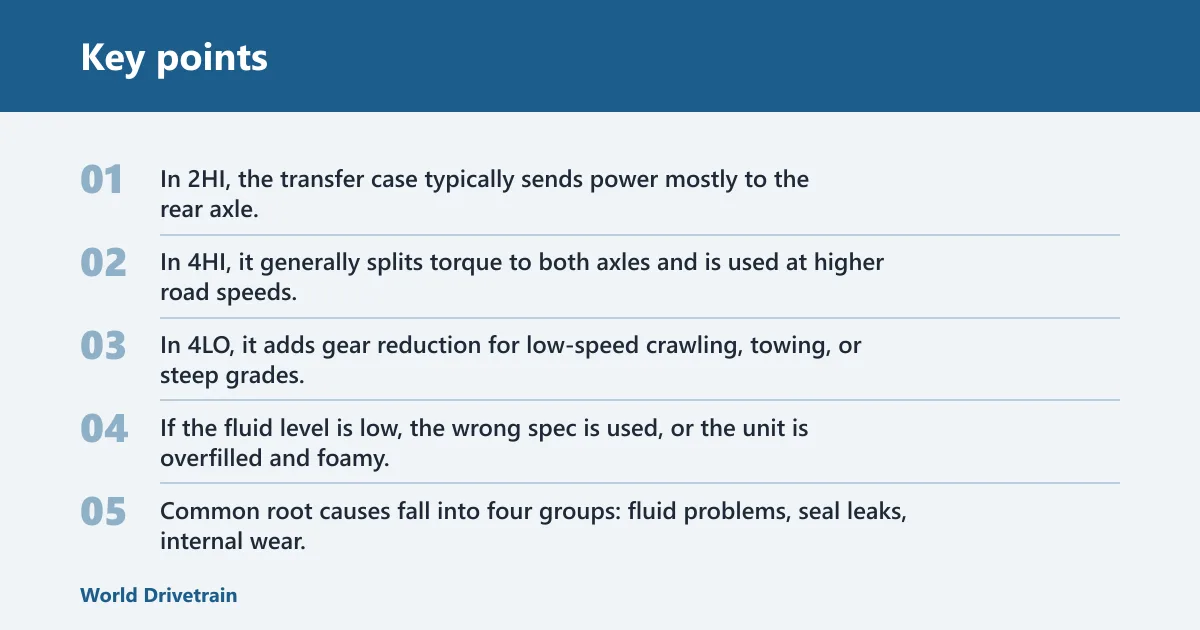
In 2HI, the transfer case typically sends power mostly to the rear axle. In 4HI, it generally splits torque to both axles and is used at higher road speeds. In 4LO, it adds gear reduction for low-speed crawling, towing, or steep grades. If the fluid level is low, the wrong spec is used, or the unit is overfilled and foamy, heat builds fast and the failure path starts early.
Common root causes fall into four groups: fluid problems, seal leaks, internal wear, and electronic control faults. A small leak can eventually lead to bearing damage. A bad bearing can shed metal. Metal debris can damage the chain, shift fork, and gears. A bad encoder motor or control module can also block proper range selection and make the unit seem mechanically bad when the fault is electrical.
How fluid problems start the failure chain
Low fluid from a leak, a missed service, or an incorrect fill level is one of the most common starting points. Transfer case fluid is not universal. Most manufacturers call for a specific fluid type, and using the wrong spec can change friction behavior, cause chatter, or reduce protection for chains and bearings. Overfill can foam the fluid, which also hurts lubrication.
Look for fluid that is burnt, metallic, or foamy. Burnt fluid points to overheating. Metallic fluid points to wear already in progress. Foamy fluid often means overfill, aeration, or a leak path that has introduced air. A common service interval is around 30,000 to 60,000 miles for severe use, but the owner’s manual is the source that matters.
How overheated fluid accelerates wear
Heat thins the fluid film between moving parts. That raises friction in bearings, chain links, gears, and the shift mechanism. Once the film breaks down, parts run hotter, debris rises, and the wear rate climbs. That is how a minor leak can become a noisy, slipping transfer case.
Suppose a truck develops a slow input seal leak and the driver keeps topping off only once in a while. The case may still shift at first, but a hot smell, whining under load, and dark fluid often follow. At that point the problem is no longer just a leak; internal wear is already part of the picture.
Can seals and bearings fail first?
Yes. Input and output shaft seals can fail before anything else, and the resulting fluid loss can damage bearings soon after. Seal leaks reduce lubricant level and allow heat to rise. As bearings run dry or run in dirty fluid, they wear faster, create more noise, and spread metal debris through the case.
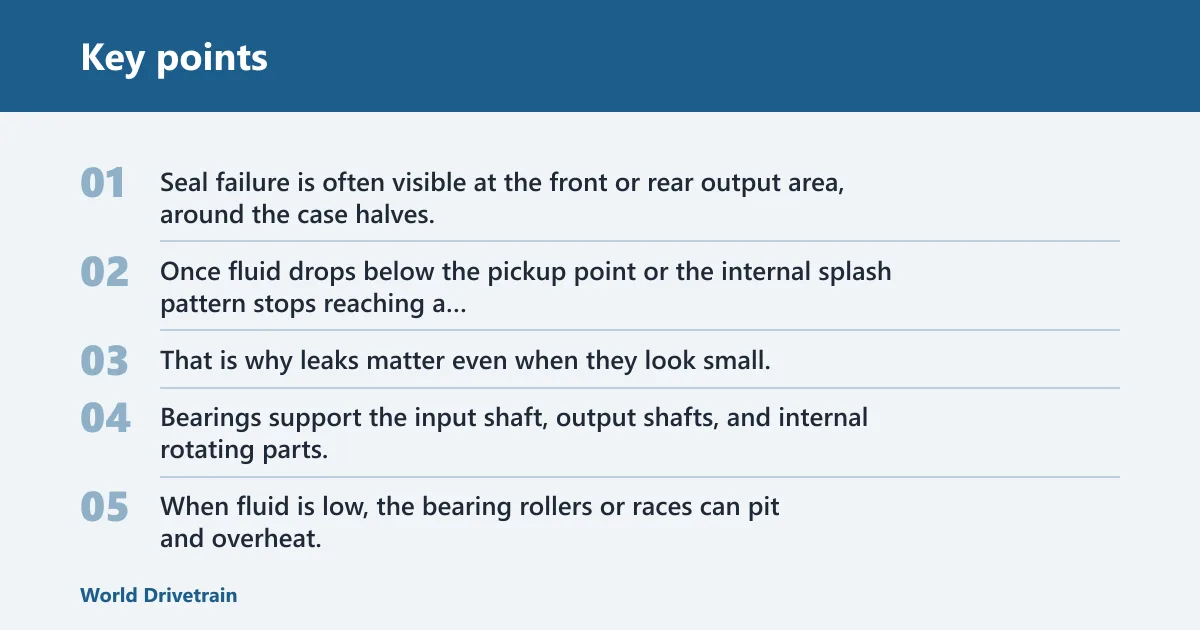
Seal failure is often visible at the front or rear output area, around the case halves, or where the front driveshaft enters the unit. Once fluid drops below the pickup point or the internal splash pattern stops reaching a bearing, the damage can move from a seep to a mechanical failure. That is why leaks matter even when they look small.
How fluid loss leads to bearing wear
Bearings support the input shaft, output shafts, and internal rotating parts. When fluid is low, the bearing rollers or races can pit and overheat. The first symptom is often a whine, growl, or rough sound that changes with load or vehicle speed. A failing bearing may also create vibration that feels like a driveline issue elsewhere.
Metal debris in the drained fluid is a strong clue. Fine glitter points to early wear. Larger flakes or chunks suggest advanced damage and a higher chance that the gears, chain, or shift components have also been affected. Once bearings shed material, the rest of the transfer case usually wears faster.
What transfer case chain wear sounds and feels like
A stretched transfer case chain often rattles, grinds, or slips under load. It may be quiet in gentle driving and noisy during acceleration, hill climbs, or when torque is applied in 4HI or 4LO. Chain wear is common in high-mileage units and in vehicles that have spent a lot of time towing or driving with low fluid.
The chain links and sprockets are designed to hold torque with very little slack. As the chain stretches, it can ride up on the sprockets, slap the case, or lose tension under load. That can feel like a brief hesitation, a bang, or a metallic rattle from the center of the vehicle.
How chain wear differs from other noises
Chain noise usually gets worse when the driveline is loaded, not just when the vehicle is moving. A rear differential often makes more of a hum from the axle area. A transmission problem tends to change with gear selection and engine speed. A transfer case chain often sounds central, load-dependent, and sharper during 4WD operation.
Picture a full-size SUV in 4HI pulling a trailer up a grade. If the chain is worn, the driver may hear a clatter only when climbing or when the throttle opens. On flat ground in 2HI, the noise may fade. That pattern points more toward transfer case chain wear than a transmission fault.
Can electronic shift faults damage the transfer case?
Yes. A shift motor, actuator, encoder motor, wiring fault, or transfer case control module problem can keep the unit from moving cleanly into the selected range. If the system tries to engage partially or repeatedly cycles between ranges, the shift fork, clutch elements, and internal gears can wear or bind. Electronic faults can become mechanical damage.
Some systems also use position feedback to confirm 2HI, 4HI, or 4LO engagement. If the encoder signal is wrong, the module may command the wrong position or think the shift failed when it did not. That can leave the vehicle stuck in a range, flash warning lights, or create symptoms that look like a bad case even when the issue starts in wiring or calibration.
How module and wiring faults show up
Electronic problems often produce intermittent symptoms. The mode selector may click, flash, or refuse to settle. The dash may show a range that does not match the actual position. Scan tool codes, communication faults, or calibration errors matter here because the module needs accurate input from the switch, position sensor, and drivetrain speed sensors.
Repeated failed shifts can stress the mechanism. If the actuator tries to move against a bind or receives false position data, the motor can overwork, and the shift fork or clutch pack can be forced into a partial engagement. That is why electronic diagnosis should happen before a technician replaces hard parts blindly.
How drivetrain binding shortens transfer case life
Driving in 4WD on dry pavement can cause drivetrain binding, sometimes called torque wind-up. In part-time systems, the front and rear axles are locked together in 4HI or 4LO, so they cannot speed-match well on high-traction roads. That stress can mimic transmission shudder, differential noise, or a failing transfer case.
Full-time 4WD systems are different because they are designed to allow some speed difference between axles, but they still depend on the correct fluid and clutch behavior. If a vehicle with a part-time system stays in 4HI on dry pavement, the transfer case, driveshafts, U-joints, and axles all absorb extra stress.
What binding feels like
Binding often shows up as hopping tires, tight steering in turns, driveline shudder, or difficulty shifting out of 4WD. The vehicle may feel like it is fighting itself in parking lots or during slow turns. That does not always mean the transfer case is broken, but it does mean the system is under strain.
A common first-timer mistake is to assume any hard shift means a bad transmission. If the symptoms happen right after 4WD was used on dry pavement, the first check should be for torque wind-up, not a transmission rebuild. Releasing the load and confirming the correct mode often restores normal operation.
What causes transfer case issues?
Transfer case issues come from the same root causes as failure, but at an earlier stage: leaks, wrong or low fluid, heat, bearing wear, chain stretch, seal damage, actuator faults, module faults, and binding from misuse. The challenge is separating a simple service problem from internal damage before the case is ruined.
The most useful clue is sequence. A leak usually comes before low fluid. Low fluid often comes before burnt fluid. Burnt fluid often comes before bearing noise or chain damage. Electronic faults often come before range-selection failure. If the symptoms line up with that order, the root cause becomes easier to identify.
How do you tell if the transfer case is the problem and not the transmission?
Transfer case problems usually change with 4WD mode, vehicle speed, and load at the center of the driveline. Transmission problems usually track engine load, gear changes, or shift timing. If the noise or binding appears only in 4HI or 4LO, the transfer case deserves first attention. If it happens in every gear and every mode, look broader.
Transmission issues often cause slipping, flare between shifts, delayed upshifts, or gear-specific codes. Transfer case issues more often cause mode-selection problems, driveline bind, central noise, or vibration that changes when switching between 2HI, 4HI, and 4LO. Differential noise usually comes from the axle ends, not the middle of the vehicle.
What to inspect first
- Check for leaks at the input seal, output seals, and case halves.
- Verify the correct fluid spec and fill level from the owner’s manual.
- Inspect the drained fluid for burnt odor, foam, or metal.
- Scan the transfer case control module for codes and live data.
- Test 2HI, 4HI, and 4LO engagement on the correct surface.
Root-cause diagnosis checklist: when to stop driving
Use the symptom pattern to decide whether to inspect first or park the vehicle. A visible leak, slightly low fluid, or an intermittent shift problem may allow a short drive to a repair bay. Burnt fluid, loud grinding, metal chunks, or severe binding are usually stop-driving signs, since they can make the problem much worse.
| Symptom | Likely failure path | Stop-driving threshold | First check |
|---|---|---|---|
| Wet case, drip at seal | Seal leak, possible fluid loss | Drive only if level is confirmed and leak is minor; park if fluid is dropping fast | Inspect input/output seals and fill level |
| Burnt smell, dark fluid | Overheated fluid, internal wear | Park and inspect now | Check fluid condition and for metal debris |
| Foamy fluid or overfill | Aeration, wrong service level, possible misfill | Inspect before driving far | Verify correct spec and fill height |
| Rattle or grind under load | Chain wear, bearing wear, or gear damage | Stop if noise is loud or getting worse | Listen in 2HI, 4HI, and 4LO, then inspect fluid |
| Won’t shift or flashes range lights | Actuator, encoder motor, module, or wiring fault | Drive only enough to get diagnostic help if the vehicle remains controllable | Scan codes and verify power, ground, and communication |
| Hopping tires, tight turns, driveline bind | Torque wind-up from 4WD on dry pavement | Stop and remove the bind immediately | Shift to the correct mode and inspect tires and driveline |
When the answer is to park it
If the transfer case is grinding, stuck in gear, leaking heavily, or producing metal in the fluid, do not keep driving it. Those are signs that the chain, bearings, gears, or shift mechanism may already be shedding damage. Continuing can spread debris through the case and into the driveshafts or differential.
Repair options usually range from a fluid service and seal replacement to actuator repair, bearing replacement, or a full rebuild. The correct choice depends on which failure path started first. That is why the root cause matters more than the loudest symptom.
Frequently asked questions
What happens when a transfer case fails?
When a transfer case fails, the vehicle may lose 4WD, make grinding or whining noises, leak fluid, bind in turns, or get stuck in one range. In severe cases, gears, bearings, or the chain can fail enough to cause loss of drive or expensive secondary damage.
Can low transfer case fluid cause failure?
Yes. Low transfer case fluid can cause overheating, bearing wear, chain damage, and gear wear. A small leak or an underfill at service can be enough to start the process. If the fluid is burnt, dark, or metallic, the case has likely already been running too hot.
Does a transfer case fail from bad seals?
Yes. Bad input or output shaft seals can leak fluid and starve the transfer case of lubrication. That fluid loss often leads to heat, then bearing wear, then chain or gear damage. A seal leak is not just a drip; it can be the first step in a larger failure sequence.
What driving habits shorten transfer case life?
Using part-time 4WD on dry pavement, towing beyond the vehicle’s limits, ignoring fluid service, and continuing to drive with leaks all shorten transfer case life. Frequent range changes under load and repeated binding from torque wind-up also add stress that raises heat and wear.