AWD Warning Light: Meaning, Causes and What to Do
An AWD warning light usually means the all-wheel-drive system has detected a fault or a temporary operating limit; if it flashes, drive gently and stop for inspection, and if it stays on with driveline noise or binding, avoid driving far. Ignoring it can leave you with reduced traction, heat damage, or expensive transfer case, differential, or coupling repairs. This guide explains the fast triage order, the common causes, and what to check first.
Steady versus flashing AWD indicators
The AWD warning light can mean different things depending on the vehicle. On some models, it signals a fault in the all-wheel drive system, which sends power to all four wheels through sensors and control modules. On others, the message can also appear during temporary AWD intervention, then clear after conditions normalize.
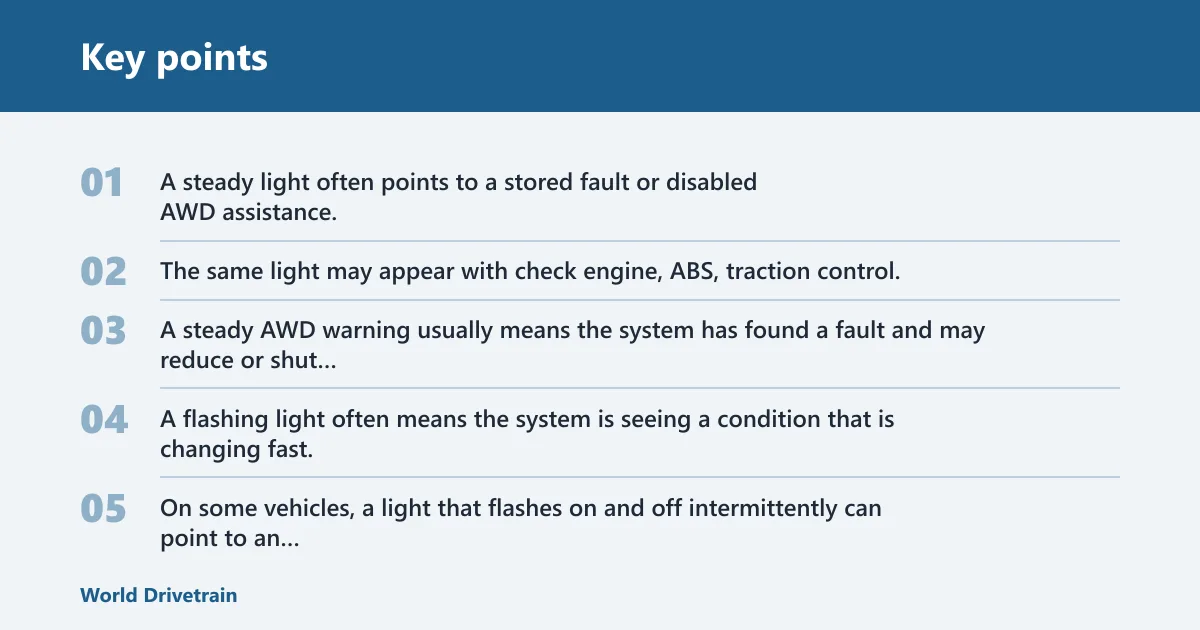
That difference matters. A steady light often points to a stored fault or disabled AWD assistance, while a flashing light can mean the system is actively reacting to slip or that a fault is present intermittently. The same light may appear with check engine, ABS, traction control, or stability control warnings because those systems share data.
Steady light versus flashing light
A steady AWD warning usually means the system has found a fault and may reduce or shut off AWD assistance. A flashing light often means the system is seeing a condition that is changing fast, such as wheel slip, a sensor signal that comes and goes, or voltage that is dropping below what modules want.
On some vehicles, a light that flashes on and off intermittently can point to an electrical or data fault rather than a mechanical one. That puts battery, charging, sensor, or communication checks ahead of transfer case teardown.
Why the light may appear with other warnings
AWD logic often relies on wheel speed sensors, ABS data, stability control inputs, and module communication. If one of those systems has a problem, the AWD warning may appear together with a check engine light or an ABS-related message even when the transfer case itself is not the original failure.
That is why a basic generic code reader can miss the real issue. Some AWD-related codes may be stored in the ABS module, the transfer case module, or the body control module rather than only in the engine computer. Some AWD-related codes mentioned include C0408 and C04091.
Why is my AWD warning light on?
The most common causes fit a few groups: tire size or tread-depth mismatch, low battery voltage or charging faults, sensor or wiring problems, fluid or mechanical issues in the transfer case or differentials, and module communication faults. The right first check depends on the symptom pattern, not just the light itself.
Tire size and tread depth mismatch
AWD systems expect all four tires to match closely in overall diameter. A mismatched spare, one new tire paired with three worn tires, or uneven tread wear can create wheel-speed differences that the AWD system may read as slip. That can trigger a warning and, in some cases, overheat drivetrain components.
Do not bury tire issues under general maintenance. Start with pressure, tire size, and tread depth. If one tire is significantly smaller in rolling diameter, the system may see a constant speed difference and keep reacting even though nothing is broken electrically.
Low battery voltage or charging faults
A weak battery can affect AWD behavior. Low voltage can cause electrical instability, which may confuse control modules and create multiple warnings at once. If the battery is weak or the alternator is not charging correctly, the AWD light may be only one of several messages on the dash.
This is a fast first check because it is cheap and often decisive. If the vehicle cranks slowly, lights dim, or several warning lights appear together, voltage deserves attention before deeper drivetrain work.
Sensor, wiring, or module communication faults
Wheel speed sensors feed data to ABS and traction systems, and AWD logic may depend on that same data. A faulty sensor, damaged wiring, corroded connector, or lost module communication can trigger false AWD alerts or put the system into a reduced-function mode.
That means the vehicle may still move normally on dry pavement, but AWD help can be reduced or shut off. If the fault is in data flow rather than hardware, a scan tool is usually needed to identify which module is complaining.
What to check first
Start with the fastest and cheapest checks before scanning anything. A practical order is tires, voltage, fluid, then module scan. That order catches the problems that are quickest to prove and avoids skipping over something obvious like a mismatched spare or a weak battery.
- Look for other warning lights and note whether the AWD light is steady or flashing.
- Check tire size, pressure, tread depth, and whether a temporary spare is installed.
- Check battery voltage and charging-system health if the vehicle shows multiple warnings or starts poorly.
- Look for obvious leaks, burnt odor, or new shudder, grinding, or binding.
- Scan the ABS, transfer case, and body control modules for codes and live data.
Say your crossover has one 225/60R17 tire on a temporary spare and three matching road tires. If the AWD light appears after the spare goes on, the spare is a top suspect because the rolling diameter difference can be enough to upset the system even when the tire pressure looks fine.
Suppose the light comes on with a weak crank, the battery is old, and the dash also shows traction control and ABS warnings. That pattern points toward voltage or charging faults before you replace sensors or open the transfer case.
AWD warning triage table
Use this table to sort the symptom first, then decide what deserves immediate service. The “likely scan source” column shows where the useful code or data is most likely stored.
| Symptom | Likely cause | Urgency | First check | Likely scan source |
|---|---|---|---|---|
| Steady AWD light, no other symptoms | Stored fault, sensor issue, module communication fault | Driveable, but needs diagnosis soon | Check other lights, then scan modules | AWD, ABS, body control module |
| Flashing AWD light | Intermittent slip signal, voltage drop, active AWD intervention | Drive gently and inspect soon | Check tires and voltage first | AWD, ABS live data |
| AWD light with check engine light | Shared sensor data, powertrain fault, communication fault | Moderate urgency | Read engine and AWD-related codes | PCM, AWD, ABS |
| Grinding noise with AWD light | Mechanical transfer case or differential damage | Stop driving if noise is severe | Check fluid leaks and avoid distance driving | Transfer case, differential modules if equipped |
| Vibration or shudder on acceleration | Transfer case wear, binding, fluid issue, driveline issue | High urgency | Check fluid level and condition | Transfer case, AWD module |
| Mismatched tires or uneven tread | Wheel-speed difference from tire diameter mismatch | Correct soon | Compare all four tires and spare use | ABS wheel speed data |
| Low battery voltage or slow start | Weak battery, charging fault, electrical instability | Moderate to high urgency | Test battery and alternator output | Body control module, AWD module, ABS |
| Wheel speed sensor code or erratic speed reading | Faulty sensor, damaged wiring, dirty tone ring | Driveable in some cases, but not ignored | Inspect sensor harness and scan live data | ABS module |
| Fluid leak or burnt odor near driveline | Low or degraded transfer case or differential fluid | High urgency | Check fluid level and leaks | Transfer case, differential scan data if available |
| Module communication fault | Network issue, wiring fault, low voltage, failed module | Needs diagnosis soon | Check battery first, then scan all modules | AWD, ABS, body control module, PCM |
How to read the table
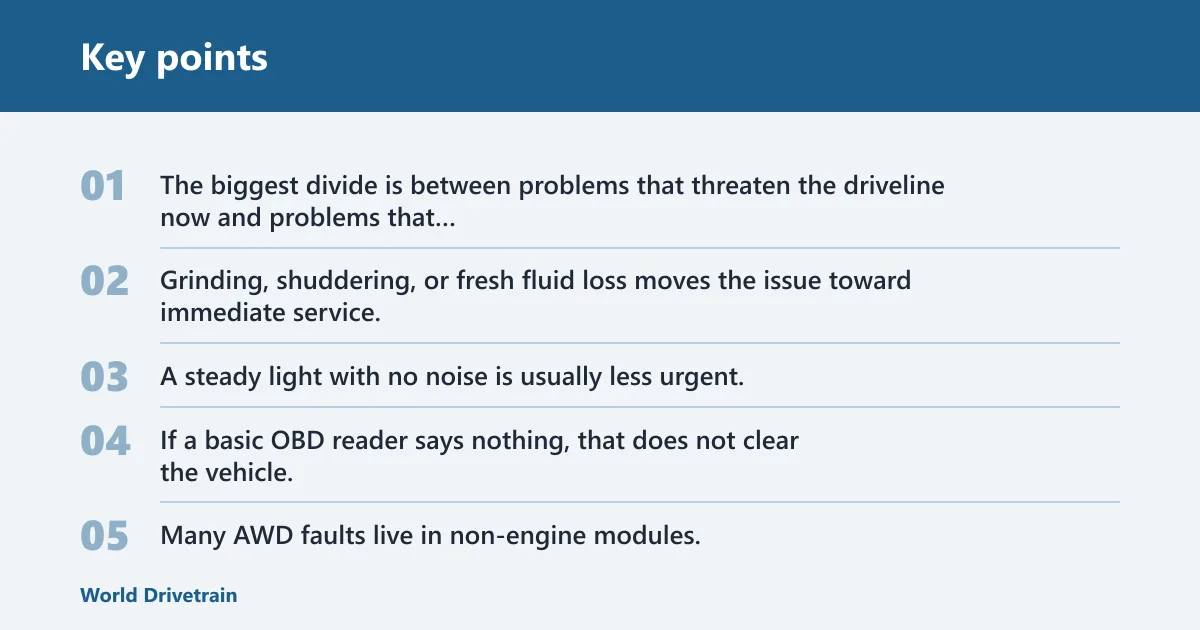
The biggest divide is between problems that threaten the driveline now and problems that mainly reduce traction. Grinding, shuddering, or fresh fluid loss moves the issue toward immediate service. A steady light with no noise is usually less urgent, but it still deserves a scan because the system may already be limiting AWD help.
Module location matters. If a basic OBD reader says nothing, that does not clear the vehicle. Many AWD faults live in non-engine modules, and the ABS or transfer case computer may store the deciding code.
Can you drive with the AWD light on?
Sometimes yes, but only for a short and careful trip if the vehicle has no grinding, binding, heavy vibration, or severe warning lights. The main risk is reduced traction or a disabled AWD function, not always immediate breakdown. If the light is flashing or the vehicle feels abnormal, reduce driving and get it checked.
When driving is usually possible
If the light is steady, the vehicle drives normally, and there is no noise or shudder, the safest assumption is that AWD support may be reduced but basic motion is still available. That is a driveable-but-needs-service situation, not a reason to ignore the warning for weeks.
When to stop driving now
Stop driving if the light comes with grinding, binding in turns, a strong shudder, burning smell, fluid loss, or repeated flashing after start-up. Those signs suggest possible transfer case, differential, or coupling damage. Continuing to drive can turn a repair into a much larger one.
How reduced AWD changes traction
When the system detects a fault, it may limit power distribution to protect itself. That can leave the vehicle behaving like front-wheel drive or rear-wheel drive depending on design. Dry pavement may feel normal, but wet, snowy, or loose surfaces can expose the loss of AWD support quickly.
What causes AWD and check engine lights to come on together?
These lights often appear together because the systems share sensor data and fault information. A wheel speed sensor problem, a battery voltage drop, or a communication fault can trigger both. A powertrain issue can also affect how the AWD system decides when and how to send power to the wheels.
Shared sensor data between systems
Wheel speed data is a common link. If that signal looks wrong, the ABS system may complain, traction control may react, and AWD logic may stop trusting the input. That is why a fault can spread across several dash messages even if the drivetrain hardware is still intact.
Powertrain faults that affect AWD control
Engine performance faults can change torque output, which changes how AWD control behaves. A misfire, throttle issue, or communication loss can cause the AWD module to flag a problem because it can no longer coordinate power delivery correctly. Some vehicles will also reduce traction assistance to protect the system.
Which codes and modules matter most?
Start with engine, ABS, AWD or transfer case, and body control modules. A basic reader may only show the engine side and miss the code that matters. If the scan tool can display live wheel speeds, transfer case data, and module communication status, that is even better.
How do I fix an AWD warning light?
Fix the simple causes first, then move to scans and mechanical inspection. Start with tire match, battery and charging checks, then scan the modules that actually control AWD behavior. If fluid is low, dirty, or leaking, that moves the problem from electrical troubleshooting to driveline service.
Match tires and correct pressure first
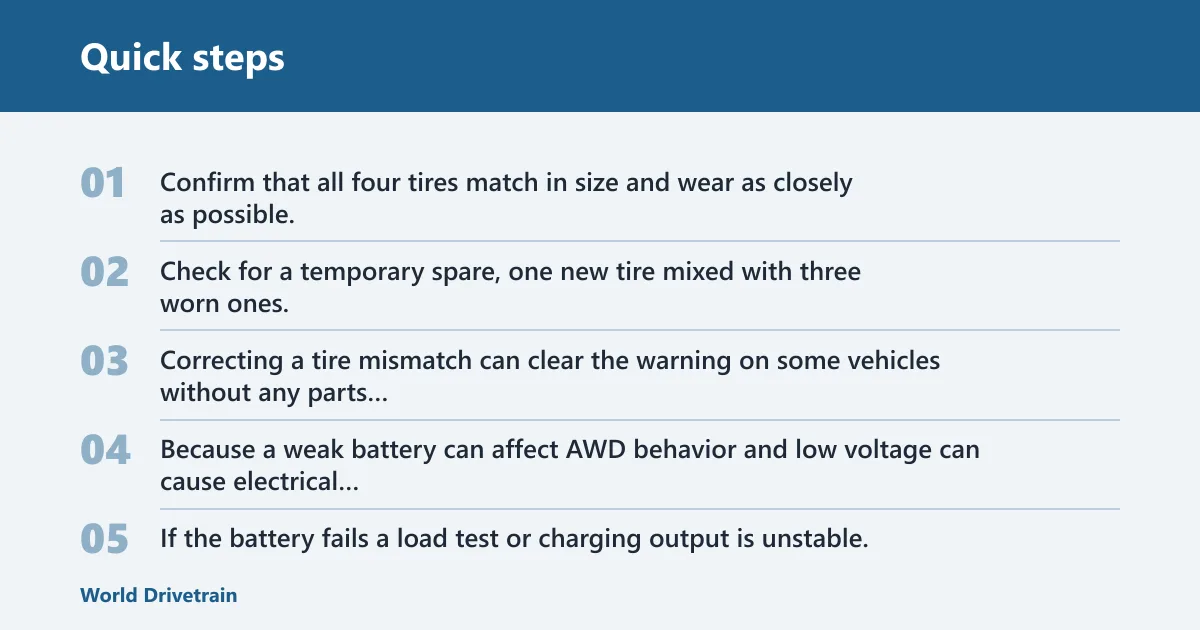
Confirm that all four tires match in size and wear as closely as possible. Check for a temporary spare, one new tire mixed with three worn ones, or incorrect pressure that could change rolling diameter slightly. Correcting a tire mismatch can clear the warning on some vehicles without any parts replacement.
Test battery and charging output
Because a weak battery can affect AWD behavior and low voltage can cause electrical instability, battery testing belongs near the top of the list. If the battery fails a load test or charging output is unstable, fix that before chasing sensor codes. One bad voltage reading can create several false leads.
Scan ABS, transfer case, and body modules
Do not stop at a generic code reader if nothing obvious shows up. AWD-related data may live in the ABS module, transfer case module, or body control module. Live wheel-speed data, module network status, and stored codes such as C0408 or C04091 can point you toward the real fault.
Inspect fluid condition, leaks, and damaged wiring
Check transfer case and differential fluid level and condition if the vehicle allows it. Low, dark, burnt, or contaminated fluid can point to heat and wear. Inspect the harnesses near wheel speed sensors and underbody connectors for damage, corrosion, or chafing, especially if the warning comes and goes.
A common first-timer mistake is to replace a sensor before checking the battery and tire setup. If the vehicle has one mismatched tire and a weak battery, both can feed the same warning pattern. Fixing the easy fault first saves time and keeps the diagnosis honest.
Frequently asked questions
What does the AWD warning light mean?
The AWD warning light means the all-wheel-drive system has detected a fault or a temporary operating limit. It can also indicate a system status on some vehicles. Use the owner’s manual for that model’s exact message, then note whether the light is steady or flashing and whether other warnings are present.
Why is the AWD light flashing?
A flashing AWD light often means the system is reacting to changing wheel slip or an intermittent fault. It can also happen with low voltage or a sensor signal that drops in and out. If the flashing continues after normal driving conditions return, a scan is the next step.
Should I check fluid or battery first when the AWD light comes on?
Check the battery first if the vehicle has multiple warning lights, slow cranking, or recent starting trouble. Then check fluid if there is grinding, shuddering, or a driveline odor. If neither points to the fault, move to tire checks and a module scan for the stored code.