4WD Not Engaging: Causes, Fixes, and Cost
4WD usually fails to engage because one of four points has failed: the shift command, transfer-case actuator, front-axle engagement system, or the vacuum/electrical controls between them; diagnosis starts with whether the transfer case shifts and whether the front axle locks. Driving it as-is can leave you stuck, cause gear damage from partial engagement, or turn a roughly $40 hose fault into a much more expensive axle or transfer-case repair. This guide sorts the symptoms by pattern, shows the likely failed subsystem, notes when it is safe to drive, and gives realistic repair-cost ranges.
The quickest way through this is to read the indicator light as a clue, then separate transfer case engagement from front axle engagement. A part-time 4WD system locks the front and rear driveshafts together, and 4WD is meant for off-road use or extremely slippery surfaces. Using 4WD on pavement can cause driveline binding, while AWD can be used on pavement with no ill effect. (Caranddriver)
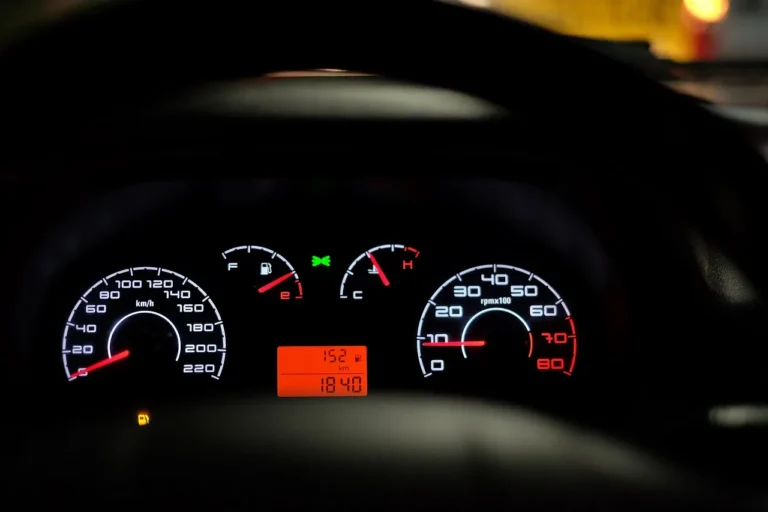
If the dash shows nothing, start with power supply. If the light flashes, suspect a failed shift, bad position feedback, or an actuator that did not reach its target. If the light goes solid but the front tires still do not pull, the transfer case may have shifted while the front axle disconnect did not. If it grinds, stop and inspect before trying again.
Symptom pattern
No light, no click, no change
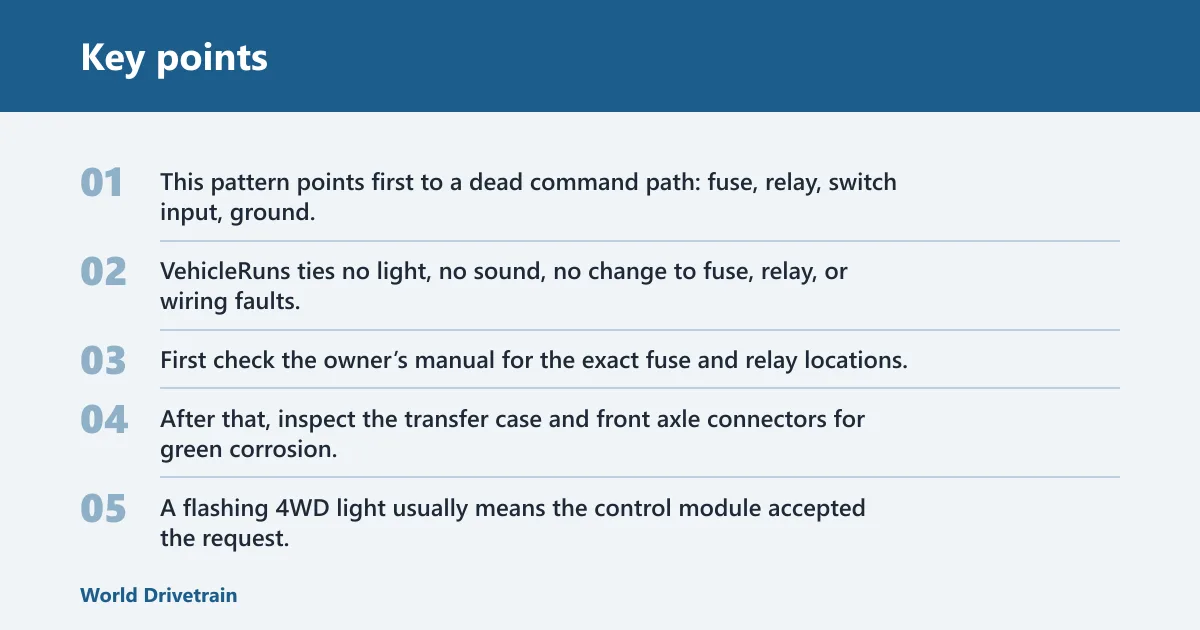
This pattern points first to a dead command path: fuse, relay, switch input, ground, wiring, or a control module that is not getting power. VehicleRuns ties no light, no sound, no change to fuse, relay, or wiring faults, and that matches what usually turns up in the first electrical checks.
First check the owner’s manual for the exact fuse and relay locations, then verify battery condition, fuse continuity, and relay function. After that, inspect the transfer case and front axle connectors for green corrosion, loose pins, and torn loom near the frame or skid plate.
Flashing light, then nothing happens
A flashing 4WD light usually means the control module accepted the request, powered the shift circuit, and then did not see the expected transfer-case position change within its time limit. VehicleRuns identifies this pattern as a likely shift actuator problem, though a position sensor fault, wiring issue, or transfer case bind can create the same failed-shift signal.
This is where a scan tool helps. It can read transfer case codes, show whether the control module received the request, and on many vehicles command actuator movement instead of leaving you to infer movement from dash lights alone.
Light says 4WD, but the front wheels do not pull
This is the pattern many owners misread. The transfer case can shift into 4HI or 4LO while the front axle disconnect never locks, so the dash may indicate a successful shift while the front tires still freewheel. VehicleRuns notes that a solid 4WD light with no front-wheel pull can indicate a front axle disconnect fault.
On some trucks that disconnect is vacuum-operated. On others it is electric, using a motor, fork, or collar inside the axle housing. The test path changes with the design, so the axle-side hardware matters here.
Grinding, banging, hopping, or bind
Grinding or banging when selecting 4WD usually points away from a simple fuse and toward a mechanical problem, low fluid, wrong fluid, or a shift made under the wrong conditions. The same source says a clunk or grind when selecting 4WD can indicate internal transfer case wear.
Hopping, tire chirp, and steering resistance on dry pavement can be normal driveline wind-up in part-time 4WD, not a failed component. Since 4×4 is synonymous with 4WD, the same dry-pavement warning applies whether the badge says 4×4 or 4WD.
📊 4×4 is synonymous with 4WD. Source: AWD vs. 4WD Explained.
What should you check first when 4WD won’t engage?
Start with the exact shift procedure in your owner’s manual, including whether your system requires 4LO selection from a full stop, under 3 mph, with the brake applied, or with the transmission in neutral, then check the 4WD fuse, relay, battery voltage, and obvious harness damage before replacing parts. Next inspect the transfer case and front axle connectors, and check transfer case fluid level and condition before repeated shift attempts or road testing.
First 10-minute inspection
- Confirm whether the vehicle requires a full stop, low speed, brake applied, or transmission in neutral for 4LO. Many systems will block 4LO if that procedure is skipped.
- Try 4HI first on a loose or slippery surface, not dry pavement.
- Check for a 4WD indicator response: no light, flashing light, or solid light.
- Inspect battery voltage health indirectly by watching for slow cranking or multiple warning lights. Low system voltage can block module and actuator operation.
- Pull and inspect the 4WD fuse. Swap the relay with an identical known-good relay if the fuse is intact and the box layout allows it.
- Look under the vehicle with a flashlight at the transfer case motor connector, front axle actuator or vacuum lines, and nearby grounds.
- Check transfer case fluid level and condition if the unit is noisy, binds, or grinds.
- Scan the transfer case control module and body control module for stored, current, or history codes such as shift-motor circuit, encoder position, range-position, or request-input faults if a scan tool is available.
Tools that actually help
- Owner’s manual
- Flashlight
- Fuse puller
- Test light or multimeter
- Scan tool, if available
Suppose the selector is moved into 4LO in a supermarket parking lot while the transmission stays in Drive and the truck is still rolling. A blocked shift there does not prove a bad transfer case. Repeat the test with the correct neutral-and-brake procedure first, then judge the hardware.
Verifying Actual Engagement on Loose Surfaces
Many drivers rely solely on dashboard indicators, which can provide false positives if hubs or transfer case components are faulty. To confirm your system is actively engaging, perform a loose-surface pull test where the front driveshaft turns and the front wheels exert force. This method identifies steering bind or driveline wind-up that dash lights ignore. Use this pass/fail checklist to distinguish between part-time, full-time, and electronic systems. Learn 4WD engagement verification steps to ensure your vehicle is truly ready for low-traction conditions.
4WD fault matrix
| Symptom pattern | Likely failed subsystem | First check | Safe to drive? | Typical repair-cost band |
|---|---|---|---|---|
| No light, no sound, no change | Fuse, relay, switch input, wiring, connector, ground, power supply | Check 4WD fuse and relay, verify connector power and ground | Usually yes in 2HI if no noises or leaks, but no 4WD available when needed | $10-$40 fuse, $20-$80 relay, $100-$300 switch, $100-$500 wiring or ground repair |
| Flashing light, then no engagement | Transfer case shift actuator, position feedback circuit, module code, bind | Scan transfer case codes and command actuator movement | Usually yes in 2HI if the case is fully in 2HI and quiet; avoid repeated shift attempts | $250-$800 actuator replacement and calibration, $100-$500 wiring repair |
| Click heard, but no engagement | Actuator travel issue, weak motor, internal transfer case binding, low fluid | Verify fluid condition, inspect actuator movement, scan for position mismatch | Maybe, only if it stays in 2HI and makes no noise; stop if it grinds or partly engages | $120-$250 fluid service, $250-$800 actuator, $1,200-$3,500 internal transfer case repair or replacement |
| Dash shows 4WD, but front wheels do not pull | Front axle disconnect, front axle actuator, vacuum leak, axle-side wiring | Confirm front driveshaft turns, then test axle actuator or vacuum supply | Yes in 2HI or if shifted back cleanly; traction is reduced because front axle is not locked | $40-$200 vacuum leak or solenoid, $250-$700 front axle actuator, $300-$1,500 disconnect repair |
| Grinding or banging during shift | Internal transfer case wear, damaged engagement parts, low or wrong fluid | Stop, inspect fluid immediately, do not keep forcing the shift | No until inspected | $120-$250 fluid service if caught early, $1,200-$3,500 transfer case internal repair or replacement |
| 4HI works, 4LO does not | Wrong shift procedure, range actuator fault, range position sensor, internal range issue | Retry with neutral, brake applied, and the procedure in the manual | Yes in 2HI or 4HI if normal, but 4LO remains unavailable | $0 procedure correction, $250-$800 actuator or sensor repair, $1,200-$3,500 internal transfer case work |
Why is the 4WD light flashing but nothing engages?
A flashing 4WD light usually means the control module accepted the request but did not finish the shift. The usual causes are a weak or failed transfer case shift actuator, a position feedback fault, driveline bind, or a stored module code that blocks actuator travel.
What the transfer case is doing
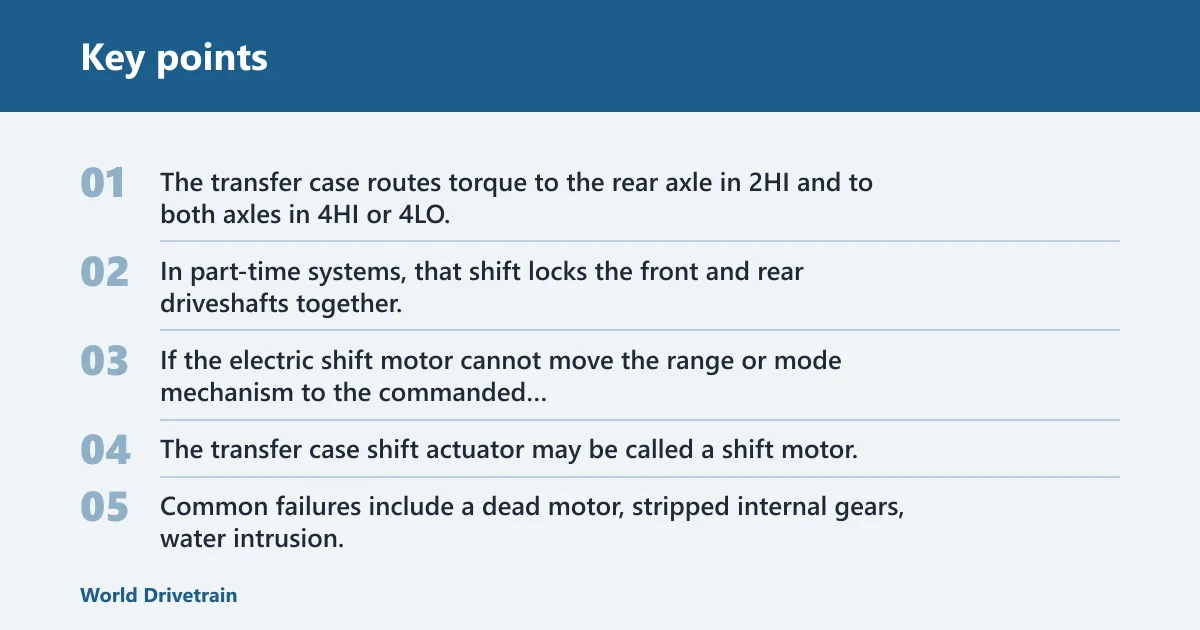
The transfer case routes torque to the rear axle in 2HI and to both axles in 4HI or 4LO. In part-time systems, that shift locks the front and rear driveshafts together. If the electric shift motor cannot move the range or mode mechanism to the commanded position, the light often flashes instead of turning solid.
How actuator faults show up
The transfer case shift actuator may be called a shift motor. Common failures include a dead motor, stripped internal gears, water intrusion, or bad position feedback that makes the module think the case never reached the target position.
The clue is often consistency. If every request produces the same flash-and-fail pattern, the actuator or its feedback circuit moves to the top of the list. Intermittent operation after mud, salt, or water points harder at connectors and grounds.
What the first test should
Use a scan tool that can access the transfer case control module. Look for stored codes, commanded state, and live position data. If the module shows the command but the actuator never moves, check power and ground at the actuator connector before replacing the motor.
Say your SUV flashes the 4WD light for ten seconds every morning after a wet snow, then shifts normally once the weather dries out. That pattern changes one variable: moisture. Corroded pins or a poor ground fit that pattern better than stripped transfer case gears.
Likely repair and cost
Typical repairs are connector cleaning, wiring repair, or transfer case shift actuator replacement. Some systems need a relearn or calibration after actuator replacement so the module can relearn the travel endpoints. Expect about $250-$800 for actuator replacement and calibration, or $100-$500 if the fix is wiring instead.
Why does the dash say 4WD but the front wheels don’t pull?
If the dash says 4WD but the front wheels do not pull, the transfer case may have shifted while the front axle disconnect failed to lock. That points to the axle-side system: a vacuum leak, bad axle actuator, failed disconnect collar, or wiring fault at the front differential.
Transfer case engaged does not mean the axle locked
This distinction matters. The transfer case can send torque toward the front driveshaft, but if the front axle disconnect stays open, the front wheels still will not drive. That is why a solid indicator light does not guarantee front-wheel pull.
Vacuum-operated front axle systems
These systems use engine vacuum, hoses, a solenoid, and a diaphragm or actuator to move the disconnect. Cracked lines, split elbows, failed vacuum solenoids, and sticky shift forks are common faults. The first check is vacuum supply at the actuator while 4WD is commanded.
Vacuum faults can be cheap if found early. A small hose or connector issue may land in the $40-$200 range, while a failed vacuum actuator or disconnect mechanism climbs higher.
Electric front axle actuators
Electric systems use a motor or thermal-style actuator to slide a collar that joins the axle shafts. The first check is whether the actuator receives voltage and ground when 4WD is requested. If power is present but the collar does not move, the actuator or disconnect mechanism is suspect.
Likely repair and cost: front axle actuator replacement commonly
Front axle actuator replacement commonly runs about $250-$700. If the disconnect housing, fork, or collar is damaged, repair can move into the $300-$1,500 range depending on axle design and labor access.
Can low transfer case fluid keep 4WD from engaging?
Yes. Low, old, contaminated, or incorrect transfer case fluid can cause poor shift quality, binding, noise, heat, and accelerated internal wear. Fluid alone will not fix every no-engage complaint, but it should be checked early, especially if 4WD clicks, grinds, or binds during engagement.
What fluid problems change
The transfer case depends on the correct fluid to lubricate chains, bearings, forks, synchronizing parts where fitted, and actuator-related internal movement. Low or degraded fluid raises friction and heat. That can make a shift motor struggle or make internal parts resist movement.
What to look
- Burnt smell
- Dark or dirty fluid
- Metal debris on the drain plug or in the fluid
- Leaks at case halves, seals, or output shafts
- Noise that changes under load or during shifts
When fluid service may help, and when it will not
If the unit is merely low or the fluid is overdue, servicing it may restore cleaner shifts and prevent more wear. If the case already grinds, bangs, or spits out metal, fluid is evidence, not a cure.
Repair cost spans a wide band here. A fluid service may run about $120-$250. Internal transfer case repair or replacement commonly lands around $1,200-$3,500, depending on whether the case can be rebuilt, whether a chain or range component is damaged, and local labor rates.
Why won’t 4LO engage when 4HI does?
When 4HI works but 4LO does not, first suspect shift procedure rather than immediate hardware failure. Many vehicles require neutral, brake applied, and very low speed or a full stop for 4LO. If the procedure is correct, focus on the range actuator, range position feedback, or internal range mechanism.
4HI and 4LO follow different paths
4HI usually changes mode. 4LO adds a low-range gear change inside the transfer case, so the system often asks for stricter conditions before it will move. That is why 4HI can engage normally while 4LO refuses.
Separate procedure error from hardware failure
If 4LO never works even with the correct neutral-and-brake sequence, check for a range-related code with a scan tool. A mode actuator may be fine while the range section fails to move, or the module may not see the transmission and brake inputs it needs to allow the shift.
A common first-timer mistake is trying 4LO while creeping downhill on packed snow with the transmission still in gear. The failed request looks dramatic on the dash, but the fix can be nothing more than repeating the shift with the vehicle stopped and the transmission in neutral.
Why does 4WD bind or refuse to engage on dry pavement?
Part-time 4WD can bind on dry pavement because the system locks the front and rear driveshafts together, and the tires cannot slip enough to release the speed difference between axles in a turn. That causes shudder, hopping, chirp, steering resistance, and sometimes refusal to shift cleanly.
When this is normal wind-up
Part-time 4WD is meant for loose dirt, mud, snow, sand, or ice, not ordinary dry pavement. Consumer Reports says all-wheel and four-wheel-drive systems provide superior traction in some slippery conditions, but it also notes tire choice makes a big difference in traction and road holding. Extra driven wheels do not cancel the need for the right surface and the right tires.
How to relieve bind safely
If the system is wound up, move to a loose surface if possible. Then drive straight and shift back to 2HI using the vehicle’s listed procedure. On some vehicles, reversing straight briefly can help release stored tension, but only if the manual allows it and the system is otherwise healthy.
When bind suggests a fault
If the truck binds on loose ground, refuses to come out of 4WD after tension is relieved, or grinds while trying to disengage, inspect for a transfer case or axle problem. Do not keep forcing the selector.
Repair cost by failed part
Electrical supply and command faults
Small electrical faults are the cheapest branch. A fuse may cost about $10-$40 installed, depending on diagnosis time and whether more than one circuit is involved. A relay often falls around $20-$80. A switch input or selector repair can be about $100-$300. Wiring, connector, or ground repair usually ranges from $100-$500, though a badly damaged harness can go higher.
Transfer case shift actuator
Actuator replacement generally runs about $250-$800 including diagnosis, depending on access, part quality, and whether the system needs relearn or calibration. If the actuator failed because the transfer case was binding internally, replacing the motor alone will not last.
Front axle disconnect and vacuum or electric axle faults
Vacuum line or solenoid repairs can be as low as $40-$200 when the leak is easy to reach. Electric front axle actuators often run $250-$700 installed. If the disconnect collar, fork, or axle-side mechanism is damaged, expect roughly $300-$1,500.
Fluid service and internal transfer case repair
Transfer case fluid service is commonly about $120-$250. Internal repair or full replacement usually starts around $1,200 and can reach $3,500 or more depending on the unit, parts availability, and whether related driveline damage is present.
Safe-to-drive calls by symptom
- No light, no engagement: usually safe to drive in 2HI if the vehicle is quiet and dry underneath, but 4WD will not be available.
- Flashing light: usually driveable in 2HI if the case is fully back in 2HI and there is no noise; avoid repeated attempts.
- Dash says 4WD but front wheels do not pull: often driveable after returning to 2HI, but do not trust the system for traction needs until fixed.
- Grinding or banging: stop driving until inspected.
- Dry-pavement bind: relieve wind-up first; do not keep turning tightly in 4WD on pavement.
Frequently asked questions
Why is my 4WD not engaging?
Usually because the shift request never reaches the system, the transfer case actuator does not complete the shift, the front axle disconnect fails to lock, or wiring and grounds interrupt power or feedback. The quickest split is whether the transfer case shifts and whether the front axle actually pulls.
What causes electric 4 wheel drive not to engage?
Electric 4WD systems commonly fail because of a bad shift motor, faulty position sensor, blown fuse, failed relay, corroded connector, poor ground, or module code. If the light flashes, actuator or feedback faults move up the list. If nothing lights at all, start with power supply checks.
How do I know if my 4WD actuator is bad?
A bad transfer case actuator often shows up as a flashing 4WD light, repeated failed shifts, or a click with no engagement. Confirm it with power-and-ground testing and a scan tool that shows command and position data. Replace it only after ruling out fuse, relay, and connector faults.
Can a blown fuse stop 4WD from working?
Yes. A blown fuse can leave the system with no light, no sound, and no change when 4WD is requested. That pattern fits a power or command fault better than a damaged transfer case. Check the fuse, then the relay, then the wiring and grounds on the affected circuit.
How much does it cost to fix 4WD not engaging?
The spread is wide because the failure points range from a small electrical issue to internal transfer case damage.
Should I stop driving if 4WD makes grinding noises?
Yes. Grinding, banging, or repeated partial engagement means stop and inspect before trying again. That pattern can signal low fluid, wrong fluid, internal wear, or damaged engagement parts, and forcing more shift attempts can turn a repairable issue into a much more expensive transfer case failure.