What Causes Electric 4 Wheel Drive Not to Engage?
Electric 4-wheel drive that will not engage is usually caused by a blown fuse, bad switch, failed transfer-case actuator, damaged wiring, or a front-axle disconnect fault; the first clue is the symptom pattern, not the dash button. Ignoring it can leave you in 2WD, strand you on slick ground, and turn a small electrical fault into a transfer-case or axle repair. This guide maps no light, flashing light, click/no shift, and dash-engaged-but-no-front-pull to the most likely fault and next check.
What the symptom means
The fastest diagnosis starts with the way the system behaves, not with parts swapping. No light and no click usually points to a power problem. A flashing light with no engagement points more toward the shift actuator or range feedback. If the dash says 4WD but the front wheels do not pull, suspect the front axle side.
Grinding or banging changes the urgency. That usually means the transfer case or gear engagement is not lining up correctly, and repeated button presses can make damage worse. 4HI and 4LO can also fail in different ways. A system that shifts one range but not the other often has a control, feedback, or procedure problem rather than a fully dead 4WD system.
4WD symptom matrix
| Observed behavior | Likely failed entity | First test | Urgency |
|---|---|---|---|
| No light, no click | Fuse, relay, or power supply | Check the 4WD fuse, relay, and related power feed | Low to moderate |
| Light flashes, but 4WD never engages | Transfer case shift actuator or position feedback | Listen for actuator movement and scan for module codes | Moderate |
| 4HI works, but 4LO fails | Shift procedure fault, range sensor, or actuator weakness | Verify stop procedure and read transfer-case data | Moderate |
| Dash says engaged, but front wheels do not pull | Front axle actuator, disconnect, or hubs | Check axle engagement and related vacuum or electrical control | Moderate to high |
| Grinding or banging on shift | Transfer case internals, fluid condition, or gear engagement issue | Stop repeated shifting and inspect fluid and linkage | High |
Older vacuum systems and newer electronic systems split the diagnosis early. If the front axle uses vacuum hoses or manual hubs, start there. If the truck has a switch, module, transfer case shift motor, and front axle device, the fault may be in the command side, actuator side, or feedback side.
Why does my electric 4 wheel drive not engage?
Electric 4WD does not engage when the command never reaches the system, the actuator cannot move the transfer case, the front axle does not lock, or the module aborts the shift because feedback looks wrong. Modern 4WD systems can include a switch, module, transfer case shift motor, and front axle device, so one bad link can stop the whole sequence.
That is why the symptom matters so much. A flashing indicator with no actual engagement is a classic sign of a failing electric shift motor. A no-light, no-click complaint points first to power or control loss. A dash that shows engaged while the front tires still freewheel points to the front axle side, not the transfer case alone.
Start with the command side
The command side includes the 4WD switch or selector, fuse, relay, power feed, ground, wiring, and the 4WD control module. If that side is dead, the actuator never gets a clean request. If the switch sends a bad request, the module may ignore it or store a fault and stop the shift.
- Check the 4WD fuse and relay first.
- Confirm battery voltage and a solid ground at the system feed.
- Inspect the selector for wear, corrosion, or a loose connector.
- Scan the 4WD module for codes and mode data.
- Inspect electrical runs near the transfer case and underbody for moisture, pulled pins, or green corrosion.
A common first-timer mistake is to replace the transfer case motor before checking the connector. If a plug is filled with road salt or the pins are spread, the motor can be fine and still never move. Exposure matters because the transfer case motor sees mud, road salt, and water crossings.
What should I check first when 4WD won’t engage?
Check the fuse, relay, and power supply first, then confirm the selector and wiring before changing any actuator. No 4WD light and no click points first to a blown fuse or power fault. That order is fast, low-cost, and far more useful than guessing at a motor or axle part before the circuit is proven.
If the fuse is good, move to the switch, connector, and grounds. Then use a scan tool that reads the 4WD or transfer-case module. That can cut hours of guessing because it shows whether the module sees your request, whether it receives a valid range signal, and whether it is trying to shift at all.
Command-side checks in order
- Fuse and relay for the 4WD system
- Battery voltage and ground quality
- Switch or selector input
- Wiring continuity and connector condition
- Module codes and live data
Suppose you press the dash switch in 2WD on a wet driveway and get no indicator at all. That points you toward a fuse, relay, switch, or power feed fault before you ever blame the transfer case motor. If the same truck gives a flashing light and a brief whir, the diagnosis moves away from the command side and toward actuator movement or feedback.
Transfer case actuator faults
The transfer case shift actuator is the electric motor and gear unit that moves between 2HI, 4HI, and 4LO. A weak actuator, stripped plastic gears, worn brushes, burned-out windings, moisture corrosion, or lost position feedback can all stop a shift. A failed or weak shift motor is one of the most common reasons the system flashes a 4WD light but never actually changes modes.
Common symptoms include a click, a short whirring sound, or a light that flashes and then stays on without engagement. That is especially important when 4HI works but 4LO fails. In that case, the actuator may still have enough strength to complete one shift range but not the slower or more demanding range change.
How to tell the actuator is the suspect
How do I know if the transfer case actuator is bad? Start with the symptom pattern. A flashing 4WD indicator with no actual engagement is a classic symptom of a failing electric shift motor. If you hear a click or whir but the truck stays in the wrong mode, check for actuator movement, position feedback, and codes before replacing the unit.
Range sensor or position feedback matters here. If the module does not see the expected position change, it may stop the shift even if the motor tried to move. That is why scan-tool data helps. It can show whether the module asked for 4HI or 4LO, whether it saw movement, and whether it aborted the shift.
Why 4HI and 4LO point to different faults
Why does 4LO fail even when 4HI works? 4LO will not engage after stopping may be a shift-procedure or range control fault. The low-range change needs the transfer case to line up correctly, and a weak actuator or incorrect range signal can prevent that final move even when high range shifts normally.
If 4HI engages but 4LO will not, do not assume the entire system is dead. Check the stop procedure, brake input if the vehicle uses it, range sensor data, and actuator behavior. A partially weak actuator or a sensor that lies about position can create exactly that split symptom.
Does the front axle engage?
If the dash says 4WD is engaged but the front wheels do not pull, the front axle actuator is a likely fault. That means the transfer case may have shifted, but the front axle disconnect did not lock in. On older systems, the same symptom can come from vacuum lines or locking hubs instead of an electric axle device.
Can a bad front axle actuator make 4WD seem like it engaged? Yes. The indicator and transfer case can both look normal while the front axle remains disconnected. That creates a false good reading unless you verify front-wheel pull on loose ground or check the axle engagement device directly.
Older systems versus newer systems
Older systems may use locking hubs, while electronic systems rely on actuators and sensors. On a manual-hub truck, the hubs must lock correctly before the front wheels will drive. On a vacuum-actuated front axle, cracked or split hoses can keep the axle from engaging even though the transfer case has shifted.
Vacuum lines matter most on older axle systems. Brittle hoses, split fittings, or mud and water exposure can create an intermittent fault that comes and goes after a storm or trail run. If the truck is older and has no front axle motor, do not skip the vacuum inspection.
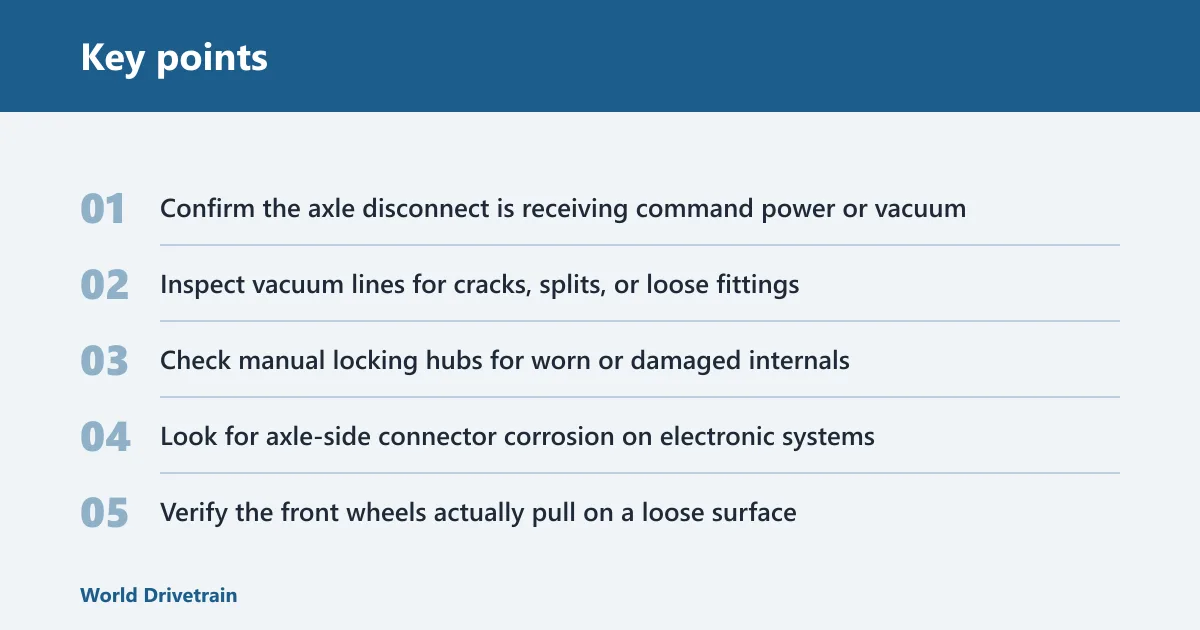
Front axle checks
- Confirm the axle disconnect is receiving command power or vacuum
- Inspect vacuum lines for cracks, splits, or loose fittings
- Check manual locking hubs for worn or damaged internals
- Look for axle-side connector corrosion on electronic systems
- Verify the front wheels actually pull on a loose surface
Picture a pickup that shifts into 4HI with a dash light, but the front tires still spin freely on gravel. That is a front axle symptom until proven otherwise. The transfer case can be working while the axle disconnect, vacuum circuit, or hubs stay open.
Range sensor and module checks
The 4WD control module receives the driver command from the switch or selector, processes the mode change request, and stores fault codes. If the range sensor or position feedback disagrees with the selected mode, the module can cancel the shift and leave the light flashing. That is why the dash may say one thing while the drivetrain does another.
A scan tool that reads the 4WD or transfer-case module can cut hours of guessing. It helps confirm whether the module sees the switch request, whether the range sensor is changing, and whether the system is stuck on an invalid position. That is more useful than replacing parts by pattern alone.
What feedback problems look like
Feedback faults often look like a failed actuator because the symptoms overlap. The motor may click, the light may flash, and the system may abort. The difference is that the module may be seeing a bad position signal rather than a dead motor, so the repair may be a sensor, connector, or wiring issue instead of a full actuator replacement.
Intermittent 4WD operation after driving through water or mud can point to corroded connectors or sticky actuators. That pattern is especially useful when the truck works again after drying out. Moisture does not prove a bad module, but it does raise suspicion on connectors and exposed wiring near the transfer case.
Can a blown fuse stop electric 4WD from engaging?
Yes. A blown fuse can stop electric 4WD from engaging because it can remove power from the switch, module, relay, or actuator circuit. No 4WD light and no click points first to a blown fuse or power fault. That is why the fuse check belongs at the top of the list, not near the end.
If the fuse blows again after replacement, do not keep cycling the system. That suggests a shorted wire, a failing actuator, or a connector problem. At that point the repair is no longer a simple fuse swap; the circuit needs tracing before more parts are damaged.
4WD fluid and mechanical wear
Low or contaminated transfer case fluid can worsen engagement and contribute to grinding or wear. Transfer case fluid lubricates internal components, and if the fluid is old, low, or contaminated, the shift parts may not mesh cleanly. Grinding or banging when selecting 4WD means the issue may be at the transfer case or gear engagement level.
When service is not enough, suspect internal wear. A damaged shift fork, worn gear teeth, or other internal transfer case fault will not be fixed by an actuator or switch. If the system grinds repeatedly, stop testing and inspect the mechanical side before more damage spreads through the case.
When to stop trying
Is it safe to keep trying to engage 4WD if it grinds or bangs? No. Grinding or banging is a warning that the gears are not lining up correctly, and repeated attempts can chip teeth or damage the shift components. Stop the test cycle, check fluid level and condition, and inspect the transfer case before another shift attempt.
Frequently asked questions
What is the most common cause of 4WD not engaging?
The most common cause is often a failed or weak shift motor, especially when the 4WD light flashes but the system never changes modes. That said, a blown fuse or power fault is the first thing to rule out when there is no light and no click. Match the fault to the symptom first.
Why does the 4WD light flash but the truck stays in 2WD?
A flashing 4WD light with no actual engagement is a classic symptom of a failing electric shift motor or a position feedback problem. The module is seeing a problem during the shift attempt and may abort it. Check the actuator, connectors, and scan data before replacing the transfer case or front axle parts.
How do I know if the transfer case actuator is bad?
Look for flashing lights, clicking, short whirring, or a mode change that never completes. A bad actuator can be weak, stuck, or unable to report position correctly. Scan-tool data is useful because it shows whether the module is commanding the shift and whether the feedback ever confirms it.
Why does 4LO fail even when 4HI works?
4LO can fail while 4HI still works because low range depends on a different range position and often more exact feedback. The problem may be a shift-procedure issue, a weak actuator, or a range sensor fault. If the system shifts high range but not low range, do not assume the whole 4WD system is bad.