Why Is Transmission Fluid Leaking From the CV Axle Area?
Red or pink fluid near the CV axle usually points to a leaking axle seal, but thick, sticky fluid is usually CV grease. Check the location, texture, and whether the leak starts at the transmission case or the boot. Driving with the wrong diagnosis can damage the transmission, contaminate brakes, or waste money on parts you do not need. This guide shows how to separate axle seal leaks from CV boot grease, cooler-line splash, and housing damage before you replace anything.
Why fluid near the CV axle matters
A leak near the CV axle matters because that area sits beside several parts that can spread fluid outward. A front-wheel-drive CV axle typically passes through the wheel hub and connects the transmission to the wheel, so a transmission seal leak can appear to be a wheel-end problem. Fluid on the axle, knuckle, or splash shield can mislead you unless you trace it back.
What the leak location tells you
On many front-wheel-drive and transaxle layouts, the axle seal sits where the CV axle enters the transmission. That makes it a common leak point on the side of the transmission. If ATF appears on the inside of the wheel well, the control arm, or the subframe, the real source may still be the transmission case or seal, not the wheel itself.
Why the wheel well can mislead you
The wheel and suspension move fluid around. Rotation throws fluid onto the knuckle, strut, splash shield, and lower body panels, then gravity carries it down. A small seep can leave a wide stain pattern. That is why a red streak on the axle shaft is not proof that the axle is the source.
What a low ATF level can do
Low automatic transmission fluid can cause slipping, delayed engagement, and overheating, and OEM service information consistently treats low fluid as a drivability risk rather than a cosmetic issue. Fresh ATF is usually bright red or pink. Older fluid turns dark brown, and a low level can go unnoticed until shifting changes.
How to tell if it is ATF
Use color, feel, and location together. ATF is usually thin and slippery, and fresh fluid appears bright red or pink. Older fluid can be dark brown. Engine oil is usually darker and heavier, while coolant tends to feel watery and often leaves a colored crust when it dries.
Color and feel checks
Put a drop on a white paper towel or cardboard. ATF spreads fast and feels slick between the fingers. CV grease is often thicker and sticky, and it is commonly gray, black, or dark amber; it may cling in strings. Coolant smells sweet and dries differently. Engine oil usually leaves a darker, more greasy ring.
Why old ATF can be harder to spot
Older transmission fluid may not look bright red. Dark brown ATF near a road-dirty wheel well can look almost black. That is one reason the inspection needs a clean starting point. If residue has built up for weeks, the visible stain may be larger than the actual leak source.
CV axle leak trace table
Clean the area first, then use this checklist to follow the trail instead of guessing from the wettest spot.
| Fluid color | Feel | Source location | Likely culprit | Next action |
|---|---|---|---|---|
| Bright red or pink | Thin, slippery | Wet at the transmission side where the axle enters | Transmission axle seal | Clean, recheck, and inspect the seal lip and housing seat |
| Bright red or pink | Thin, splattered | Starts on a line above the axle, then runs down | Transmission cooler line or fitting | Inspect line rust, clamps, and fittings |
| Dark brown | Thin, oily | Transmission side or underbody trail | Old ATF from a seal, line, or housing seep | Trace upward to the highest wet point |
| Gray, black, or amber | Thick, sticky | Inside of the CV boot or thrown from a split boot | Torn CV joint boot | Inspect boot clamps and tears, then check for grease sling |
| Red or brown on a cracked edge | Thin, runs from a seam | Transmission housing or case seam near the seal seat | Housing damage or seep point | Look for impact marks and cracked casting before replacing the seal |
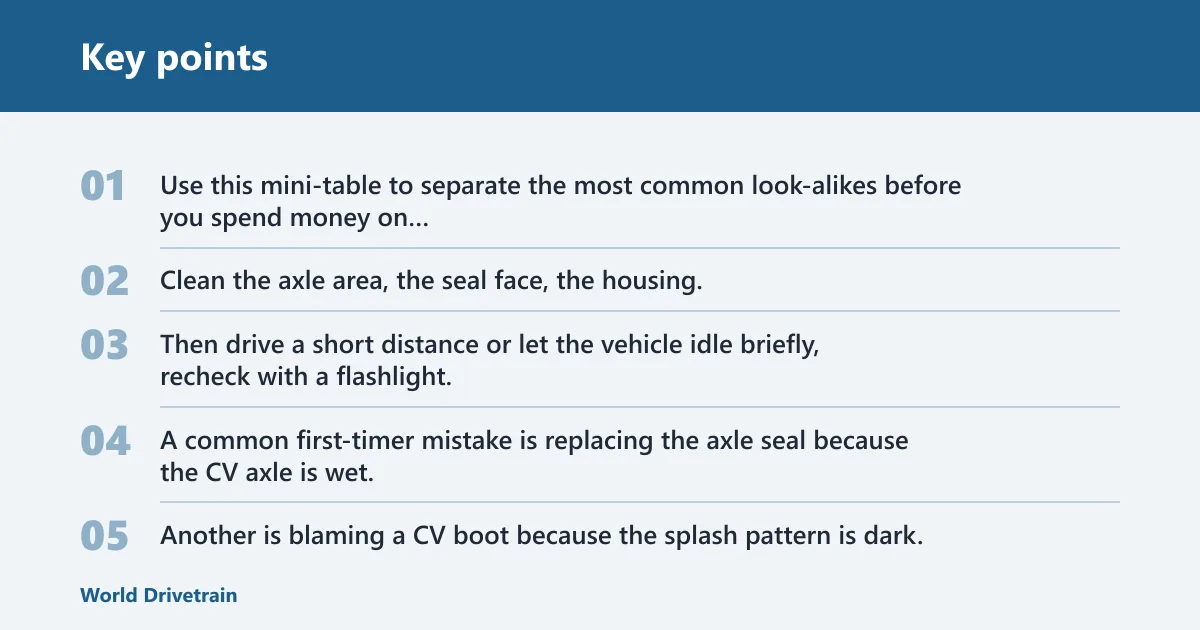
Use this mini-table to separate the most common look-alikes before you spend money on the wrong part.
| Common misdiagnosis | Single clue that separates it |
|---|---|
| Torn CV boot | Thick grease is inside the boot or slung in blobs near the joint |
| Axle seal | The wettest point is exactly where the axle enters the transmission case |
| Cooler line | The trail starts above the axle on a hard line, clamp, or fitting |
| Pan drip | The first fresh wet point is at the pan rail or gasket seam, not the axle bore |
How to use the checklist
Park on level ground. Raise the vehicle safely with jack stands. Clean the axle area, the seal face, the housing, and the nearby suspension parts with degreaser or brake cleaner. Then drive a short distance or let the vehicle idle briefly, recheck with a flashlight, and look for the highest fresh wet point.
A common first-timer mistake is replacing the axle seal because the CV axle is wet, when the fluid started above it and ran down the case. Another is blaming a CV boot because the splash pattern is dark, even though the fluid is thin ATF. Cleaning removes that guesswork.
Is it an axle seal or a CV axle boot leaking transmission fluid?
It is usually an axle seal if the wettest point is where the CV axle enters the transmission. It is usually a CV boot if the problem is thick grease inside or around the boot, with splits, torn clamps, or grease thrown in a circular pattern. The two leaks can sit close together, so the texture matters.
Clues that point to a transmission axle seal
A transmission axle seal leak often starts at the side of the transmission, then slings fluid onto the suspension and subframe. Heat and age can harden the rubber sealing lip. If the seal area is shiny, wet, and the nearby axle shaft is coated with thin red or brown fluid, the seal rises to the top of the list.
Clues that point to a torn CV boot
A torn CV boot leaks grease, not ATF. The grease is usually thicker and sticks to the inside of the wheel, the boot itself, and nearby parts. If the boot has a split or loose clamp and the material inside looks pasty rather than watery, that points to a boot problem instead of a transmission leak.
How grease sling differs from ATF spray
Grease sling tends to leave heavy blobs and streaks close to the boot. ATF spreads farther, runs thinner, and often coats the lower control arm, knuckle, or splash shield. If the wheel well has both, the boot may be torn and the transmission may also be leaking. Check both, do not assume one explains everything.
Other sources near the axle
The axle area can hide leaks from more than one system. Transmission cooler lines can route ATF near the front of the vehicle, and rust or loose fittings can leak fluid that travels along the undercarriage. A crack in the transmission case or a damaged housing seam can also mimic a bad seal.
Transmission cooler lines and fittings
Cooler lines carry ATF to and from the radiator cooler. If a line is rusted, bent, or loose at the fitting, fluid can drip forward or run back along the underbody before it falls near the wheel. That can make the axle area look guilty when the leak actually starts farther up the vehicle.
Transmission housing cracks and seep points
The transmission case or housing can crack near the axle seal seat after impact damage. In that situation, a new seal may not fix the leak. Look for chipped casting, wet seams, and fresh seep points around the seal bore. A seal that keeps failing after replacement may point to shaft wear or bearing play too.
Pan drips that travel to the wheel area
A loose or damaged transmission pan can leak at the gasket area, and ATF can track along air shields or frame shapes before dropping near the front wheel. Always use the vehicle-specific torque specification for the pan bolts; OEM service procedures vary by model and transmission, and many pans are tightened in a low inch-pound range with a crisscross pattern rather than a generic foot-pound number. Over-tightening can warp the rail and cause repeat leaks.
What to inspect first
Start with cleaning, then work upward from the lowest wet point to the highest fresh mark. That method separates the real source from the splash pattern. Use a flashlight, jack stands, a drain pan, and a white paper towel or cardboard. Guessing from a dirty wheel well usually leads to the wrong repair.
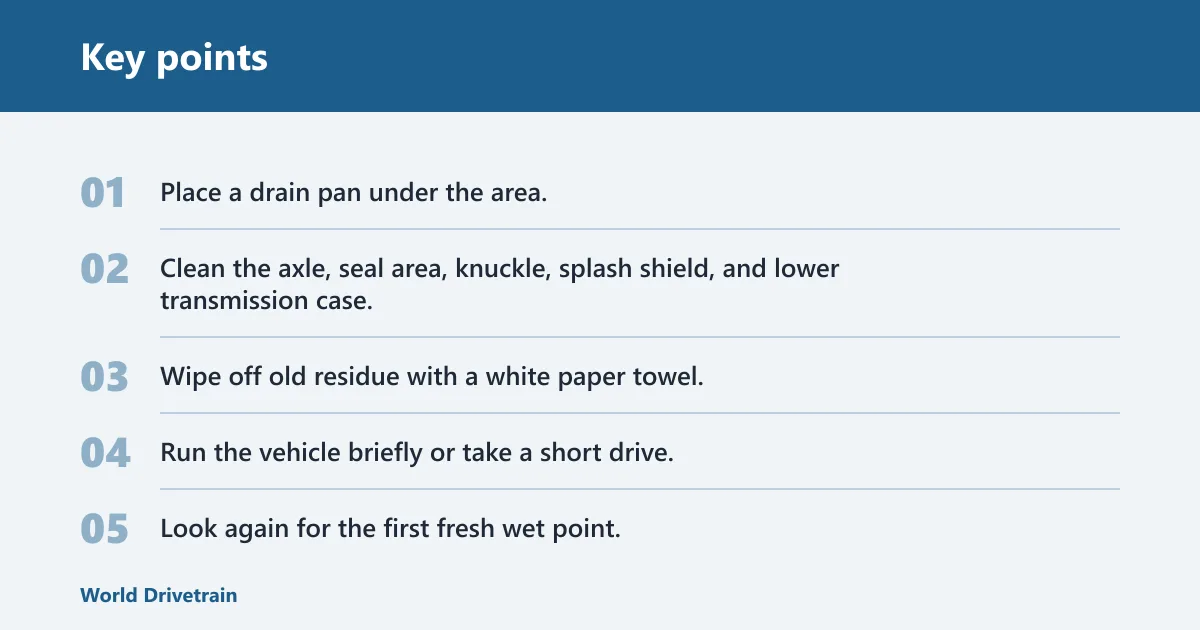
Clean the area and recheck
- Place a drain pan under the area.
- Clean the axle, seal area, knuckle, splash shield, and lower transmission case.
- Wipe off old residue with a white paper towel.
- Run the vehicle briefly or take a short drive.
- Look again for the first fresh wet point.
Trace the drip path upward
Follow the fluid trail from the floor up to the source. The highest fresh wet spot usually matters more than the lowest drip. If the trail starts at the seal and moves outward onto the suspension, that supports an axle seal leak. If it starts on a line above, the cooler line is the better suspect.
Look for axle shaft wear or play
Repeated seal leaks can happen when the axle shaft is grooved, the seal was installed at the wrong angle, or the bearing has play. A worn shaft can chew the seal lip until it leaks again. If a new seal failed quickly, inspect the shaft surface and the bearing fit before replacing another seal.
A front-wheel-drive car may leave a red spot about the size of a quarter on the driveway after a short drive if the seal or housing is leaking. If the inside of the wheel well is wet but the boot is dry and the fluid is thin, the seal or housing is more likely than the CV boot. If the boot is split and the material is thick and sticky, the diagnosis changes.
How serious is it?
It depends on leak rate and fluid level, but any steady ATF loss near the CV axle deserves quick attention. If the level is still within range and the leak is a light seep, a short drive to a repair shop may be reasonable. If the fluid is pouring, park it and stop driving.
When you can drive a short distance
A brief drive may be acceptable when the leak is minor, the transmission shifts normally, and the level is not obviously low. Check the dipstick if the vehicle has one and follow the manufacturer procedure. If shifting gets delayed, harsh, or slippy, do not keep testing it on the road.
When to park it and stop the leak from spreading
If fluid is dripping fast, spraying the wheel well, or reaching the brake area, stop driving. Transmission fluid on brakes is a safety problem, and low ATF can damage the transmission quickly. Tow it if the leak is large or the transmission has already started to slip. That warning is consistent with OEM driveability guidance: once line pressure or lubrication is compromised, continued driving can cause rapid internal damage.
Signs the transmission is already low
Watch for delayed engagement when shifting into drive or reverse, engine rev flare, slipping on acceleration, or overheating warnings. Those symptoms mean the leak is already affecting operation. A seal leak is not harmless just because the vehicle still moves.
How much does it cost to replace a transmission axle seal?
Axle seal repair is commonly listed at $100–$400, which is consistent with widely used labor-cost guides for seal replacement jobs. That range usually covers the seal and labor, but not every case is simple. If the housing is cracked, the axle shaft is worn, or the bearing has play, the total climbs because the root cause needs repair too.
For context, a transmission pan gasket leak is listed at $75–$350, and transmission cooler lines are listed at $100–$300. Torque converter seal repair is listed at $600–$1,500+. Those numbers help separate a moderate seal job from a deeper transmission repair.
What other parts can leak fluid near the CV axle?
Besides the axle seal and CV boot, the main suspects are cooler lines, fittings, the transmission housing, and the pan gasket if the leak tracks forward or outward. On rear-wheel-drive vehicles, an output shaft seal leak appears near the driveshaft yoke instead, and a front pump seal leak develops between the engine and transmission bell housing.
That layout difference matters. A front-wheel-drive axle seal leak sits right where the CV axle enters the transmission. An all-wheel-drive setup can add more shafts, couplings, or transfer case parts, so the trace path may be less direct. Do not assume every red drip near the front wheel has the same source.
Frequently asked questions
Why is transmission fluid leaking from the CV axle area?
Most often, it is an axle seal at the point where the CV axle enters the transmission, but cooler lines, a cracked housing, or pan-related splash can also put ATF near that area. The key is to find the highest fresh wet point, not the lowest drip on the floor.
How can I tell if the leak is transmission fluid and not engine oil or coolant?
Fresh ATF is usually bright red or pink, while older ATF can be dark brown. It feels thin and slippery. Engine oil is usually heavier and darker. Coolant is more watery and often leaves a colored crust after it dries. A white paper towel makes the comparison easier.
What does a leaking transmission axle seal look like?
A leaking axle seal usually shows wet fluid right where the axle passes into the transmission case, with a trail outward onto the suspension or subframe. The seal lip may look shiny or damp. If the housing around the seal is cracked or damaged, the leak can look very similar at first glance.
Can I keep driving if transmission fluid is leaking near the CV axle?
Only if the leak is light, the transmission still shifts normally, and the fluid level is not low. A steady drip or any slipping, delayed engagement, or overheating means you should stop driving. A small leak can become a transmission-damaging problem fast if the fluid level drops too far.
Can overfilled transmission fluid leak from the axle area?
Yes, overfilled ATF can be forced out through weak spots, including seals, but it should not be the default explanation. Treat overfill as one possible cause, not the first assumption. A leak at the axle area still needs the seal, housing, cooler lines, and boot inspected before you top off or drain anything.