What Is an Axle Seal Leak? Signs, Causes, and Fixes
An axle seal leak is fluid escaping past the axle shaft seal, usually because the seal is worn, the axle shaft has play, pressure is wrong, or debris cut the sealing lip. Leave it alone and the differential or transmission can run low, brake parts can get coated, and a cheap seal job can turn into shaft or bearing damage. This guide shows how to tell a true axle seal leak from bearing, vent, or axle damage before you replace parts.
What is an axle seal leak?
An axle seal leak is lubricant getting past the seal that keeps differential or axle fluid inside the housing and dirt out. The fluid is usually gear oil, which has a distinct sulfur smell and a slick feel. The seal matters because it keeps the gear set lubricated; when it leaks, fluid level can drop even if some oil is still inside.
That last part matters more than many owners expect. A leak can be present long before the housing runs dry, so a normal dipstick-style check does not apply here. Judge the leak by location, fluid type, and what else is wearing in the axle assembly.
What the axle seal does
The axle seal sits between rotating parts and the housing. Its job is direct: hold lubricant in and contamination out. On rear axles, that means keeping differential fluid inside the axle housing. On some front solid axles, the seal sits farther inboard, so leaked oil may travel before it shows up outside.
What fluid is usually leaking
Axle seal leaks often involve differential fluid, also called gear oil. It is not the same as engine oil or coolant. Gear oil is usually thicker, often has a strong sulfur smell, and can look dark and slick. If the fluid on the wheel end smells like gear oil, check the axle seal, vent, bearing, or shaft fit first.
Why the leak matters
Low fluid can wear gears and bearings over time. Rear axle seal leaks can contaminate brake parts, especially if fluid reaches the backing plate or parking brake shoes. A leak that seems small today can turn into humming, whining, or clunking during driving.
What does an axle seal leak look like?
An axle seal leak often shows up as a stain, drip, or wet wheel area, but the visible spot is not always where the leak started. Gear oil usually travels before it drips, so the stain can mislead you. Clean the area first, then look for the fresh path after a road test.
Drips under the axle housing
Rear axle seal leaks can leave fluid spots or puddles where the vehicle is parked. If the drip is centered under the axle housing, the source may be a seal, a vent issue, or a housing seep. Match the drip with what is wet above it, not just the spot on the ground.
Wet wheel area or backing plate
Rear axle seal leaks may appear at the wheel, backing plate, or parking brake shoes. That does not automatically mean the wheel seal is the only fault. Excessive axle or bearing movement can cause or worsen seal leaks, and fluid can spread across nearby parts before it reaches the outside edge.
Gear oil smell and fluid color clues
Leaking differential fluid has a distinctive gear oil smell and slick texture. If the fluid smells like sulfur and feels oily rather than watery, it points toward gear oil rather than brake fluid or coolant. Color alone is less useful, because old gear oil can be dark and dirty.
Axle seal leak decision table
Use this table after you clean the area. It separates common look-alikes so you can decide whether the seal, vent, bearing, or an unrelated part is the likely source.
| Leak location | Likely fluid type | Probable root cause | Urgency | Next check |
|---|---|---|---|---|
| Rear axle seal | Gear oil | Seal wear, shaft play, or contamination at the lip | Moderate to urgent if fluid is dripping or noise is present | Check axle bearing play, seal surface, and vent condition |
| Front inner axle seal | Gear oil | Seal wear inside the tube, shaft movement, or housing contamination | Moderate to urgent if oil reaches brakes or hub area | Inspect the tube path and note whether oil traveled before appearing outside |
| Axle vent blockage | Gear oil pushed past seals | Pressure buildup from a clogged breather | Urgent if leakage increased after mud or water exposure | Check the vent and breather for blockage before replacing the seal |
| Bearing-related leak | Gear oil | Excess axle or bearing movement damaging the sealing lip | Urgent if there is play, noise, or repeated seal failure | Check axle shaft movement and bearing condition |
| Not the axle seal: CV boot grease contamination | Grease | Torn CV boot or thrown grease, not gear oil | Moderate, but different repair path | Inspect the boot for splits and the grease pattern around the joint |
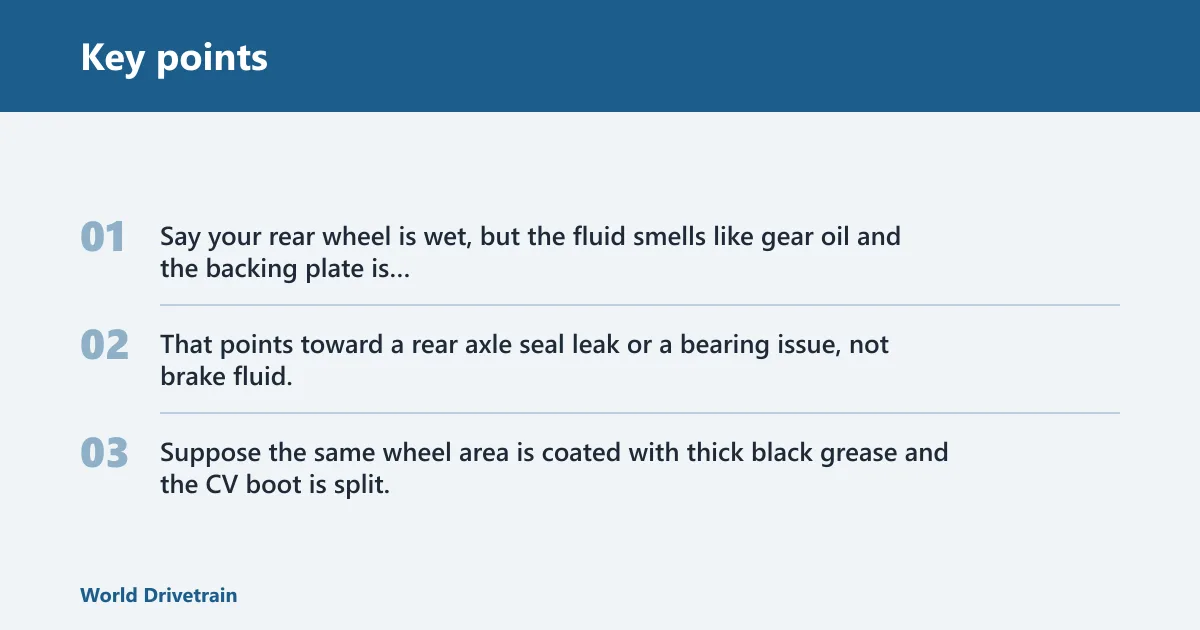
Say your rear wheel is wet, but the fluid smells like gear oil and the backing plate is damp. That points toward a rear axle seal leak or a bearing issue, not brake fluid. Suppose the same wheel area is coated with thick black grease and the CV boot is split; that points away from the axle seal and toward the boot.
What causes an axle seal leak?
Axle seals leak when the sealing lip can no longer hold fluid under normal conditions. The cause may be seal wear, a damaged shaft surface, contamination, too much internal pressure, or bearing movement. Replacing the seal alone helps only when the rest of the axle path is sound.
Seal wear or damage
Technicians inspect axle seals for cracks, deformation, or hardening. Those are direct clues that the rubber lip has aged or been damaged. If the seal has lost flexibility, it may leak even with a healthy axle shaft. A torn or hardened lip usually means the seal itself is part of the failure.
Contamination at the sealing lip
Dirt, rust, and old fluid residue can cut the sealing surface. That is one reason cleaning matters before diagnosis. If the lip runs across a grooved or dirty shaft surface, it may fail again soon after replacement. Contamination can also come from water intrusion after deep mud or water exposure.
Pressure buildup from a clogged vent
The axle vent, or breather, relieves pressure as fluid heats and expands. If it clogs, pressure can force oil past seals. A clogged axle vent can push oil past seals, and a new seal can fail faster if the vent stays clogged. That is why the breather should be checked after mud or water exposure.
Axle bearing play or shaft movement
Excessive axle or bearing movement can cause or worsen seal leaks. A loose bearing lets the shaft move enough to disturb the sealing lip, and that movement can keep the leak coming back. Repeated seal failure often means the shaft, bearing, or housing deserves attention before another seal goes in.
How do front and rear leaks differ?
Front and rear axle seal leaks can look similar on the ground, but the fluid path is often different. Rear axle leaks usually show near the wheel end or backing plate. Front solid-axle leaks may begin inside the axle tube, then travel outward before you ever see a wet wheel end.
Rear axle seal leak behavior
Rear axle seals are described as preventing differential fluid from leaking out. When they fail, the first clue may be a damp backing plate, a wet wheel, or fluid on the inside of the tire area. Noise can follow if the leak lowers oil level enough to affect gears or bearings.
Front axle seal leak behavior on solid axles
On many Wrangler front axles, the seal sits inside the axle tube near the differential. That means oil can travel inside the tube before it appears at the wheel end. On some designs, diagnosis and repair may require shaft and carrier removal, so the visible leak location can be misleading.
Why fluid location can mislead diagnosis
Gear oil usually travels before it drips, making the visible stain unreliable. A wet spot near the wheel does not prove the seal at that exact end failed first. The source can be farther inboard, or the housing can be pressurized by a vent problem that pushed oil to the same place.
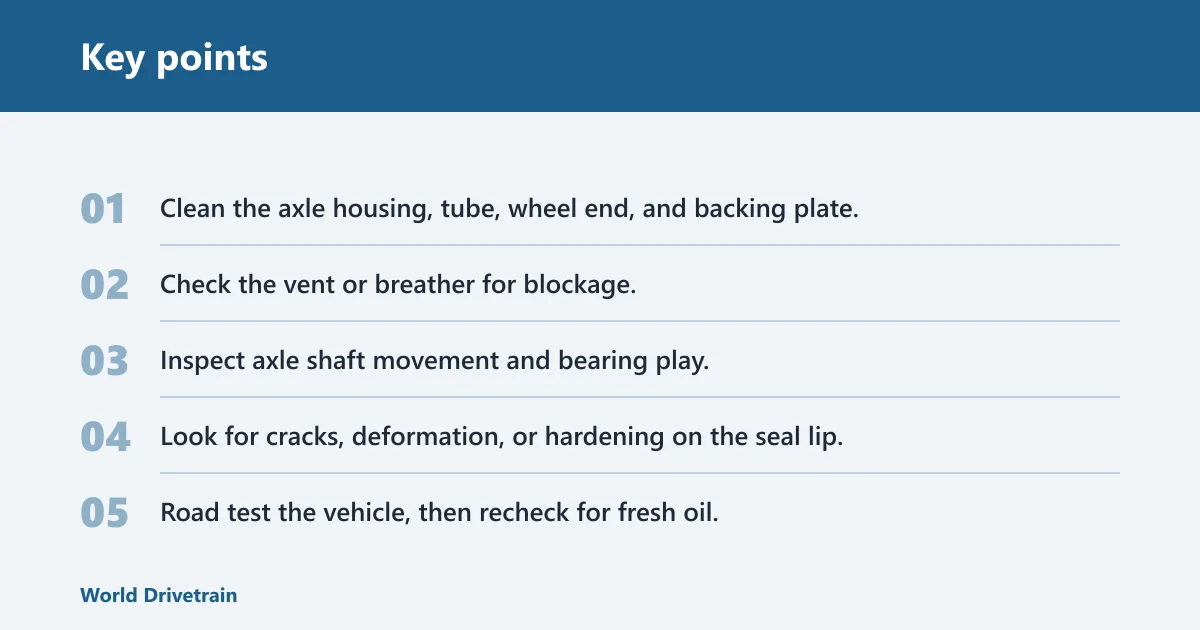
- Clean the axle housing, tube, wheel end, and backing plate.
- Check the vent or breather for blockage.
- Inspect axle shaft movement and bearing play.
- Look for cracks, deformation, or hardening on the seal lip.
- Road test the vehicle, then recheck for fresh oil.
- Use a UV dye leak test if the source is still unclear.
A UV dye test may be used to trace gear oil leaks after cleaning the area. The dye helps confirm the source once the vehicle has been road tested and inspected under UV light. That is especially useful when oil has traveled and the visible drip point does not match the true failure point.
Is an axle seal leak dangerous?
An axle seal leak can be minor at first, but it becomes more serious when fluid level drops, noise starts, or brakes get contaminated. If the leak is only a light seep and the axle level stays stable, the repair may be less urgent. If it drips, makes noise, or spreads to brake parts, it needs prompt attention.
When it is a minor seep
A light film on the housing without fresh dripping may be monitored briefly while you confirm the source. That does not mean it is harmless. It means the axle may still have enough fluid for the moment, but the seal, vent, or bearing should still be checked before the leak grows.
When it becomes urgent
It becomes urgent when the leak is dripping, the differential runs low, the wheel area is wet again after cleaning, or noises appear. Rear axle seal leaks can cause humming, whining, or clunking noises during driving, which suggests the problem is no longer limited to the seal alone.
What low fluid can do to gears and bearings
Low differential fluid can reduce lubrication and heat control. That can wear gears and bearings over time. If the seal leak has already introduced bearing wear or shaft movement, replacing only the seal may stop the drip for a while and still leave the underlying wear in place.
What causes rear axle seal leak?
Rear axle seal leaks are often linked to seal wear, shaft movement, vent blockage, or contamination at the sealing surface. The leak may show at the wheel, backing plate, or parking brake shoes. If the bearing is loose or the axle shaft has play, the seal may keep failing after replacement.
What causes an axle seal to leak?
The main causes are the same across many layouts: a worn seal, a rough or damaged shaft surface, contamination at the lip, pressure buildup from a clogged vent, or axle bearing play. The failure path matters because the fix changes with the cause. A seal swap alone does not correct every leak.
What is axle seal replacement?
Axle seal replacement is the process of removing the failed seal and installing a new one, but that is only part of the job when the leak has a deeper cause. The housing should be checked for vent blockage, the bearing for play, and the shaft surface for damage before the new seal goes in.
Replacement is not just swapping parts. If the vent is clogged, pressure will still push oil past the new seal. If the bearing is loose, the shaft will still move. If the sealing surface is grooved or contaminated, the new seal may start leaking again sooner than expected.
Frequently asked questions
What is front axle seal leak?
A front axle seal leak is gear oil escaping from the front axle assembly, often on a solid front axle where the seal sits inside the tube near the differential. Oil can travel before it appears outside, so the wet spot may be farther from the real failure point.
What is rear axle seal leaking?
Rear axle seal leaking means the seal at the rear axle end is allowing differential fluid out. It often shows as fluid near the wheel area, backing plate, or parking brake shoes. It can also be tied to bearing wear or axle play, not only seal wear.
What happens if axle seal leaks?
If the leak continues, the axle can lose lubricant, the brake area can get contaminated, and the gears or bearings can run with less protection. The visible stain may also mislead diagnosis if the fluid has traveled from the true source. Cleaning and rechecking are essential.