Why Is My CV Axle Clicking When Turning?
A clicking CV axle on turns often points to a worn outer CV joint, especially if the noise seems to speed up on full-lock circles and fade when the wheels are straightened. Ignore it, and the joint can wear fast enough to leave you stranded. This guide shows how to separate outer CV joint noise from wheel bearing, brake, inner joint, and suspension problems before you replace the wrong part.
How tight steering angles expose outer joint wear
A CV axle drives torque from the transmission or differential to the wheel through inner and outer constant-velocity joints. The outer joint works through the largest steering angle, so it is the one most likely to click when the wheel is turned hard. Worn balls and races inside that joint snap across worn spots under load.
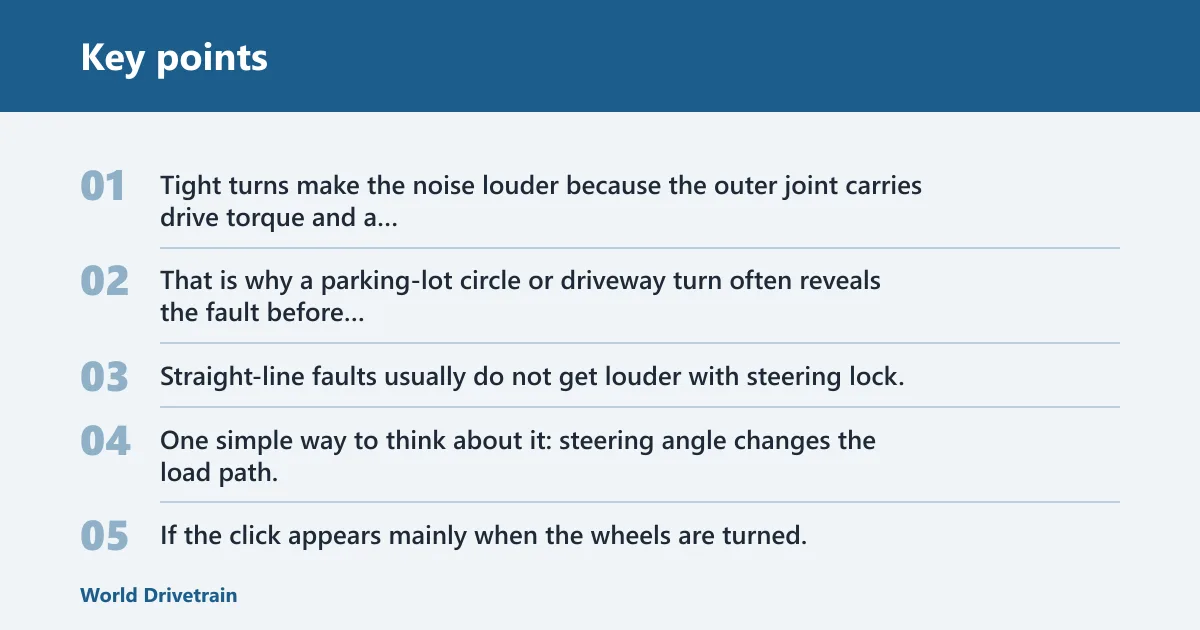
Tight turns make the noise louder because the outer joint carries drive torque and a sharp angle at the same time. That is why a parking-lot circle or driveway turn often reveals the fault before straight-road driving does. Straight-line faults usually do not get louder with steering lock.
One simple way to think about it: steering angle changes the load path. If the click appears mainly when the wheels are turned, the outer CV joint moves higher on the list than the inner joint, wheel bearing, or shaft balance issue.
How tight turns expose the fault
The outer joint reaches its highest operating angle near full lock. Wear that is quiet in gentle turns can become obvious there. If the click speeds up with vehicle speed while the steering angle stays fixed, that also fits an outer joint pattern.
Left turn or right turn
A click on left turns often points to the right-side outer CV joint, since that joint typically carries more load when the body rolls to the outside of the turn. A click on right turns often points to the left-side outer joint for the same reason. Full-lock noise sharpens that clue.
If the sound changes sides with steering direction, you can narrow the diagnosis before replacing parts. If it does not change with steering input and instead follows road speed or wheel load, wheel bearing, brake, or suspension noise becomes more likely.
How full-lock noise narrows the diagnosis
Full-lock clicking is often a strong CV hint because it loads the outer joint at a steep angle. A wheel bearing more often hums, growls, or changes pitch with speed and side load, while brake hardware may tick or scrape regardless of steering angle. That difference matters before disassembly.
CV axle diagnostic checklist
Use this table as a fast path from symptom to likely source. Start with the easiest check, then move to play, boot, and seating inspection before you decide on replacement.
| Symptom | When it happens | Likely source | Quick test | Next action |
|---|---|---|---|---|
| Left-turn click | Harder on left turns, often at low speed | Right outer CV joint | Repeat in a parking lot, then straighten the wheels | Inspect right boot and joint play |
| Right-turn click | Harder on right turns, often at low speed | Left outer CV joint | Repeat at full lock in both directions | Inspect left boot and joint play |
| Full-lock clicking | Steering near stop | Outer CV joint | Slow circle in both directions | Check for wear, boot damage, and grease loss |
| Straight-line vibration | During acceleration at speed | Inner CV joint, axle imbalance, tire issue | Lift off the throttle briefly and note change | Inspect inner joint and related driveline parts |
| Grease sling | Visible near wheel well or suspension | Torn CV boot | Look for grease on the strut, control arm, or rim | Replace boot or axle assembly soon |
| Boot tear or grease loss | During visual inspection | CV joint contamination risk | Flex the boot and check for cracks, splits, or wet grease | Do not wait for the click to get worse |
Boot tear, grease sling, and contamination checks
A CV boot keeps grease in the joint and dirt and water out. Cracks, tears, and grease sling are warning signs because the joint loses lubrication and contamination reaches the bearing surfaces. Once grit gets inside, wear speeds up and clicking often follows.
Picture a front-wheel-drive car with grease sprayed on the inside of one wheel and the lower control arm. That pattern usually points to a torn outer boot, not a bad tire. If the boot is wet with grease but the axle has no click yet, repair is still due soon.
Play, seating, and fastener checks
Raise the vehicle with a floor jack and support it on jack stands. Wear gloves and use a flashlight. Check the axle nut, hub seating, and visible fasteners before you assume the joint is bad. A loose or not-seated axle can mimic a failed joint.
Grip the axle near the joint and test for excess play by hand or with a pry bar used carefully. A small amount of movement in the suspension is normal; obvious clunking at the joint, torn boot clamps, or a shaft that shifts in the hub calls for repair. Use a torque wrench during reassembly checks.
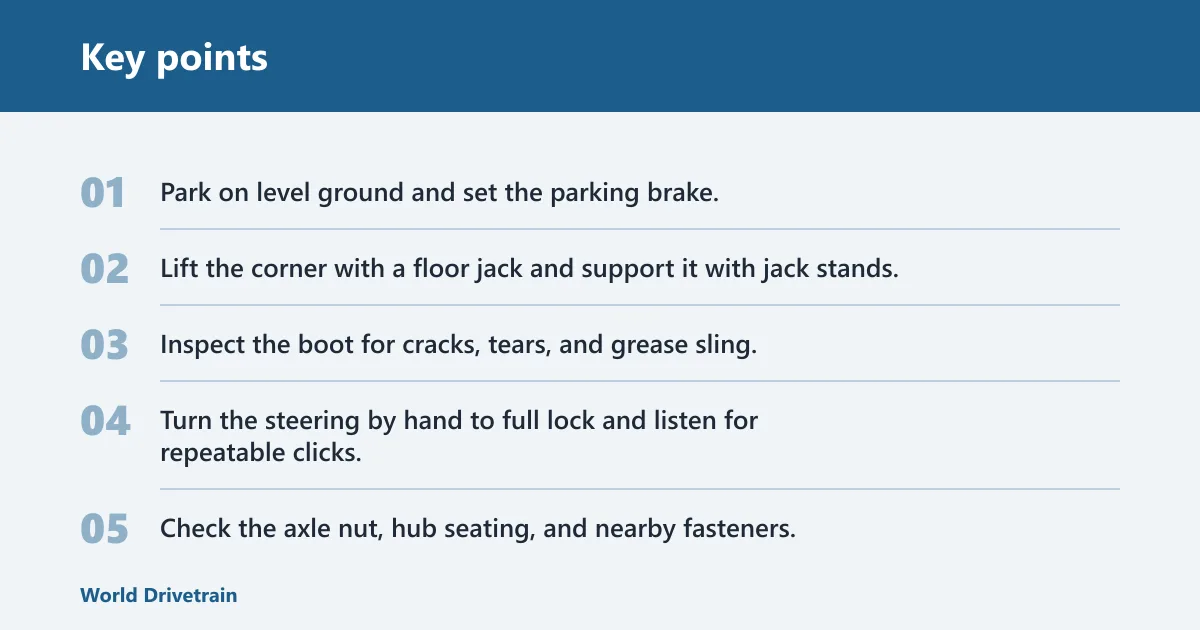
- Park on level ground and set the parking brake.
- Lift the corner with a floor jack and support it with jack stands.
- Inspect the boot for cracks, tears, and grease sling.
- Turn the steering by hand to full lock and listen for repeatable clicks.
- Check the axle nut, hub seating, and nearby fasteners.
- Feel for play at the joint with hand force or a pry bar.
What else can click while turning?
Wheel bearings, brake parts, tie rods, ball joints, calipers, and loose hardware can all make clicking or ticking noises while turning. The difference is usually in how the sound changes. A bad CV joint is tied closely to steering angle, while other parts often react more to speed, load, or suspension movement.
That means you should not replace an axle based on sound alone. A wheel bearing may hum, a caliper bracket can clunk on direction changes, and a loose splash shield can tick against the rotor. The job is to separate those patterns before parts shopping.
Wheel bearing noise versus CV joint noise
A wheel bearing more often changes with vehicle speed and side load than with steering lock. It usually hums or growls rather than clicks. If the sound gets louder when the vehicle’s weight shifts to one side in a long sweeping turn, the bearing rises on the list.
CV noise usually sharpens in tight turns and can fade when you straighten the wheel. That difference is useful on a road test. A bearing problem can still exist alongside a worn axle, so inspection should cover both.
Brake and suspension sources
Loose caliper hardware can knock or click as the brake shifts in its bracket. Worn tie rods and ball joints can add clunks when the suspension loads up in a turn. If the noise appears while the body rolls or the wheel moves over bumps, suspension parts deserve a close look.
Can a bad CV axle cause vibration?
An inner CV joint is more often associated with vibration, shudder, or play under acceleration than with clicking only on turns. If the vehicle shudders on takeoff or at highway speed, especially while powering up a grade, the inner joint or axle shaft condition may be part of the problem.
Highway vibration can also come from tire balance, bent wheels, or driveline issues, so turn-only clicking and straight-road vibration should not be treated as the same fault. Outer joint wear favors clicking in turns; inner joint wear favors vibration under load.
Inner joint symptoms under acceleration
If a car shudders when you roll on the throttle and settles when you lift off, the inner joint deserves inspection. Excess play there can transmit a shake through the body without producing the classic full-lock click. That pattern matters on FWD and many AWD vehicles.
Can you keep driving with a bad CV axle?
You can sometimes move the vehicle short distances, but continued driving is a bad trade once the click is repeatable. After a boot tear, grease loss and contamination can sometimes turn a mild click into a louder clunk, more play, and eventual joint damage. Repair sooner rather than later.
Stop driving and inspect immediately if the click turns into a heavy clunk, the axle visibly wobbles, grease is thrown across the wheel well, or the vehicle begins to shudder badly under power. If the axle fails while driving, it can lose drive to that wheel and leave you stranded.
What happens when the axle breaks
If the outer joint separates or the shaft breaks, the wheel may stop receiving torque. On driven front wheels, that often means loss of motion and a vehicle that will not move under power. On some setups, the broken parts can damage nearby components before the vehicle stops.
FWD, AWD, lifted, and high-mileage cases
FWD vehicles often make diagnosis easier because the front axles do both steering and drive work. AWD vehicles can be harder to isolate because multiple axles may carry wear, and a front or rear shaft can create similar symptoms. Lifted vehicles change axle angles and can push joints toward wear sooner.
High-mileage vehicles deserve a close boot and play check even if the clicking is not constant. Wear often starts at the boot, then moves to contamination, then clicking, then more serious joint damage. That progression is common enough that a clean boot inspection should never be skipped.
Suppose an AWD crossover has a right-turn click and a torn outer boot on the left front axle. The side of the noise may still point to the right outer joint, but the torn boot on the left side also needs correction because contamination can create a second fault later.
What to inspect first on higher-mileage vehicles
Start with the boots, axle nut, and visible play at both front corners. Then check for grease sling, torn clamps, and signs that the axle is not fully seated at the hub. That order catches the common failure path before more expensive parts are replaced.
Frequently asked questions
Why is my CV axle clicking when turning?
The most common reason is a worn outer CV joint. It is loaded hardest at steering lock, so clicking often appears in tight turns first. If the sound gets faster with wheel speed and fades when you straighten the wheels, the outer joint moves to the top of the list.
What causes a CV axle to click on turns?
Wear inside the outer joint causes the balls to move across damaged grooves under load. A torn CV boot can start that process by letting grease out and dirt in. Once contamination reaches the joint, clicking usually becomes more frequent and louder.
How do I tell if my CV axle is bad?
Look for repeatable clicking on tight turns, grease sling near the wheel, a torn or leaking boot, and excess play at the joint. If the vehicle also shudders during acceleration, inspect the inner joint too. A single symptom is not enough on its own.
How do I check a CV axle for play and boot damage?
Raise the vehicle safely with jack stands, inspect the boot with a flashlight, and look for cracks, tears, or wet grease. Then grasp the axle near the joint and check for obvious looseness. A pry bar can help reveal joint play, but use only light force.