CV Axle: Symptoms, Diagnosis and Replacement Cost
A bad CV axle usually shows up as repeated clicking on turns, shudder under acceleration, or grease around the inside of a wheel. If the clicking becomes severe, the vehicle shakes hard under ordinary throttle, drive power changes suddenly, or the axle feels obviously loose, stop driving and tow it rather than trying to limp home.
Outer CV joints usually click on turns, inner joints often cause acceleration shudder, and grease around a wheel points to a torn boot. Miss the pattern and you can end up stranded, damage the joint further, or spend roughly a few hundred dollars replacing the wrong axle, bearing, tire, or suspension part. This guide ties noise, vibration, and grease patterns to likely faults, lays out safe driveway checks, and shows when you can schedule service, when you should book it soon, and when a tow makes more sense. For cost context, national estimate tools from sources such as Kelley Blue Book and AAA Approved Auto Repair commonly show one-axle replacement landing anywhere from the low hundreds into higher three-figure totals depending on vehicle and labor market.
What a CV axle does and where it fails
CV axle, half shaft, and drive axle
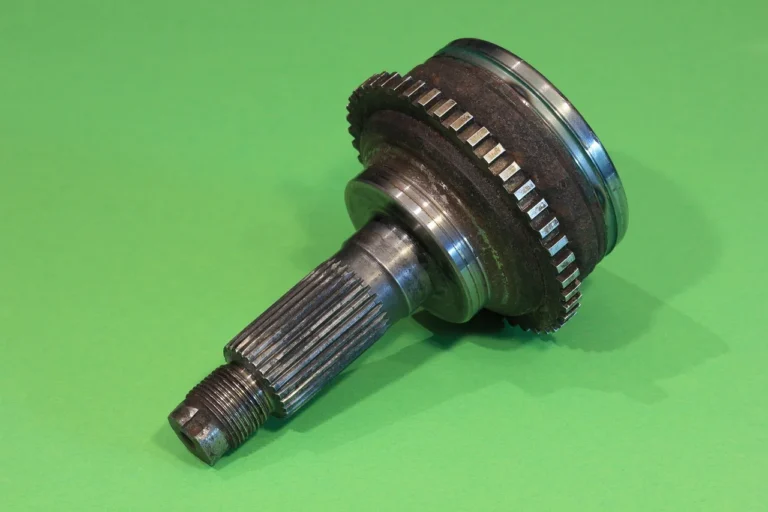
CV means constant velocity, which refers to how the joint passes torque smoothly through a range of angles. A CV axle, also called a half shaft or drive axle, links the transmission or differential to a driven wheel. It has to send torque while the suspension moves up and down, and at the outer end it also has to keep working as the wheel steers left and right.
That layout is why CV axles are standard on front-wheel-drive cars, many all-wheel-drive vehicles, and some independent rear suspension setups. Most front-wheel-drive cars use two front CV axles. Many all-wheel-drive vehicles use CV axles at both ends.
Outer joint, inner joint, boot, and grease
The outer CV joint sits at the wheel hub and works through the largest steering angles. A worn outer joint is commonly reported to make a steady, repeating click or pop while driving a tight circle under power, especially near full steering lock. The inner CV joint sits near the transmission or differential and helps accommodate suspension movement; when it wears, vibration or clunking often shows up as torque comes on.
Each joint is sealed by a grease-filled CV boot held in place by clamps. If the boot cracks, splits, or loosens at the clamp, grease can be flung outward and dirt or water can get in. The sequence matters: boot damage causes grease loss, then contamination, then joint wear, then noise or vibration.
A cracked boot with no joint noise can still deserve service before contamination gets established. Once the joint has been running with low grease or dirty grease, replacing the full axle assembly is often the safer use of your money.
Why symptom pattern matters more than one noise
Many owners hear one sound and jump straight to “bad axle.” That is how good parts get replaced.
Wheel bearings, tires, tire pressure, bent wheels, engine mounts, brakes, and suspension joints can all imitate axle trouble. The useful clue is when the symptom appears: on turns, under throttle, on coast, only at one speed, or during a left-right load change. A CV axle diagnosis gets much stronger when the sound, the boot condition, and the load behavior all point to the same side. That symptom split also matches widely used service guidance: CV joints more often complain during turning or torque application, while wheel bearings more often hum or growl with road speed and side loading.
Identifying which CV axle part is failing
Knowing what a CV axle does helps you diagnose why specific symptoms occur. CV axle failure symptoms explain how clicking, vibration, and clunking map to outer joint wear, inner spline damage, or torn boots. This distinction matters because each fault requires a different repair approach, and ignoring the specific signal can damage the transaxle output seal or strand the vehicle.
The section provides a visual and mechanical breakdown of how each joint operates under load. It clarifies which components to inspect first when symptoms change with steering angle or throttle position.
What are the symptoms of a bad CV axle?
A bad CV axle usually shows up as repeated clicking or popping on turns, shudder under acceleration, grease around the inside of a wheel, or a clunk when drive load changes. It can also cause pull or wheel-area noise, but those two signs need more caution because bearings, tires, mounts, and suspension faults can create them too.
Clicking or popping on turns
The classic outer-joint symptom is repeated clicking during a tight turn, especially in a parking lot at low speed. Because the outer joint works through the biggest steering angle, wear there often shows up first when the steering is near full lock.
If the clicking is strongest on right turns, the left outer joint is often the first suspect, and vice versa, because the outside wheel carries more load. That is a clue, not proof. Brake backing plates, loose trim, and tire scrub can still send you the wrong way.
Shudder or vibration under acceleration
An inner CV joint problem may create vibration as torque is applied. Owners often describe it as a shudder through the seat or floor rather than a click through the steering wheel. It may be faint at steady cruise and stronger when accelerating uphill or merging.
Do not treat highway-speed vibration as automatic proof of an axle. Tire pressure, uneven tire wear, wheel balance, bent wheels, and engine mounts are common look-alikes. Load sensitivity tells you more than speed by itself. If the shake persists on light throttle and coast, move tires, wheel balance, and wheel bearings higher on the list.
Grease sling, clunk on load change, pull, and wheel-area noise
Fresh grease around the wheel may point to a damaged boot or loose clamp. Grease on the inside of the wheel, strut, or control arm is a stronger axle clue than grease on the wheel face alone, because road grime and brake dust can fool a quick glance.
A clunk when shifting from drive to reverse, or when getting on and off the throttle, can come from an inner joint with excess play. But worn engine mounts and suspension joints can do the same thing, often with a duller, heavier thud.
Steering pull and wheel-area noise are weaker CV-axle clues. Pull may come from tire pressure, alignment, or brake drag. A humming or growling wheel-area noise more often points to a wheel bearing or tire issue than to a CV joint.
Why is a CV axle clicking when turning?
A CV axle clicks on turns because the outer joint near the hub is worn and starts binding or skipping as it works through a large steering angle. Repeated clicking during tight turns is the usual pattern. One scrape, one chirp, or a constant hum is less convincing and should shift the diagnosis toward brakes, tires, or bearings.
Why outer joints click
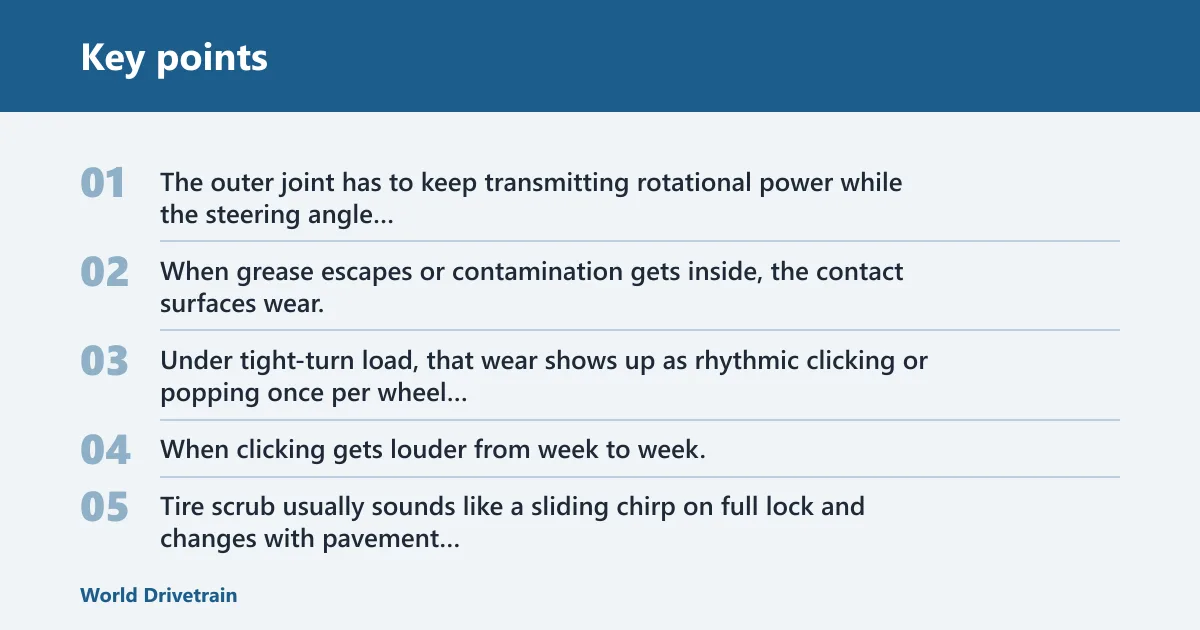
The outer joint has to keep transmitting rotational power while the steering angle changes. When grease escapes or contamination gets inside, the contact surfaces wear. Under tight-turn load, that wear shows up as rhythmic clicking or popping once per wheel rotation or several times per revolution, depending on joint condition.
When clicking gets louder from week to week, the joint is usually moving past “monitor it” and into “plan repair soon.” Heavy clicking that gets worse fast is a stop-driving warning, especially if you also find obvious looseness.
How to separate joint clicking from tire scrub or brake noise
Tire scrub usually sounds like a sliding chirp on full lock and changes with pavement type. Brake noise often appears whether the wheel is straight or turned and may react to light brake pressure. Outer-joint clicking is usually more rhythmic and tied to powered turns.
Picture a front-wheel-drive sedan in a parking garage making clean, repeated clicks only while pulling away on a tight left turn, with silence in a straight line. That pattern points harder at an outer joint than at a bearing, because the symptom depends on steering angle and drive load. If the sound remains in a straight line or changes with brake application, inspect brake hardware before condemning the axle.
Can a bad CV axle cause vibration at highway speeds?
Yes, a bad CV axle can cause vibration at highway speeds, but road speed alone does not identify it by itself. Inner-joint wear is more likely when the shake appears under throttle and eases when coasting. If the vibration stays the same whether accelerating or not, tires, wheel balance, bent wheels, or mounts become stronger suspects.
Inner-joint shudder versus tire or wheel vibration
An inner CV joint problem may cause acceleration-related shudder or clunking. That often feels load-sensitive: stronger on uphill acceleration, milder on light throttle, and reduced when the drivetrain is not pulling hard.
Tire or wheel problems usually build with speed whether the engine is pulling or not. Cupped tread can create a coarse vibration and noise. Low or uneven tire pressure can also change the feel enough to mimic drivetrain trouble. Tire checks belong near the top of the diagnosis flow, not the bottom.
Other faults that mimic axle vibration
Engine mounts can let the powertrain shift under load and send a thump or buzz through the cabin. Suspension joints can add clunks over bumps and on throttle transitions. A wheel bearing can growl or hum with speed and may change tone as the car loads one side in a curve.
Say your crossover shudders at 45 to 65 mph only when climbing a grade, then smooths out the moment the throttle is lifted. That pattern fits an inner joint better than a simple wheel-balance issue, because the shake follows torque input more than vehicle speed.
Axle symptom decision table
| Symptom pattern | Likely source | Quick driveway check | Confidence level | Replace-now warning signs |
|---|---|---|---|---|
| Repeated clicking or popping on tight turns under power | Outer CV joint at the wheel hub | Make slow left and right circles in an empty lot; note whether the click is rhythmic and turn-dependent; inspect outer boot for splits and grease sling | High if the sound appears only on turns and grease is present | Clicking that gets louder quickly, visible looseness, or a sharp bang followed by loss of pull |
| Shudder or vibration during acceleration, especially uphill | Inner CV joint near transmission or differential; engine mount is a key alternate | Compare light throttle, heavy throttle, and coast; inspect inner boot; watch for drivetrain movement when shifting from drive to reverse with the brake firmly applied | Medium to high if load-sensitive and tied to throttle | Strong shaking under moderate throttle, clunking on takeoff, or axle play with a damaged inner boot |
| Fresh grease around wheel, strut, or control arm | Split CV boot or loose boot clamp | Look behind the wheel for grease radiating outward; inspect boot ribs and clamp seating with the wheel turned | High for boot damage; low for joint failure until noise or play is confirmed | Torn boot plus dirt or water inside, heavy grease loss, or any clicking or shudder already present |
| Clunk when shifting load: drive to reverse, takeoff, or on-off throttle | Inner CV joint, engine mount, or suspension joint | Listen for a single clunk versus repeated clicking; inspect mounts, sway bar links, and lower joints along with the axle | Medium only; this symptom is shared by several parts | Clunk paired with visible axle looseness, torn boot, or worsening acceleration shudder |
| Steering pull under acceleration or at speed | Tire pressure, alignment, brake drag, or axle issue if combined with other axle symptoms | Check tire pressure first, compare tread wear side to side, note whether the pull changes during braking | Low by itself | Pull with severe shudder, obvious axle damage, or a wheel that no longer tracks normally |
| Humming, growling, or general wheel-area noise | Wheel bearing or tire more often than CV axle | Note whether noise rises with speed in a straight line and changes on gentle lane-load shifts; inspect tires for feathering or cupping | Low for axle unless paired with turn-clicking or boot failure | Noise with wheel wobble, heat at the hub, or roughness when the wheel is rotated off the ground safely |
| Severe noise, heavy shaking, loss of drive, or an axle that feels loose | Advanced CV joint or axle failure; other serious driveline faults still possible | Do not continue diagnosis on the road; stop safely and assess only from outside the vehicle | Very high that immediate service is needed | Stop driving and tow |
How do you tell a CV axle from a wheel bearing or tire problem?
A CV axle is more likely when the symptom depends on turning angle or throttle load, while a wheel bearing or tire problem is more likely when the noise or vibration rises with road speed in a straighter, steadier way. Check tire pressure and tread condition early, and rule out wheel-bearing noise before replacing an axle.
Wheel bearing versus CV joint
Wheel bearings commonly hum, growl, or drone with speed. The sound may get louder when the vehicle’s weight shifts onto the bad side in a curve, even without throttle. By contrast, outer CV joints usually click on turns, and inner joints usually react more to torque than to simple speed. That difference aligns with typical symptom guidance from major bearing makers and consumer safety references, though real cars can still overlap.
Wheel-bearing complaints often come from one corner all the time. CV-joint complaints are more event-specific: tight turns, hard pull-away, or throttle-on shudder. There can be overlap, which is why boots, grease, and play still matter.
Tires and tire pressure first
Check tire pressure before chasing anything else. An underinflated tire, uneven wear, separated tread, or bent wheel can mimic both vibration and pull. A coarse, cyclic thump that changes little with throttle usually belongs on the tire-and-wheel side of the flowchart.
Suppose one front tire is low enough to show shoulder wear and the car now pulls right with a highway buzz. That does not clear the axle, but it drops its priority until tire pressure and tire condition are corrected and the symptom is checked again. If wear looks uneven, an alignment check belongs on the shortlist too.
Engine mounts and suspension joints
Engine mounts can create a hard clunk on takeoff or when shifting from drive to reverse. Suspension joints can knock over bumps and on direction changes. If the noise happens with the steering straight and the suspension moving over rough pavement, suspension hardware may be the better suspect than the axle.
Axle diagnosis should include a quick look at lower ball joints, tie-rod ends, sway bar links, and visible mount condition. Replacing an axle without checking those parts is how “the noise is still there” happens. Related checks on suspension wear and brake drag can save a wrong repair.
How to check a CV axle for play and boot damage
Check a CV axle by looking first for split boots, missing clamp tension, and grease sling, then by confirming whether the symptom appears on turns or under acceleration. Play checks can help, but they are not a stand-alone verdict because some movement is normal and bearing, mount, or suspension wear can muddy the result.
Cv axle inspection checklist
- Park on level ground, set the parking brake, and use wheel chocks if the vehicle will be raised.
- Turn the steering to expose each outer boot and inspect the rubber ribs for cracks, splits, or wet grease.
- Look behind the wheel and on nearby suspension parts for fresh grease thrown outward from a rotating joint.
- Check both inner boots near the transmission or differential for tears, loose clamps, or grease seepage.
- Compare left and right tire pressure and inspect tread for cupping, broken belts, or uneven wear.
- If the vehicle is safely lifted and supported, grasp the axle near each joint and feel for obvious looseness, but do not confuse small movement with a failed joint.
- Road-test at low speed in an empty lot: slow tight left and right turns under light throttle for outer-joint clicking.
- Road-test on a straight road: light and moderate acceleration, then coast, to see whether vibration follows torque input.
What play can and cannot tell you
Obvious looseness with a torn boot and matching noise is meaningful. Small hand movement at the shaft or joint is not enough by itself to condemn the axle. Different joint designs feel different, and other worn parts can add slack that seems to come from the axle.
Do not work under a vehicle supported only by a jack. Basic consumer safety guidance from NHTSA and the Car Care Council supports using level ground, wheel chocks, and properly rated jack stands before any under-vehicle inspection. If a clearer play test needs more access than a driveway setup safely allows, that is the point to move the inspection to a shop.
CV boot replacement vs axle replacement: which makes sense?
Boot-only repair makes sense when the boot damage is found early, the joint is still quiet, grease loss is limited, and contamination has not set in. Axle replacement makes more sense once there is clicking, acceleration shudder, heavy grease loss, or likely dirt and water entry, because labor spent trying to save a worn joint is often money spent twice.
When boot-only repair is rational
A cracked or split boot with no clicking on turns, no acceleration shudder, and no gritty feel in the joint can still be a good boot-service candidate. This is the narrow window where replacing the boot and repacking grease can preserve the original joint.
The case gets stronger when the tear looks recent and the area is still mostly clean. A boot clamp that loosened and started light grease seepage is very different from a boot that has been open long enough to coat the suspension and ingest road grit.
When a full axle is the smarter spend
If the joint already clicks, shudders, or clunks, the wear has moved past the boot itself. At that point, a complete axle assembly often beats boot labor on value because it replaces the worn joint and boot together.
That is especially true when labor access is the same either way. Paying for boot service, then replacing the axle a month later when the noise remains, is the expensive route.
Parts choices: reman, new aftermarket, and OEM
Remanufactured axles are usually the lowest-priced complete assemblies. New aftermarket axles often sit in the middle. OEM parts usually cost more but may offer better fit or lower vibration risk on vehicles that are sensitive to axle quality.
The right choice depends on vehicle sensitivity, intended ownership length, and labor cost. When labor is high, better parts often make more economic sense because repeating the job is expensive.
How much does CV axle replacement cost?
CV axle replacement cost is parts plus labor, and the total moves a lot with vehicle layout, access, and part choice. A common one-side repair often falls in roughly the $200 to $800 range, while difficult access, premium parts, or both axles can push the bill higher. Estimate tools from Kelley Blue Book and AAA Approved Auto Repair show why asking for a split quote matters: part price, labor, fluids, seals, and hardware can vary a lot by vehicle.
One axle versus both axles
One noisy or damaged axle does not automatically mean both need replacement. If the opposite side boot is intact and the joint is quiet, replacing one side is often reasonable. If both boots are torn or both sides show matching symptoms, doing both may save return labor and another alignment check if one is recommended.
The opening warning about wasting $200 to $600 fits this exact decision point. Misreading a bearing hum or tire vibration as an axle issue can burn that amount on the wrong repair, and the original fault is still there after the bill is paid.
Why layout changes labor
Front-wheel-drive cars are often simpler than all-wheel-drive layouts, but there is no universal rule. Rust, seized axle nuts, stuck hub splines, and transmission-side retaining clips can turn a basic job into a slower one. Some rear independent suspension designs add access work too.
On some vehicles, pulling the inner axle can also lose transmission fluid or disturb a seal. That can add fluid, a seal, or both to the estimate. Some shops also recommend an alignment check if suspension fasteners were loosened for access.
DIY reality check
DIY replacement is possible on many vehicles, but it is not a beginner-friendly “bolt off, bolt on” job every time. The axle nut torque is high, splines may seize in the hub, the transmission side may use a snap ring that takes a firm release, and damaging a seal can create a leak.
A common first-timer mistake is freeing the axle from the hub, then overextending the steering knuckle and straining a brake hose or ABS wire. Another is guessing on axle-nut torque instead of following the vehicle spec and stake or replacement-hardware requirement.
Can you drive with a bad CV axle?
You might manage a short trip to a shop if the symptom is mild and limited to a small boot crack with no noise, but driving gets risky fast once clicking grows, shudder becomes strong under throttle, grease loss is obvious, or the axle has noticeable play. Severe noise, shaking, or loss of drive power calls for stopping safely.
When a short trip may be reasonable
A cracked boot discovered early, with no clicking on turns and no acceleration shudder, is usually a service-soon issue rather than an immediate tow case. The same goes for light grease seepage from a clamp if the joint is still quiet and clean.
That does not mean you should put it off for weeks. Once grease leaves and contamination gets in, wear can speed up fast.
When to stop driving and tow
Heavy clicking that rapidly worsens, strong shudder during ordinary acceleration, obvious joint play, severe grease loss, or a loud clunk followed by poor drive engagement moves the problem into tow territory. If the axle feels loose, or the vehicle suddenly loses drive power, do not try to limp it home.
What failure can look like on the road
When a CV axle fails while driving, the vehicle may lose effective drive to that wheel or become undrivable, depending on layout and failure mode. It can start as a worsening click or shudder, then turn into a bang, free-revving, or a car that barely moves.
Picture a car leaving a stop sign with a loud pop after weeks of turn-clicking. The engine revs, but the car no longer pulls normally. That is the end-stage failure this guide is trying to help you avoid.
Frequently asked questions
What happens when a CV axle fails while driving?
A failing axle usually gets louder first, then may clunk, shake hard, or stop transferring power normally to the driven wheel. Depending on the layout and exact break, the vehicle can become undrivable. If noise turns severe or drive power changes suddenly, stop safely and tow rather than risking a roadside failure.
How to tell if a CV axle or wheel bearing is bad
CV axle problems usually depend on turning angle or throttle load: clicking on turns suggests an outer joint, while throttle-on shudder suggests an inner joint. Wheel bearings more often hum, drone, or growl with road speed and often change tone when the vehicle is gently loaded side to side in curves.
Can you replace a CV axle yourself?
Yes, on some vehicles, but the job can be more involved than it looks. High-torque axle nuts, seized splines, retaining clips, possible fluid loss, and seal damage are common hurdles. If you do not have safe lifting equipment, torque specs, and the right tools, professional repair is usually the safer route.
CV boot replacement vs axle replacement: which is better?
Boot replacement is better only when the damage is caught early and the joint is still quiet, clean, and smooth. If the joint already clicks, shudders, clunks, or has lost substantial grease, a complete axle is usually the better value because the wear has likely moved beyond the boot itself.