How to Diagnose Differential Noise at Home Before a Shop Visit
Start by sorting the noise by load: if it gets louder on throttle and quieter on coast, suspect gear mesh or backlash; if it changes in turns, suspect bearings or limited-slip parts. Ignoring that pattern can turn a repair into axle, bearing, or differential failure. This guide gives a safe home decision tree for throttle, coast, turns, and steering-load checks before you visit a shop.
What differential noise sounds like
Differential noise is often described in a few common patterns, such as acceleration whine, decel howl, steady-speed hum, turn-only chatter, or cyclic vibration. The fastest clue is whether the sound tracks throttle, steering input, or vehicle speed. That split helps separate ring-and-pinion issues, bearing wear, tire noise, and driveshaft faults before you lift anything.
Acceleration whine, decel howl, and steady-speed hum
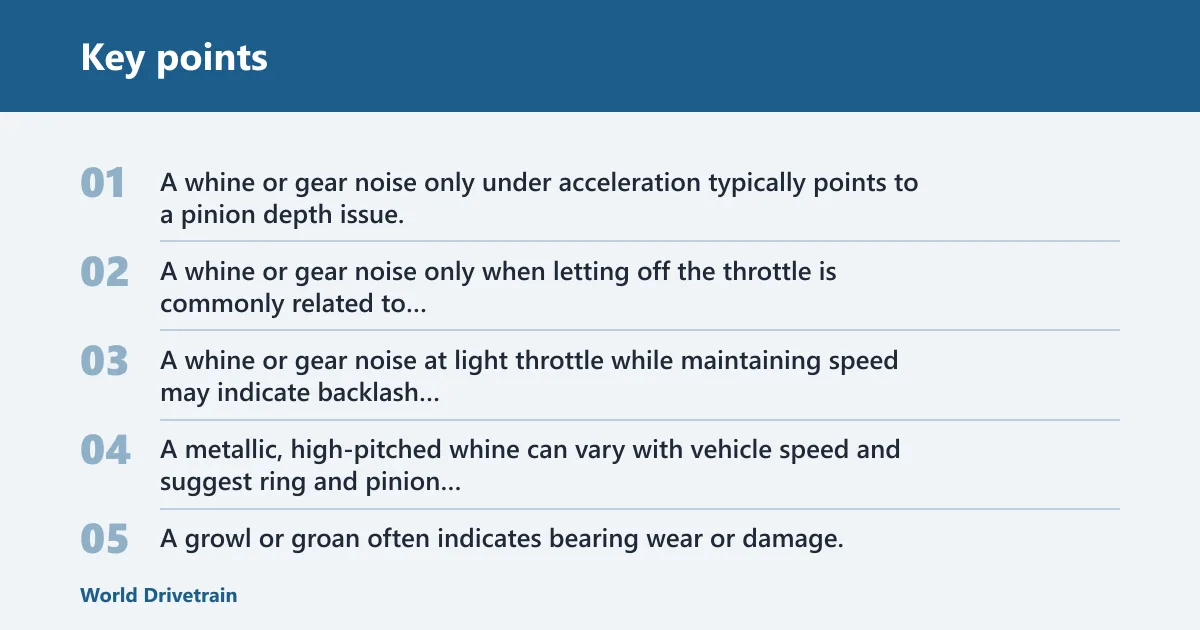
A whine or gear noise only under acceleration typically points to a pinion depth issue. A whine or gear noise only when letting off the throttle is commonly related to incorrect pinion bearing preload. A whine or gear noise at light throttle while maintaining speed may indicate backlash out of specification.
A metallic, high-pitched whine can vary with vehicle speed and suggest ring and pinion setup or gear contact pattern. A growl or groan often indicates bearing wear or damage. A steady humming sound is frequently caused by tire tread patterns or uneven tire wear, so a road test matters before any repair guess.
Turn-only chatter and cyclic vibration
Turn-only chatter in a low-speed parking lot often points to limited-slip differential clutches, especially if the chatter feels like binding during tight turns. Cyclic vibration that repeats at a fixed road speed is less typical of the gears themselves and more typical of a driveshaft or worn universal joint.
A rear axle hum at around 35 mph that stays present on a straight road and changes little with throttle may lean toward a wheel bearing, tire, or carrier bearing. That pattern leans toward a wheel bearing, tire, or carrier bearing before it leans toward gear mesh. The steering-input test is what separates them.
Which sounds point away from the differential?
A sound that changes mainly with steering load points away from ring-and-pinion noise and toward a wheel bearing, tire issue, or sometimes a CV joint on front-drive or AWD vehicles. A vibration that repeats at constant speed points away from gear whine and toward the driveshaft or U-joints.
| Symptom | Likely source | Simple driveway check | Stop-driving threshold | Book a shop |
|---|---|---|---|---|
| Acceleration whine | Pinion depth or ring-and-pinion setup | Repeat the road test on light and moderate throttle | Stop if the noise gets sharply worse or metal is found in the oil | Yes, if it persists on multiple drives |
| Decel howl | Pinion bearing preload or gear wear | Lift off the throttle at the same speed and compare | Stop if the howl is loud, new, or accompanied by vibration | Yes, soon |
| Steady-speed hum | Tires, wheel bearing, backlash outside spec | Weave slightly within the lane and note any change | Stop if a wheel gets hot or the hum turns into grinding | Yes, if steering input changes the sound |
| Turn-only chatter | Limited-slip clutches or wrong lubricant | Make tight low-speed turns in a parking lot | Stop if the axle binds, hops, or locks a wheel | Yes, especially for AWD and 4×4 systems |
| Cyclic vibration | Driveshaft or U-joints | Note whether the vibration repeats at the same road speed | Stop if the vibration is severe or the shaft clunks | Yes, before the joint fails |
Can you tell the diff from a wheel bearing?
Yes, often. Differential noise usually tracks throttle state, while a wheel bearing or tire issue usually tracks vehicle speed and may change with steering input. If the noise gets louder when you steer left, the right-side bearing is a stronger suspect. If the sound stays nearly the same on gentle lane changes, look harder at the differential, tires, or driveshaft.
Steering input versus straight-line noise
Wheel bearings often change load when the body rolls in a turn, so the noise may get louder when weight shifts to one side. Differential gear noise usually does not care about a gentle lane change as much as it cares about throttle, coast, or steady cruise. That difference is one of the most useful home checks.
Road-speed noise versus engine-speed noise
A sound that rises and falls with road speed, even with the transmission in the same gear, points toward axle, tire, bearing, or driveshaft parts. A sound that changes with engine rpm in a way tied to throttle is more likely to involve gear mesh inside the differential. The two are not the same clue.
Quick checks for tire and hub noise
Look for scalloped tread, uneven wear, or cupping on the tires. A steady humming sound from tire tread patterns can imitate a bad differential. If the sound changes on a smooth road surface, or when the steering wheel is held slightly left or right, a wheel bearing moves up the list.
Which gear or bearing problem fits the sound?
Ring and pinion gears, pinion bearings, carrier bearings, and backlash each produce a different pattern. Backlash is the clearance between the ring gear and pinion gear. Too much or too little clearance can create steady-cruise noise, while bearing wear more often produces howl, whir, growl, or rumble.
Ring and pinion wear and backlash
Ring and pinion gears can whine on acceleration, deceleration, or cruising depending on the setup fault. Gear contact pattern matters, and incorrect pattern can create a metallic high-pitched whine that changes with vehicle speed. Outside-spec backlash is a common reason for a whine at light throttle while maintaining speed.
Pinion bearing noise patterns
Pinion bearings support the pinion shaft and set preload, which is the controlled tightness of the bearing stack. When preload is off, the bearing can howl, whir, or growl. Whirring during acceleration or deceleration at about 10 miles per hour can indicate worn pinion bearings, and a decel-only howl fits that diagnosis well.
Carrier bearing rumble and growl
Carrier bearings support the differential carrier and help keep the ring gear aligned. Low-pitch rumble at all speeds over 20 miles per hour can point to worn carrier bearings. The sound often feels speed-related rather than throttle-related, which helps separate it from a pure pinion issue.
Could it be the driveshaft or U-joints?
Yes. A cyclic vibration or noise is often related to the driveshaft. Worn U-joints can also cause squeaking, grinding, vibration, or clunking. When the noise repeats at a fixed speed and does not change much with throttle, the driveshaft side of the driveline moves higher on the list than the differential gears.
Cyclic vibration that repeats at speed
A repeating thump, buzz, or vibration that appears at the same road speed is a classic driveshaft clue. It may stay nearly constant on smooth pavement and repeat every few seconds or every wheel revolution-like interval. That pattern is different from a gear whine, which usually rises more smoothly with speed or load.
Clunking, squeaking, or grinding from worn joints
U-joints can make a clunk when shifting from drive to reverse or when taking up slack after a coast. They can squeak or grind as well. If the noise is accompanied by a cyclic vibration, the driveline is a stronger suspect than the differential gears themselves.
Why these faults can mimic differential noise
Driveshaft imbalance and worn joints transmit sound through the axle housing and floorpan, so the cabin can make the source seem rear-end related. The clue is consistency: a driveshaft issue tends to repeat at the same vehicle speed, while a gear issue changes more clearly with throttle or coast.
Limited-slip chatter in tight turns
Limited-slip differential clutches can chatter or bind in low-speed turns, especially in parking lots. The sound is usually a chatter, shudder, or hop rather than a smooth whine. Wrong lubricant or a missing friction modifier can make it worse, so turn-only noise is not automatically a gear failure.
What clutch chatter sounds like
Clutch chatter often appears as a series of short skips or grabs while you turn slowly and apply light throttle. It may stop when the steering wheel is returned to center. If the axle binds hard enough to hop or drag a tire, treat that as a stop-driving problem, not a nuisance noise.
Lubricant and friction modifier clues
For many limited-slip units, the wrong oil or lack of friction modifier can cause chatter. If the fluid is otherwise clean but the chatter appears only in tight turns, lubrication choice becomes a strong suspect. If the fluid is burnt, metallic, or milky, the issue is larger than additive choice.
When binding points to a deeper fault
If a limited-slip axle binds in both directions, makes noise even after fluid checks, or produces heavy groan and drag, the clutches or internal parts may be worn. That is a shop-level diagnosis. A brief parking-lot chatter can be monitored, but wheel hop, lockup, or severe bind should end the drive.
What checks can I do in my driveway before taking it to a shop?
Use a flat surface, a flashlight, and basic hand tools. The goal is not repair. The goal is to sort the noise by throttle state, steering input, and fluid condition so the shop starts with a better fault tree. On front diff, rear diff, AWD, and 4×4 vehicles, the order of checks matters.
Rear differential check order
Start with a straight-road test, then a decel test, then a tight-turn test in a parking lot. If the noise is rear only, inspect the rear housing for leaks, then the fill plug and fluid condition. After that, check for tire wear, wheel-bearing play, and driveshaft vibration before assuming the gears are bad.
Front differential, AWD, and 4×4 check order
On front-diff or AWD vehicles, a turn-related noise can come from a front wheel bearing, CV joint, or transfer case, not just the front differential. On 4×4 systems, confirm whether the sound appears in 2WD, 4WD, or both. If it appears only in one mode, the transfer case or front driveline moves higher on the list.
Short driveway sequence
- Drive a smooth route with the radio off.
- Note acceleration, coast, and steady-cruise noise separately.
- Repeat with a gentle lane change left and right.
- Make a few slow, tight turns in a lot.
- Check the housing, fill plug, and fluid condition.
- Look for tire wear, leaks, and obvious shaft play.
A 4×4 truck that whines only in 4WD at around 30 mph and stays quiet in 2WD may point toward the transfer case, front driveline, or front differential. That points you toward the transfer case, front driveline, or front differential before you blame the rear axle. The mode matters as much as the sound.
When a noisy differential means you should stop driving
Stop driving now if the noise is paired with metal in the fluid, a burnt smell plus worsening howl, binding in turns, severe vibration, or a wheel that gets hot. If the sound is loud enough to drown normal conversation in the cabin, or if it changes into grinding, the risk has moved past monitor-only territory.
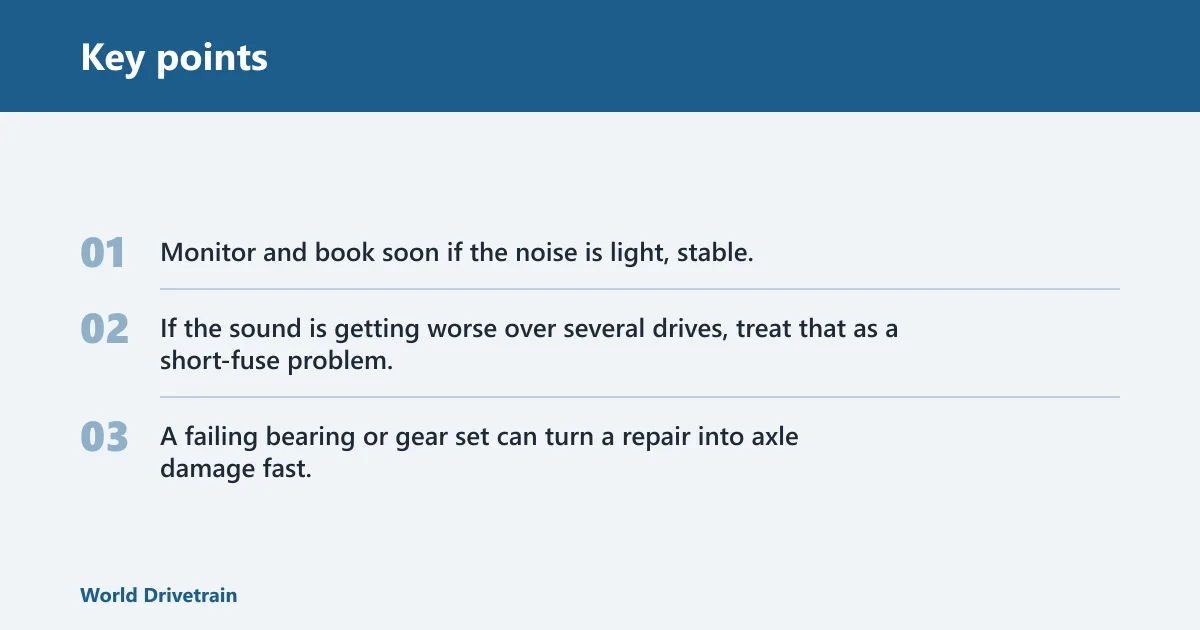
Monitor and book soon if the noise is light, stable, and limited to one pattern such as mild steady-speed hum or limited-slip chatter. If the sound is getting worse over several drives, treat that as a short-fuse problem. A failing bearing or gear set can turn a repair into axle damage fast.
Frequently asked questions
How can I tell if the noise is the differential or a wheel bearing at home?
Use steering input. A wheel bearing often gets louder when weight shifts in a gentle left or right turn, while differential gear noise usually follows throttle, coast, or steady load more than lane position. If the sound changes most with steering, the hub or tire climbs the list.
What does differential noise sound like on acceleration versus deceleration?
Acceleration whine often points to pinion depth or gear contact pattern. Decel howl commonly points to pinion bearing preload. A light-throttle whine at steady speed can point to backlash out of specification. The direction of the noise change matters more than the volume alone.
Can low differential fluid cause whining or growling?
Yes. Low or contaminated differential gear oil can cause whining and overheating, and the noise may become a growl if bearings or gears are already worn. Dark, burnt, metallic, or milky oil is not a normal finding. Low fluid is a repair-now clue, not a watch-it-for-weeks clue.
How do I know if the noise is from the front diff, rear diff, or tires?
Front-diff noise often shows up with front-end steering load or specific AWD/4×4 modes. Rear-diff noise is more likely to stay tied to rear axle speed and throttle. Tire noise usually sounds like a steady hum and changes with pavement texture or steering input more than with throttle.
When does a noisy differential mean I should stop driving?
Stop driving if the noise is joined by burning smell, metal in the oil, severe vibration, binding in turns, grinding, or a hot wheel or housing. Those findings suggest active damage. If the sound is mild and stable, you may have time to book a diagnosis soon, but not to ignore it.
Can I inspect the diff fluid without special tools?
Usually yes. On many vehicles, a flashlight and a basic hand tool are enough to reach the fill plug and check level. You are looking for fluid at the hole, plus smell, color, and debris. If the plug is inaccessible or heavily corroded, leave it for the shop.
What noises point to bearings, gears, or backlash?
Growl or rumble often points to bearing wear. Whine under acceleration suggests pinion depth, while whine on decel suggests pinion bearing preload. A light-throttle whine at cruising speed can point to backlash outside spec. Metallic high-pitched whine leans toward ring-and-pinion setup or gear contact pattern.