What Does Differential Noise Sound Like While Driving?
Differential noise while driving usually sounds like a light hum, a whine on acceleration or deceleration, a growl that rises with speed, or a click or clunk on turns. A loud roar, vibration, or metal-on-metal scrape means stop driving. Ignoring it can turn gear wear or a bad bearing into axle damage and a much larger repair bill. This guide maps each sound to the driving condition that produces it so you can narrow rear differential noise fast.
Common sounds of a failing rear differential
A healthy rear differential in the axle housing is usually quiet enough to blend into road noise. When it starts to fail, the sound often changes with speed, throttle input, or turning. The most useful clues are whether the noise is a whine, hum, whir, clunk, clicking, or banging, and whether it gets louder on acceleration, deceleration, or in a corner.
At highway speed, a bad rear differential is often reported as a steady whine or humming that rises with road speed. A whir that tracks vehicle speed points more toward bearings, while a rhythmic click or clunk can point toward ring and pinion gear wear. If the sound becomes a roar or metal scrape, stop driving.
Perlin noise sounds more natural than white noise. The same idea fits here: gear whine usually has a smooth, tonal edge, while a failing bearing sounds rougher and less even, closer to cabin rumble than a clean hiss.
What you’ll need
- Flashlight
- Gloves
- Drain pan
- Rags
- Brake cleaner
- Basic hand tools for the cover and fill plug
- Correct gear lubricant
- New gasket or sealant
Differential noise symptom matrix
| Sound | Speed | Throttle position | Turning | Deceleration | Likely source | Stop driving now |
|---|---|---|---|---|---|---|
| Whine | Rises with vehicle speed | Often louder on acceleration | May change slightly in a corner | Can shift pitch on coast | Ring gear and pinion gear wear | No, unless it becomes loud or abrasive |
| Hum | Steady at a given speed | May stay constant under light load | Sometimes changes on one side of a turn | May be less obvious on coast | Low fluid, gear wear, or bearing wear | No, unless vibration or roar appears |
| Growl | Gets louder as speed rises | May not change much with throttle | Can sharpen in turns | Can remain present on deceleration | Carrier bearings or pinion bearings | Maybe, if it turns into a roar |
| Whir | Tracks road speed closely | Often present under both light throttle and coast | May change when loaded in a turn | Common on both accel and coast | Carrier bearings or pinion bearings | No, unless it becomes metal-on-metal |
| Clunk | Most obvious at launch or gear change | Noticeable when applying or lifting throttle | Can happen on tight turns | Can follow a throttle lift | Ring gear and pinion gear wear, or lash issues | Yes, if it gets sharp or repeated |
| Clicking | May be intermittent | Can happen during load changes | Often louder in turns | May continue on coast | Ring gear and pinion gear wear | Yes, if clicking becomes banging |
| Metal-on-metal, sudden loudness increase, or leaking fluid | Any speed | Any throttle | Any turn state | Any coast state | Severe wear, low lubricant, or damaged gasket/cover | Yes |
How does the noise change when you turn?
A turn test helps separate bearing wear from gear wear. If the sound gets louder in a corner, the differential load is shifting from one side to the other. That often points toward carrier bearings or pinion bearings, but worn ring and pinion gears can also complain under load. A noise that changes on one side of a turn tells you more than one that stays the same.
Suppose a rear axle makes a whir only on long right-hand curves at about 35 to 45 mph; that pattern can fit a load-sensitive bearing. That pattern fits a load-sensitive bearing more than a general road-tire hum. If the same noise is louder on both left and right turns, gear wear or low lubricant stays on the short list.
How to narrow down the source
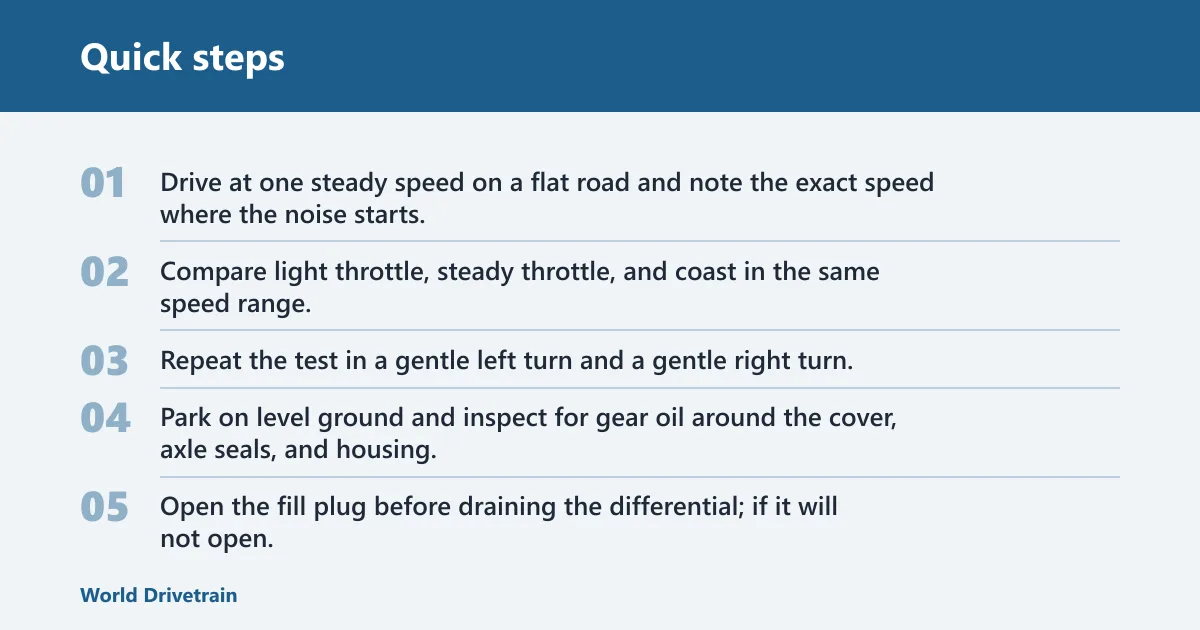
- Drive at one steady speed on a flat road and note the exact speed where the noise starts.
- Compare light throttle, steady throttle, and coast in the same speed range.
- Repeat the test in a gentle left turn and a gentle right turn.
- Park on level ground and inspect for gear oil around the cover, axle seals, and housing.
- Open the fill plug before draining the differential; if it will not open, do not drain it yourself.
- Remove the cover after loosening the bottom bolts first, leaving the top bolt last, then inspect the oil for metal.
What causes rear differential noise?
Rear differential noise usually comes from worn parts, low lubrication, or fluid loss. Worn ring and pinion gears can trigger differential noise and may create clicking, clunking, or banging. Whirring points more toward pinion or carrier bearings. Low, contaminated, or missing gear lubricant can make every one of those sounds worse, because differential gears need to stay submerged in oil.
A damaged gasket can let fluid drain from the chamber, which lowers the oil level and can reduce the lubrication film the gears need. Off-road water contamination can also create a strange sound. If the noise began after water exposure, or if the oil looks milky or dirty, treat contamination as a real cause rather than a coincidence.
What causes rear differential noise: ring gear wear often shows
Ring gear wear often shows up as whine under acceleration or deceleration, especially if the sound follows road speed closely. Carrier bearings and pinion bearings usually make a whir or growl that rises with speed. A clunk or bang under throttle changes leans more toward gear wear or excess lash than a simple lubricant issue.
The first DIY step is to lift the car. Before anything comes apart, find the fill plug. That one check decides whether a drain-and-refill is safe to attempt or whether the vehicle needs a shop or tow.
How can I tell if the noise changes when I turn?
Turn-dependent noise is one of the fastest ways to sort differential sounds. If the noise gets louder in a corner, the differential is reacting to side load. That often points toward carrier bearings or pinion bearings. If the sound changes only a little, the source may be ring and pinion wear or fluid level rather than a single bad bearing.
Pay attention to which side of the turn changes the sound. A noise that becomes stronger in only one direction is a stronger bearing clue than a noise that stays identical through left and right turns.
Common mistakes
- Guessing from sound alone instead of checking speed, throttle, and turn behavior.
- Skipping the fluid check and missing low or contaminated gear lubricant.
- Ignoring metal in the oil after removing the cover.
- Forcing a stuck fill plug and creating a tow situation later.
- Reusing a damaged gasket or bent cover after a leak.
How do I quiet rear differential noise without guessing?
Start with the least invasive checks and move upward only if each step fails. A quieting fix that ignores fluid level, leaks, or metal in the oil is a guess. The safer path is inspection first, then refill or repair based on what the housing actually shows.
- Check the differential for external leaks at the gasket, cover, and axle seals.
- Remove the fill plug and verify fluid level before draining.
- Drain through the cover if the plug opens, then inspect the oil for glitter, flakes, or chunks.
- Clean the cover and housing with brake cleaner so residue does not hide leaks or debris.
- Install a new gasket or approved sealant, then refill with the correct gear lubricant until the level matches the fill opening.
- If the noise remains after a correct refill and no leak is present, inspect bearings and gear wear before driving long distances.
A common first-timer mistake is topping off a noisy axle without confirming whether the fill plug will open. Another is opening the cover first and discovering too late that the plug is seized. If the plug will not open, stop and arrange towing rather than draining a differential you cannot refill.
When should you stop driving?
Stop driving if the noise turns into metal-on-metal scraping, if the volume jumps suddenly, or if gear oil is leaking fast enough to be obvious on the housing or ground. Those are not monitor-it-later symptoms. They suggest the differential may be losing lubrication or shedding parts.
If a rear axle starts as a mild whine on the freeway, then becomes a loud roar within about ten miles, it is generally unsafe to keep moving, especially if it leaves a wet trail near the cover. That change is enough to treat the vehicle as unsafe to keep moving. A cover leak, damaged gasket, or worn gear set can progress quickly once oil level drops.
If that didn’t work, try this next
- Stop driving and inspect for fresh oil streaks, loose cover bolts, or debris around the housing.
- Check whether the fill plug is stuck before any drain attempt.
- If the plug is seized, schedule towing rather than forcing the repair.
- If the oil contains metal or the gears sound rough by hand, arrange a shop inspection for ring gear, pinion gear, and bearing damage.
Prevention: Keep the differential oil at the correct level and fix gasket leaks early. A low chamber is much easier to catch before the gears and bearings start making noise.
Frequently asked questions
What does differential noise sound like while driving?
It usually sounds like a whine, hum, whir, growl, clunk, clicking, or banging that follows speed, throttle, or turning. A steady roar, vibration, or scrape is not normal. The key is pattern: gear wear, bearing wear, and low oil each leave a different driving signature.
Why is my rear differential whining on acceleration?
Whining on acceleration often points to ring gear and pinion gear wear, especially if the tone rises with road speed. Low or contaminated differential oil can make that whine louder. If the sound fades on coast but returns under load, gear mesh problems move up the list.
What does a bad rear differential sound like at highway speed?
At highway speed, a bad rear differential may sound like a steady hum, a rising whine, or a growl that gets louder as speed climbs. If it turns into a harsh roar, vibration, or metal scraping, do not keep driving. That pattern can mean active wear or low lubrication.
Can low differential fluid cause whining or humming?
Yes. Differential gears need to stay submerged in oil, and low fluid can create whining, humming, or whirring. A damaged gasket can let fluid drain from the chamber, so a leak matters even when the axle is not dripping heavily. Check the fill plug and oil level before guessing.
How do worn bearings sound compared with gear wear?
Worn carrier bearings and pinion bearings often sound like a whir or growl that rises with speed and may change in turns. Gear wear more often produces whine, clicking, clunking, or banging. Turn-dependent noise leans bearing, while load-dependent whine leans gear mesh.