What Causes Differential Noise When Turning?
Differential noise when turning can come from worn carrier or pinion bearings, damaged ring-and-pinion gears, low or incorrect fluid, or a limited-slip clutch pack; a clicking sound that changes with steering angle often points to an axle or CV joint instead. Ignoring it can turn a small bearing or gear problem into metal contamination, overheating, and expensive gear damage. This guide shows how cornering changes torque split and side-loads inside the differential, then walks through the checks that separate differential noise from tire, axle, and CV-joint sounds.
What differential noise sounds like
Different sounds point to different parts. A high-pitched whine often tracks gear mesh or bearing load. A growl or rumble often points to rough bearings. Chatter in tight turns can suggest limited-slip clutch pack slip-stick. Clicking usually comes from an axle or CV joint, while clunking and grinding mean you should treat the problem as more urgent.
Listen for the point where the noise changes. A drivetrain fault that gets louder on acceleration but quiets on coast often points to ring-and-pinion mesh, backlash, or pinion bearing preload. A noise that shows up mainly on deceleration can point the other way, because the coast side of the gear teeth is carrying the load. If the sound follows vehicle speed more than engine speed, suspect the rear axle housing, differential, or axle shafts rather than the engine.
Acceleration, coast, and steady-throttle differences
Acceleration loads the drive side of the ring and pinion. Coast loads the opposite side. Steady throttle can blur that pattern, but the way the sound changes as you lift or add throttle is one of the fastest clues you can get without tools.
Why turning changes differential load
In a turn, the inside wheel travels a shorter path than the outside wheel, so they must rotate at different speeds. An open differential allows that speed difference with little friction. A limited-slip differential adds clutch or gear resistance, and a locking differential tries to force both axle shafts to turn closer together. That change in wheel speed and torque split is why turning can expose a noise that does not appear on a straight road.
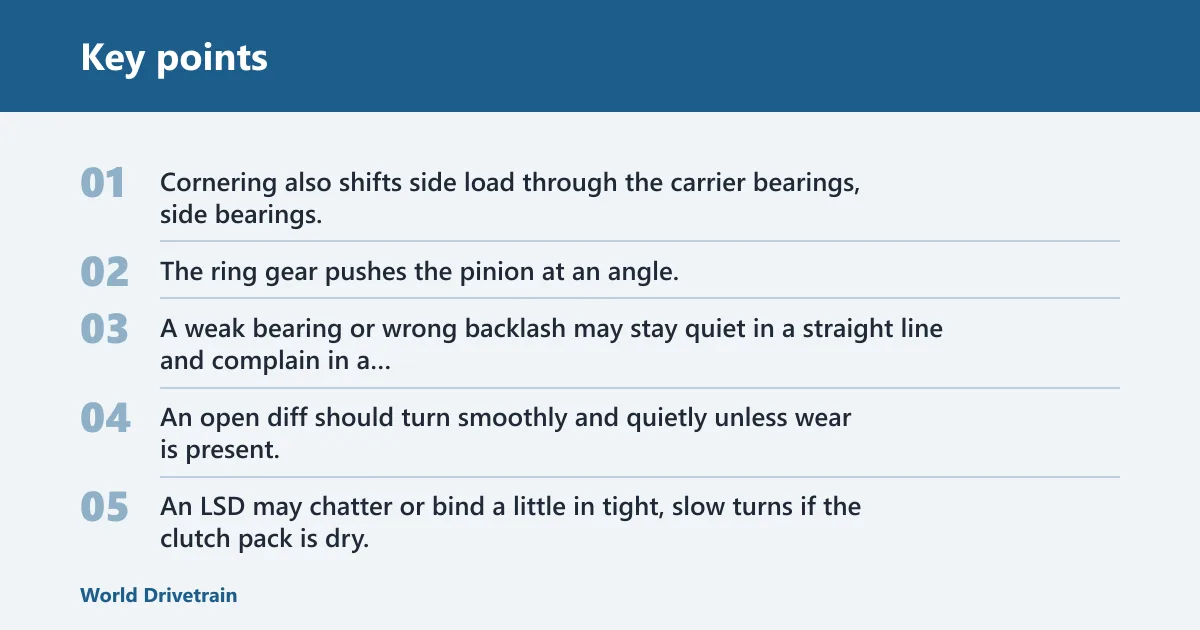
Cornering also shifts side load through the carrier bearings, side bearings, and gear mesh. The ring gear pushes the pinion at an angle, and the load on the bearing races changes as torque moves from one side of the housing to the other. A weak bearing or wrong backlash may stay quiet in a straight line and complain in a parking-lot turn.
Open diff, LSD, and locking-diff behavior
An open diff should turn smoothly and quietly unless wear is present. An LSD may chatter or bind a little in tight, slow turns if the clutch pack is dry, glazed, or missing the correct friction modifier. A locking differential can click, clunk, or ratchet as it changes state, especially during low-speed turns on pavement.
What causes rear differential noise when turning?
Rear differential noise during turns usually comes from bearing wear, gear wear, low or wrong gear oil, or an LSD clutch pack that is sticking. Turns load the carrier and side bearings differently than straight driving, so a worn part can become audible only when the axle shafts are working at different speeds. Clicking that changes with steering angle still points first to axle shafts or CV joints.
Gear oil matters here. Too little oil, dirty oil, or the wrong viscosity and API GL rating can increase heat and metal contact. Metal debris in the oil is a bad sign, because it often means teeth or bearings are already shedding material. Check fluid level and condition before blaming the housing itself.
Say your truck starts to groan only in a slow right-hand turn and the sound fades on the straight. That pattern fits load-sensitive bearing or gear wear more than tire noise. If the rear cover or fill plug shows glittery oil, inspection should move from “soon” to “now.”
Ring and pinion gears
Ring-and-pinion wear often sounds like a whine that changes with throttle. Poor contact pattern, incorrect backlash, or incorrect pinion depth can shift the tooth contact to a noisy edge of the gear. A drive-side whine under acceleration and a coast-side whine on deceleration are classic clues that the gear set is set up wrong or worn in a specific pattern.
Tooth pitting, scuffing, or a pattern worn toward the heel or toe of the tooth can create noise that gets louder in turns because the gear mesh is already being pushed sideways by the changing load. This is not the same as tire hum, which usually rises and falls with road speed and road surface more than steering angle.
Carrier bearings and side bearings
Carrier bearings support the differential case. Side bearings support the case in the housing. When either one develops play or roughness, the noise often changes with turning because the load shifts from one side of the carrier to the other. The result is often a growl, rumble, or low whine that follows axle load more than engine rpm.
Preload matters here. Too little bearing preload lets parts move and changes backlash under load, which can add clunking or gear howl. Too much preload increases heat and can make the assembly noisy after a short drive.
Limited-slip clutch pack
LSD chatter is most common in tight, low-speed parking maneuvers. The classic symptom is a grab-and-slip feeling with a chirp or chatter from the rear axle. The friction modifier in the oil helps the clutch packs slip smoothly; without it, or when the clutches are worn or glazed, the differential can chatter hard enough to feel like hopping tires.
This is one area where the sound can fool readers. A limited-slip differential making chatter in a full-lock parking turn is not automatically failing. But if the chatter comes with shudder, harsh clunks, or metal in the oil, the clutch pack or gears deserve inspection.
Locking differential symptoms
A locking differential can make a brief click, thunk, or ratchet as it changes state. That can be normal behavior depending on design. If the noise is harsh, repeats on every corner, or feels like binding, the locker may not be disengaging cleanly or the axle may be seeing abnormal torque windup.
What causes a differential to whine?
Whine usually means gear mesh or bearing load is wrong. On acceleration, look first at the drive side of the ring and pinion, pinion preload, and backlash. On deceleration, focus on the coast side of the tooth pattern and pinion bearing wear. A whine that changes with turn direction can still be differential-related even if it does not show up on every corner.
Incorrect setup angles and contact pattern are common causes after gear service. If backlash is too tight or too loose, or pinion preload is off, the gears can sing under load and heat up more than they should. That heat can accelerate oil breakdown and bearing wear.
Backlash and preload
Backlash is the clearance between ring and pinion gear teeth. Too much can create clunking and a distinct on-off throttle noise. Too little can cause heat, whine, and rapid wear. A dial indicator is the normal tool for measuring backlash during setup, because guessing at gear clearance usually ends badly.
Preload is the controlled resistance in the bearings. Pinion preload and carrier bearing preload both matter. Too little preload lets parts move; too much raises friction and heat. Either condition can turn a minor noise into a major failure if the vehicle keeps being driven hard.
Gear oil condition
Use the correct viscosity and API GL rating for the axle, then keep the fluid at the proper level. Low, dirty, or incorrect gear oil can cause noise when turning by starving bearings, reducing lubrication film strength, or upsetting limited-slip clutch behavior. If the oil smells burnt, looks dark, or shows metal debris, do not ignore it.
Differential noise diagnostic matrix
| Sound type | When it happens in a turn | Likely component | Quick at-home check | Drive/stop severity |
|---|---|---|---|---|
| Whine | More noticeable on acceleration, sometimes on coast | Ring and pinion gear mesh, backlash, pinion preload, carrier bearings | Check whether it changes with throttle; inspect fluid level and metal particles | Gentle driving only, then inspect soon |
| Growl | Gets louder as the axle loads up in the turn | Carrier bearings or side bearings | Listen for roughness that changes with load, not steering angle alone | Schedule inspection promptly |
| Chatter | Low-speed, tight parking turns; often with wheel hop | Limited-slip clutch pack; sometimes wrong fluid without friction modifier | Check for LSD type, fluid spec, and whether additive is required | Usually drive gently, but inspect if severe or new |
| Clicking | Changes with steering angle, often at low speed | Axle shaft, CV joint, or outer joint more than the differential | Compare straight-line rolling versus tight full-lock turns | Drive gently; inspect axle joints soon |
| Clunk | On throttle tip-in, lift, or direction change in the turn | Backlash too large, worn splines, locker engagement, worn bearings | Check for delay or lash when shifting between drive and coast | Schedule inspection; stop if it becomes violent |
| Grinding | Can appear anytime, often worse under load | Severely damaged bearings, gears, or metal contamination in the axle housing | Check oil for glitter, flakes, or burnt odor | Stop driving |
| Whine | Open differential, on accel or coast | Ring and pinion setup, pinion bearing preload | Throttle test: louder on accel or coast points to gear side being loaded | Inspect soon if persistent |
| Chatter | LSD in tight turns at low speed | Clutch pack friction behavior | Confirm friction modifier requirement and service history | Drive gently if mild; service if repeated |
| Clunk or ratchet | Locking differential during state changes | Locker mechanism or engagement surfaces | Check whether the noise matches locker behavior in low-speed turns | Inspect if harsh, frequent, or accompanied by binding |
How to separate differential noise from axle or tire noise
A clicking sound that follows steering angle and gets faster with wheel rotation usually points to an axle or CV joint, not the differential. Tire hum rises and falls with road speed and surface texture, and it usually stays fairly steady through a corner. Differential whine and growl, by contrast, often change with throttle and axle load.
Simple checks help. Make a few slow figure-eights in an empty lot. If the noise is strongest at full lock and sounds like clicks at the outside wheel, suspect the joint or axle shaft. If the sound changes more with acceleration and deceleration than with steering angle, look back at the rear axle housing.
A common first-timer mistake is blaming the differential for a steady drone that actually comes from cupped tires. A tire howl usually stays about the same in a sweeping turn and changes little when the throttle changes, while a differential whine often does the opposite.
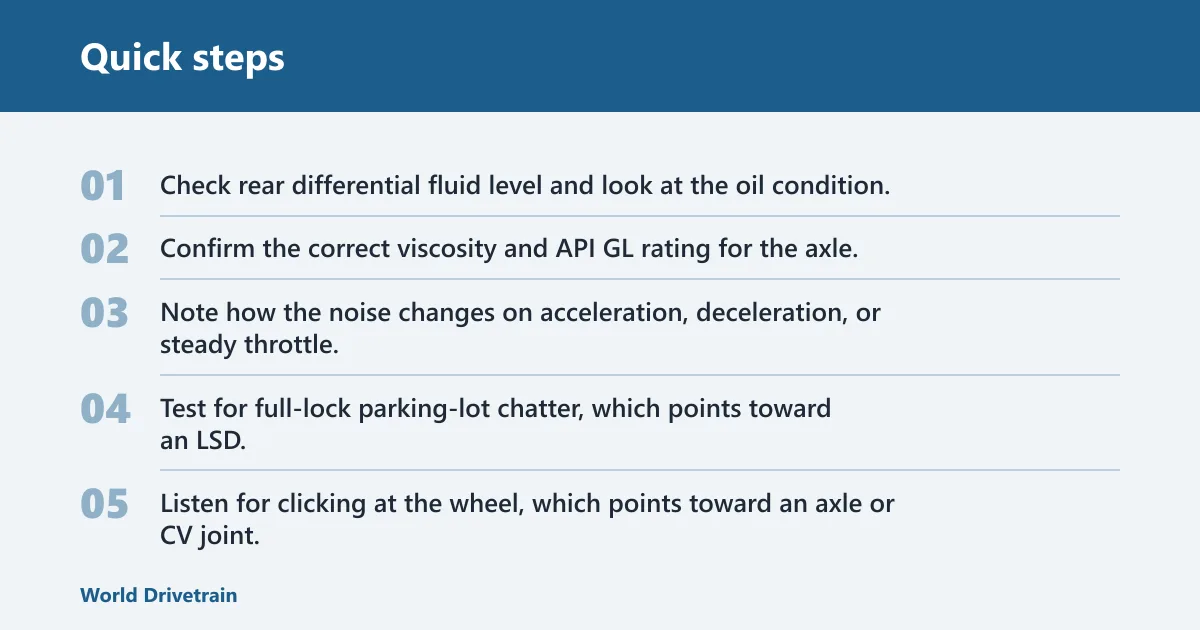
- Check rear differential fluid level and look at the oil condition.
- Confirm the correct viscosity and API GL rating for the axle.
- Note how the noise changes on acceleration, deceleration, or steady throttle.
- Test for full-lock parking-lot chatter, which points toward an LSD.
- Listen for clicking at the wheel, which points toward an axle or CV joint.
- Stop driving if you hear grinding, feel severe binding, or find metal debris in the oil.
Frequently asked questions
Why does my rear differential make noise on turns only?
Turns force the inside and outside wheels to rotate at different speeds, which changes the load on side gears, carrier bearings, and the ring-and-pinion mesh. That can expose wear that a straight line hides. If the noise is clicking and tied to steering angle, check the axle or CV joint first.
Is differential noise when turning always the bearings?
No. Bearings are common, but not the only cause. Ring and pinion wear, backlash problems, low or wrong gear oil, and LSD clutch chatter can all show up in turns. Locking differentials can also click or clunk as they change state. The sound pattern matters more than the turn itself.
Can low fluid cause differential noise when turning?
Yes. Low fluid can starve bearings and gears, raise heat, and worsen limited-slip chatter. It can also make existing wear louder because the oil film is thinner. Check level, smell, and contamination first. If the oil shows metal debris, treat that as a warning sign, not a minor service issue.
What causes rear differential noise on deceleration?
Noise on deceleration often points to the coast side of the ring and pinion, pinion bearing wear, or backlash that is out of spec. Coast-side whine or growl is a common clue after gear wear or incorrect setup. If the sound also changes in turns, carrier bearing load may be involved too.
What causes differential noise on acceleration?
Acceleration noise usually points to the drive side of the ring and pinion, pinion preload issues, or worn carrier bearings. A whine that gets louder under throttle is especially suggestive of gear mesh trouble. If the sound is a click rather than a whine, the axle shaft or CV joint deserves a closer look first.