Why Does the Differential Make Noise When Accelerating?
Noise that gets louder only on throttle, and eases when you lift, often points to differential gears, bearings, or ring-and-pinion wear; if the sound changes with road speed but not engine rpm, inspect the rear or front differential first. Ignore it and metal wear can turn a repairable whine into damaged gears, contaminated oil, or a locked axle. This guide shows how to separate differential noise from wheel bearing and CV joint problems by throttle, speed, and axle type.
Why differential noise changes under acceleration
Differential noise often changes with throttle because load changes how gears and bearings sit against one another. Under acceleration, the pinion is driven hard into the ring gear. On coast, the load flips. That change can make a worn bearing whine, a gear set howl, or a loose part rattle more clearly.
What the sound type can tell you
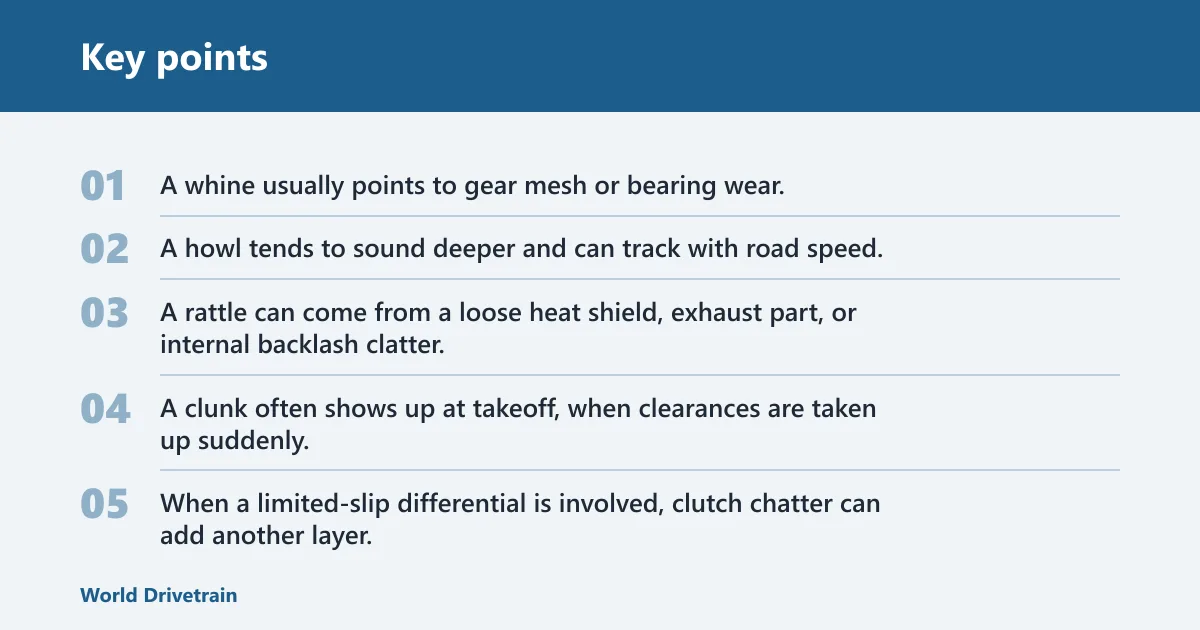
A whine usually points to gear mesh or bearing wear. A howl tends to sound deeper and can track with road speed. A rattle can come from a loose heat shield, exhaust part, or internal backlash clatter. A clunk often shows up at takeoff, when clearances are taken up suddenly.
When a limited-slip differential is involved, clutch chatter can add another layer. It usually shows up during slow turns rather than only on straight-line acceleration, and it may improve after the correct friction modifier is added to the gear oil. That makes the sound pattern useful, not just the noise itself.
Which axle is making the noise?
Axle location narrows the fault fast. A rear differential usually sends noise from the back of the vehicle, often most obvious under load in the same lane and at the same speed range. Front differential or AWD noise can blend with transaxle, CV joint, and wheel bearing sounds, so you need to localize carefully.
Rear differential clues
A rear axle whine that gets louder on throttle and quieter on coast points first to the ring-and-pinion set, pinion bearings, or carrier bearings. If the sound comes from behind the cabin and does not change much with engine rpm, that matters more than whether it feels like a transmission complaint.
Front differential and AWD clues
Front-differential noise can be harder to separate because the front axle also carries CV joints and, on many vehicles, the transaxle. A front-axle whine under acceleration still raises suspicion for internal gear or bearing wear, but clicking or knocking on turns pushes the diagnosis toward a CV joint first.
Picture an AWD crossover that hums only when climbing a grade at light throttle. If the noise fades on a downhill coast, that load-sensitive behavior fits differential or transfer-case gear wear better than a tire roar.
When the sound is actually from the transaxle
On some front-wheel-drive vehicles, the differential is built into the transaxle. That means a noise blamed on “the differential” may actually come from transmission bearings, final drive gears, or the axle shafts. The key clues stay the same: throttle state, speed, and whether the sound changes in turns.
Could it be the pinion bearings, carrier bearings, or gears?
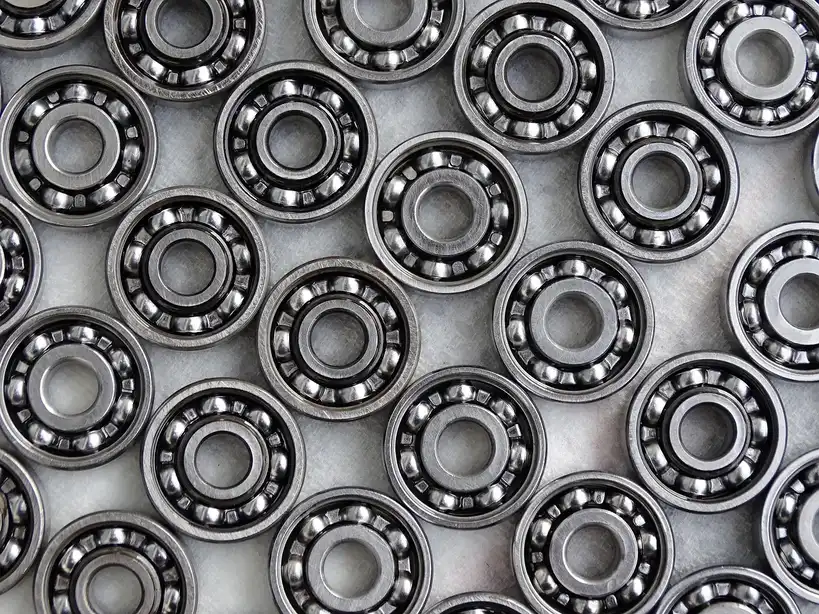
Yes. Those three parts are the core of most differential-noise diagnoses. Pinion bearings often complain under load first. Carrier bearings can make a speed-related growl or whine that changes with throttle. Ring-and-pinion wear usually shows up as a gear whine that follows load and may reflect poor backlash or contact pattern.
Pinion bearing symptoms under load
Pinion bearings are a common load-sensitive source. A worn or loose pinion bearing may whine on throttle and may growl or rumble on deceleration. Preload and play matter here; even small changes can alter the gear mesh enough to make a noise that comes and goes with acceleration and lift.
Carrier bearing wear patterns
Carrier bearings support the differential case. When they wear, the noise may sound broader and less sharp than a pinion whine. It can rise with road speed and remain present across a wider throttle range. If the sound is more like a steady growl than a fine whine, carrier bearings move higher on the list.
Ring-and-pinion backlash and contact pattern problems
Ring-and-pinion wear can produce a whine under acceleration when the gear teeth are loaded unevenly in the contact pattern. If backlash is out of spec or the pattern is off-center, the gears can sing under throttle and change tone on coast. That is a classic differential-specific clue.
Suppose a pickup starts whining only in third gear at 35 mph and the note fades the moment the driver lifts. That pattern points away from a wheel bearing and toward a loaded gear set, especially if the sound comes from the axle housing rather than a front corner.
What gear oil checks can confirm differential trouble?
Gear oil can confirm a lot before the cover comes off. Check level, leaks, odor, and contamination. Low oil level is a possible cause of rattling noises, and low oil pressure can also cause rattling sounds. Burnt oil, metal paste on the drain plug, or shiny debris in the fluid all support internal wear.
Fluid level and leak inspection
Start with the housing, seals, and cover. Wet pinion seals, axle seals, or a damp cover edge can mean the unit has been running low. A low gear-oil level does not prove a failed differential, but it raises the odds of bearing and gear damage if the noise has been present for a while.
Burnt odor, metal debris, and contamination
Fresh gear oil has a strong odor, but burnt oil smells darker and sharper. If the fluid looks glittery or contains chunks, stop treating the noise as a simple annoyance. Metal debris often means the gear teeth, pinion bearings, or carrier bearings are shedding material into the housing.
Viscosity, grade, and friction modifier for limited-slip units
Use the viscosity and grade listed by the vehicle maker, because the wrong oil can change how gears and clutches behave. Limited-slip units often need a friction modifier additive to reduce clutch chatter. If the noise is mostly during slow turns, clutch chatter belongs on the checklist before you condemn the gears.
How to separate differential noise from wheel bearings and CV joints
Wheel bearings and CV joints can mimic differential trouble, but the pattern differs. A wheel bearing often makes a speed-related hum or growl that may change with load transfer in turns. A bad CV joint often clicks or knocks under load, especially on a front axle. Differential noise is more tied to throttle than steering angle.
Speed-related hum versus load-related whine
If the sound rises with vehicle speed and stays about the same whether the engine is pulling or coasting, a wheel bearing becomes more likely. If the noise gets louder only on throttle and softens when you lift, that load-sensitive change points back to the differential.
Turn-in, turn-out, and lane-change clues
During lane changes, a wheel bearing may get louder when weight shifts onto the bad side. A differential usually does not care much about gentle lane changes, but it may react to acceleration and deceleration. Limited-slip clutch chatter often changes during tight turns more than straight-line cruising.
Front-axle clicking and knocking clues
Bad CV joints are another acceleration-noise possibility, especially on the front axle. Clicking on turns, or a knock when pulling away from a stop with the wheels turned, is a stronger CV clue than a gear whine. Differential noise is usually less rhythmic and less tied to steering angle.
Load-based diagnosis table: noise, throttle state, and likely cause
This table maps the most useful clues: sound type, throttle state, axle location, and the component most likely to fit. Treat it as a sorting tool, not a final verdict. The more columns that agree, the stronger the case.
| Noise type | Throttle state | Likely axle location | Most likely component |
|---|---|---|---|
| Whine | Only on throttle | Rear or front differential | Pinion bearings or ring-and-pinion mesh |
| Howl | Changes with road speed, on or off throttle | Rear differential or AWD final drive | Carrier bearings or gear wear |
| Growl | More noticeable on deceleration | Rear or front differential | Pinion bearings |
| Rattle | During takeoff or light load | Rear axle or underbody | Loose parts, low fluid, heat shield, or internal backlash |
| Clunk | At start-up or gear engagement | Rear or front axle | Backlash, worn mounts, or CV joint play |
| Clicking on turns | On steering input, under load | Front axle most often | CV joint |
| Speed hum | Appears at the same road speed in any gear | Any corner or axle end | Wheel bearing |
Quick inspection checklist before you drive again
If the noise persists, inspect the basics before putting more miles on the vehicle. Catching a leak or debris early can keep a worn gear set from becoming a much larger repair. If the sound grows louder, or the axle starts to vibrate, stop driving and get a professional diagnosis.
- Look under the vehicle for gear-oil leaks at the cover, pinion seal, and axle seals.
- Check the differential housing for wet residue, fresh drips, or burnt-smelling fluid.
- Inspect the drain plug or fluid for shiny metal flakes or paste.
- Note whether the noise appears only on throttle, only on coast, or at all speeds.
- Identify the axle location: rear, front, or a transaxle/AWD unit.
- Listen for turn-related clicks or chatter that point toward CV joints or clutch packs.
Safety note before inspection
The diagnosis advice warns to avoid moving parts because hair and clothing can get caught. If you raise the vehicle, keep clear of rotating parts and hot exhaust components. If you cannot find the noise under the hood, listen under the vehicle as recommended, but do not reach near spinning shafts or wheels.
Frequently asked questions
why does my rear differential make noise when accelerating
A rear differential that gets louder only when you apply throttle usually points to pinion bearings, ring-and-pinion mesh, or carrier bearing wear. The load on acceleration changes how the gears contact each other, so a worn setup may whine, howl, or growl more clearly under power than on coast.
why does my differential make noise
Many differential noises come from wear in the gears or bearings, but the sound can also come from low gear oil, a leak, or backlash that has changed over time. The most useful clues are whether the noise tracks throttle, road speed, or turning, because each pattern points to a different fault.
what can cause a whining noise when accelerating
A whining noise when accelerating can come from pinion bearings, a worn ring-and-pinion set, carrier bearings, or low or contaminated gear oil. If the sound fades when you lift off the throttle, the differential moves higher on the list than a wheel bearing or tire noise.
what would make a whining noise when accelerating
Internal gear wear is the main differential-specific answer. Poor gear contact pattern, incorrect backlash, damaged pinion bearings, and low fluid can all make a whine most obvious under load. On front-axle vehicles, CV joints and transaxle parts can overlap with that sound, so location matters.
what does it sound like when your differential is going bad
A failing differential may whine, howl, clunk, or rattle depending on which part is worn. Whine and howl often point to gears or bearings, while clunking can show backlash or engagement play. If the sound changes with throttle more than speed alone, that is a strong differential clue.
why is my rear differential making noise
A noisy rear differential is often reacting to worn pinion bearings, carrier bearings, or ring-and-pinion wear that only shows up under load. Check for low or burnt gear oil, leaks, and metal debris first. If the noise persists or gets worse, the housing should be inspected before more damage spreads.