Can a Bad CV Axle Cause Vibration at Highway Speeds?
Yes. A bad CV axle can cause highway-speed vibration, but the pattern matters: if the shake changes with throttle or steering input, the axle is a stronger suspect than tire balance; if it stays constant at one road speed, look elsewhere first. Wrong diagnosis burns time and money, and a failing axle can move from shake to clunks, grease loss, or drivetrain damage. This guide shows how to separate CV-axle vibration from tire, wheel, brake, hub, and suspension faults.
Can a bad CV axle cause highway vibration?
Yes. A worn CV axle can make a car vibrate more than usual on the highway, especially when the vibration shows up under power or changes as load changes. That matters because the axle does more than spin a wheel; it sends power from the transmission or differential while the suspension and steering move.
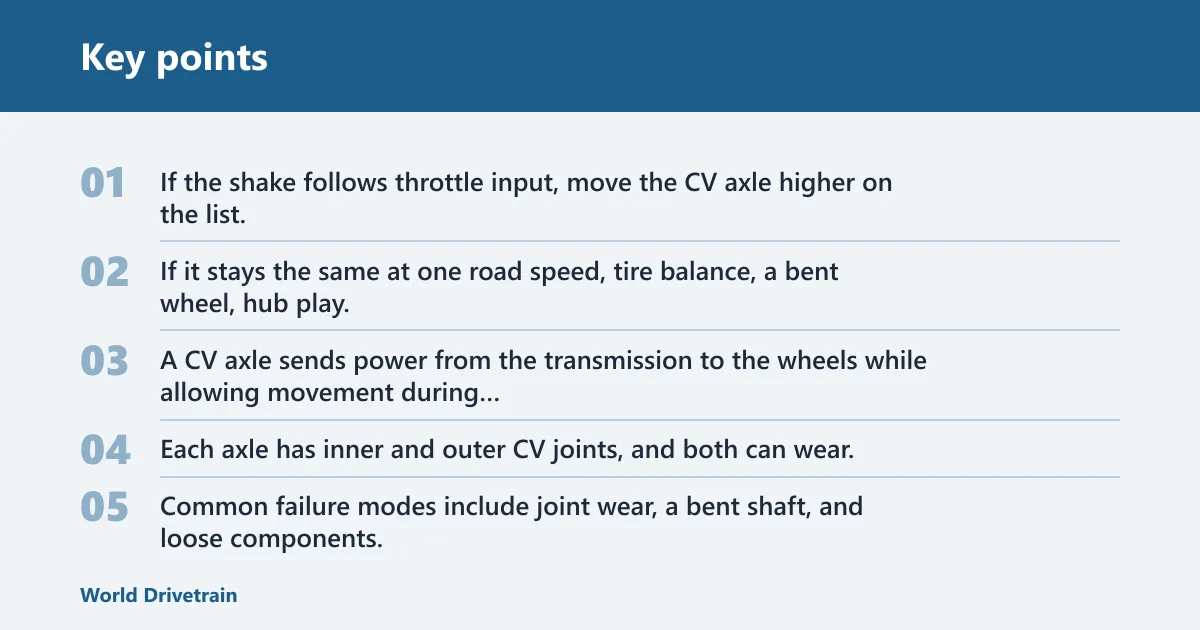
If the shake follows throttle input, move the CV axle higher on the list. If it stays the same at one road speed, tire balance, a bent wheel, hub play, or suspension wear may be the better first checks.
What a CV axle does and how it fails
A CV axle sends power from the transmission to the wheels while allowing movement during turns. Each axle has inner and outer CV joints, and both can wear. Common failure modes include joint wear, a bent shaft, and loose components.
Wear creates play and uneven torque transfer. That can show up as vibration under acceleration or, in some cases, at steady speed. Severe wear can also lead to clicking, popping, or loss of drivability.
Why vibration depends on load and speed
Speed alone does not tell the whole story. Acceleration load is the key test condition for many CV axle complaints. If the vibration gets worse on throttle and fades when you lift off, the axle or joint becomes more likely.
By contrast, a wheel balance problem usually follows wheel speed more than engine load. That is why the same 65 mph shake can point to very different parts depending on whether you are cruising, accelerating, or coasting.
When the symptom points away from the axle
Not every highway shake comes from a CV axle. Cruising vibration can also come from wheel balance issues, worn suspension, or minor CV axle wear. If the vibration is steady, repeatable at one speed, and unchanged by throttle, start with the wheels and tires first.
Steering-wheel shake often points toward a front tire, wheel, or hub issue. Floor vibration can point toward drivetrain load, rear wheel issues, or suspension. Whole-vehicle shake can come from several places, so location matters as much as speed.
How CV axle wear creates vibration
Wear in the axle or either joint changes how power reaches the wheel. The result can be shudder, shake, clicking, or popping depending on which part is worn and how the vehicle is loaded. The same axle can act differently in a straight line, on a hill, or while turning.
Inner CV joint wear and acceleration shake
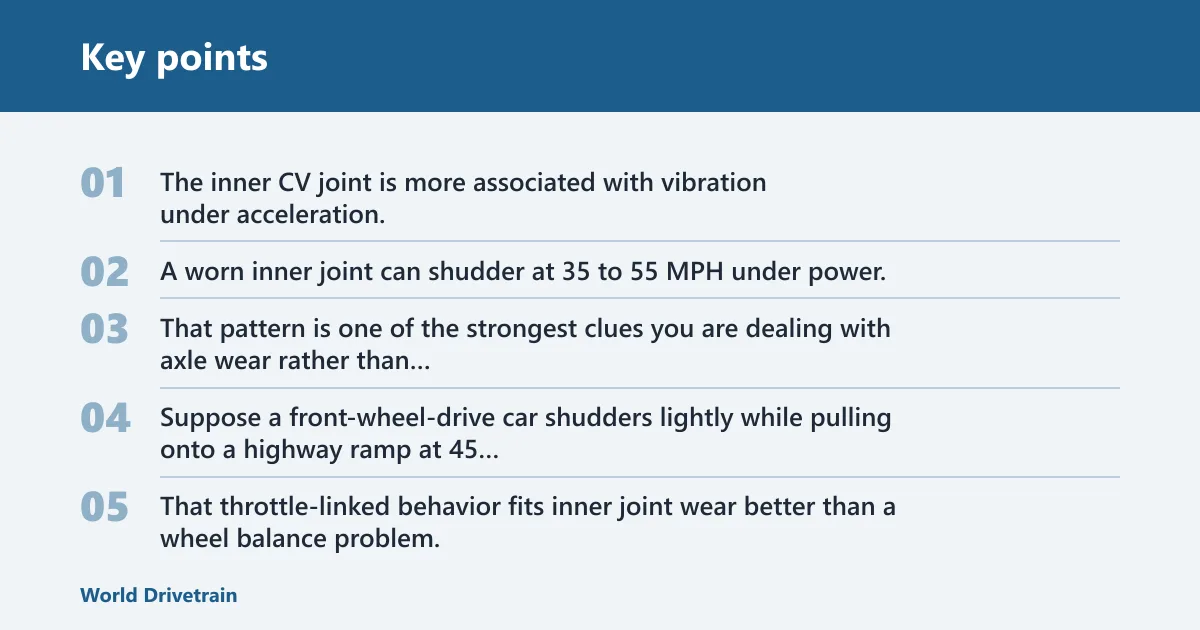
The inner CV joint is more associated with vibration under acceleration. A worn inner joint can shudder at 35 to 55 MPH under power, and the vibration may stop when you let off the accelerator. That pattern is one of the strongest clues you are dealing with axle wear rather than tire balance.
Suppose a front-wheel-drive car shudders lightly while pulling onto a highway ramp at 45 MPH, then smooths out the moment the driver lifts off. That throttle-linked behavior fits inner joint wear better than a wheel balance problem.
Outer CV joint wear and turn-related symptoms
The outer CV joint is more associated with clicking or popping in turns. A sharp turn at slow speeds often reveals a worn outer CV axle with popping or clicking. Severe outer-joint wear can also vibrate, but turn noise is usually the earlier clue.
Outer-joint symptoms are less likely to be the first explanation for straight-ahead highway vibration unless the wear is severe. If the main complaint is a steady shake at 70 mph with no turn noise, do not jump to the outer joint first.
Bent shafts, loose parts, and missing grease
A bent shaft can create an obvious speed-related vibration because the axle no longer runs true. Loose components at the joint or shaft end can do the same thing. A damaged axle can also vibrate without clicking if the wear is in the shaft or if the joint is early in its failure.
Grease splattered around the wheel well is a sign the CV axle should be replaced. That visible sling often comes before the joint feels obviously bad, because the boot fails first and the joint wears faster after grease loss and contamination.
Highway-speed vibration diagnosis
Highway-speed vibration is often felt during steady cruising, but the real clue is how it behaves under load. A vibration that changes with throttle, climbing, or turning points in a different direction than a vibration that stays fixed to road speed. Use that split before you blame the axle.
Steady cruising vibration
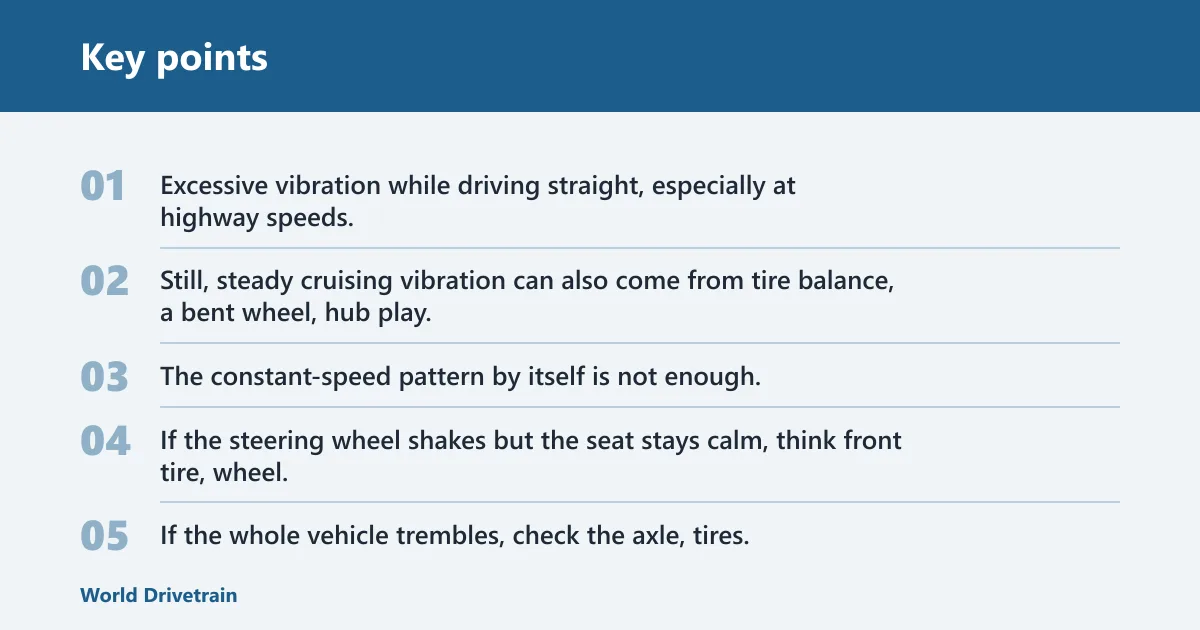
Excessive vibration while driving straight, especially at highway speeds, can point to a failing CV axle. Still, steady cruising vibration can also come from tire balance, a bent wheel, hub play, or worn suspension parts. The constant-speed pattern by itself is not enough.
If the steering wheel shakes but the seat stays calm, think front tire, wheel, or front hub first. If the whole vehicle trembles, check the axle, tires, and suspension together instead of picking one part too early.
Acceleration versus coasting
Acceleration versus coasting is one of the cleanest ways to sort CV axle symptoms from wheel balance symptoms. A bad axle often shakes under throttle and calms when load comes off. A wheel balance issue usually stays closer to the same speed pattern whether you are accelerating or coasting.
That difference matters on the road and in the shop. If a vibration fades during coast-down but returns as soon as you press the pedal, the axle deserves a close look.
Through the floor, steering wheel, or whole vehicle
Where the shake is felt helps narrow the source. A steering wheel vibration often suggests a front-end wheel, tire, hub, or front axle issue. A floor vibration can come from the drivetrain or a rear wheel problem. A whole-vehicle shake often calls for a broader inspection.
Do not diagnose from location alone. A front CV axle can shake through the steering wheel, but so can a bent rim or wheel balance issue. Use location together with load and speed.
CV axle vibration or wheel balance?
Wheel balance is one of the most common lookalikes for highway-speed vibration. It can mimic CV axle symptoms at highway speeds, especially if the shake appears at one road speed and feels steady. The difference is that wheel balance usually tracks wheel speed, not throttle.
Tire balance and bent wheel clues
A tire or wheel problem usually shows a strong speed window and little change with throttle. A bent wheel may create a rhythmic shake, and tire damage can do the same. If the symptom is constant at 60 to 75 mph whether you are on the gas or not, start here.
Check for uneven tire wear, a missing balance weight, visible wheel damage, or a tire that has developed a belt issue. Those faults can feel very similar to an axle problem from the driver’s seat.
Hub bearing and suspension clues
Hub bearing play can create vibration, noise, or looseness. Suspension wear can let the wheel move enough to mimic axle shake. If the wheel wobbles, the hub or suspension may be to blame before the CV axle is.
A common first-timer mistake is to replace an axle because the car shakes at 65 mph, then find the real fault was a loose wheel bearing. That is why a physical check matters before parts replacement.
Why speed alone is not enough
Speed alone is not enough because several faults show up in the same road-speed range. A CV axle, tire balance issue, and hub play can all become noticeable on the highway. The deciding factor is whether throttle, coasting, or turning changes the symptom.
Start with the condition that changes the shake. That simple step saves time and keeps you from replacing the wrong component first.
CV boot and grease sling clues
A torn CV boot is often the beginning of the failure chain. The boot is the rubber protective seal that retains grease and excludes contaminants. When it tears, grease escapes, dirt gets in, and joint wear speeds up. Vibration often comes later.
What a torn boot means
A torn boot does not always mean the joint is already noisy, but it does mean the axle is at risk. The boot’s job is to hold grease inside the joint and keep grit out. Once that seal fails, the joint can wear faster than normal.
Look for cracks, splits, loose clamps, or grease thrown onto nearby suspension parts. Grease around the wheel well is not a minor cosmetic issue; it is a clue that the protection system has failed.
How grease loss leads to joint wear
The sequence is usually leak first, contamination second, vibration third. Once grease escapes, the joint runs hotter and with less protection. Dirt and water inside the boot accelerate the wear that eventually creates play, shudder, or clicking.
That is why a boot issue should not be ignored just because the axle is not clicking yet. The failure often starts before the noise does.
What to inspect around the wheel well
- Look for grease sling on the strut, control arm, inner fender, and subframe.
- Check both boots for cracks, splits, missing clamps, or wet grease at the folds.
- Inspect the shaft for obvious bends, dents, or missing hardware.
- Lift the wheel safely and check for play at the axle and hub area.
- Compare both sides if only one side shows grease or wear.
CV axle diagnostic matrix
This table separates speed, load, and turning behavior. Use it to decide whether the next inspection should target the axle, wheel balance, hub, or suspension first.
| Driving condition | Vibration location | Most likely cause | Next inspection |
|---|---|---|---|
| Cruising at 55-75 mph | Steering wheel, floor, or whole vehicle | Wheel balance, bent wheel, hub play, or mild CV axle wear | Check tire balance, wheel runout, hub looseness, and axle boot condition |
| Acceleration from a stop | Floor or seat, often through the drivetrain | Inner CV joint wear | Inspect inner joint play, boot condition, and axle seating |
| Uphill throttle | Floor or whole vehicle while under load | Inner CV joint wear or bent axle shaft | Repeat the symptom on a grade, then inspect for shaft damage and joint looseness |
| Coasting | Usually reduced or absent if axle-related | Less likely CV axle; more likely wheel, tire, or hub issue if shake remains | Check wheel balance, tire condition, and hub bearing play first |
| Turning at speed | Front end with clicking or popping | Outer CV joint wear | Inspect outer joint, boot, and axle end for play or grease loss |
| Wheel looseness or severe clunking | Any location, often obvious and worsening | Unsafe axle, hub, or suspension failure | Stop driving and inspect for loose wheel hardware, hub play, and axle separation |
When should you stop driving?
Stop driving if the wheel is loose, the clunking is severe, or the vibration is rapidly worsening. Those signs can mean the axle, hub, or suspension is failing in a way that can leave the vehicle undrivable. Do not keep going past obvious looseness.
Wheel looseness
Wheel looseness is a hard stop. If the wheel can move by hand, or the axle end feels sloppy enough to clunk under a light check, the vehicle should not stay on the road. That is a safety problem, not a diagnosis puzzle.
Severe clunking or grinding
Severe clunking or grinding means the damage is no longer limited to light vibration. The joint may be far beyond normal wear, or another part may be contacting or separating. Either way, continued driving can make the failure worse fast.
Rapidly worsening vibration
If the vibration grows stronger in a short drive, do not wait for a louder noise. A fast change in shake often means the part is moving from wear into failure. That is especially true if the symptom appears with grease sling or a torn boot.
Frequently asked questions
Can a bad CV axle cause vibration at highway speeds?
Yes. A bad CV axle can cause vibration at highway speeds, especially if the shake changes with throttle or gets worse under load. If the vibration is constant at one road speed and does not change with acceleration or coasting, tire balance, wheel damage, or hub issues may be more likely.
Will a bad CV axle cause vibration while cruising?
It can. Cruising vibration can come from wheel balance, worn suspension, or minor CV axle wear. If the vibration is steady during cruise but becomes stronger on throttle or fades when you lift off, the axle moves higher on the list than a simple balance issue.
Can a loose CV axle cause vibration?
Yes. Loose components, excess play, or a shaft that is not seated correctly can create vibration. A loose axle may also clunk, click, or worsen quickly. If you can feel obvious looseness at the wheel or axle, stop driving and inspect it before the part separates or damages the hub.
Can a bad front axle cause vibration?
Yes. A bad front axle can cause vibration through the steering wheel, floor, or whole vehicle, depending on which joint or shaft section is worn. Front axles are also more likely to be confused with tire balance or hub issues, so load and turn behavior matter during diagnosis.
How do I tell if the vibration is from a CV axle or tire balance?
Use the throttle test. A CV axle problem often changes with acceleration load and may stop when you lift off the accelerator. Tire balance problems usually track road speed more than engine load and often stay similar during cruise and coast. That difference is the best first filter.
Does a bad CV axle vibrate only under acceleration?
No. Acceleration is the classic clue, especially for inner joint wear, but a worn axle can also vibrate during steady cruising or at highway speed. The key is whether the shake changes with load. If it does, the axle becomes a stronger suspect than wheel balance alone.
What does a torn CV boot have to do with vibration?
A torn CV boot lets grease escape and dirt enter. That leads to faster joint wear, and worn joints can vibrate. Grease splattered around the wheel well is an early warning that the boot has failed and the axle should be replaced before the joint wears further.
Can a CV axle cause vibration without clicking?
Yes. A CV axle can vibrate without clicking if the shaft is bent, the joint wear is still early, or the issue is under load rather than during a turn. Clicking usually points to outer joint wear, but vibration alone can still be an axle symptom.