What Are the Symptoms of a Bad CV Axle?
A bad CV axle is often reported to make clicking on turns, vibration under acceleration, grease around the wheel, or clunking on shifts. If the symptom changes with steering angle or throttle, inspect the axle, outer joint, and boot first. Leave it alone, and you can lose drivability, damage the transaxle output seal, or break an axle that strands the vehicle. This guide maps each symptom to the likely failed part and tells you what to check next.
What a CV axle does and how it fails
A CV axle links the transaxle or differential to the wheel hub on front-wheel-drive and many AWD vehicles. It uses an inner CV joint, an outer CV joint, and a boot system that keeps grease in and dirt out. Failure often starts in the boot, then moves into joint wear and shaft play.
CV axle, CV joint, and boot: the parts that matter
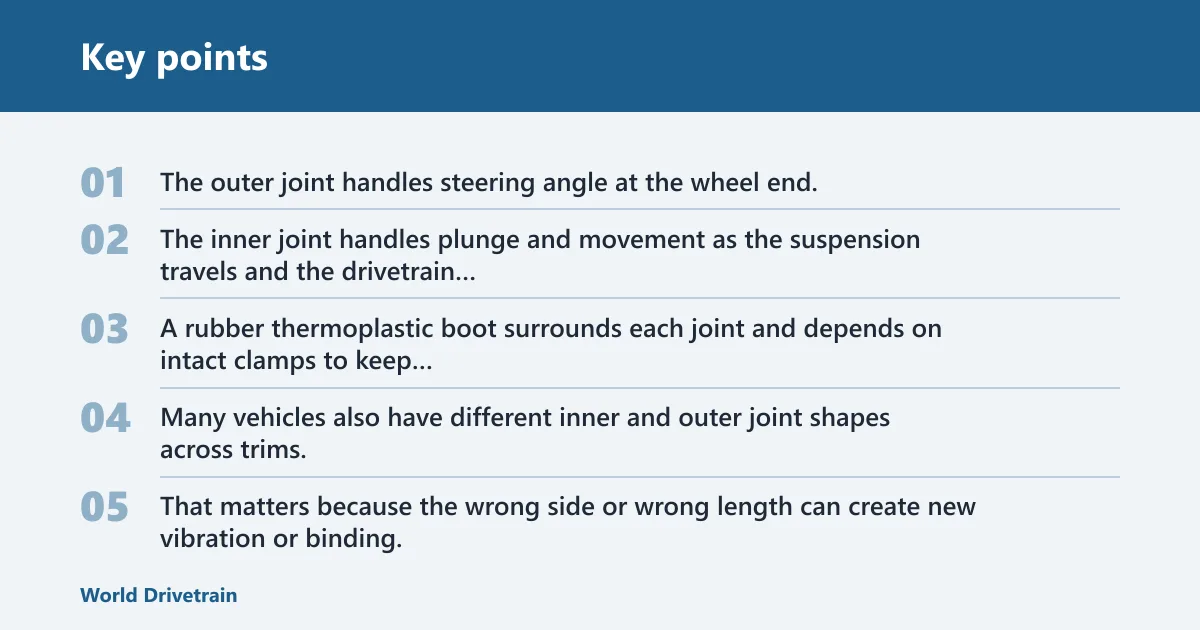
The outer joint handles steering angle at the wheel end. The inner joint handles plunge and movement as the suspension travels and the drivetrain loads up. A rubber thermoplastic boot surrounds each joint and depends on intact clamps to keep grease sealed inside.
Left and right axle variants are common. Many vehicles also have different inner and outer joint shapes across trims, and OEM and aftermarket replacements are both common repair paths. That matters because the wrong side or wrong length can create new vibration or binding.
Why inner and outer joints fail differently
Outer joints usually complain while turning. Inner joints usually complain under acceleration or when the driveline is loaded. That split gives you a first guess before you put the car on a lift.
Wear shows up as play, roughness, or noise. Once grease escapes or dirt gets in, the joint loses lubrication and wears faster. A boot problem can exist long before the axle becomes noisy.
When a worn boot turns into a failed axle
A cracked boot, torn boot, or missing clamp does not always mean the axle is already broken. It does mean the joint has lost its seal or is about to. Grease sling on the wheel well, suspension arm, or subframe is an early warning that the joint may be running dry.
A common first-timer mistake is to ignore a small split because the car still drives normally. A tear around 1 inch or so can throw grease outward in a fan pattern after a few drives, especially near the full steering-lock position.
Clicking on turns: what it points
Clicking that gets louder on full-lock turns often points to the outer CV joint. The sound is often rhythmic and tied to vehicle speed, so it can click faster as the wheel rotates faster. If it changes most at one steering angle, the outer joint moves to the top of the list.
Why outer CV joints click at full steering lock
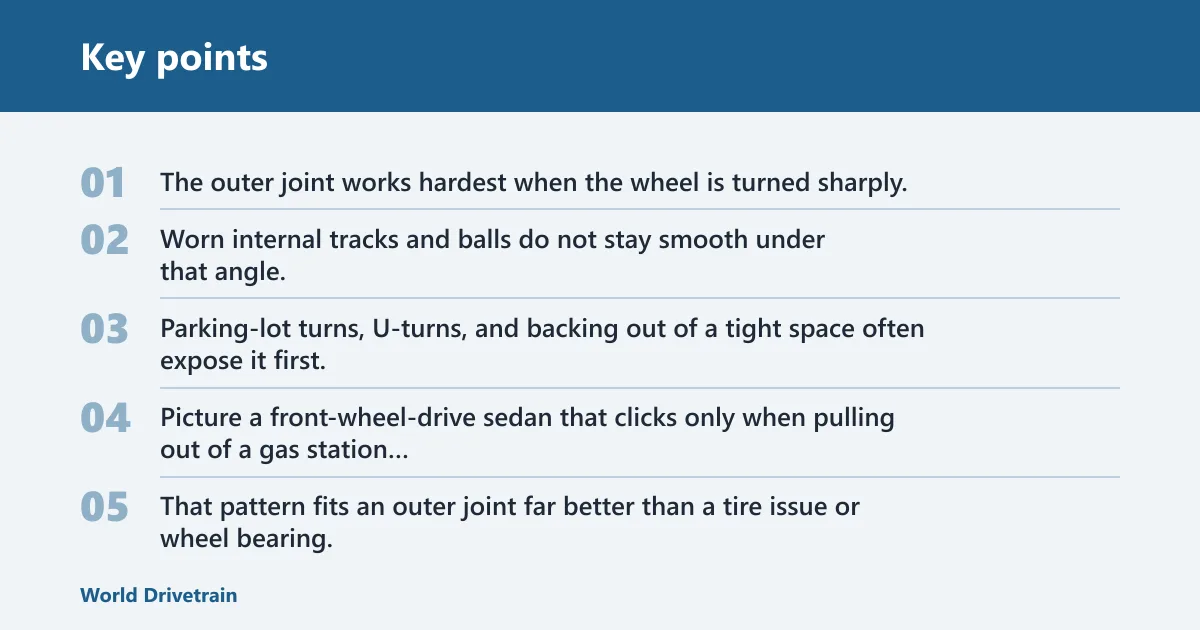
The outer joint works hardest when the wheel is turned sharply. Worn internal tracks and balls do not stay smooth under that angle, so each rotation can create a sharp click or pop. Parking-lot turns, U-turns, and backing out of a tight space often expose it first.
Picture a front-wheel-drive sedan that clicks only when pulling out of a gas station with the wheel hard over. That pattern fits an outer joint far better than a tire issue or wheel bearing.
How speed changes the rhythm of the noise
The cadence of the click usually tracks wheel speed. Faster rolling means faster clicks. If the sound is tied to steering angle and road speed together, the outer joint is the better fit than the inner joint.
What to inspect first: boot, clamps, and joint movement
Start with the outer boot. Look for tears, cracks, grease sling, or a boot that has slipped out of its groove. Check clamp integrity and the area around the wheel well for grease contamination. Then raise the vehicle safely and check for roughness or play at the joint.
Any clicking that appears only on full lock deserves prompt inspection. If the click becomes a grind, the steering feels jerky, or the boot is open and empty of grease, the car should be handled soon rather than later.
Vibration under load: is the inner joint failing?
Vibration that rises with road speed or gets worse under acceleration is often associated with the inner CV joint. The clue is load sensitivity. If the shake lessens when you lift off the throttle and returns when you accelerate, the inner joint moves higher on the list than the outer joint.
Why inner joint wear often shows up on acceleration
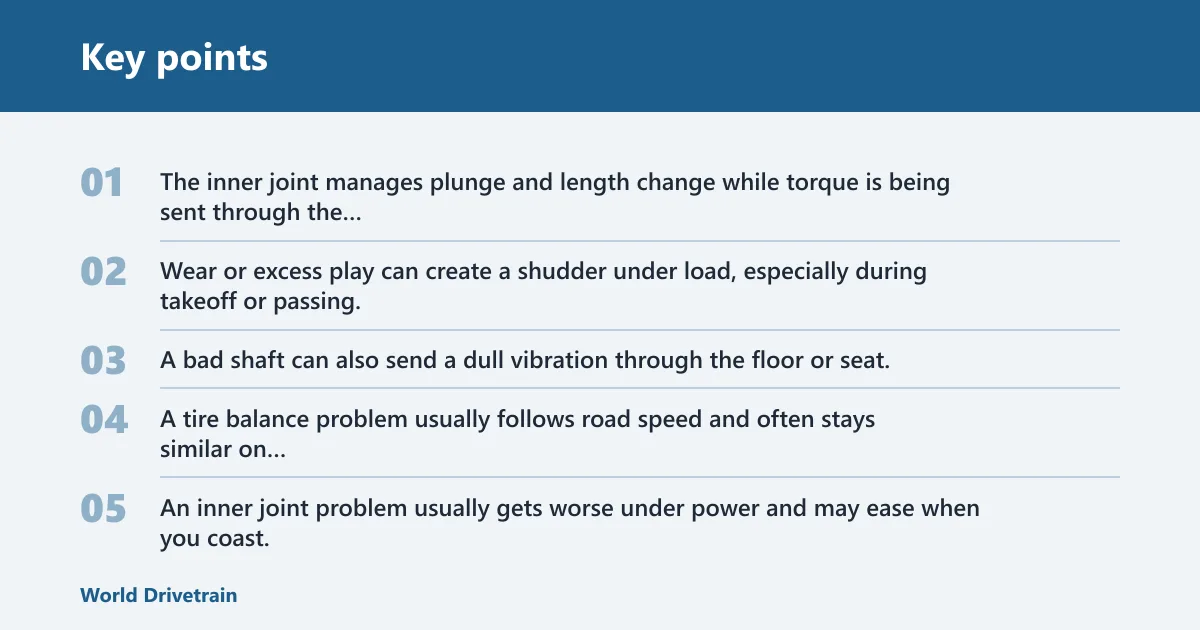
The inner joint manages plunge and length change while torque is being sent through the axle. Wear or excess play can create a shudder under load, especially during takeoff or passing. A bad shaft can also send a dull vibration through the floor or seat.
How to tell axle vibration from tire or wheel balance issues
A tire balance problem usually follows road speed and often stays similar on acceleration and coasting. An inner joint problem usually gets worse under power and may ease when you coast. Wheel bearing noise often changes with lane load or cornering, not just throttle.
Engine mounts and transmission mounts can also copy this symptom. If the vibration shows up at idle, during shifts, or when revving in Park, the axle is not the only suspect. If it appears mainly while moving and loading the drivetrain, inspect the axle first.
What to check next on a lifted vehicle
Raise the vehicle safely, remove the wheel, and check the shaft by hand. Look for axial play that seems excessive, rough movement through the joint, torn boots, loose clamps, and wetness around the transaxle or differential seal area. A leaking seal can contaminate the joint and cloud the diagnosis.
Can a bad CV axle cause vibration at highway speeds? Yes, especially if the inner joint is worn or the shaft is bent. Highway vibration that rises with throttle is more suspicious than vibration that stays exactly the same with coast-down. That said, wheel balance and tire defects still need to be ruled out.
CV axle symptom matrix
This table gives the quickest symptom-to-failure map. Use the driving condition and the first inspection step together. If two rows seem possible, inspect the boot, clamps, and joint movement before replacing anything.
| Symptom | Likely failed part | When it appears | First inspection step |
|---|---|---|---|
| Clicking on tight turns | Outer joint | Turning | Inspect the outer boot, clamp, and joint play with the wheel turned full lock |
| Vibration that rises with throttle | Inner joint | Acceleration | Check shaft straightness, boot condition, and transaxle-side movement on a lift |
| Grease splatter near wheel well | Boot | All speeds | Look for a torn boot, missing clamp, or boot half off the groove |
| Clunk on takeoff or shift load | Inner joint or shaft | Acceleration, deceleration | Check for excessive shaft play and separate it from mount movement |
| Grinding or roughness by hand | Joint | All speeds | Raise the vehicle and rotate the axle by hand while feeling for rough spots |
| Wet axle seal area | Shaft or seal area | All speeds | Inspect the transaxle or differential seal for leakage and contamination |
When the same symptom can point away from the axle
Clunking can come from engine mounts, transmission mounts, or suspension bushings. Vibration can come from tire balance, tire separation, bent wheels, or a failing wheel bearing. The axle becomes the stronger suspect when the symptom changes with steering angle, throttle, or both.
Visible damage you can spot fast
The fastest clues are visual. A torn axle boot clamp, grease around the wheel well, or a boot hanging half off the groove can tell you the joint has been exposed long enough to matter. These are not cosmetic issues. They are contamination and lubrication issues.
Torn boot, missing clamp, or boot half off the groove
A missing clamp lets grease escape and dirt enter. A boot that has walked out of its groove usually means the joint has been flexing while the seal was compromised. If the boot is damaged near the small end, check the inner joint first. If it is damaged near the wheel end, check the outer joint first.
Grease sling on the wheel well and suspension
Grease sling often appears as a spray pattern on the inside of the wheel, liner, control arm, or strut. Full steering lock can make the pattern easier to see because it changes the boot angle and throws grease outward more aggressively.
Axle seal area and contamination checks
Inspect the transaxle or differential seal area for wetness, dirt buildup, or fresh grease mixed with road grime. If the seal is leaking, the axle may not be the only part that needs attention. That seal problem can also shorten the life of a new joint if it is ignored.
Clunking, binding, or shaft play
Clunking at takeoff or during shift changes often points to excess movement in the axle assembly. Binding or roughness during hand rotation points more directly to a worn joint. If the shaft itself has noticeable play, the issue may be beyond a boot-only repair.
Takeoff clunks and shift-load knocks
A clunk when moving off from a stop can mean the joint has too much clearance. A knock that appears during on-off throttle changes can also come from mounts, so compare the sound with engine load and vehicle motion. A mount-related knock often shows up outside steering input.
Roughness during hand rotation
With the car safely raised and the wheel removed, turn the axle by hand. A good joint should move smoothly. Notchy movement, grinding, or tight spots point to wear inside the joint, while free play at the hub end can point to the shaft or spline area.
Left side versus right side clues
Left and right axles do not always fail the same way or at the same time. One side may carry more angle, more heat, or more plunge depending on the vehicle layout. If the symptom is stronger while turning one direction, the outside-loaded side may be the better inspection target.
Suppose a crossover starts clunking only during hard left turns and the right front boot is coated in grease. That pattern does not prove the right axle is bad, but it does tell you where to begin: the outer joint and boot on that side.
- Confirm the symptom and note whether it appears on turns, acceleration, coasting, or all speeds.
- Inspect both boots for tears, missing clamps, grease sling, and contamination.
- Raise the vehicle safely and remove the wheel.
- Check shaft play, joint roughness, and the axle seal area.
- Compare the symptom with wheel bearing, tire balance, and mount-related causes before replacing parts.
What are the symptoms of a bad CV axle?
The most common symptoms are clicking on turns, vibration under acceleration, grease around the wheel area, and clunking during takeoff or shifts. The strongest clue is how the symptom changes with steering angle or throttle. That pattern usually points to the axle or one of its joints, not a random noise.
What are the signs of a bad CV axle?
Signs include a torn boot, missing clamp, grease sling, roughness when the axle is turned by hand, and play in the shaft or joint. If the vehicle also clicks on full-lock turns or shudders on acceleration, the axle deserves a close look before replacement decisions are made.
What are the symptoms of a broken CV axle?
A broken CV axle can cause a sudden loss of drive, loud knocking, or severe vibration before failure. In some cases the car may move poorly or not at all. If the axle has separated, do not keep driving; the vehicle can lose drivability quickly and may damage the seal or nearby parts.
What are the symptoms of a bad CV axle shaft?
A bad CV axle shaft often shows up as vibration that rises with speed, clunks on load changes, or visible wobble, bend, or play. If the shaft is damaged rather than just the joint, the symptom may appear at more than one condition and not only on turns.
What are the symptoms of a bad CV joint?
Outer CV joint problems are commonly reported to click or pop on turns, especially at full steering lock. Inner CV joint problems are more commonly associated with shudder or vibration under acceleration. Checking which end is noisy matters, because the symptom pattern often tells you whether the outer joint or inner joint is the likely failure.
What are the signs of a broken CV axle?
Signs of a broken CV axle include a sudden clunk, a loss of drive, heavy vibration, or an axle that is visibly separated or hanging out of position. If the boot is destroyed and the joint is making loud mechanical noise, the axle may be at the point where driving further is unwise.
What are the symptoms of a bad front axle?
On front-wheel-drive and many AWD vehicles, a bad front axle often shows up as turning clicks, acceleration vibration, grease at the wheel, and knock on takeoff. Because the front axle also handles steering angle, its symptoms are often easier to trigger than a rear axle symptom on the same vehicle.
What are the signs of a bad CV shaft?
Signs of a bad CV shaft include shaft play, vibration that follows throttle, visible damage to the shaft or boots, and noise that changes with load. A shaft problem can also overlap with wheel bearing or tire issues, so the first inspection should still include the boot, hub nut, and seal area.
Frequently asked questions
What are the signs of a bad CV joint?
The classic signs are clicking on tight turns for the outer joint and shudder under acceleration for the inner joint. Roughness by hand, boot damage, and grease loss also point toward joint wear. If the symptom changes with steering angle or throttle, the joint deserves immediate inspection.
What are some symptoms of a bad CV axle?
Common symptoms are clicking, vibration, grease sling, and clunking on takeoff or gear changes. The next step is not a guess at replacement; it is a check of the boot, clamps, shaft movement, hub nut condition, and axle seal area so you know which part has actually failed.
Can a bad CV axle cause vibration at highway speeds?
Yes. A worn inner joint or bent shaft can create vibration that becomes more obvious as speed rises, especially under load. Because tire balance, bent wheels, and wheel bearings can feel similar, the vibration pattern should be compared against acceleration, coasting, and cornering before parts are ordered.