Can a Bad Shift Solenoid Cause Hard Shifting?
Yes. A bad shift solenoid can cause hard shifting, especially in one gear or one shift event, but fluid level, adaptive relearn, and mechanical faults can create the same symptom. This guide shows how to sort out fluid, solenoid, and mechanical causes before you spend money on the wrong repair.
How a faulty solenoid disrupts shift pressure and timing
Yes. A shift solenoid is an electromagnet component inside an automatic or semi-automatic transmission that controls hydraulic fluid flow for gear changes. When the transmission control unit sends power or ground to the required shift solenoid, that valve opens or closes at the wrong time, and the shift can feel late, abrupt, or slow.
Hard shifting can also come from a pressure-control solenoid, which affects line pressure more broadly than a shift solenoid that helps route fluid for a specific gear change. That distinction matters because a shift solenoid often contributes to gear-specific harshness, while pressure-control problems and valve-body wear can mimic the same complaint across multiple shifts. Service-manual diagnostics commonly treat P0700 as an umbrella flag, not a root-cause code by itself, so the exact follow-up code and live data matter.
A bad solenoid can affect both upshifts and downshifts. It may also create a pattern that shows up in only one gear change, which is why the symptom often feels more specific than a general transmission failure. One shift is harsh. The next one may feel normal.
Why the shift can feel harsh, delayed, or late
Hard shifting happens when the transmission applies pressure at the wrong moment or too quickly. A solenoid that sticks, responds slowly, or opens the wrong circuit can disturb that pressure control. The result can be delayed engagement followed by a firm bang into gear, or a shift that drags out before it finally completes.
That pattern matters. A solenoid fault often follows a repeatable gear-change pattern, while fluid, valve body, or mechanical wear is more likely to make several shifts feel wrong. OEM service information also warns that limp mode behavior can appear when the control module sees a fault it cannot trust, so a harsh shift followed by reduced-shift operation deserves prompt diagnosis.
When the symptom points away from the solenoid
If every shift is harsh from cold start through full warm-up, low or dirty fluid is a stronger suspect than a single solenoid. If the problem appears after battery disconnect or transmission service, adaptive relearn or software logic may be involved. If drive and reverse both clunk hard, torque-converter or hydraulic issues deserve attention too.
Suppose second gear always hits hard after a hot restart, but the rest of the shifts feel normal. That pattern leans toward a gear-specific control issue. Suppose every shift is harsh only on a freezing morning, then smooths out after a few miles. That pattern points more toward fluid behavior or wrong fluid specification.
Fluid vs solenoid vs mechanical: quick triage checklist
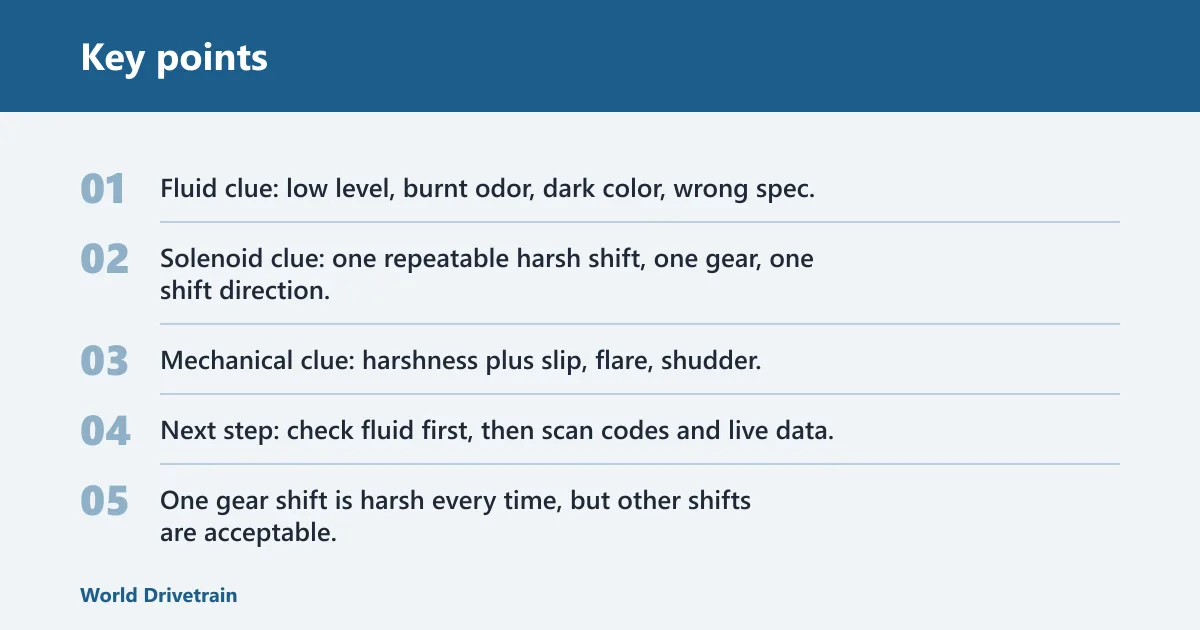
- Fluid clue: low level, burnt odor, dark color, wrong spec, or a recent service with the wrong ATF.
- Solenoid clue: one repeatable harsh shift, one gear, one shift direction, or a code that points to electrical control.
- Mechanical clue: harshness plus slip, flare, shudder, delayed engagement in multiple ranges, or valve-body wear symptoms.
- Next step: check fluid first, then scan codes and live data, then decide whether the fault is electrical, hydraulic, or internal.
Hard shifting patterns that point to a solenoid
Solenoid problems usually show up as a pattern, not a random complaint. The best clue is whether one shift is wrong every time, while the others stay close to normal. That pattern is more useful than how dramatic the jerk feels.
- One gear shift is harsh every time, but other shifts are acceptable.
- The transmission delays, then bangs into a specific upshift or downshift.
- Drive or reverse engagement is harsh, while forward shifts may be less affected.
- The vehicle may feel like it is shifting very slowly before the gear change completes.
Shift direction clues
Some solenoids mainly influence upshifts, while others influence downshifts or pressure control during multiple gear changes. If the problem happens only during an upshift into a certain gear, that narrows the search. If it happens during a downshift, especially during deceleration, the control path may be different.
Hard engagement in drive or reverse is a separate clue. That can still involve a solenoid, but it can also point toward hydraulic pressure issues or a torque converter concern. Keep the direction of the complaint in view before replacing parts.
Shift solenoid matrix
This matrix helps separate one-gear harsh shifting from broader transmission problems. It is not a parts list. Use it to match the symptom pattern first, then inspect the most likely system before buying a solenoid pack, valve body, or fluid service.
| Symptom pattern | Fluid clue | Code/live-data clue | Repair-likelihood confidence | Likely non-solenoid causes | Recommended first check | Stop-driving red flags |
|---|---|---|---|---|---|---|
| One upshift is harsh every time | Fluid may be normal or slightly degraded | Gear-specific shift code or commanded-shift mismatch in live data | High for electrical/hydraulic control, moderate for internal wear | Adaptive relearn, valve body sticking, wrong fluid | Read codes, then confirm fluid level and condition | Transmission stuck in one gear, slipping after the harsh shift |
| One downshift is delayed, then abrupt | Often no obvious fluid clue unless pressure is unstable | Shift timing or speed-ratio data does not match the commanded event | Moderate to high | Valve body wear, TCM logic, hydraulic pressure loss | Scan for transmission codes and review live data | Repeated neutral flare or loss of engine braking |
| All shifts are harsh when cold only | Low fluid, dirty fluid, or wrong-spec fluid is common | No consistent gear-specific code; behavior improves with temperature | Lower for a single solenoid | Low fluid, dirty fluid, wrong viscosity or spec | Check fluid level and service history first | Burning smell, visible leaks, or no reverse |
| Drive and reverse both engage with a clunk | May show low fluid, aeration, or delayed pressure fill | May log pressure-control or range-related data rather than one shift code | Low to moderate for a shift solenoid | Torque converter, hydraulic pressure, engine idle issue | Inspect engagement behavior and scan for related codes | Vehicle shudders, stalls, or will not move normally |
| Shifts worsen after battery disconnect or service | Fluid clue may be unrelated unless service introduced the wrong fluid | Codes may be absent while adaptives are reset or incomplete | Moderate for relearn-related concern, lower for failed solenoid | Adaptive relearn not completed, software issue | Check for relearn or reset procedure | Limp mode, flashing warning light, or severe slip |
| Transmission stuck in a gear | May show burnt fluid if the fault has been present a while | Umbrella code such as P0700 plus transmission-side codes, or live-data mismatch | High for control fault, but mechanical failure must be ruled out | Limp mode, valve body fault, internal mechanical failure | Scan codes before clearing anything | Cannot safely accelerate with normal traffic flow |
| Hot-only harsh shifts after normal driving | Fluid may thin out or show heat-related degradation | Issue appears only after heat soak or rising transmission temperature | Moderate for solenoid or valve body, moderate for fluid/pressure loss | Valve body wear, pressure loss, fluid breakdown | Check temperature-linked behavior and live data | Slip, flare, burnt smell, or worsening engagement |
| Post-service harsh shifts | Wrong fluid or low fill level is a key clue after service | May have no code until the controller adapts or the fault worsens | Lower for failed solenoid, higher for service-related issue | Wrong fluid, incomplete relearn, disturbed connector, valve body issue | Confirm fluid spec, level, and reset/relearn needs | Warning light, stuck gear, or new leak after service |
| No-light, no-code harsh shifting | Fluid condition becomes a top clue | No MIL does not rule out transmission fault; scan transmission data if possible | Moderate for fluid or mechanical issue, lower for obvious electrical failure | Low fluid, dirty fluid, valve body wear, mechanical wear | Check fluid, then scan with a transmission-capable tool | Slip, no reverse, or severe engagement delay |
What else can cause hard shifting?
Low, dirty, or incorrect transmission fluid can cause hard shifting, and it may do so even without a solenoid failure. A valve body can also stick or wear out and mimic a bad solenoid. Adaptive relearn issues and torque-converter problems can create the same complaint, especially after service or on certain gear changes.
Fluid level and fluid condition
Transmission fluid affects hydraulic pressure. If the level is low, pressure can drop and shifts can become delayed or harsh. Dirty fluid can make valves respond poorly. Wrong fluid specification can worsen cold shifting because viscosity and friction behavior are off for that transmission family.
Fluid specification matters because many transmissions are calibrated around a specific friction profile, not just “ATF” generically. OEM fluid charts and service manuals typically treat the wrong fluid as a diagnosis problem, not a minor maintenance detail.
Check the service history before replacing electrical parts. If the fluid is dark, smells burnt, or appears wrong for the transmission, that is a stronger starting point than a blind solenoid swap.
Valve body wear or sticking valves
The valve body routes hydraulic fluid and can house solenoids. A sticking valve inside the valve body can create the same one-gear harsh shift that people blame on the solenoid. In those cases, replacing only the solenoid may not fix the fault because the hydraulic path is still wrong.
Valve body wear can also mimic a pressure-control solenoid problem. That is why a technician should separate gear-specific electrical control from a broader hydraulic response before approving larger repairs.
TCM adaptive learning or software issues
The automatic transmission control module uses sensor inputs to decide shift timing and can store trouble codes. After service or battery disconnect, it may need an adaptive relearn. If the relearn is incomplete, the transmission can shift too firmly or too late without a failed solenoid.
That matters after battery replacement, transmission work, or a software update. If the hard shift began right after one of those events, relearn should stay on the short list.
Torque converter and hydraulic problems
The torque converter can contribute to clunking or harsh engagement, especially in drive or reverse complaints. It is a hydraulic component, so the symptom can overlap with solenoid and valve body issues. If the complaint is strongest when selecting drive or reverse from a stop, do not assume the solenoid is the only cause.
What codes and lights matter?
A check engine light may illuminate with transmission problems, and it can be the first sign of a shift solenoid issue. A transmission warning light can also appear. But not all transmission problems trigger a lamp right away, so the absence of a light does not rule out a fault.
How to read trouble codes with an OBD2 scanner
Use an OBD2 scanner to read transmission-related codes, including P0700 and related TCM codes when the vehicle supports them. P0700 usually means the transmission control module has stored a fault, but it is only an umbrella indicator. The exact code set tells you whether the problem looks electrical, hydraulic, or mechanical.
Some vehicles need a scanner that can talk to the transmission control module directly. Generic engine-only readers may miss the useful part of the diagnosis.
What live data can add
Live data can show commanded gear, shift timing, input and output speed, and whether the controller is asking for a shift that never completes cleanly. That combination can raise or lower the odds of a solenoid fault. If the controller commands a shift and the transmission reacts late or erratically, the control side deserves attention.
Codes alone are not the whole story. A hard shift with no code can still be fluid-related, while a code with a clean shift may point to an intermittent electrical fault.
Can a bad shift solenoid put a car in limp mode?
Yes. A bad shift solenoid may cause limp mode, which is a protective mode that limits how the transmission operates. Limp mode may limit the transmission to gear 3 or below. The goal is to reduce damage when the controller sees a fault that it cannot trust.
What limp mode changes in how the car drives
In limp mode, the vehicle may feel stuck in a single gear, shift very little, or accelerate poorly. That protective behavior can keep the transmission from making repeated bad shifts, but it also changes normal drivability fast. Ignoring a faulty shift solenoid can cause the vehicle to run in the wrong gear.
When to stop driving
Stop driving if the transmission will not shift out of one gear, if the vehicle loses reverse or drive, or if the warning light flashes and the transmission behavior gets worse with each mile. A hard-shifting transmission that also slips, smells burnt, or shudders under load needs prompt diagnosis.
Repair choices and diagnosis order
Diagnosis should come before replacement, because single-solenoid service, solenoid packs, valve body work, and fluid service vary by transmission family. A single solenoid replacement cost can vary by transmission design and labor access; a pack or valve-body repair can vary even more. Examples commonly cited in repair guides range from about $100 to $350 for a single solenoid and about $400 to $700 for a solenoid pack service, but pricing depends heavily on design, parts availability, and labor time. Valve body replacement can run roughly $500 to $1000 in some applications, but that is not universal.
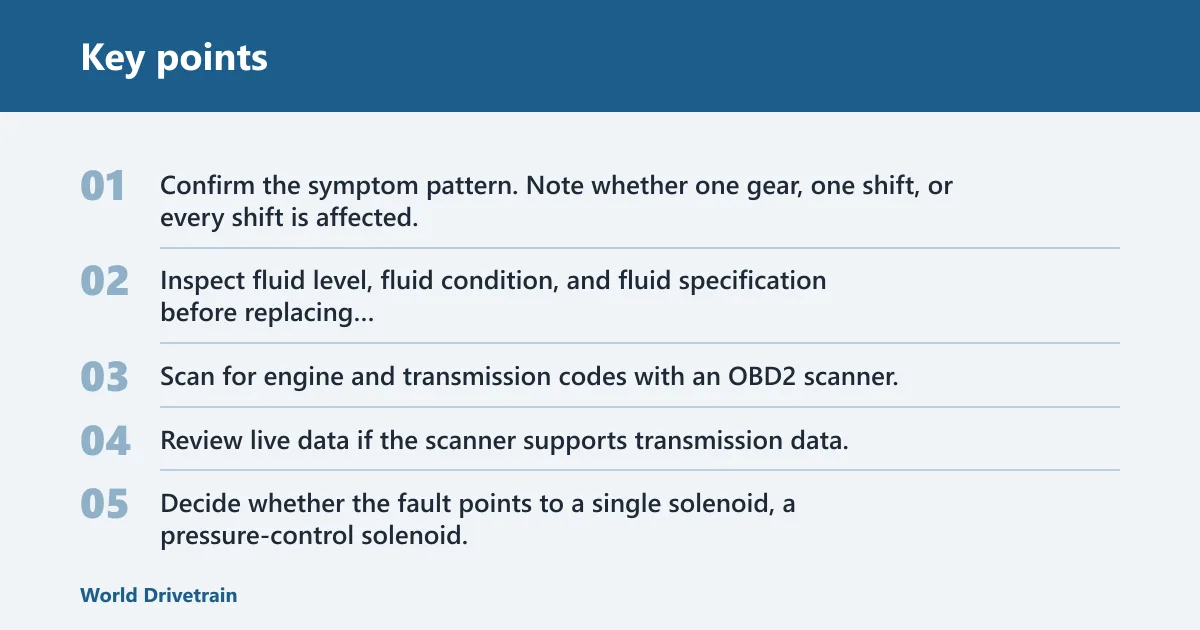
- Confirm the symptom pattern. Note whether one gear, one shift, or every shift is affected.
- Inspect fluid level, fluid condition, and fluid specification before replacing electrical parts.
- Scan for engine and transmission codes with an OBD2 scanner.
- Review live data if the scanner supports transmission data.
- Decide whether the fault points to a single solenoid, a pressure-control solenoid, a solenoid pack, a valve body, or a relearn issue.
- After repair, clear codes and complete any adaptive relearn required by that transmission.
Single solenoid, pack, or valve body
Some transmissions allow a single solenoid to be replaced. Others place the solenoid in a pack or build it into the valve body. That is why the same symptom can lead to very different repair bills and why a one-price answer is unreliable.
A bad solenoid may also sit inside a valve body assembly, which can push the repair toward a larger job. In those cases, a quick parts swap may not be enough.
Fluid and filter service during related repairs
When the diagnosis points toward contaminated or incorrect fluid, service the fluid and filter with the correct specification. That will not fix every hard shift, but it can remove a basic hydraulic problem before you spend on parts that were never the root cause.
Frequently asked questions
Can shift solenoid cause hard shifting?
Yes. A shift solenoid controls hydraulic fluid flow, so a fault can make an upshift or downshift feel abrupt, delayed, or slow. The strongest clue is a repeatable pattern in one gear or one shift event, rather than a random harsh feeling across every gear change.
What does a bad shift solenoid cause?
A faulty shift solenoid can be associated with delayed shifting, hard shifting, a gear that seems stuck, or slower gear changes. It may also trigger limp mode and a check engine light. If the transmission runs in the wrong gear or stays stuck in one gear, the fault can become much more serious.
How do I know if hard shifting is from fluid or a solenoid?
Fluid-related hard shifting usually shows up across more than one gear, often worse when cold, and may follow low, dirty, or wrong-spec fluid. A solenoid fault more often affects one gear change or one direction of shift. Scan codes, then inspect fluid level and condition before replacing electrical parts.
Is hard shifting from one gear more likely a solenoid problem?
Usually, yes. Hard shifting in one specific gear change is more consistent with a solenoid, a sticking valve in the valve body, or a control issue than with a general fluid problem. The exact shift pattern matters, so read codes and inspect the fluid before replacing parts.
What could cause a transmission to shift hard?
Hard shifting can come from a bad shift solenoid, low or dirty fluid, the wrong fluid specification, valve body wear, adaptive relearn problems, torque-converter issues, or mechanical wear. The right first check depends on whether the complaint affects one gear, every shift, or drive and reverse engagement.