What Causes Hard Shifting in an Automatic Transmission?
Hard shifting in an automatic transmission usually points to low fluid level, dirty or burnt ATF, the wrong viscosity, a failing shift solenoid or valve body, bad line-pressure control, or sensor/TCM data that makes the unit command harsh gear changes; if it happens only cold, hot, or in one gear, that pattern narrows the cause fast. Ignore it and you can overheat the transmission, damage clutches, and turn a fluid-level fix into an expensive rebuild. This guide matches the shift pattern, temperature, and warning lights to the most likely fault and the next checks.
What hard shifting means
Hard shifting is a harsh, firm, delayed, or jerky gear change in an automatic transmission. The shift may feel like a bang, a shudder, a flare followed by a catch, or a clunk when you move from park to reverse. The exact feel matters, because upshifts, downshifts, and engagement problems do not point to the same fault.
Hard upshifts, downshifts, and park-to-reverse clunks
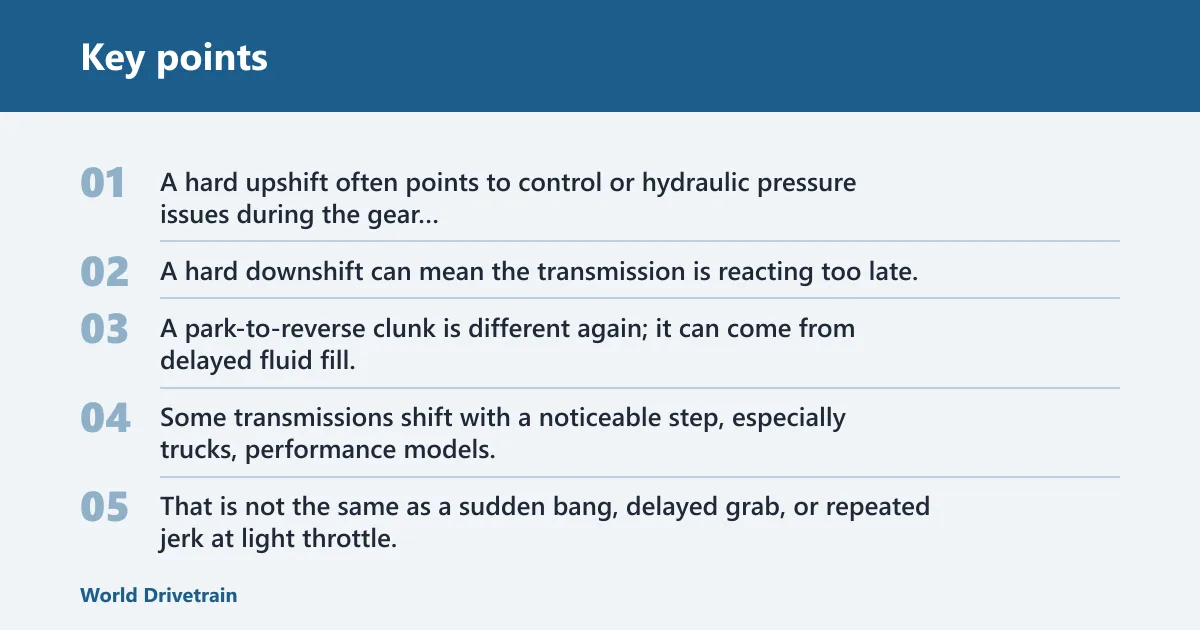
A hard upshift often points to control or hydraulic pressure issues during the gear change itself. A hard downshift can mean the transmission is reacting too late, then applying pressure too quickly. A park-to-reverse clunk is different again; it can come from delayed fluid fill, a worn mount, excess line pressure, or a valve body that is not cushioning engagement properly.
Normal firmness versus a fault
Some transmissions shift with a noticeable step, especially trucks, performance models, DSG units, or vehicles in tow/haul mode. That is not the same as a sudden bang, delayed grab, or repeated jerk at light throttle. Normal shift feel stays consistent and matches the vehicle type; fault-related harshness changes with temperature, throttle input, or gear.
Why is it worse when cold?
Cold ATF is thicker, so flow through the valve body, solenoids, and passages is slower until the fluid warms. That can make a transmission shift harder for the first few minutes without meaning there is permanent internal damage. If the problem fades as the temperature rises, the diagnosis leans toward fluid condition, adaptation, or pressure control rather than a deep mechanical failure.
Cold-only symptoms versus persistent symptoms
If harsh shifts happen only on a cold start and improve after several miles, start with fluid level, fluid specification, and temperature-related control behavior. If the same hard shift appears hot, in traffic, or after the transmission is fully warm, the problem is less likely to be simple viscosity and more likely to involve solenoids, valve wear, line pressure, or TCM strategy.
Why warm-up changes the diagnosis
Warm fluid moves more easily, so a cold-only complaint can disappear even when the transmission still has a minor issue. That makes the warm-up pattern a useful clue, not a final answer. A hard shift that stays consistent at operating temperature deserves a more complete diagnosis.
Transmission shift matrix
This matrix gives a fast first pass. Match the symptom pattern before replacing parts.
| Symptom pattern | Likely cause | Quick check | Scan-tool clue | Escalation level |
|---|---|---|---|---|
| Cold-only harsh shifts for the first 5–10 minutes | Thick ATF, low level, wrong-spec fluid, or cold adaptation behavior | Check level and ATF spec at the correct temperature; note color and smell | Coolant temp and transmission temp disagree with shift timing; adaptive shift data changes with warm-up | Moderate: fluid and calibration checks first |
| Park-to-reverse clunk or delayed engagement | Low line fill, worn mounts, valve body leakage, or torque converter drainback | See whether reverse engages after a pause; inspect mounts and fluid level | Commanded gear appears, but apply pressure rises late | Moderate to high |
| First-to-second flare then jerk | Shift solenoid problem, valve body wear, or slipping clutch apply | Check for burnt fluid and repeatability under light throttle | Shift time longer than normal; solenoid current or ratio error present | High |
| No-code hard shifting | Early hydraulic wear, fluid issue, adaptation drift, or pressure problem | Inspect fluid condition and confirm the exact symptoms in each gear | No fault codes, but live data shows pressure or load mismatch | Moderate to high |
| Tow/haul-related firmness | Normal calibration for load, or a mode input problem if the mode is stuck on | Confirm mode switch status and whether the firmness changes when tow/haul is off | TCM requests later shifts and higher pressure in load mode | Low if expected, moderate if mode is incorrect |
What fluid problems cause hard shifts?
Fluid issues are the first thing to rule out because they can create hard, delayed, or inconsistent shifts without any internal failure. Check level, condition, and the exact manufacturer-specified ATF type before looking deeper. Low fluid, dirty fluid, burnt fluid, or the wrong viscosity can all change hydraulic pressure and shift timing.
Low fluid level and aeration
Low fluid can let the pump pull air and make pressure unstable. That can cause delayed engagement, harsh gear changes, or a momentary slip followed by a grab. A low reading should be verified at the correct temperature and procedure for that transmission, because an incorrect check can mislead the diagnosis.
Dirty, burnt, or wrong-spec ATF
Dark fluid, a burnt smell, or visible debris points to heat and wear. Wrong-spec fluid can also create bad shift feel because viscosity and friction behavior may not match the calibration. A transmission built for one ATF type may shift too firmly, too late, or too erratically on a substitute fluid.
Clogged filter and pressure instability
A clogged transmission filter restricts fluid flow to the pump and valve body. That restriction can reduce pressure stability and cause delayed fills, harsh apply events, or repeated shift complaints. A dirty filter often shows up alongside burnt fluid, debris in the pan, or a history of overheating.
Say your sedan shifts hard only after a cold start, and the fluid on the dipstick smells burnt and looks dark red-brown. That pattern points first to fluid condition and service history, not an automatic rebuild. If the fluid is also low, the hard shift may improve after the level is corrected and leaks are found.
Which control faults cause hard shifting?
Control faults are the next branch in the diagnosis tree when fluid checks do not explain the symptom. Shift solenoids, valve body wear, and TCM adaptation problems can all change how quickly the transmission applies pressure. These faults often need scan data, resistance checks, and a careful review of the exact shift pattern.
Shift solenoid failure or sticking
A shift solenoid is an electrical valve that helps route fluid to the right circuits. Shift solenoids can fail electrically, stick open or closed, or respond slowly. That changes line pressure and gear changes, and it often shows up as a repeatable harsh upshift, harsh downshift, or a flare followed by a grab.
Valve body wear and debris
The valve body is the hydraulic control assembly inside the transmission. Wear, debris, or sticky valves can make shifts abrupt or unpredictable. A transmission with worn bores or contaminated passages may still move through the gears, but it can do so with a bang, a pause, or a double-hit feel.
TCM adaptation, software, and relearn data
The transmission control module uses adaptive shift strategy to fine-tune apply timing over time. Software calibration problems, corrupted adaptive values, or an incomplete relearn after battery disconnect or repair can change shift feel. A scan tool may show no hard fault, yet the live data and adaptation counters can still point to a control issue.
When is it a mechanical problem?
Mechanical trouble becomes more likely when hard shifting continues after fluid and control checks, or when the transmission shows slipping, delayed engagement, or repeated pressure-related complaints. At that point, line pressure, the torque converter, the filter, and internal wear matter more. That is where diagnosis prevents unnecessary parts replacement.
Line pressure too high or too low
Line pressure is the hydraulic pressure that runs the transmission. Line pressure that is too high can make shifts bang. Line pressure that is too low can cause slippage, flare, or a delayed catch. Verifying line pressure usually requires a scan tool, a pressure gauge, or both, depending on the design.
Torque converter lockup issues
The torque converter is a fluid coupling, and its lockup function can affect drivability once the vehicle is moving. A failing converter can contribute to shudder, harsh engagement, or a strange near-shift feel that is not a normal gear change. A problem here may feel like a transmission fault even when the gears themselves are not the only issue.
Internal wear or damage
Worn clutches, damaged seals, internal leaks, or overheated hard parts can create shifts that get worse over time. If the fluid is contaminated, the pan contains heavy debris, or the transmission slips before it grabs hard, internal damage becomes more likely. That is the point where continuing to drive can raise the repair bill quickly.
Picture a pickup that bucks hard on the 1-2 shift only when towing uphill, then feels normal empty. That could be a calibration or line-pressure response to load, not necessarily a failed hard part. If the same truck also shows burnt fluid and delayed reverse, the diagnosis shifts toward hydraulic wear.
Why engine signals matter
The transmission does not decide shift timing in isolation. It uses engine load signals such as throttle position, engine speed, and MAF or load inputs to decide when and how firmly to shift. Bad input data can make a healthy transmission act rough because the TCM is reacting to the wrong request.
Throttle position and load input errors
If throttle position or load data is inaccurate, the transmission may think the engine is under more load than it really is. That can raise line pressure and delay shifts, creating a hard feel. Faulty input data can come from sensors, wiring, or software calibration, so scan data matters here.
Engine speed and shift timing
Engine speed helps the TCM match the shift to road speed and load. If that signal is erratic, the transmission may command a late or abrupt change. A hard shift with no obvious fluid problem can still trace back to the engine side of the control picture.
Tow/haul mode, CVT, and DSG differences
Tow/haul mode often raises shift firmness by design. That is normal if the mode is active and the vehicle is under load. CVT and DSG units also do not feel like a conventional automatic; a DSG may shift sharply by design, while a CVT may feel unusual in a different way. The key question is whether the feel matches the vehicle’s intended behavior.
How to fix hard shifting automatic transmission
Start with the least invasive checks: confirm the symptom pattern, check fluid level and condition, verify the correct ATF type, and scan for codes or live-data abnormalities. If the fluid is wrong, low, burnt, or contaminated, correct that before replacing solenoids or major parts. If the symptom persists hot, under load, or in one specific gear, move to scan data, pressure checks, and hydraulic inspection.
A practical order of checks
- Confirm when the hard shift happens: cold, hot, one gear, tow/haul, or every drive.
- Check transmission fluid level at the correct temperature and procedure.
- Inspect fluid color, smell, and debris for burn or contamination.
- Verify the ATF specification matches the vehicle requirement.
- Scan for transmission and engine codes, even if the check engine light is off.
- Review live data for shift solenoids, load inputs, temperature, and adaptive shift behavior.
- Move to pressure, valve body, filter, torque converter, or internal inspection if the first checks do not explain the symptom.
When to stop driving
The article says to stop driving if the transmission slips, refuses a gear, bangs violently into gear, leaks fluid, or smells burnt after a short drive. Continued driving can overheat the unit and spread debris through the valve body and cooler circuit. If the harsh shift is severe, a professional inspection is the safer move.
Frequently asked questions
What causes hard shifting in an automatic transmission?
Hard shifting usually comes from low, dirty, or wrong-spec fluid, a failing shift solenoid, valve body wear, line-pressure problems, or a TCM input issue. Temperature and gear pattern matter. Cold-only harshness points one way; warm, repeatable harshness points another.
Why is my transmission hard shifting with no check engine light?
No warning light does not rule out a transmission fault. Fluid level, filter restriction, adaptation drift, early valve body wear, or a pressure problem can all create hard shifts before a code sets. Live data and fluid condition become especially important in that case.
What causes rough shifting in an automatic transmission?
Rough shifting is usually the same family of problem as hard shifting: fluid issues, solenoid trouble, valve body wear, pressure faults, or TCM command problems. The difference is often in how the shift feels, not in the underlying branch of the diagnosis tree.
What causes a transmission to shift hard?
A transmission shifts hard when hydraulic pressure, apply timing, or control inputs do not line up with the gear change. Low or wrong fluid, clogged filters, sticking solenoids, worn valves, bad engine load data, and internal wear are common reasons. Tow/haul mode can also make firm shifts normal.
What causes hard shifting on an automatic transmission?
Hard shifting on an automatic transmission can come from fluid that is low, burnt, or wrong for the unit; a sticking shift solenoid; a worn valve body; poor line pressure; or a torque converter concern. If it is cold-only, the diagnosis starts differently than if it happens hot.