Transmission Replacement Cost: What to Expect
Transmission replacement cost usually runs about $3,000 to $7,500 installed, while some CVT, dual-clutch, and heavy-duty units may exceed $8,000; a fair quote typically breaks out the transmission source, labor hours, fluids, programming, and warranty. Those broad totals are market-built estimates rather than one national flat rate: late-model OEM replacement assemblies can vary widely by application in manufacturer parts catalogs, reman units vary by supplier and core policy, and labor times vary by vehicle layout and labor guide. Reference points used for this article include manufacturer parts catalogs from Ford, GM Genuine Parts, and Toyota; reman and used supplier listings from JASPER, LKQ, and Car-Part; and labor-guide benchmarks from ALLDATA and Mitchell 1.
Approve the wrong fix, and you can waste thousands or end up with repeat failures, towing bills, and a car that still shifts badly. This guide compares repair, rebuild, reman, used, and new options, shows what drives price most, and explains how to spot an inflated quote.
How these estimates were built: pricing ranges here are composite planning ranges built from supplier and manufacturer sources, not one shop’s menu price. New-OEM pricing was checked against manufacturer-backed parts catalogs, used pricing against nationwide salvage listings, reman pricing against major transmission suppliers, and labor expectations against common professional labor guides. Final estimates still depend on your exact VIN, drivetrain, local labor rate, taxes, and whether contamination, programming, or related hard parts are involved.
Editorial trust note: this page is written as a quote-analysis guide, not a shop endorsement. Brand examples are included only where a supplier publishes specific warranty or product terms that help explain how to compare estimates.
What transmission replacement cost really includes
The base quote
A usable quote starts with four core items: the transmission unit, labor to remove and install it, fluid and consumables, and basic shop supplies. If any one of those is missing, the bottom-line number is not ready for approval.
The transmission itself may be a new OEM assembly, a used salvage-yard unit, a locally rebuilt transmission, or a remanufactured unit from a national supplier. That choice changes both price and risk. Labor depends on shop rate, billed hours, and how much of the vehicle has to come apart to reach the transmission. If you are still deciding between replacement and repair, see transmission repair and rebuild vs replace for the decision points that most affect total cost.
The commonly missed items
Many low quotes leave out the parts and services that make a replacement last. Common omissions include the torque converter, transmission cooler flush, cooler replacement if debris is present, pan gasket or filter parts where applicable, axle seals, and programming or adaptation resets after installation.
Those are not cosmetic add-ons. If a failed unit shed friction material or metal into the cooler circuit, skipping cooler service can contaminate the replacement unit almost at once. If the transmission family requires a matched converter, reusing the old one can turn a cheap quote into a second removal bill. Transmission suppliers and rebuilders commonly flag cooler cleanliness and converter requirements in installation and warranty instructions, including JASPER installation guidance and other reman supplier warranty materials.
What may appear separately?
Many shops list diagnostics, sales tax, disposal or environmental charges, and shop-supply fees outside the installed price instead of folding them into one total. A diagnostic fee is reasonable if the shop actually confirms failure with scan data, road test findings, fluid inspection, and mechanical checks. It should not be a vague charge attached to an already-decided replacement.
Core charge is another line that confuses buyers. Many rebuilt and remanufactured units are sold with a refundable core charge, meaning the old transmission must be returned within the seller’s deadline and in acceptable condition. A cracked case, missing hard parts, or late return can reduce or eliminate that refund. Supplier listings from reman sellers and salvage networks commonly publish separate core terms, which is why core should always be broken out instead of hidden in the total.
Line items in a transmission replacement quote
A transmission replacement cost estimate breaks down into the part itself, labor, fluids, seals, programming, and diagnostics. Each line item matters because a quoted price can shift once the unit is removed and hidden damage surfaces. Understanding what goes into the estimate helps you spot gaps before work begins.
This guide covers every standard charge, optional extras, and what typically appears only after teardown. Transmission replacement costs explained details each component so you know exactly what you are paying for.
How much does a transmission replacement cost?
Installed totals often break down into roughly $1,500 to $5,500 for the transmission, about $900 to $2,800 for labor, and another roughly $120 to $350 for fluid and consumables, with diagnostics, taxes, and warranty-related items sometimes added separately. Those planning ranges reflect the spread seen across OEM parts catalogs, reman supplier pricing, salvage listings, and labor-guide times rather than a universal posted price. Front-wheel-drive sedans often start lower, while AWD crossovers, trucks, CVTs, dual-clutch units, and heavy-duty applications can move well past the top of that range. For vehicle-specific CVT examples, see CVT repair cost.
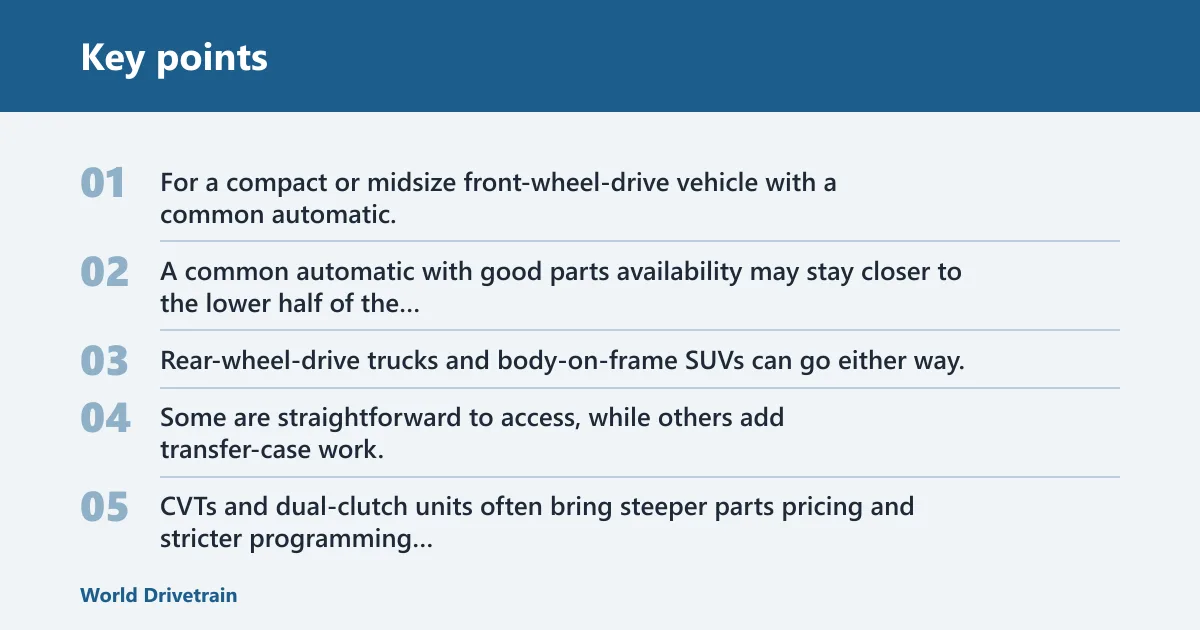
Typical total ranges by vehicle class
For a compact or midsize front-wheel-drive vehicle with a common automatic, the total is often driven more by transmission source than by exotic labor. A common automatic with good parts availability may stay closer to the lower half of the range.
Rear-wheel-drive trucks and body-on-frame SUVs can go either way. Some are straightforward to access, while others add transfer-case work, crossmember issues, exhaust removal, or cooler contamination that pushes the total higher.
CVTs and dual-clutch units often bring steeper parts pricing and stricter programming requirements. Heavy-duty pickups and performance cars also climb fast because the transmission itself costs more and the surrounding hardware tends to be bulkier and slower to remove. OEM parts catalogs and reman supplier listings show this clearly: the gap between a common small-car automatic and a heavy-duty truck or specialty transmission can be several thousand dollars before labor is added.
Why layout changes the price
Front-wheel-drive does not automatically mean cheap. On many vehicles, the unit is packed tightly against the subframe, steering components, and exhaust. That can mean extra setup time even if the transmission is smaller.
AWD and 4WD raise costs in two places: removal complexity and related parts. A transfer case, prop shaft, power takeoff hardware, and tighter packaging add billed hours. Some quotes also need to include transfer-case fluid service or seals disturbed during removal.
Picture an AWD crossover with a failed six-speed automatic and debris in the pan. The quote should rise because the job now includes cooler cleaning and AWD-related access steps. That is different from a quote growing for vague “miscellaneous” charges with no explanation.
When a low quote is missing required items
A suspiciously low quote often omits one or more of the following: converter, fluid, cooler service, programming, taxes, or core charge. Another warning sign is labor shown as a single flat number with no billed hours and no note about whether book time includes transfer-case or subframe work.
If the quote says only “install transmission” and nothing else, it is incomplete. Replacement is not one part in one box.
Replacement quote estimator table
| Line item | Common estimate range | When it belongs | Status | What to verify |
|---|---|---|---|---|
| Transmission unit | $1,500 to $5,500 | Every replacement | Required | New, used, rebuilt, or remanufactured; part number; warranty terms; core charge rules |
| Labor | $900 to $2,800 | Every replacement | Required | Shop hourly rate, billed hours, book time basis, AWD or 4WD adders, subframe or exhaust removal |
| Fluid and consumables | $120 to $350 | Every replacement | Required | Correct fluid specification, quantity, seals, gaskets, filter or pan parts if applicable |
| Diagnostic fee | $100 to $250 | Before approval | Vehicle-dependent | Whether it includes scan data, road test, fluid inspection, and whether it is credited to the job |
| Cooler flush service | $150 to $300 | After internal failure or contamination risk | Commonly missed | Method used; whether the cooler is actually reusable |
| Cooler replacement or line replacement | $250 to $900 | When debris cannot be fully removed or lines are damaged | Vehicle-dependent | Reason for replacement; whether lines and radiator-integrated cooler are both addressed |
| Torque converter | $250 to $700 | Common on automatics; often required by supplier warranty | Commonly missed | New or reman converter; included with unit or separate |
| Programming or adaptations | $100 to $300 | Late-model electronically controlled units | Vehicle-dependent | TCM calibration, relearn procedure, immobilizer or coding needs |
| Mounts, crossmember hardware, seals | $80 to $450 | When wear is found during removal | Optional unless failed | Which part is worn and whether labor overlaps with transmission removal |
| Tax and shop fees | $150 to $600 | Most retail jobs | Separate but normal | What is taxable, what the fee covers, and whether disposal is separate |
| Core charge | $300 to $1,500 | Many rebuilt and reman units | Refundable if rules are met | Return deadline, damage limits, who handles pickup, when refund posts |
| Warranty value | Compare terms, not dollars alone | Every quote comparison | Required comparison item | Duration, mileage, parts-and-labor inclusion, nationwide support, transferability, exclusions |
How to use the table
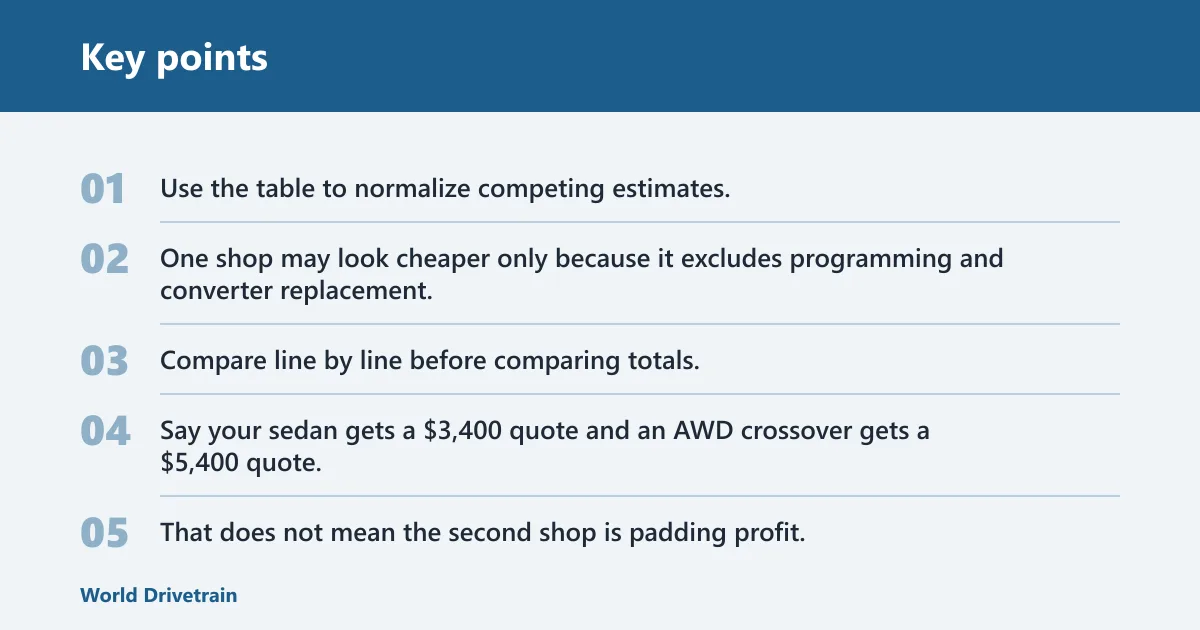
Use the table to normalize competing estimates. One shop may look cheaper only because it excludes programming and converter replacement, while another includes both. Compare line by line before comparing totals.
Say your sedan gets a $3,400 quote and an AWD crossover gets a $5,400 quote. That does not mean the second shop is padding profit. The crossover may simply include more labor, different fluid, transfer-case-adjacent work, and a reman unit with longer labor-backed coverage. The line-item ranges above are planning benchmarks synthesized from supplier pricing and labor-guide time, so they are best used for comparison rather than as a promise that every market will match them exactly.
Why do some quotes jump by thousands?
Quotes jump by thousands because three variables stack on top of each other: transmission source, labor complexity, and failure-related extras. Changing from a used unit to a remanufactured one, or from front-wheel drive to AWD packaging, can move the total far more than the shop rate alone.
Parts source changes everything
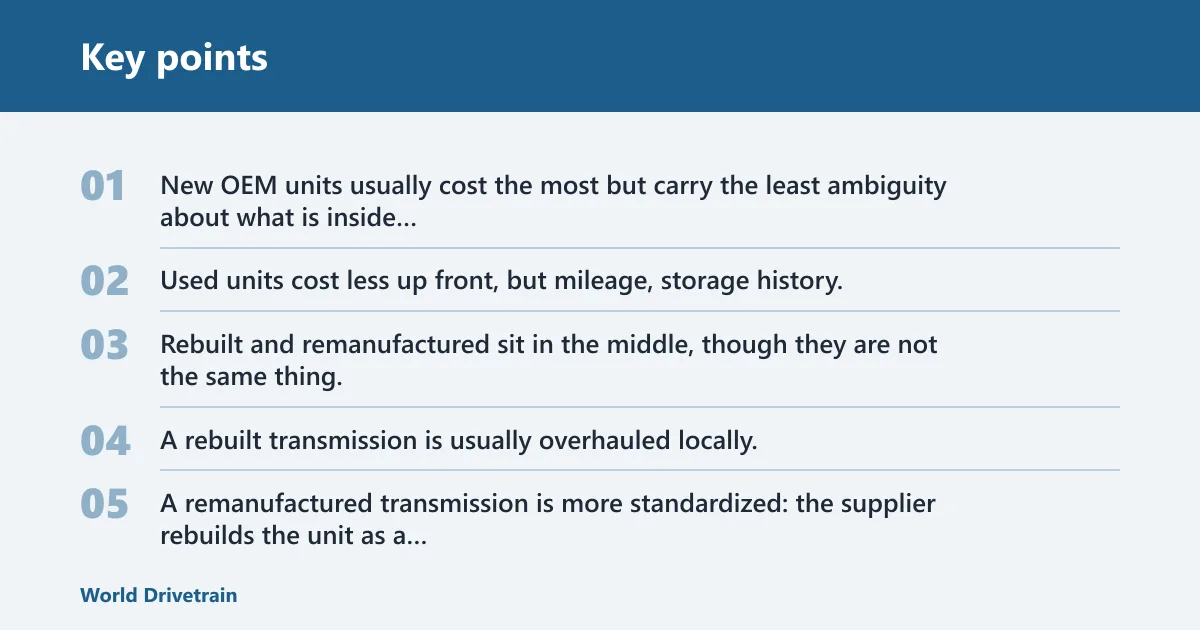
New OEM units usually cost the most but carry the least ambiguity about what is inside the case. Used units cost less up front, but mileage, storage history, and failure risk are harder to judge. Rebuilt and remanufactured sit in the middle, though they are not the same thing.
A rebuilt transmission is usually overhauled locally, often using the customer’s original core, with replacement of failed or worn components as needed. A remanufactured transmission is more standardized: the supplier rebuilds the unit as a complete assembly to a repeatable spec and ships it ready to install.
As one example of a national reman supplier, JASPER states on its product pages that it supplies remanufactured transmissions and on its consumer-facing tools that buyers can look up pricing and find installers by application. That does not make it the right choice for every vehicle, but it is a useful example of the kind of published supplier information that helps you compare quotes on something more concrete than “rebuilt” versus “reman.”
Labor is more than an hourly rate
Ask for both hourly rate and billed hours. A shop charging less per hour can still produce a higher labor total if the book time is longer or if added operations are broken out separately.
Book time is the labor guide estimate for the job under standard conditions. Actual elapsed time can run longer because of rust, seized fasteners, subframe alignment work, exhaust bolts, or transfer-case removal. A fair quote explains which of those are already included and which would require approval if discovered later. If you want a second framework for comparing major drivetrain estimates, the logic is similar to rebuild vs replace comparisons: the cheapest line today is not always the lowest total risk.
Failure-related extras
Two failed transmissions can create very different bills. A slipping unit with relatively clean fluid may need the replacement plus routine consumables. A unit that failed hard and filled the pan with debris may also require converter replacement, cooler replacement, line cleaning, and extra inspection time.
A common first-timer mistake is treating all “metal in pan” comments the same. Fine clutch material points one way; larger hard-part debris points another. The latter raises the odds that a simple in-car repair will not hold, which makes replacement or a full rebuild financially safer.
What should diagnostics confirm before replacement?
Diagnostics should confirm that the transmission itself has failed, not just a sensor, solenoid, mount, axle issue, or engine-performance problem that feels like shifting trouble. A proper pre-approval process combines scan tool data, road-test findings, fluid inspection, and mechanical checks before anyone sells a full replacement.
What a real diagnostic process includes
The minimum should include computer diagnostic testing, code review, freeze-frame or live-data review where available, fluid level and condition check, and a road test if the vehicle can be driven safely. On some units, basic hydraulic or pressure verification also helps separate internal damage from control issues.
Scan data matters because transmission complaints can start outside the gearbox. Engine misfires, throttle-body faults, wheel-speed sensor errors, and low system voltage can all trigger shift complaints or limp mode.
What findings support repair, rebuild, or replacement
Repair may make sense when the problem points to an external electrical component, a leaking seal, a pan service issue, or a known valve-body or solenoid fault with limited internal damage. Rebuild is often viable when the case and major hard parts are still usable and a local specialist can inspect them directly.
Replacement moves to the front when there is widespread internal damage, hard-part failure, contaminated cooler circuits, repeated prior repair attempts, or when downtime matters more than opening the original unit for inspection.
Suppose a truck has delayed reverse, burnt fluid, ratio codes, and visible hard debris in the pan. That combination supports replacement or full rebuild more strongly than a single shift-solenoid code with otherwise clean fluid and normal line pressure.
Is it cheaper to rebuild or replace a transmission?
Rebuilding can be cheaper when the case and hard parts are reusable and the failure is contained. Replacement is often the safer financial move when internal damage is widespread, the cooler is contaminated, parts supply is uncertain, or repeat labor would erase any savings from trying to save the original unit.
When rebuilding can save money
A local rebuild can control cost if the unit is common, parts are available, and the shop is clear about what gets replaced versus reused. This route also makes sense when the original transmission is valuable to keep, such as a harder-to-source unit with a good case and good major geartrain parts.
When replacement is the better call
Replacement usually wins when turnaround time matters, when supplier-backed warranty terms are stronger than a local rebuild warranty, or when opening the original unit is likely to reveal expensive hard-part damage. At that point, the quote can drift upward after teardown anyway.
Remanufactured options often reduce that uncertainty. Using JASPER again only as a published example, the company states on its warranty page that most remanufactured transmissions carry a 3 year/100,000 mile parts-and-labor limited warranty, while off-road use carries different terms. That kind of supplier-published warranty can justify a higher initial unit price when labor risk is part of the calculation, but you should compare it with the exact written warranty on any alternative quote. For a deeper cost tradeoff, see rebuild vs replace.
Which transmission option makes sense for your budget?
Your best option depends on how long you plan to keep the vehicle, how much downtime you can tolerate, and how much risk you are willing to accept. Used is cheapest to buy, remanufactured usually offers the clearest middle ground, and new OEM is the least ambiguous but often the highest-priced path.
New transmission
New OEM units tend to have the clearest fitment and update path, but price can be hard to justify on older vehicles. They also may still require separate converter, programming, and fluid charges.
Remanufactured transmission
Remanufactured means the unit has been completely remanufactured as an assembly rather than patched only where obvious damage appeared. That reduces guesswork compared with a quote that simply says “rebuilt” without a scope of work. Reman suppliers commonly work through installer networks, which can simplify labor-backed warranty claims.
Rebuilt transmission
Rebuilt does not automatically mean bad. It means the quality depends more heavily on the rebuilder’s process, replacement standards, hard-part inspection, and test procedure. Ask exactly which wearable parts, solenoids, valve-body components, and converter work are included.
Used transmission
Used units lower the entry price, but they raise labor duplication risk. If the salvage transmission arrives with unknown mileage, poor storage history, or a short startup warranty, the savings can disappear with one repeat removal.
What extra costs catch drivers by surprise?
Most surprise costs come from items attached to the failure, not from the transmission case itself. Core charges, cooler contamination, converter replacement, mounts, axle seals, flexplate issues, programming, and transfer-case-related work can all be valid, but each should be tied to a stated reason.
Core charge and core return timing
Core charge is normal on many rebuilt and reman units. The shop should tell you the amount, who owns the refund process, whether core pickup is included, and how long it takes for the credit to appear after return. Missing parts or a broken case can reduce core value.
Cooler service and contamination
Flushing is appropriate only if the cooler can actually be cleaned to standard. If the old unit suffered a destructive internal failure, replacement of the cooler or cooler lines may be the safer move. Ask what contamination was found and why the chosen remedy is enough. This is also one reason CVT quotes deserve extra scrutiny, since contamination standards and relearn procedures can be stricter; see CVT repair cost.
Converter, seals, mounts, flexplate, and transfer-case work
Converter replacement is common and sometimes required by the transmission supplier’s warranty terms. Seals and mounts are often discovered only after removal starts, but they should still be itemized. On some trucks and SUVs, transfer-case removal or service belongs in the quote because access demands it.
Programming and adaptation resets
Many late-model units need more than fluid fill and bolt-up installation. They may require TCM programming, clutch touchpoint learn, shift adapts, or other initialization. If the quote ignores that on a modern electronically controlled transmission, ask why.
How do you judge warranty value in the quote?
Warranty value comes from coverage terms, not from the word “warranty” alone. The useful comparison points are duration, mileage cap, whether labor is included, whether support is nationwide, whether coverage transfers to a new owner, and how hard the claim process is in practice.
Parts-only versus parts-and-labor coverage
A parts-only warranty can leave you paying for a second removal and installation if the unit fails. That is why parts-and-labor coverage matters. JASPER states on its warranty page that most remanufactured transmissions are covered by a 3 year/100,000 mile nationwide parts-and-labor limited warranty; that is materially different from a shorter or parts-only promise. Compare that language with the shop’s written estimate and with any guidance in a car repair warranty guide before approving the work.
Nationwide support and claim handling
If the vehicle travels, nationwide support has real value. Installer networks and transferable coverage can matter more than an extra few months on paper. Ask whether pre-authorization is required, whether diagnostics are reimbursed during a claim, and who pays for fluid, towing, or related parts if the unit fails.
Some independent shops also coordinate with outside coverage providers, but that should be verified directly with the shop and your contract administrator rather than assumed from advertising. The practical question is not the shop name; it is whether the shop can document the diagnosis, follow the provider’s claim steps, and tell you in writing which labor and fluid costs remain your responsibility.
What should you ask before approving the job?
Before approving replacement, ask the shop to identify the exact transmission source, the reason replacement is needed, the billed labor hours, and every included fluid, converter, cooler, and programming item. A good shop can answer those questions clearly without hiding behind one lump-sum price.
Checklist for quote approval
- Is the unit new, rebuilt, remanufactured, or used?
- What part number or supplier is being installed?
- Is the torque converter included, replaced, or reused?
- Does the quote include all required fluid and the correct specification?
- Was failure confirmed by scan data, road test, fluid inspection, and mechanical checks?
- Is cooler flush included, and under what conditions would cooler replacement be required?
- Does the labor line show billed hours and any AWD, 4WD, subframe, or transfer-case adders?
- Does the job require programming, coding, or adaptation resets?
- What is the core charge, when is it refunded, and what core damage can reduce it?
- What exactly does the warranty cover: parts only, or parts and labor?
- Is the warranty nationwide and transferable?
- What is excluded, including towing, diagnostics, fluids, and related damaged parts?
- How many billed hours are on the estimate, and how many calendar days is the vehicle likely to be in the shop?
How long transmission replacement usually takes
Billed labor hours and calendar time are different. A job may carry one day of labor but stay in the shop several days because of diagnosis, parts shipping, programming, road testing, or core logistics. Ask for both numbers. That prevents frustration and shows whether the shop is scheduling realistically.
Frequently asked questions
What is included in a transmission replacement quote?
A solid quote includes the transmission unit, labor, fluid, seals and consumables, and any required programming. It should also state whether the torque converter, cooler service, taxes, fees, and core charge are included or separate. If those items are unclear, the quote is incomplete.
How much does transmission replacement labor cost?
Labor commonly falls between $900 and $2,800 because the real driver is billed hours times shop rate, plus layout complexity. AWD, 4WD, subframe removal, exhaust work, and transfer-case-adjacent removal can push labor much higher than a basic front-wheel-drive installation. That planning range is based on common labor-guide times and prevailing retail labor rates layered onto them, not a fixed national menu price.
Should I buy a new, rebuilt, or remanufactured transmission?
New offers the least ambiguity but usually the highest price. Rebuilt can save money if the shop explains the scope clearly. Remanufactured is often the best middle ground because the build is more standardized and warranty terms are often stronger than a local rebuild.
What extra costs can come with transmission replacement?
Common add-ons include diagnostics, converter replacement, cooler flush or cooler replacement, mounts, seals, axle-related parts, flexplate issues, programming, tax, shop fees, and a refundable core charge. None of those are automatically padded charges, but each needs a specific reason and itemized price.
Can I use a warranty for transmission replacement?
Sometimes, yes. Factory coverage, service contracts, and aftermarket warranty providers may help, but approval usually depends on diagnosis, claim procedure, and the exact failed parts. Confirm whether the shop works directly with the provider and whether labor, fluids, diagnostics, and towing are covered. If you are comparing coverage language, a car repair warranty guide can help you decode exclusions before you approve the job.
What should I ask a shop before approving transmission replacement?
Ask what failed, how the diagnosis confirmed it, what transmission source will be installed, what the labor hours are, and whether converter, cooler service, programming, and fluid are included. Then ask about core return rules, warranty exclusions, and realistic calendar time in the shop.
Is a used transmission ever the smart choice?
Yes, but usually only when the vehicle’s value is limited, the used unit has documented compatibility, and the warranty and installed total still make sense if the job has to be repeated. Compare the savings against the risk of paying labor twice. If the gap between used and reman is small, reman is often the safer total-cost choice.
Can a transmission be repaired instead of replaced?
Often, yes. Solenoids, valve bodies, wiring faults, leaks, and some external hard-part issues can sometimes be repaired without replacing the whole unit. The key is a diagnostic process that proves the fault is limited. If you want those repair scenarios broken out, see transmission repair.
Quick decision checklist
If you need a fast approval framework, choose the option that best matches vehicle value, planned ownership length, downtime tolerance, and warranty needs. Then compare quotes line by line, not just by headline total.
| If your priority is… | Usually compare first | Best fit when… | Main risk to watch |
|---|---|---|---|
| Lowest upfront price | Used transmission | The vehicle is older and you can accept higher failure risk | Paying labor twice if the used unit is bad |
| Balanced cost and warranty | Remanufactured transmission | You want stronger published terms and predictable build standards | Higher initial price than used or some local rebuilds |
| Keeping the original unit if hard parts are sound | Local rebuild | A reputable rebuilder can inspect and document the internals | Quality depends heavily on process and parts replaced |
| Least ambiguity on fitment and updates | New OEM transmission | The vehicle is newer or high value | Highest parts cost |
Sources
- Ford Parts, GM Genuine Parts, and Toyota official parts catalogs: application-specific OEM transmission assembly pricing and part availability.
- JASPER Engines & Transmissions official product, price lookup, installer finder, installation, and warranty pages: remanufactured transmission product scope, availability statements, and published warranty terms.
- LKQ and Car-Part supplier listings: used transmission market pricing, availability spread, and core practices by application.
- ALLDATA and Mitchell 1 labor guides: benchmark labor operations and billed-hour comparisons by vehicle configuration.
- Transmission supplier warranty and installation materials from major reman sellers: common requirements for converter replacement, cooler flushing, contamination control, and core return conditions.