Transmission Fluid Leak Causes, Symptoms, Repair Cost
A transmission fluid leak usually comes from the pan gasket, cooler lines, axle seals, output seal, or front pump seal; if the dipstick reads below the add mark or shifting slips, do not drive it except straight to repair. Ignore it, and you can burn clutches, overheat the unit, and turn a $150 seal job into a $4,000 rebuild. This guide matches puddle location and symptoms to the likely source, urgency, and typical repair cost.
Start with three facts: where the fluid lands, what drivetrain layout the vehicle uses, and whether you have a light film, an active drip, or an overnight puddle. That separates lower-risk external leaks, such as a pan gasket, drain plug, or dipstick tube O-ring, from bellhousing and axle-area leaks that may involve seals, a torque converter, or transmission removal.
What does a transmission fluid leak look and smell like?
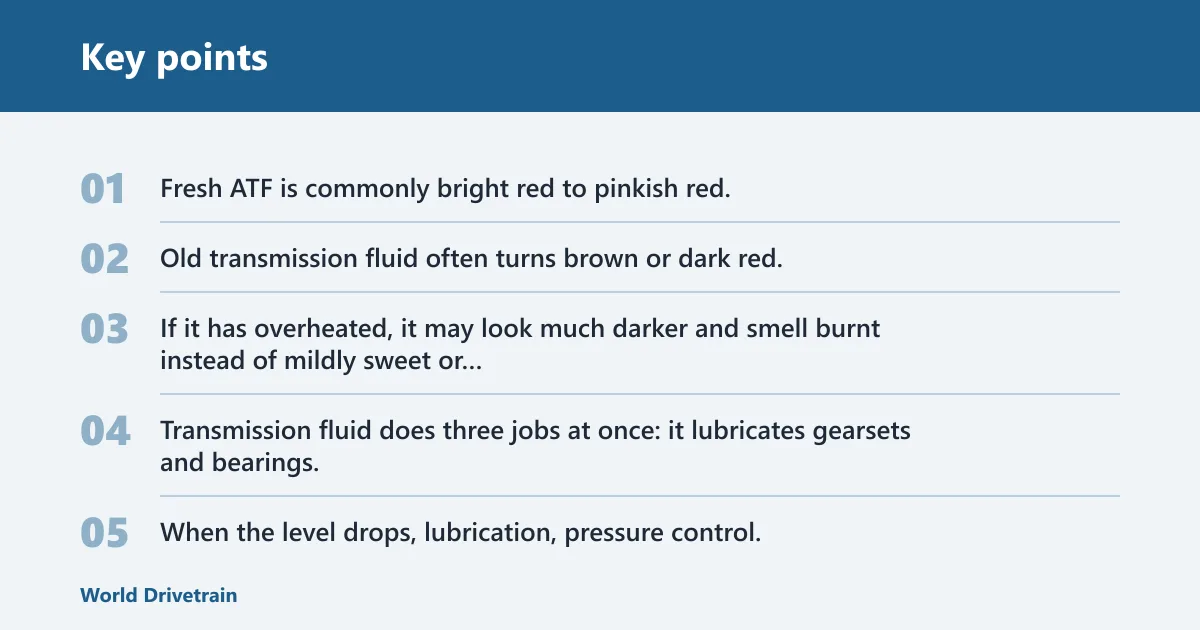
Transmission fluid is easiest to identify by color, smell, and where it shows up. Fresh ATF is commonly bright red to pinkish red, while old fluid often turns brown or dark red. It usually has a faint sweet or oil-like smell, and it feels slicker and lighter than engine oil.
Color, smell, and texture
Fresh ATF is commonly bright red to pinkish red. Old transmission fluid often turns brown or dark red. If it has overheated, it may look much darker and smell burnt instead of mildly sweet or oil-like.
Transmission fluid does three jobs at once: it lubricates gearsets and bearings, transfers hydraulic pressure to apply clutches and bands, and carries heat into the cooler circuit. When the level drops, lubrication, pressure control, and heat removal all suffer at the same time.
How it differs from other vehicle fluids
Engine oil is usually amber, dark brown, or black and feels heavier. Coolant is often green, orange, yellow, pink, or blue and feels watery. Brake fluid is usually clear to amber and slick, but it tends to appear near the wheels or master cylinder area, not under the transmission. Power steering fluid can also be red on some vehicles, which is why puddle location matters.
If a reddish fluid appears near the center of the vehicle, under the transmission pan, at the cooler lines, near a CV axle on a transaxle, or at the tailshaft on a rear-wheel-drive vehicle, transmission fluid moves up the suspect list. If the fluid is dark brown and dripping from the back of the engine or oil pan rail, engine oil is more likely.
Cardboard check
One simple leak-check method is to park on level ground with cardboard underneath overnight. Mark where the front wheels sat, then compare the drips to the engine, transmission, axle, and radiator-cooler areas the next morning. It will not identify the failed part by itself, but it gives you a solid starting point.
What are the symptoms of a transmission fluid leak?
The first sign is often a few drips or a small overnight puddle, but driving symptoms can show up fast if the level falls. Common signs include delayed engagement, slipping, rough shifts, overheating, burnt smell, whining noises, and flare between shifts after the vehicle has been parked.
Ground spots and puddle size
A damp case or pan rail is seepage. A wet drop forming at the bottom edge of the pan, cooler line, or seal is an active leak. A measurable puddle after one night of parking raises the stakes because the transmission may lose enough fluid to affect line pressure and clutch apply.
Say your car leaves a red spot about the size of a coin after every commute, but shifts normally. That points more toward a pan gasket, drain plug washer, or cooler line seep than a severe internal failure, though it still needs diagnosis before residue spreads and hides the source.
Driving symptoms that matter
If the level drops, the transmission can hesitate before going into Drive or Reverse. It may slip on acceleration, flare between gears, bang into gear, or start whining. Some vehicles will also show a transmission temperature or warning message.
A burning smell matters because old or overheated fluid loses film strength and predictable hydraulic behavior. Rough shifts, delayed engagement, and overheating together point to more than a minor leak, even if the puddle itself does not look dramatic.
Can you drive with a transmission fluid leak?
You can sometimes move a vehicle with a minor seep, but you should not keep driving once the fluid level is below the add mark, the transmission slips, engagement is delayed, or the leak leaves fresh drops after each stop. At that point, towing is usually cheaper than transmission damage.
Seepage versus active leak
A dry, dusty case with a slight damp stain is different from a leak that forms drops at the pan lip, cooler line, or bellhousing drain area. Light seepage usually allows scheduled repair. An active drip, repeated overnight puddle, or leak that appears after short trips deserves prompt repair.
When to stop driving
Stop driving if the transmission slips, revs rise without matching vehicle speed, takes too long to engage, or makes new whining noises. Also stop if the fluid is visibly low and the vehicle uses a dipstick-based check method. Many newer vehicles do not have a transmission dipstick, which makes guesswork riskier.
Suppose an AWD crossover backs out of the driveway, hesitates before Reverse engages, then leaves two fresh red drops near the front subframe. That is not the time for errands. The hesitation means low fluid may already be affecting hydraulic pressure.
Urgency thresholds
- Light seepage: damp residue, no fresh drops, normal shifting. Schedule repair.
- Active drip: fresh drops after parking, but no shift symptoms. Repair soon and monitor level if the design allows.
- Overnight puddle: visible puddle on cardboard by morning. High urgency.
- Rapid loss or shift symptoms: slipping, delayed engagement, overheating, whining, burnt smell. Stop driving and tow.
Where does transmission fluid leak from?
Automatic transmissions most often leak from the pan gasket, pan, drain plug, cooler lines, axle seals, output seal, bellhousing area, or dipstick tube base. Overfill can also force fluid out of vents or seals. Puddle location helps, but airflow and splash can move fluid away from the actual source.
Bottom-side leak points
The transmission pan is the lowest point on many automatics. The pan gasket is a common leak point because heat cycles can harden, crack, or shrink the gasket over time. Some pans also rust, crack, or get punctured by road debris or a curb strike.
Where equipped, the drain plug can leak from a loose plug, a damaged sealing washer, stripped threads, or a cracked pan area around the bung. A replacement plug itself may cost about $10 to $25, but thread damage can turn that into a pan repair.
Cooler lines and fittings
Cooler lines carry hot fluid to and from the radiator cooler or an external cooler. They may be metal, rubber, or a mix of both. Because these lines sit in road spray and debris, corrosion, pinholes, cracks, and hose ruptures are common failure modes.
Seals and shaft-related leaks
Axle seals leak where the CV axles enter a front-wheel-drive transaxle or the front differential section of some AWD units. Output shaft seals leak at the driveshaft yoke on many rear-wheel-drive vehicles. Input shaft or front pump area leaks show up at the bellhousing, where the transmission mates to the engine.
Dipstick tube, case seams, and overfill vents
Older vehicles may leak at the dipstick tube where it enters the case. The base O-ring hardens with age, and fluid runs down the transmission side, often mimicking a pan or case leak. Overfilling can force fluid past seals or out a vent, and it can also foam the fluid, which affects operation.
Leak location cost matrix
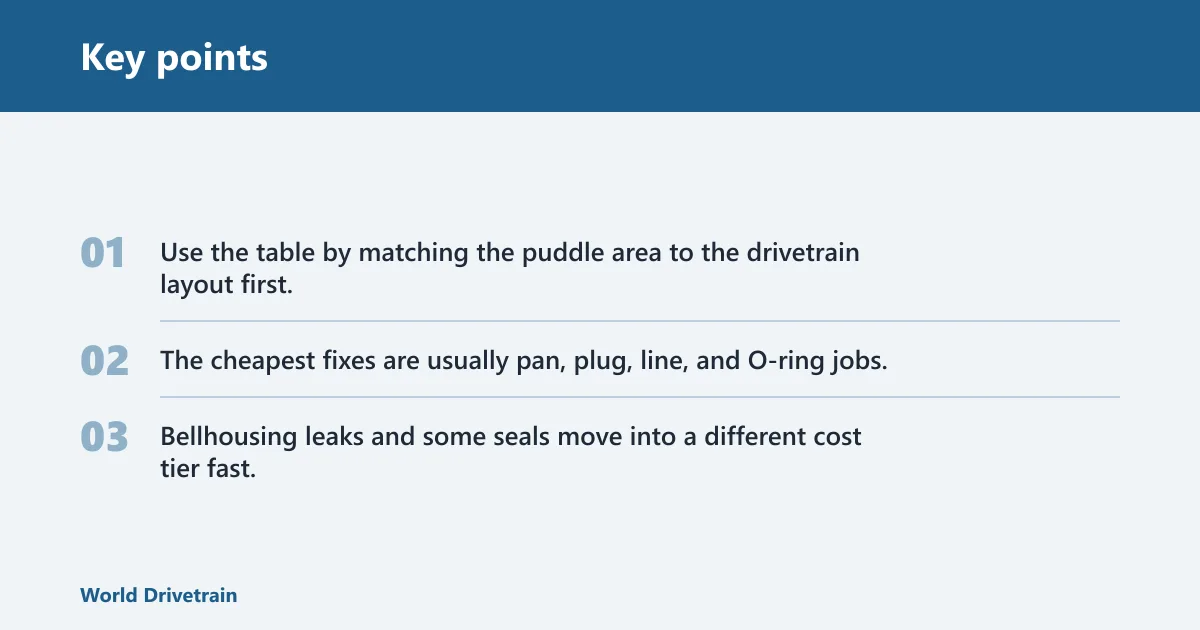
Use the table by matching the puddle area to the drivetrain layout first, then checking the likely failed part and whether the repair is external or removal-heavy. The cheapest fixes are usually pan, plug, line, and O-ring jobs. Bellhousing leaks and some seals move into a different cost tier fast.
| Leak location | Likely failed part | Driveway check | Urgency level | Typical shop cost range | Transmission removal usually required? |
|---|---|---|---|---|---|
| Pan edge or pan rail | Pan gasket hardened, cracked, or shrunk | Wet pan perimeter, drips at bolt flange, fluid on lowest edge | Moderate unless fluid loss is rapid | $150-$400 | No |
| Very bottom of transmission | Damaged pan or drain plug leak | Dented pan, scrape marks, wet plug, stripped threads, cracked bung area | Moderate to high | $10-$25 for plug only; up to $150-$400 if pan repair or replacement is needed | No |
| Front of vehicle, near radiator or cooler route | Cooler line or fitting | Wet metal line, cracked rubber hose, fluid spray pattern | High if dripping under pressure | $150-$400, with some jobs reaching $550 | No |
| Base of dipstick tube | Dipstick tube O-ring | Fluid running down case from tube entry point | Low to moderate | $100-$250 | No |
| CV axle area on FWD or many AWD transaxles | Axle seal | Fluid around axle stub and inner joint area | Moderate to high | $250-$500 | No |
| Tailshaft or driveshaft yoke area on RWD | Output shaft seal | Fluid at rear of transmission and on driveshaft area | Moderate | $250-$450 | No |
| Bellhousing opening or lower inspection cover | Front pump seal, input shaft area, or torque converter-related leak | ATF dripping from bellhousing after cleaning, pan area above stays drier | High | $600-$1,200+ | Usually yes |
| Multiple areas after recent service or fluid addition | Overfilled transmission or foamed fluid pushing past seals | Check service history, level procedure, vent residue | Moderate to high | Varies by cause; correction may be simple, but repeated seal leaks can add cost | Usually no, unless a seal was damaged |
How do you diagnose the source by puddle location?
Diagnose by location in this order: confirm the fluid really is ATF, identify the drivetrain layout, then inspect the highest wet point above the drip. Front-wheel-drive vehicles often leak near CV axle seals, rear-wheel-drive vehicles often leak at the pan, cooler lines, or tailshaft, and bellhousing leaks need extra caution.
Front-wheel drive and transaxle patterns
On a front-wheel-drive car, the transmission and differential are combined in one transaxle. A puddle near either front axle opening often points to an axle seal. If the fluid appears farther inboard, look for a pan gasket, side cover seep, cooler line, or dipstick tube leak before blaming the axle seal.
Why is transmission fluid leaking from the CV axle area? On a transaxle, the usual cause is an axle seal where the axle stub enters the case. That seal rides on a rotating shaft, so wear, hardening, or a groove in the sealing surface can let fluid escape.
Rear-wheel drive patterns
On a rear-wheel-drive vehicle, a front-center puddle can come from cooler lines or the front of the transmission. A middle puddle under the pan suggests pan gasket, pan, or drain plug. A rear transmission-area leak near the driveshaft yoke usually points to the output shaft seal.
Bellhousing leaks
Why is transmission fluid leaking from the bellhousing? That area often points to a front pump seal, input shaft area leak, or a torque converter-related leak located between the engine and transmission. Access usually requires transmission removal, which is why bellhousing leaks cost much more than external line or pan leaks.
Do not assume every bellhousing drip is ATF. Engine oil from a rear main seal or valve-cover runoff can also collect there. Compare color and smell. Fresh ATF is commonly bright red to pinkish red, while engine oil is commonly amber to black. Clean the area first before deciding.
AWD packaging and splash effects
AWD layouts pack more hardware into the same space. Fluid can track along a subframe, skid shield, transfer housing, or underbody panel before it drops to the ground. On these vehicles, the first drip point is often misleading, so tracing the highest wet area matters more than the puddle itself.
What are the most common causes and repair costs?
The most common causes are the pan gasket, cooler lines, axle seals, output seals, dipstick tube O-ring, drain plug issues, and bellhousing-area front pump or torque converter leaks. Costs vary mainly by access: external repairs are often measured in hundreds, while removal-required repairs can push well past $1,000.
Pan gasket, pan damage, and drain plug issues
A transmission pan gasket replacement typically costs between $150 and $400 at a shop. DIY pan gasket repair can run around $50 to $100 if the pan is straight and the fasteners and sealing surfaces are still good.
If the pan itself is rusted, cracked, or punctured, replacement cost can also land in the $150-$400 range depending on the pan design. Drain plug problems range from a simple plug replacement to thread repair or a new pan when the bung area cracks.
Cooler lines and fittings: transmission cooler line replacement costs
Transmission cooler line replacement costs between $150 and $400. Some vehicles with longer line runs, difficult routing, or multiple hose-and-pipe sections can reach about $550. Failures include rusted metal sections, cracked rubber, pinholes, and seepage at fittings.
Seals by location
Do not treat all seal leaks as one category. Axle seal repairs are often less invasive and commonly fall around $250-$500. Output shaft seals on rear-wheel-drive vehicles are often in the same general band, around $250-$450. Front pump or input-area leaks at the bellhousing are different because access usually requires transmission removal, so a rough estimate of about $600-$1,200 or more is often more realistic.
Dipstick tube O-ring and older-vehicle leaks
Dipstick tube O-ring replacement costs $100 to $250 at a shop. This leak is easy to miss because fluid runs downward and spreads across the case, making owners suspect a pan gasket or case seam first.
Overfill, foaming, and torque converter leaks
An overfilled transmission can force fluid past seals and vents, and it can foam the fluid enough to affect operation. Correcting the level may stop the mess if no seal was damaged. If the torque converter or front pump area is leaking, though, the transmission usually has to come out for access.
Picture a sedan that just had fluid service and now leaks from more than one area, with aerated fluid on the dipstick. That pattern fits overfill better than three separate seal failures appearing overnight. Correct the level and recheck after cleaning before replacing parts.
How do you confirm a transmission leak at home?
Home diagnosis works best when you confirm the fluid first, check the level only if the design provides a service method, clean the undercarriage, and then trace the leak from the highest fresh wet point. Old residue can make a minor seep look like a major case or seal failure.
Step-by-step driveway inspection
- Park on level ground and place cardboard under the suspected area overnight.
- Confirm the fluid color and smell before calling it transmission fluid.
- Check the level only if the vehicle has a dipstick or a specified service procedure you can follow accurately.
- Inspect the pan, pan rail, and drain plug first because they are easy to see.
- Follow cooler lines from the transmission toward the radiator or external cooler.
- Check the dipstick tube base on older vehicles.
- Inspect CV axle entry points on FWD and many AWD vehicles, or the tailshaft on RWD vehicles.
- Look at the bellhousing opening only after the outside of the case is clean, so runoff does not mislead you.
Why cleaning matters
Sprayed fluid travels. Road grime holds old leaks. That mix makes diagnosis harder than it needs to be. Cleaning the pan, case, cooler lines, bellhousing area, and nearby crossmembers gives you a fresh baseline.
Using UV dye
For hard-to-find leaks, a UV leak detection dye kit is useful after cleaning. The kit typically includes fluorescent dye, a UV light, and tinted glasses. Once the dye circulates through the transmission fluid, the fresh leak path stands out far better than red fluid on a dirty underbody.
Should you use a stop-leak additive?
Stop-leak additives may slightly swell an aging seal and sometimes slow a minor seep, but they do not repair torn seals, cracked pans, rusted cooler lines, stripped drain plug threads, or front pump leaks. On modern transmissions, they can add risk without fixing the actual failure.
When it might buy time
If the leak is a very mild seal seep, fluid level remains stable, and repair is already scheduled, an additive may reduce dripping for a short period. That is the narrow use case. It is not a substitute for diagnosis.
When it is a bad bet
Do not use stop-leak for a bellhousing leak, axle seal leak that is actively dripping, cooler line corrosion, pan damage, or overfill-related foaming. Those are mechanical problems. Additives cannot rebuild metal, restore hose integrity, or fix improper fluid level.
Risk on sealed and newer units
Many newer vehicles have no dipstick and depend on precise fluid condition and level. Adding extra chemicals to a sealed unit with shift complaints or a serious leak can complicate diagnosis and may delay the repair that actually solves the problem.
Frequently asked questions
How much does transmission fluid leak repair cost?
Cost depends mostly on where the leak is. Bellhousing leaks are pricier because transmission removal is usually required.
How do you tell if the fluid under your car is transmission fluid?
Look at color, smell, and location together. Fresh ATF is commonly bright red to pinkish red, while old fluid can turn brown or dark red. It often smells slightly sweet or oil-like. Drips near the transmission pan, cooler lines, axle seals, or bellhousing make ATF more likely.
Why is transmission fluid leaking from the bellhousing?
ATF dripping from the bellhousing usually points to a front pump seal, input shaft area, or torque converter-related leak between the engine and transmission. Because that area is enclosed, diagnosis often requires cleaning first, and repair usually requires removing the transmission for access.
Why is transmission fluid leaking from the CV axle area?
On front-wheel-drive and many AWD vehicles, fluid near the inner CV joint often comes from an axle seal where the axle enters the transaxle. The seal rides on a rotating shaft, so wear, hardening, or shaft-surface issues can cause a drip or sling fluid outward.
Is it normal for transmission fluid to leak?
No. A minor seep may not require same-day repair, but transmission fluid is not meant to leave the case. Even a small leak can spread, hide the true source, lower the fluid level over time, and lead to slipping, overheating, or rough shifts if ignored.
Where does transmission fluid leak from on an automatic transmission?
Common sources include the pan gasket, transmission pan, drain plug, cooler lines, dipstick tube O-ring, axle seals, output shaft seal, and bellhousing area. Overfill can also push fluid out through vents or past seals. The exact puddle location shifts with FWD, RWD, and AWD layouts.