What to Do If Your Transmission Is Slipping
If your transmission is slipping, stop driving right away when you have delayed engagement, flashing warning lights, a burnt smell, or the engine revs without steady acceleration. If the symptom is mild and the vehicle still moves normally, do one safe fluid check and book a diagnosis soon. Ignoring slip can turn a repair into a rebuild, strand you, or damage the clutch packs and torque converter. This guide shows what each symptom means and what to do next based on severity.
What transmission slipping feels like
Slip usually feels like engine speed rises without a matching increase in road speed, a flare between shifts, or a delay before the vehicle moves after you select Drive or Reverse. In an automatic, that can point to a clutch or pressure problem. In a CVT, it may also be belt or control behavior that sounds like slip.
Automatic transmission symptoms
Common signs include a sudden RPM jump on upshift, hesitation into gear, a hard or soft flare between gears, and a delay before Reverse engages. If the vehicle moves normally at first and then starts to slip after it warms up, fluid level, fluid condition, or apply pressure is often part of the diagnosis.
CVT symptoms that can feel like slip
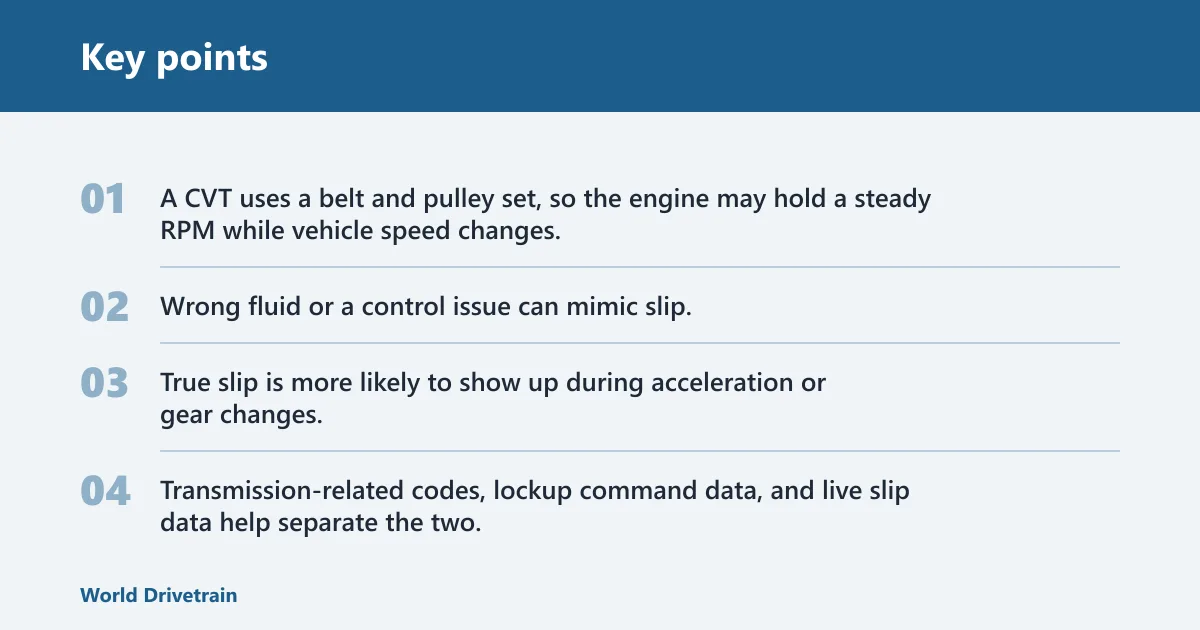
A CVT uses a belt and pulley set, so the engine may hold a steady RPM while vehicle speed changes. That is normal. What is not normal is shudder, surging, a rubber-band feel that gets worse under light throttle, or hesitation after a fluid overheat event. Wrong fluid or a control issue can mimic slip.
Torque-converter shudder versus true slip
Lockup shudder is often reported as a vibration or light bucking at steady cruise, commonly around 30 to 50 mph, rather than a free-revving flare. True slip is more likely to show up during acceleration or gear changes. Transmission-related codes, lockup command data, and live slip data help separate the two.
What you’ll need
- Vehicle owner’s manual or service information for the correct ATF or CVT fluid specification.
- Clean paper towels or a white rag.
- Gloves and a flashlight.
- OBD-II scan tool with transmission code and live-data access.
- A level parking spot or driveway.
- Drain pan or cardboard for spotting fresh leaks.
- Transmission dipstick, if your vehicle has one.
What to do if your transmission is slipping while driving
Ease off the throttle, avoid hard acceleration, and watch for warning lights, a strong burning odor, or repeated flare on every shift. If the vehicle still drives, use the gentlest route to a safe stop. If slip is severe, pull over and arrange a tow. Do not keep driving to “see if it clears.”
- Lift off the throttle. Reduce load right away. Hard throttle raises heat and can finish off clutch material that is already failing.
- Check for a limp mode. If the vehicle locks itself into one gear, limit speed and distance. Limp mode means the control system has already seen a fault worth protecting against.
- Pull over safely. If the engine flares, the smell turns burnt, or the transmission stops responding normally, stop in a safe place and shut down.
- Arrange a tow. A flatbed is the safest choice for severe slip, repeated warning lights, or no-drive conditions. For a short move, a tow truck should follow the vehicle maker’s towing limits.
Transmission slip triage checklist
| Symptom severity | Safe next action | Likely cause |
|---|---|---|
| Mild intermittent slip | Check fluid level and condition, then book diagnosis soon | Low fluid, early wear, minor valve body or solenoid issue |
| Hot-only slip | Avoid heavy traffic and highway pulls; inspect for leaks | Overheated fluid, thin fluid, restricted cooler flow |
| Flare on upshift | Ease off and scan for codes before more driving | Apply pressure loss, worn clutch pack, shift solenoid fault |
| Delayed reverse engagement | Do not keep cycling the shifter; get a diagnosis | Low fluid, worn reverse clutch, valve body problem |
| RPM rise without acceleration | Stop hard driving and inspect fluid condition | True clutch slip or torque converter problem |
| CVT shudder | Scan the control module and verify CVT fluid spec | Wrong fluid, belt-and-pulley control issue, lockup behavior |
| Hesitation into gear | Check level, leaks, and warning lights before more use | Low line pressure, filter restriction, adaptive issue |
| Limp mode | Drive only if needed to reach a safe stop, then tow | Stored fault code, sensor failure, control-module protection |
| Burning smell | Pull over and shut down | Overheated fluid, slipping clutch material, internal damage |
| Warning lights | Scan codes before any long trip | Transmission fault, temperature issue, sensor or module fault |
| Do not continue driving thresholds | Stop driving and arrange a flatbed tow | Repeated flare, no forward movement, harsh bang shifts, burnt fluid, or severe limp mode |
What to check at home before you drive again
Do only the checks your vehicle allows. Some sealed transmissions require a specific fluid temperature and fill procedure, so a simple dipstick check is not always enough. If the vehicle has a dipstick, verify level at the specified temperature, inspect the fluid for dark color, burnt odor, or contamination, and look for fresh leaks under the vehicle.
Fluid level and condition
If the fluid is low, top up only with the exact ATF or CVT fluid listed for the vehicle. Add about 0.25 quart, or about 0.25 liter, when topping up low fluid, then recheck. Do not overfill. Dark, gritty, or burnt fluid points to a deeper issue than a simple top-off.
Warning lights and stored codes
An OBD-II scan tool can read transmission-related trouble codes, live temperature, commanded gear, and sometimes slip or lockup data. That information helps separate a pressure problem from a control problem. If the scan tool shows transmission codes or the temp is very high, do not keep driving casually.
Say your sedan flares on the 2-3 shift only after a 20-minute commute. That pattern points away from a random one-time event and toward heat-sensitive fluid, pressure loss, or a solenoid issue that deserves a scan and road test.
How to decide whether you can keep driving
You can sometimes make a short, cautious drive for diagnosis if the symptom is mild, intermittent, and the vehicle still moves normally. If the symptom grows with heat, appears every shift, or comes with warning lights, it should move to shop diagnosis quickly. Severe slip, limp mode, or burn smell means stop now.
Mild intermittent symptoms
If the problem happens once or twice and then disappears, check fluid, scan codes, and book an appointment. Keep trips short and avoid steep grades or hard throttle. Do not assume the fault is minor just because the vehicle still moves.
Hot-only symptoms
If the slip starts only after warmup, the fluid may be thinning out, overheated, or low. That pattern can also point to a restricted filter or cooler issue. A shop should check fluid condition, pan debris, and pressure data before recommending a repair.
Limp mode and severe symptoms
If the transmission is stuck in one gear, skips multiple gears, or shudders so badly that safe acceleration is impossible, arrange a tow. A flatbed is commonly preferred for severe slip, and the distance should be kept as short as possible. Driving farther can convert a repairable fault into internal damage.
What a shop should diagnose next
A transmission repair shop should not guess. It should road test the vehicle, pull codes, inspect fluid, and compare commanded gear to actual behavior. If the unit is slipping, the shop should also check line pressure, adaptation data, and whether the issue is in the transmission, the torque converter, or the control system.
Scan data and transmission codes
Ask for the exact fault codes, freeze-frame data, and live temperature readings. Transmission control module faults, speed sensor issues, and pressure-control codes can all point in different directions. If the control module has stored adaptation or shift-learning data, that should be reviewed too.
Fluid, pressure, and adaptation checks
Fluid condition tells a lot. A burnt smell, dark color, or metal debris changes the repair path. On some units, a restricted transmission filter can reduce apply pressure enough to cause slip. The shop may also need to check whether a pan-drop service is possible or whether the unit is sealed and requires a different fill procedure.
Suppose a crossover with a CVT shudders at low speed and stores a temperature code. A shop should confirm the CVT fluid spec first, then check for overheating history, control logic, and any step in the fill procedure that was missed. Wrong fluid can mimic a hardware failure.
Common mistakes
Do not keep driving because the symptom is mild today. Heat and load usually make it worse.
Do not top up with universal fluid. ATF and CVT fluids are not interchangeable, and the wrong spec can change shift behavior fast.
Do not confuse torque-converter shudder with a slipping clutch pack. The fix path is different, and the scan data often tells them apart.
Do not drain and refill a sealed unit without the proper fill method and temperature check.
Frequently asked questions
What to do if your transmission is slipping while driving: ease off the throttle, stop
Ease off the throttle, stop hard acceleration, and head for a safe place if the slip repeats. If the engine revs without matching speed, or the vehicle drops into limp mode, shut it down and arrange a tow. A short drive to a shop is not worth additional clutch damage.
What to do if your automatic transmission is slipping
Check fluid level and condition if the vehicle has an accessible dipstick, then scan for codes. If the fluid is burnt, low, or contaminated, book a diagnosis immediately. The next useful data points are live slip, commanded gear, and line pressure, not another aggressive test drive.
What to do when the transmission is slipping
Use the least risky path: reduce load, inspect for leaks, and get a code scan. If the symptom is mild and intermittent, keep the trip short. If it is severe, repeatable, or paired with warning lights, stop driving and use a flatbed tow.
What to do if you think your transmission is slipping
Confirm whether the problem is true slip, torque-converter shudder, CVT behavior, or an engine misfire that feels similar. A scan tool, fluid check, and road test separate those cases faster than guesswork. If any check points to heat or pressure loss, schedule diagnosis right away.
What to do if your cvt transmission is slipping
Verify the correct CVT fluid specification before anything else, because the wrong fluid can cause shudder or odd ratio changes. Then scan for transmission codes and temperature data. If the CVT shudders under light throttle or goes into protection mode, stop extended driving and book service.
How do you know if your transmission is slipping automatic?
The classic sign is engine RPM rising without a matching increase in vehicle speed. Other clues are delayed engagement, flare on upshift, or hesitation into gear. If those symptoms appear with dark or burnt fluid, the transmission should be diagnosed, not driven normally.