What Happens If You Never Change Transmission Fluid
If you never change transmission fluid, it breaks down, loses friction control and cooling, and the transmission usually starts shuddering, slipping, or shifting hard long before it fails completely. Neglect can turn a fluid service into a rebuild or replacement, often at four-figure cost. This guide walks through the symptom stages so you can tell when fresh fluid may still help and when the damage is already a repair job.
Transmission fluid failure stages
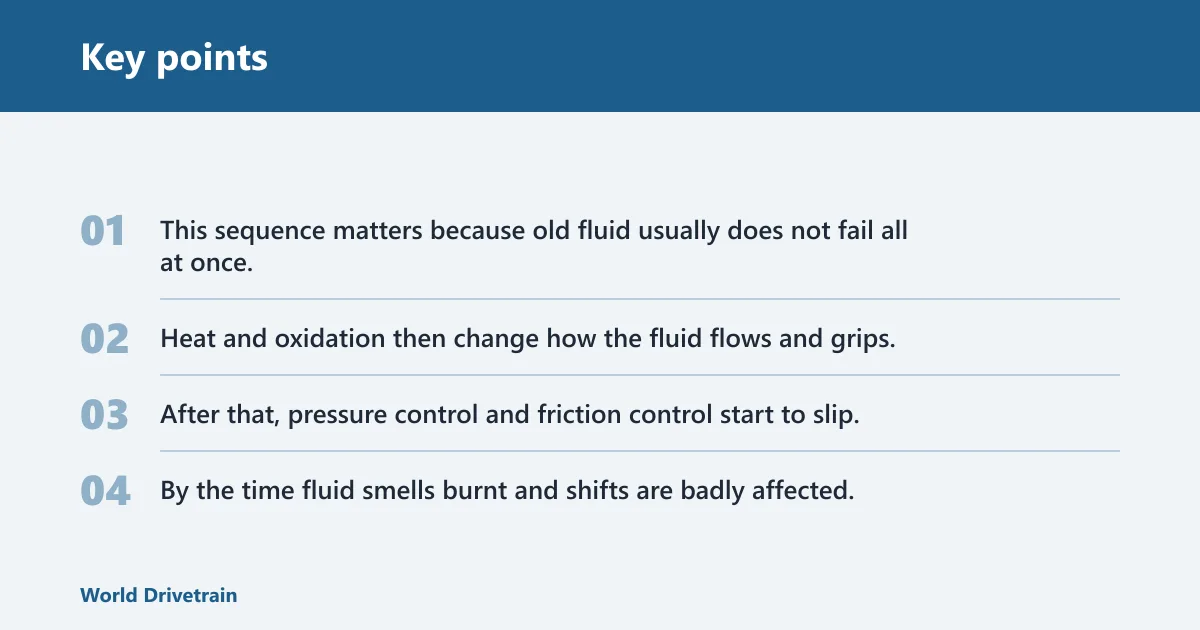
| Stage | Likely symptom | Likely internal cause | Recommended action |
|---|---|---|---|
| 1. Additive depletion and heat stress | Shifts still feel normal, but the fluid is darker and may smell slightly off | Anti-wear, anti-foaming, and friction modifiers have thinned out from heat and age | Service the fluid now if the transmission still shifts normally and there is no debris or slip |
| 2. Oxidation, varnish, and control issues | Delayed engagement, light flare on shifts, or occasional harsh shifts | Oxidation thickens the fluid and forms varnish that can stick valve body passages | Inspect for codes, check service history, and change fluid before control problems spread |
| 3. Slip, shudder, and pressure loss | Torque converter shudder, slipping under load, or repeated hard shifts | Friction characteristics are off, clutch packs slip, and debris starts reducing hydraulic control | Diagnose before servicing if symptoms are strong; a fluid change may not fix worn internals |
| 4. Debris, overheating, and failure | Burnt fluid, no movement in gear, or severe flare and loss of drive | Clutch material, metal particles, heat damage, and possible cooler restriction have pushed wear too far | Expect repair-level work, often rebuild or replacement, plus cooler inspection and flushing |
This sequence matters because old fluid usually does not fail all at once. Additives fade first. Heat and oxidation then change how the fluid flows and grips. After that, pressure control and friction control start to slip. By the time fluid smells burnt and shifts are badly affected, the problem is often no longer preventive maintenance.
What transmission fluid does
Hydraulic pressure and gear changes
Automatic transmission fluid is a hydraulic fluid that lubricates moving parts, cools internal components, cleans the transmission, and allows the gearbox to shift gears. In an automatic, that hydraulic job is what moves clutches, bands, valves, and converters at the right time and pressure.
That is why fluid condition matters even before the transmission feels “bad.” If pressure control slips, shift timing changes. If friction control changes, clutch engagement changes. If cooling drops off, wear rises fast.
Lubrication, cooling, and cleaning
ATF also carries fine debris away from wear surfaces and toward the pan and filter. Over time, it collects metal particles. Small amounts are normal. The problem starts when the fluid stays in service long enough for contamination to build and recirculate.
The transmission cooler matters here too. It removes heat from fluid, and a restricted cooler can trap heat in the system. Heat stress makes fluid degradation faster, and that compounds the wear cycle.
Why additives matter
Transmission fluid additives do several jobs at once: they reduce wear, limit foaming, and control friction. Those additives do not last forever. Heat and age wear them down, which is why fluid that still looks “full” can still perform poorly.
Oxidation is the next step. Heat-accelerated breakdown thickens the fluid, forms varnish, and reduces protective properties. Varnish is a sticky deposit, and in an automatic it can clog valve body passages and impair hydraulic control.
What happens first when fluid ages?
The first changes are chemical, not dramatic. Additives lose strength with heat and time, oxidation starts to thicken the fluid, and small amounts of debris begin to circulate. At this stage, the transmission may still behave normally, which is why neglected fluid often goes unnoticed until the next stage.
Additives deplete with heat and time
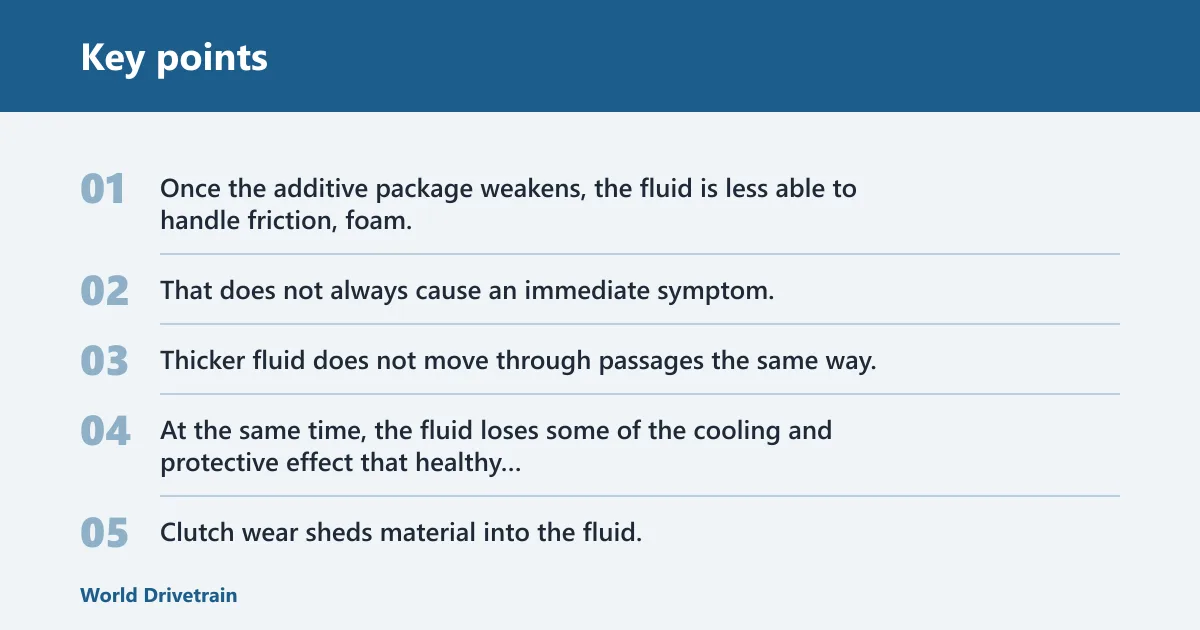
Once the additive package weakens, the fluid is less able to handle friction, foam, and wear. That does not always cause an immediate symptom, but it lowers the margin the transmission relies on during hot operation, towing, and stop-and-go traffic.
Oxidation thickens the fluid
Oxidation changes fluid texture and flow. Thicker fluid does not move through passages the same way, so valve body control can become less precise. At the same time, the fluid loses some of the cooling and protective effect that healthy transmission fluid provides.
Debris starts to accumulate
Clutch wear sheds material into the fluid, and metal particles can build as the transmission ages. Some of that debris is normal. Too much of it means internal wear is advancing and the filter, cooler, and valve body may all be working in worse conditions.
Suppose a sedan with about 90,000 miles still drives fine, but the fluid is dark and the shift quality can feel a little less crisp on warm days. That is usually a maintenance window, not a crisis. The point is to service it before slip and varnish become the next stage.
Which symptoms show up next?
The next symptoms usually involve timing and feel. Delayed or harsh shifts, torque converter shudder, and burnt-looking fluid are common warning signs that the fluid has moved beyond simple aging and into a stage where the transmission may already be wearing internally.
Delayed or harsh shifts
Delayed engagement can mean pressure control is getting lazy or sticky. Harsh shifts can mean the valve body is reacting poorly to varnish, or that the transmission is compensating for weaker friction performance. A sticky valve body is one of the more common control-side failures tied to old fluid.
Torque converter shudder
Torque converter shudder is a likely early symptom when friction modifiers are no longer doing their job. It often shows up as a steady-speed vibration during light throttle or lockup operation. That symptom does not point to one single failure, but it is a strong clue that the fluid’s friction behavior has changed.
Burnt smell and dark fluid
Burnt transmission fluid is usually dark brown or black and has a burnt smell. That is an indicator of advanced wear, not just ordinary discoloration. At that point, heat, oxidation, and clutch wear are often feeding each other.
A common first-timer mistake is to notice only the color and ignore the shift feel. Dark fluid alone does not always mean the transmission is done. Dark fluid plus shudder, flare, or delayed engagement is a different situation.
How do automatics, CVTs, and manuals differ?
They fail differently because they use fluid differently. Conventional automatics depend on hydraulic pressure and friction control. CVTs rely on specific fluid characteristics for belt or chain grip on pulleys. Manuals use gear oil mainly for lubrication, but low or degraded oil still increases wear and shift quality problems.
Automatic transmission fluid and valve body control
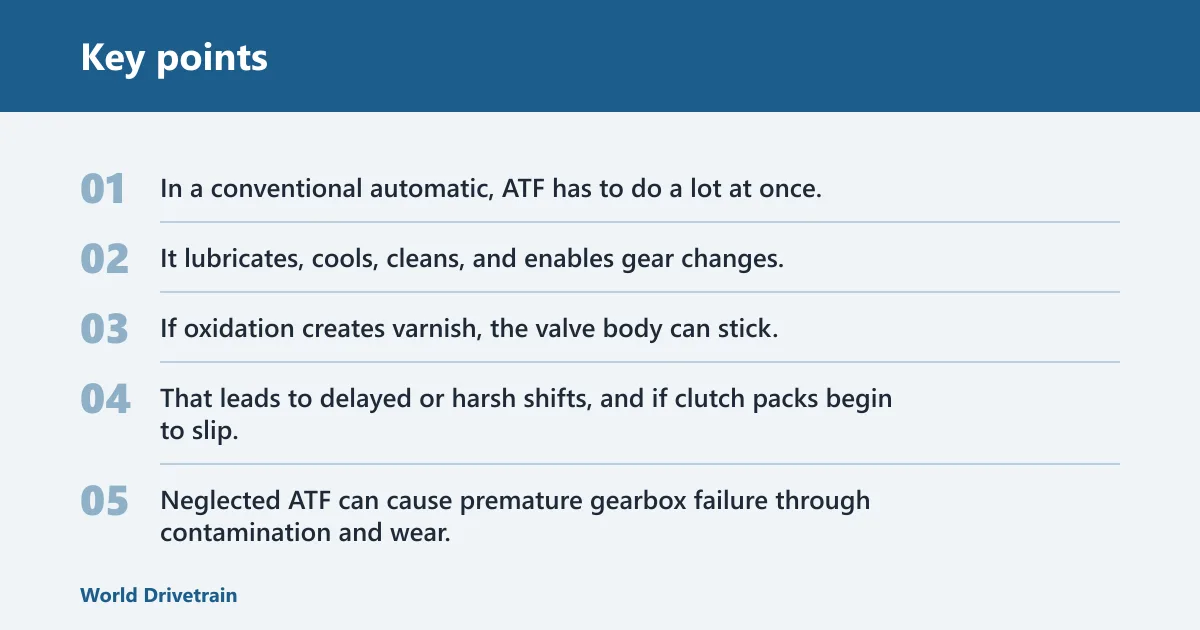
In a conventional automatic, ATF has to do a lot at once. It lubricates, cools, cleans, and enables gear changes. If oxidation creates varnish, the valve body can stick. That leads to delayed or harsh shifts, and if clutch packs begin to slip, the damage can move beyond simple service.
Neglected ATF can cause premature gearbox failure through contamination and wear. Flushing and replenishing ATF every 60,000 to 100,000 miles, while TP Auto Repair says service is typically between 30,000 and 100,000 miles depending on use and design. TP Auto Repair also lists conventional automatic severe-service intervals at 30,000 to 60,000 miles.
CVT fluid and belt or chain grip
CVT transmission fluid is more specialized because it has to support the belt or chain grip on the pulleys. That is why many CVTs specify shorter service intervals than conventional automatics. TP Auto Repair says CVTs often specify 30,000 to 60,000 miles.
ZF six- and eight-speed automatic transmissions are cited as having “lifetime” fluid claims, but ZF transmission recommends a transmission fluid and filter change at 70,000 to 80,000 miles. That gap is why the owner’s manual and the actual service schedule matter more than marketing language.
Manual transmissions and wear behavior
Manual transmissions usually do not depend on the same hydraulic control system, so the failure path is different. Old fluid can still raise wear, make shifting rougher, and let heat and contamination damage synchronizers and bearings. The point is the same: fluid condition still matters, even when the transmission is not automatic.
Temperature makes all of this worse. Transmissions.biz says fluid life roughly halves for every 20°F above about 175°F. That is why towing, stop-and-go driving, and a restricted cooler can shorten the useful life of fluid even when mileage looks moderate.
When is it still maintenance?
It is still maintenance when the transmission shifts normally, the fluid is aged but not burnt, and there is no strong evidence of slip, debris, or overheating. At that point, a fluid service can still be preventive rather than corrective. Once slip, shudder, or burnt odor are present, diagnosis comes first.
Fluid service before slip becomes severe
If the vehicle has no major symptoms, a drain-and-fill or pan service is usually the first move. A drain-and-fill may cost $100 to $300. A pan drop with filter and gasket can run $200 to $450. That is far less than a rebuild, and it can be the difference between maintenance and repair.
Inspection for cooler restrictions and debris
If the fluid is old and the transmission has been hot, the cooler needs attention. A restricted cooler can hold heat in the system, and heat drives oxidation faster. If you find heavy debris in the pan, metal paste on the magnet, or burnt fluid, the transmission likely needs diagnosis before any service decision.
When to stop and diagnose first
If the vehicle already shudders, slips, or refuses to engage correctly, changing fluid is not a cure-all. Very old fluid can be part of a failing transmission, but the fluid change did not create the failure. It simply exposed a condition that was already there. The real question is whether the unit still has enough healthy material left to respond to service.
Repair cost versus service cost
The financial tradeoff is straightforward. Routine fluid service is measured in hundreds of dollars. Repair-level failure is measured in thousands. A conventional automatic rebuild typically runs $3,000 to $6,000, while CVT replacements frequently range from $4,000 to $8,000 or more.
That gap is why waiting can be so expensive. If the fluid is still in the maintenance stage, a service may buy time and reduce wear. If the transmission has already entered the slip and debris stage, the same service may be too late to prevent rebuild-level damage.
- Check the owner’s manual or factory schedule first.
- Look at the fluid condition and smell, not just the mileage.
- Note the symptom stage: none, slight delay, shudder, slip, or failure.
- If there is no slip and no burnt smell, service is usually the safer move.
- If there is shudder, flare, or debris, diagnose before servicing.
- If the fluid is burnt and the unit is slipping hard, prepare for repair decisions.
How towing and stop-and-go use change the math is simple: they raise heat, and heat shortens fluid life. That means the same transmission may need service much sooner under severe use than it would in easy highway driving. If the vehicle spends its life under load, the “normal” interval may not be the right interval.
Frequently asked questions
What happens if you never change transmission fluid?
If you never change transmission fluid, the additive package depletes, oxidation thickens the fluid, and debris builds up until the transmission starts shifting badly or slipping. Over time, that can move from a maintenance issue to a repair problem, especially once varnish and clutch wear affect hydraulic control.
What happens if you don’t change transmission fluid?
You usually get the same failure sequence: heat stress first, then poorer friction control, then shift complaints, and finally wear that can lead to rebuild-level damage. Some transmissions survive longer than others, but the risk rises as the fluid ages and the cooler, valve body, and clutch packs take more abuse.
What if you never change your transmission fluid?
Never changing the fluid gives oxidation, contamination, and heat more time to work. That can lead to delayed engagement, harsh shifts, shudder, and eventual loss of drive. In an automatic or CVT, the damage is often more expensive because the fluid is part of the control system, not only lubrication.
Is it bad to not change transmission fluid?
Yes. It is bad because the fluid is a working part of the transmission. It lubricates, cools, cleans, and helps the gearbox shift. When additives fade and varnish builds, the transmission loses margin. The result can be slip, poor shift quality, and internal wear that is harder to reverse.
How long can you go without changing transmission fluid?
There is no universal answer. The right interval depends on design and use.
Can old transmission fluid cause shifting problems?
Yes. Old fluid can cause shifting problems because additive depletion, oxidation, and varnish change hydraulic control and friction behavior. That can show up as delayed shifts, harsh shifts, or torque converter shudder. If the fluid is very dark or burnt, the problem may already involve internal wear.
Will changing very old transmission fluid cause problems?
Usually no, but the risk is real when the transmission is already slipping badly, has heavy debris, or is near failure. In that case, fresh fluid does not cause the failure; it can simply reveal it. If the unit still shifts cleanly, service is usually the safer choice.
What happens if you never change transmission oil
Transmission oil in a manual still ages, loses protective properties, and picks up debris. The result is usually more wear, rougher shifting, and shorter component life rather than the hydraulic-control problems seen in automatics. The service need may be different, but the “never change it” approach still carries risk.
What happens if you don’t change your transmission fluid
The likely outcome is progressive wear: lost additive strength, thicker fluid, more heat stress, and eventually symptoms such as shudder, slip, or hard shifts. If the vehicle is a CVT, the risk is often higher because the fluid must maintain specific friction behavior for belt or chain grip on the pulleys.