Should You Buy a Used Car with the AWD Warning Light on?
Usually no, unless the seller can document a minor fix or you can confirm a simple, low-risk cause before money changes hands. An AWD light can be as small as a sensor, tire mismatch, or overdue service, but it can also hide transfer case, differential, or control-module trouble that turns into a costly repair.
Reading the AWD warning light: when to stay, when to walk
What the warning light usually means
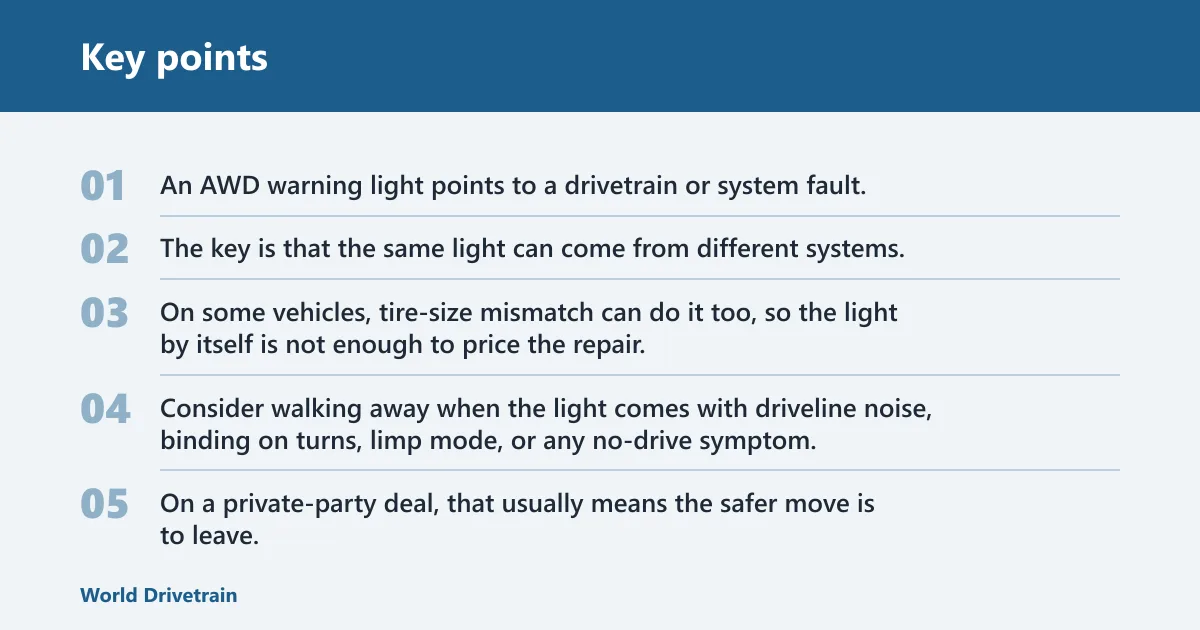
An AWD warning light points to a drivetrain or system fault. It may be intermittent or persistent. It can affect traction and drivability, and it often needs scan-tool diagnosis before anyone can say whether the problem is minor or mechanical.
The key is that the same light can come from different systems. Wheel speed sensors, wiring, fluid condition, a transfer case or coupling fault, a differential issue, or a control module problem can all trigger the warning. On some vehicles, tire-size mismatch can do it too, so the light by itself is not enough to price the repair.
When the car is still worth considering
A used AWD vehicle can still be worth considering if the warning light is the only symptom, the car drives normally, and the seller can document a simple fix. That often means a stored code tied to a sensor, a fluid service that was overdue, or a tire issue that explains an intermittent warning.
If the seller agrees to a pre-purchase inspection and the scan shows no active drivetrain damage, the light may be a negotiation item instead of a dealbreaker. That is especially true when the car otherwise has clean maintenance records and no binding, shudder, or low-speed noise.
When the risk is high enough to walk away
Consider walking away when the light comes with driveline noise, binding on turns, limp mode, or any no-drive symptom. Those signs suggest the fault is beyond a sensor or fluid service and may involve the transfer case, differential, coupling, or control module.
If the seller cannot provide a scan, the light returns after clearing, or the symptom changes under load, the discount needs to cover uncertainty, not just a repair guess. On a private-party deal, that usually means the safer move is to leave.
AWD warning light decision table
| Likely AWD fault pattern | Estimated risk level | Negotiation guidance |
|---|---|---|
| Intermittent light only; car drives normally; no noise or binding | Low to moderate | Inspect first. Ask for an OBD-II scan, tire-size check, and fluid history. Proceed only if the issue looks like a sensor, tire mismatch, or overdue service, and use the result to ask for a modest price cut. |
| Light plus driveline noise at low speed | High | Request a mechanic inspection and budget for a larger repair range. Renegotiate hard or walk away if the seller cannot document a clear cause. |
| Light plus binding on turns or shudder in parking maneuvers | High to severe | Inspect the transfer case or coupling, differential fluid, and tire match. Treat this as a strong walk-away case unless the repair is proven minor and fully priced into the deal. |
| Light with no codes found by a basic scan | Moderate to high | Do not assume the car is fine. Ask for a deeper scan, check for pending codes, and verify the warning behavior on a longer road test before making an offer. |
What should you check before making an offer?
You should treat the pre-purchase inspection as a fault-finding exercise, not a yes-or-no formality. A proper check includes a road test, an OBD-II scan, an underbody inspection, and a review of service history so you can tell the difference between a minor warning and a drivetrain-risk buy.
OBD-II scan and stored codes
Start with a scan of the engine, transmission, ABS, and AWD-related modules. Look for active codes, stored codes, and pending codes, because a light can be on even when a quick scan shows no current hard fault.
Ask whether the code returns after clearing. If a seller recently erased codes before listing the car, the warning may have been hidden long enough to pass a casual look but not long enough to solve the problem.
-
Scan every relevant module. Check the AWD, ABS, engine, and transmission systems together. A wheel speed sensor fault may appear in one module while the AWD light appears in another.
-
Look for pending codes. Pending codes matter because they can point to an issue that has not fully matured into a hard fault. That helps you judge whether the light is intermittent or already active.
-
Confirm whether codes return. Clearing a code once is not a repair. If the light comes back on during the same drive cycle or after a short road test, the defect is still present.
Road test for noise, shudder, and binding
The road test should check warning-light behavior, shudder or binding, turning performance, and noise at low speed. Make slow circles in a parking lot, then drive at neighborhood speed and on a straight road to see whether the problem changes with steering angle or load.
Picture a crossover that drives straight without drama but shudders in a full-lock turn at about 5 mph. That points away from a simple dash-light glitch and toward a coupling, differential, or tire mismatch issue that needs more than a scan.
-
Test slow turns. Turn tightly in both directions in a lot. Binding, hopping, or shudder on turns is a serious warning because AWD systems should not fight the steering wheel in normal low-speed maneuvers.
-
Listen at low speed. Pay attention to whining, clunking, grinding, or rhythmic noise from beneath the car. Noise that tracks vehicle speed often points to driveline wear rather than a false dash alert.
-
Watch the light behavior. Note whether the light flashes, stays solid, or appears only after several minutes. Intermittent warnings can still matter, but a persistent light with repeatable symptoms is a much stronger risk signal.
Underbody and service-history checks
Check the underside for leaks, damaged boots, impact marks, and wet housings around the transfer case or rear differential. Then review service records for differential fluid changes, transfer case service, tire rotations, and any prior drivetrain repair.
Say your seller says the AWD light is “probably nothing,” but the underbody is oily around the rear coupling and the records show no differential service in years. That is a different offer than one on a car with clean paperwork and a recent fluid change.
How much can AWD repairs cost?
AWD repair cost depends on whether the issue is diagnostic, electronic, fluid-related, or mechanical. A simple warning-light diagnosis may be affordable, while a transfer case, differential, or module fault can move the repair from manageable to a strong bargaining problem. Reputable repair data and OEM service information generally place the cheapest fixes in the sensor or wiring tier, with fluid service and coupling work in the middle and major drivetrain or module repair at the top.
Diagnostic fee and sensor-level fixes
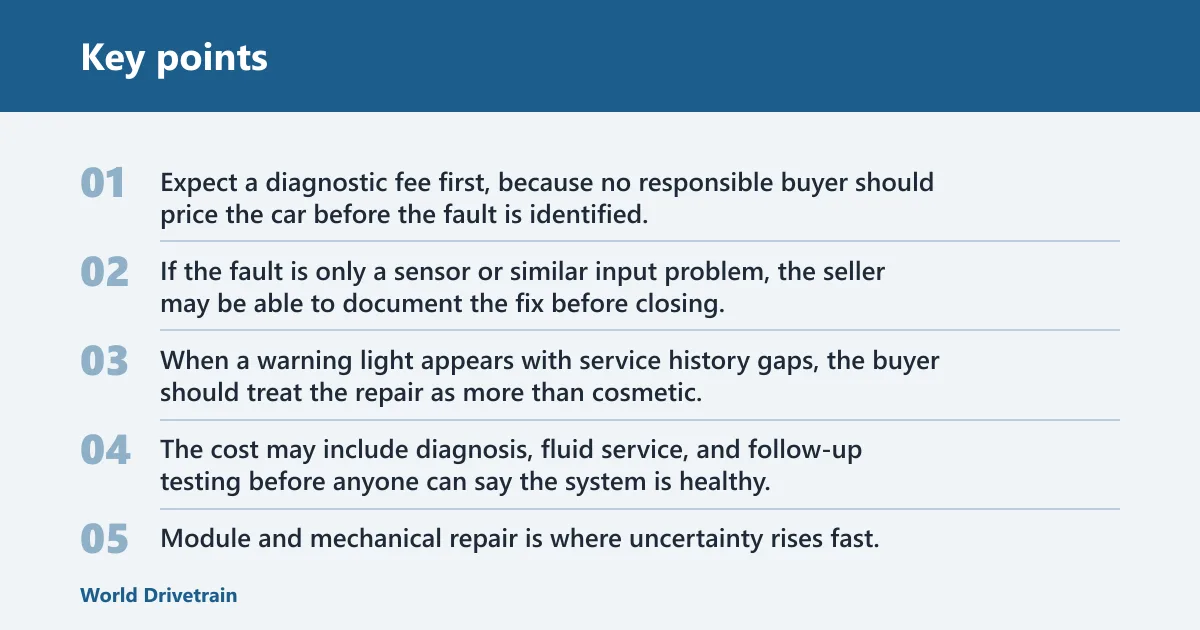
Expect a diagnostic fee first, because no responsible buyer should price the car before the fault is identified. Sensor-level repairs such as a wheel speed sensor or a related wiring fix are usually the least expensive category, and they are the best-case scenario for negotiation.
If the fault is only a sensor or similar input problem, the seller may be able to document the fix before closing. That is the point where the car can move from risky to reasonable.
Fluid service and coupling-related work
Fluid service matters because low, old, or contaminated differential fluid can trigger AWD complaints and accelerate wear. Transfer case or coupling-related work sits in the middle: more expensive than a sensor, less alarming than a full mechanical rebuild, and still worth careful negotiation.
When a warning light appears with service history gaps, the buyer should treat the repair as more than cosmetic. The cost may include diagnosis, fluid service, and follow-up testing before anyone can say the system is healthy.
Module or mechanical repair uncertainty
Module and mechanical repair is where uncertainty rises fast. If the control module, transfer case, differential, or related internals are involved, the repair estimate can swing widely until a shop isolates the fault.
That is why a car with an AWD light and a vague seller explanation deserves a larger discount than a car with a clear sensor diagnosis. The price should reflect the possibility that the final bill will be far above the first guess.
| Repair category | What to verify | Negotiation use |
|---|---|---|
| Diagnostic fee | OBD-II scan, code history, pending codes | Use as the starting cost for your offer reduction |
| Sensor replacement | Wheel speed sensor, wiring, connector condition | Negotiable if the car drives normally |
| Fluid service | Differential fluid condition, transfer case service history | Good target for a moderate price cut |
| Module or mechanical repair | Transfer case, coupling, differential, control module | High-risk item; ask for a steep discount or leave |
When is it a dealbreaker?
It becomes a dealbreaker when the warning light is paired with symptoms that point to active drivetrain damage or unsafe operation. A flashing light, limp mode, binding on turns, or repeated noise should change the decision from “negotiate” to “walk away” unless a full inspection proves the fix is minor.
Light plus driveline noise
Noise under acceleration or at low speed raises the risk level fast. Whine, clunk, or grinding can point to bearing wear, gear wear, or internal damage in the transfer case or differential, and that is rarely a cheap surprise.
Light plus binding on turns
Binding on turns is one of the clearest warning signs. An AWD system that hops or fights during low-speed turns may have a coupling problem, tire mismatch, or internal issue that can worsen if the car is driven more.
Light with no codes or no clear diagnosis
A light with no obvious code is not reassuring by itself. It may mean the fault is intermittent, the scan missed a relevant module, or the seller cleared the data before the sale; any of those should slow the deal or stop it.
A common first-timer mistake is to accept “no codes found” as proof the system is fine. A deeper scan and a longer road test are more useful than a quick dashboard glance.
Can a CPO warranty reduce the risk?
Yes, a certified pre-owned warranty can reduce the risk, but it does not erase it. CPO programs can add peace of mind, yet coverage limits differ, and wear items may be excluded even when the vehicle passed a predelivery inspection. The most useful protection is written coverage for the AWD system, not a general sales promise.
Coverage limits to verify
Read what the warranty actually covers before you pay more for the car. CPO warranties are not all the same, and the parts that matter in an AWD complaint may sit inside separate coverage buckets or carry different deductibles.
Ask for the warranty booklet and the inspection report, not a summary from the salesperson. You need to know whether the transfer case, coupling, sensors, control module, and related labor are included, and whether any pre-existing issue language could block a claim.
Wear items and exclusions
Wear items still matter because a bad tire set, contaminated fluid, or damaged part from normal use may not be covered. A warranty can help with a failed module, but it may not pay for tires, fluid condition, or maintenance items that caused the warning.
What paperwork to ask
-
Request the inspection report. A CPO predelivery inspection tells you what was checked before the sale. That helps confirm whether the AWD issue existed, was repaired, or was missed.
-
Read the coverage terms. Verify coverage limits, deductible, and excluded items. If AWD components are excluded or limited, the warranty is far less useful than the seller’s pitch suggests.
-
Confirm repair history. Ask for records showing what code was found, what part was replaced, and whether the light returned. That paper trail matters more than a verbal promise.
Frequently asked questions
Should I buy a used car with the AWD warning light on?
Usually only if the price leaves room for uncertainty and the issue looks minor after a scan and road test. If the seller can show a sensor, fluid, or tire-related cause, the car may still be worth buying. Without that proof, the risk rises fast.
Is it safe to drive a used car with the AWD light on?
Sometimes, but not always. If the car drives normally and the light is intermittent, a short trip to a shop may be reasonable. If it shudders, binds, goes into limp mode, or makes noise, do not assume it is safe to keep driving.
How much does it cost to fix an AWD warning light?
The cost ranges from a diagnostic fee and a sensor-level repair to much higher module or mechanical work. Fluid service and coupling-related repairs sit in the middle. The only honest way to price it is with a scan and an inspection that identifies the fault.
Can an AWD warning light mean a major drivetrain problem?
Yes. It can point to a transfer case, differential, coupling, or control-module fault, and those repairs can become expensive after warranty coverage ends. A light alone does not prove major damage, but light plus driveline symptoms often does.
Should I walk away from a used car if the AWD light is on?
Walk away if the light comes with binding, driveline noise, limp mode, or no clear diagnosis after a proper scan. If the problem is intermittent and the seller can document a simple fix, you can still negotiate. The price must cover the uncertainty, not just the obvious repair.
Can a certified pre-owned warranty cover AWD problems?
It can, but only within the plan’s coverage limits. Some CPO programs include drivetrain protection and a predelivery inspection, while others exclude certain wear items or limit what is paid for. Read the paperwork before you assume the warning light is covered.