Questions to Ask Before Buying 4WD Parts That Won’t Engage
Before ordering parts, ask these four questions: is the 4WD system full-time or part-time, is it vacuum or electric, which axle or transfer case appears to be failing, and what test confirms the fault. Wrong parts waste money, delay repairs, and can leave the system stuck in 2WD. This guide shows the failure patterns, drivetrain checks, and confirmation tests that match the right part to buy.
What the symptom pattern means
The symptom pattern tells you where to start. If there is no shift command, check the switch, module, fuse, or wiring. If the transfer case shifts but the front axle does not pull, focus on the actuator or vacuum side. Flashing lights and stored codes point to sensor or control faults.
No command versus no engagement
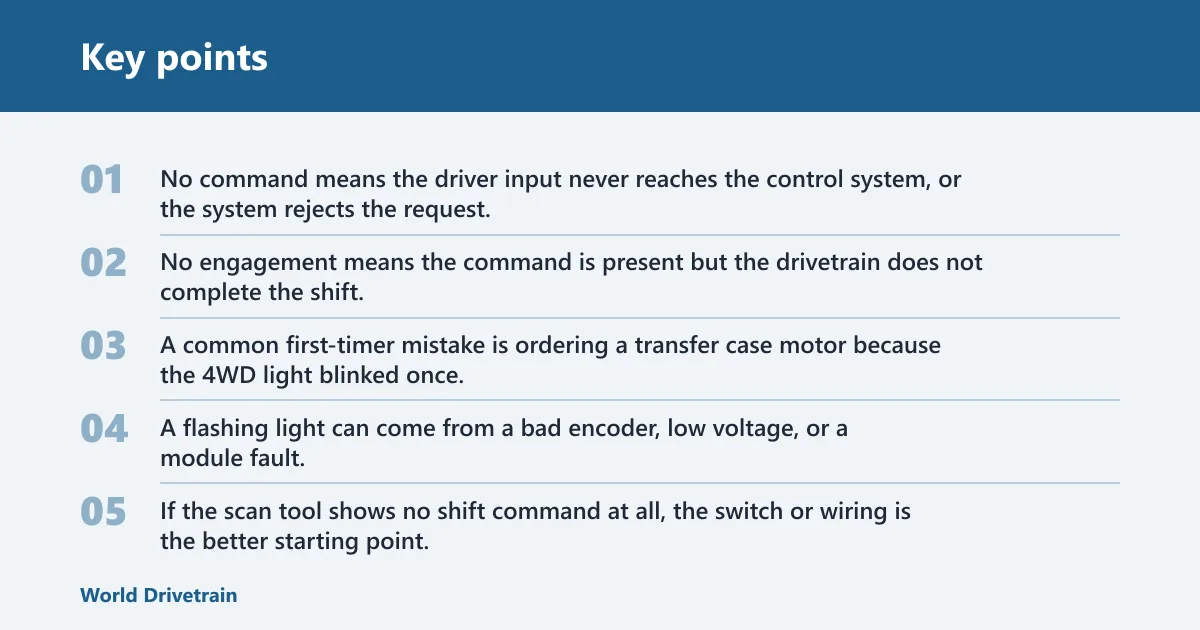
No command means the driver input never reaches the control system, or the system rejects the request. No engagement means the command is present but the drivetrain does not complete the shift. Those are different failures, and they do not call for the same part.
A common first-timer mistake is ordering a transfer case motor because the 4WD light blinked once. A flashing light can come from a bad encoder, low voltage, or a module fault. If the scan tool shows no shift command at all, the switch or wiring is the better starting point.
Shifts but the front axle does not pull
When the transfer case changes range but the front wheels do not drive, the front axle actuator, vacuum system, or axle disconnect mechanism moves to the front of the list. On many trucks and SUVs, the transfer case can shift normally while the axle stays open.
Suppose the dash shows 4H, the transfer case makes its usual motor sound, and the front prop shaft is engaged, but the front tires still freewheel. That pattern points away from the shift motor and toward the axle actuator, vacuum lines, or an axle disconnect fault.
Flashing 4WD light and stored codes
A flashing 4WD indicator can mean the control system sees an incomplete shift, a mismatch between commanded and actual position, or a feedback-circuit fault. Stored diagnostic trouble codes help separate a motor issue from an encoder, switch, or module problem. Read the codes before buying anything.
Which part is most likely bad?
The most likely part depends on the failure pattern, not on the most common part in a catalog. Transfer case shift motors usually fail with no engagement, clicking, or a blinking light. A 4WD mode switch is more likely when the dash input is erratic. Front axle actuators and vacuum parts matter when the case shifts but the front axle stays open.
Transfer case shift motor
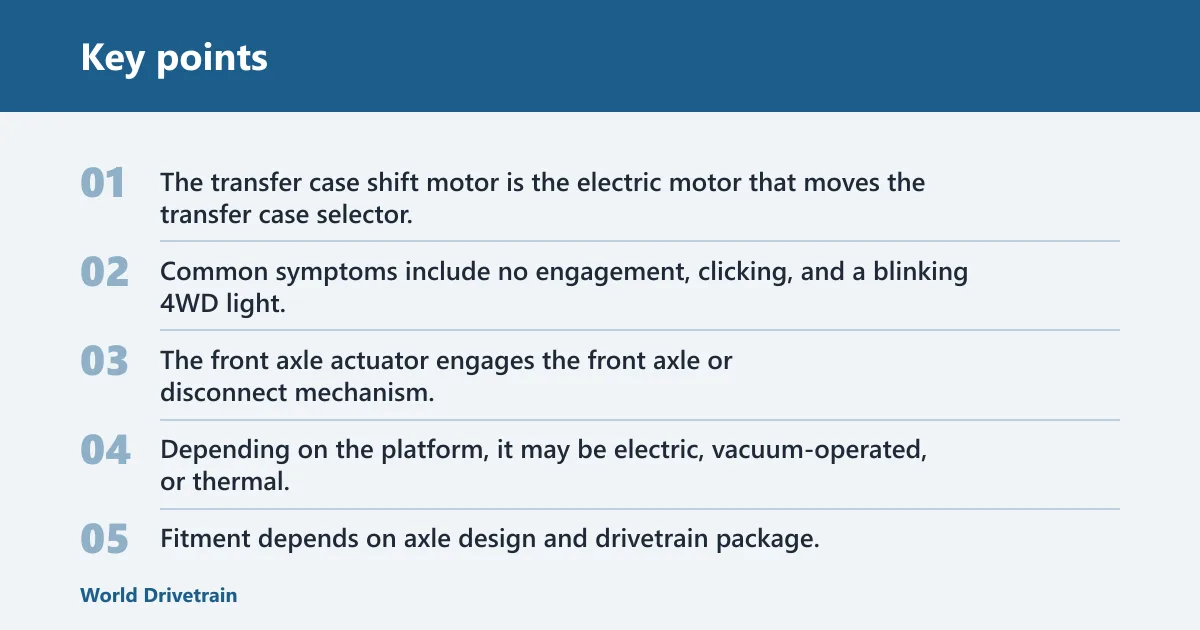
The transfer case shift motor is the electric motor that moves the transfer case selector. It has a vehicle-specific connector and mounting pattern, and it must match the transfer case model and year range. Common symptoms include no engagement, clicking, and a blinking 4WD light.
4WD mode switch
The 4WD mode switch is the dash-mounted selector or rotary switch that sends the driver’s request to the transfer case control system. Many vehicles use 2H, 4H, and 4L positions. It must match trim, model year, and wiring style, even when the switch face looks similar.
Front axle actuator
The front axle actuator engages the front axle or disconnect mechanism. Depending on the platform, it may be electric, vacuum-operated, or thermal. It is a common failure point when the transfer case shifts but the front wheels do not pull. Fitment depends on axle design and drivetrain package.
Transfer case control module
The transfer case control module handles shift commands and diagnostics on some vehicles. It may store fault codes related to engagement, and some systems require scan-tool access to check data and command tests. Compatibility varies by model and software calibration, so module swaps need exact verification.
Vacuum lines and solenoids
Vacuum lines and solenoids are used on some front axle engagement systems. Cracked hoses, weak vacuum, stuck solenoids, routing errors, and broken fittings can stop the axle from engaging. Diagnosis may require a vacuum gauge or a hand vacuum pump, not just a visual check.
Transfer case position sensor or encoder
The transfer case position sensor or encoder reports shift position back to the control system. It can cause a mode light flashing, an incomplete shift, or a false position reading. Technicians often verify it with scan data plus resistance or voltage checks, and the specs vary by transfer case family.
What do you need to verify before ordering?
Before ordering, verify the exact vehicle and drivetrain setup. VIN, model year, engine, transmission, axle ratio, and transfer case code are common base filters for the correct part number. Connector style, mounting pattern, wiring layout, trim, and axle type finish the fitment check. That is how you avoid returns.
-
Record vehicle identity data.
Write down the VIN, model year, engine, transmission, axle ratio, and transfer case code. Those details separate similar-looking parts that do not interchange. -
Match the connector and mount.
Compare connector pin count, plug shape, bolt pattern, and clocking position against the original part. Small differences here are enough to stop installation. -
Check trim and drivetrain package.
Confirm whether the vehicle uses a specific axle disconnect, vacuum system, or control module calibration. Trim-specific and drivetrain-specific differences are common on 4WD systems.
4WD parts decision checklist
This checklist maps the symptom pattern to the likely failed part, the test that confirms it, the fitment data needed, and the buy-or-wait decision. Use it before you order a motor, switch, actuator, or module. If the confirmation test is incomplete, wait.
| Symptom pattern | Likely component | Test to confirm | VIN and fitment data needed | Buy or wait recommendation |
|---|---|---|---|---|
| No 4WD command from dash or rotary switch | 4WD mode switch or wiring | Scan for input change while moving the switch; check fuse, power, and ground | VIN, model year, trim, switch style, wiring style | Buy only after the input change is verified |
| Clicking noise, blinking 4WD light, no engagement | Transfer case shift motor or encoder | Read codes, command shift with a scan tool, check voltage at the motor | VIN, transfer case code, connector style, mounting pattern, year range | Buy after code and command tests point to the motor or encoder |
| Transfer case shifts, front wheels do not pull | Front axle actuator or vacuum system | Check vacuum supply, actuator movement, axle disconnect response | VIN, axle type, drivetrain package, vacuum or electric actuator design | Buy after axle engagement is confirmed as the fault |
| Intermittent engagement or flashing indicator with codes | Transfer case position sensor or control module | Compare commanded versus actual position in scan data; test voltage or resistance where specified | VIN, transfer case code, software calibration, module part number | Buy after scan data shows a position or control error |
| 4WD works sometimes, then drops out | Vacuum lines, solenoids, grounds, or low voltage | Inspect hoses and fittings, measure system voltage, check charging and grounds | VIN, axle design, vacuum routing, electrical connector style | Wait until supply and wiring issues are ruled out |
Can bad tires, low voltage, or fluid stop engagement?
Yes. Mismatched tire sizes can create drivetrain bind that mimics a 4WD fault, especially on part-time systems. Low battery voltage, weak grounds, and charging problems can block motor movement or corrupt module operation. Low, contaminated, or wrong transfer case fluid can also damage parts and should be checked first.
Mismatched tire sizes and drivetrain binding
Different tire diameters can make 4WD hard to engage or impossible to use on some systems because the driveline is fighting itself. Check all four tire sizes and wear levels before buying parts. If one axle has a noticeably different circumference, correct that first.
Battery voltage and ground quality
Low voltage can cause a shift motor to click, a module to log false faults, or an encoder to report bad position data. Check battery state, charging output, and grounds before ordering parts. A weak battery can look like a failed actuator.
Transfer case fluid condition
Transfer case fluid level and condition matter. Leaks, contamination, or the wrong fluid can cause wear or internal damage, and some symptoms that look electrical are actually mechanical. Verify the fluid before replacing an expensive motor or module.
Should you buy OEM, remanufactured, or aftermarket?
Exact-match OEM is the safer buy when the part is trim-specific, connector-specific, or tied to transfer case software and calibration. Remanufactured parts can work for motors and some modules if the seller gives the exact part number match. Aftermarket parts can fit, but only when the listing matches the drivetrain details exactly.
When exact-match OEM is the safer buy
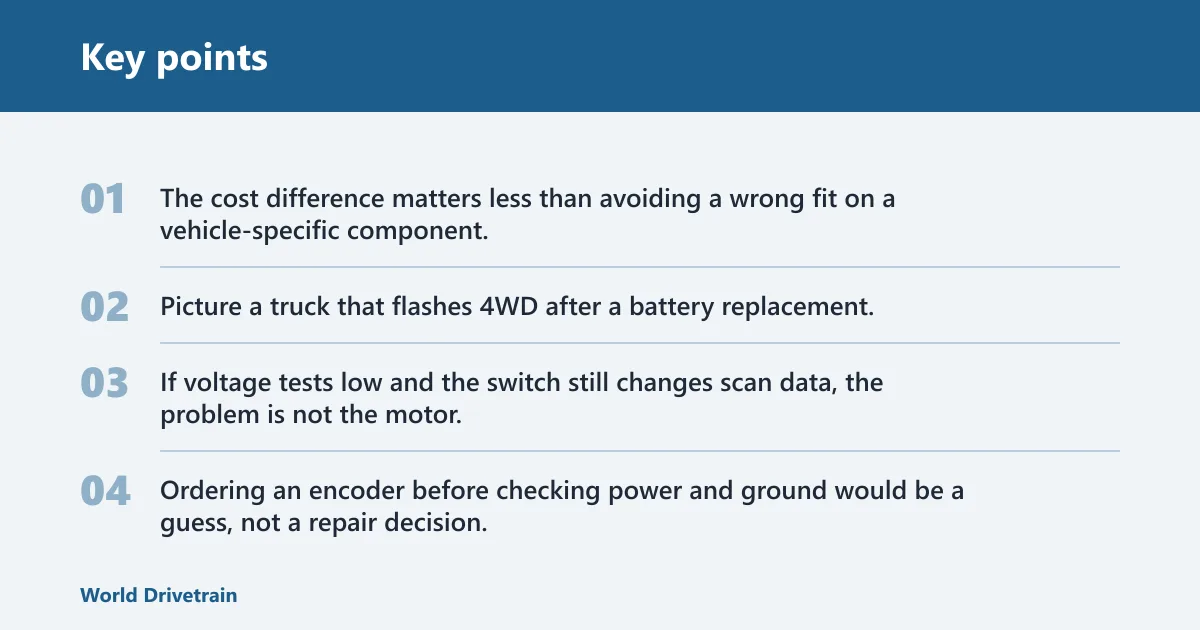
Choose OEM when the failure is tied to a transfer case code, a software-calibrated module, or a part with a unique connector and mounting pattern. The cost difference matters less than avoiding a wrong fit on a vehicle-specific component.
When remanufactured or aftermarket parts can work
Remanufactured motors and some vacuum components can be a sound choice if the part number, connector, and year range are exact. Aftermarket parts are more acceptable for common hoses, solenoids, and some switches, provided the fitment is confirmed against the VIN and drivetrain code.
Picture a truck that flashes 4WD after a battery replacement. If voltage tests low and the switch still changes scan data, the problem is not the motor. Ordering an encoder before checking power and ground would be a guess, not a repair decision.
Frequently asked questions
What part should I replace first if my 4WD will not engage?
Start with the part that matches the symptom pattern and the confirmation test, not the most common failure on a parts list. If there is no driver command, check the switch and wiring first. If the case shifts but the front axle stays open, start with the actuator or vacuum system.
How do I know whether the problem is the switch, actuator, vacuum system, or transfer case?
Use the behavior, codes, and a basic command test. A switch fault usually shows no input change. An actuator or vacuum fault shows a successful transfer case shift with no front-wheel pull. A transfer case fault usually shows motor noise, incomplete movement, or encoder codes.
Do I need OEM parts or will aftermarket parts work for a 4WD not engaging issue?
OEM is the safer choice for trim-specific switches, software-dependent modules, and transfer case motors with unique mounts or connectors. Aftermarket parts can work when the listing matches the exact VIN, year range, transfer case code, and wiring style. Do not assume a universal fit.
What tests should I do before buying a 4WD actuator or shift motor?
Check fuse power, ground, and battery voltage first. Then read codes, verify the switch input with a scan tool if available, and confirm the commanded shift. For an actuator, check vacuum supply or electrical feed. For a motor, confirm the correct transfer case code and connector style.
Can bad tires, mismatched tire sizes, or low voltage cause 4WD not to engage?
Yes. Mismatched tire sizes can create bind that makes 4WD act wrong or seem stuck. Low voltage can weaken a shift motor, confuse a module, or cause a false fault. Verify tire size, battery condition, charging output, and grounds before buying drivetrain parts.
What vehicle-specific details do I need before ordering 4WD parts?
Use the VIN, model year, engine, transmission, axle ratio, and transfer case code. Then confirm connector style, mounting pattern, trim, and wiring layout. Those details prevent most wrong-part orders, especially for motors, modules, switches, and axle actuators that vary by drivetrain package.