
How much is transmission replacement labor by drivetrain?
Transmission replacement labor often falls in the low hundreds to a few thousand dollars. Simpler rear-wheel-drive jobs sit lower, while transverse front-wheel-drive or AWD jobs sit higher. Bad quotes often hide extra hours, missing fluids, and transfer-case or axle work that change the final bill. This guide breaks labor by drivetrain layout, complexity tier, and the line items that should appear on a valid estimate.
How much is transmission replacement labor?
Labor-only versus total invoice
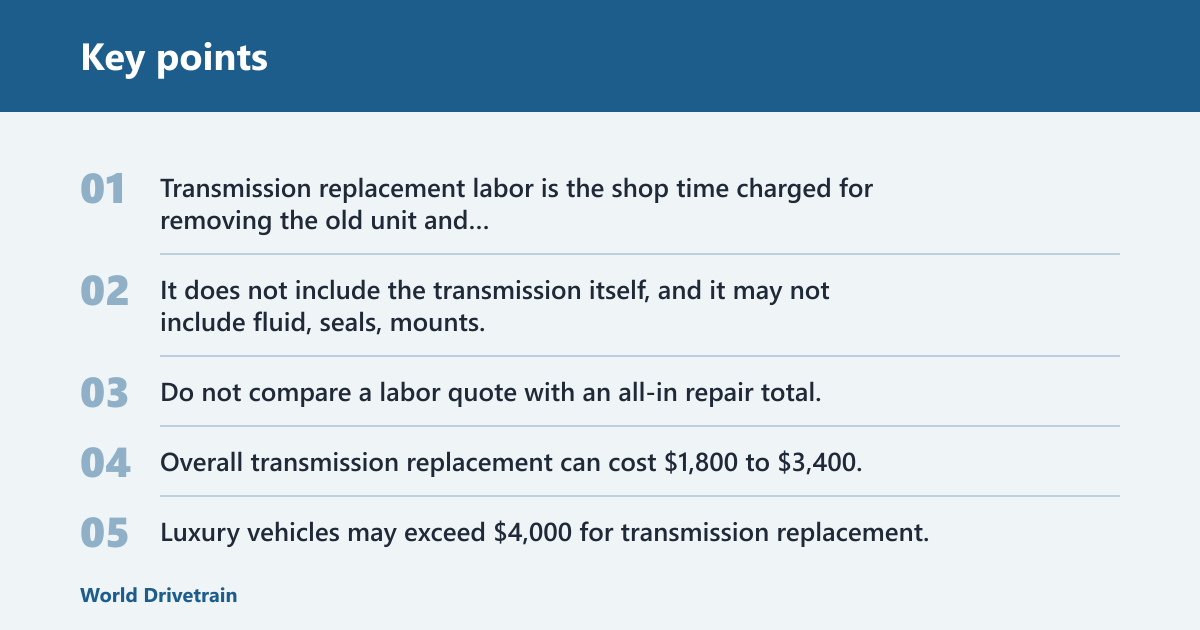
Transmission replacement labor is the shop time charged for removing the old unit and installing the replacement. It does not include the transmission itself, and it may not include fluid, seals, mounts, or programming. Do not compare a labor quote with an all-in repair total.
Overall transmission replacement can cost $1,800 to $3,400, and labor costs are often $500 to $1,200 of that total. Luxury vehicles may exceed $4,000 for transmission replacement. Those totals help with context, but labor-only pricing shows whether the quote is normal or padded.
Typical labor price range by complexity tier
A practical benchmark is to sort labor by access and drivetrain layout. Easy jobs sit at the low end because the transmission comes out with fewer disconnections. Moderate jobs add more disassembly. High-complexity jobs need more time for access, transfer-case work, or electronics.
| Complexity tier | Common layout | Typical labor benchmark | What usually drives the hours |
|---|---|---|---|
| Easy | Longitudinal rear-wheel-drive, common platform | Lower end of the labor range | Cleaner access, fewer subassemblies, simpler removal path |
| Moderate | Front-wheel-drive, transverse layout | Midrange labor quote | Tighter packaging, more bracket and axle disassembly |
| High | AWD, 4WD, luxury, or specialty platform | Upper end of the labor range | Transfer-case work, extra shafts, programming, limited access |
What a normal quote should list
A valid estimate should separate labor from parts and show the major operations. You should see removal and installation labor, fluid, and any additional work the technician expects. If the quote only lists a single lump sum, ask for line items before authorizing the repair.
📊 Transmission replacement can cost $1,800 to $3,400 overall. Source: How Much Does It Cost To Replace A Transmission?.
What is included in transmission removal and installation labor?
Removal and installation labor, often shortened to R&R, covers the time needed to disconnect the transmission, remove it from the vehicle, install the replacement, and verify that the drivetrain operates correctly. It should also account for related parts that must move over from the old unit.
Removal and reinstallation steps
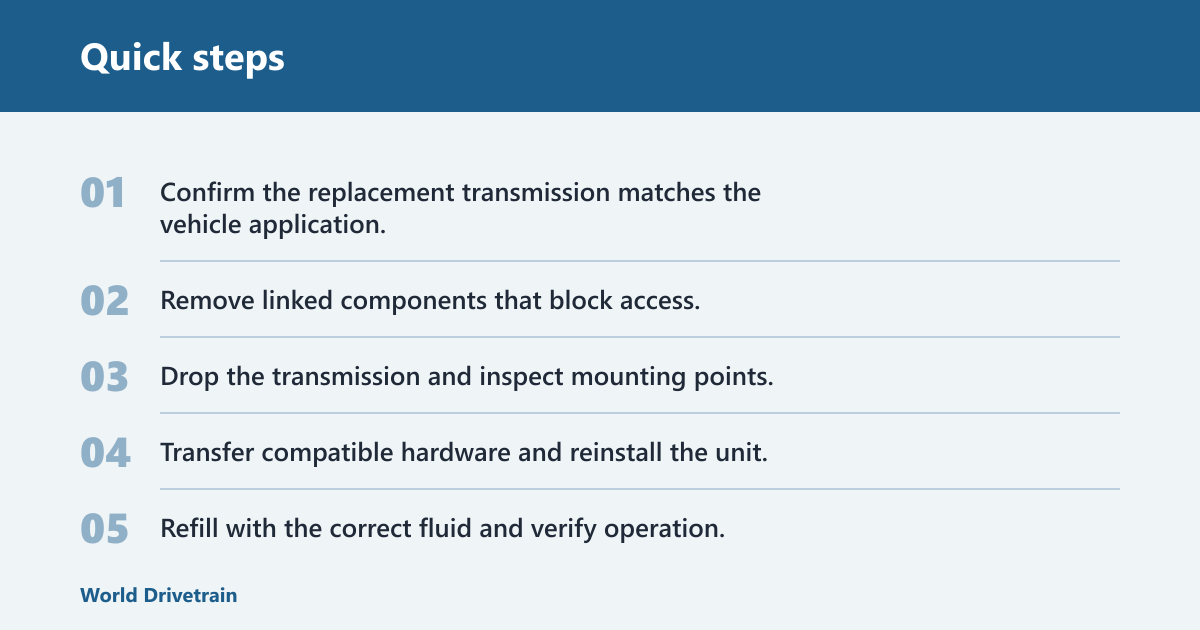
R&R labor usually includes disconnecting the battery, draining fluid if needed, removing driveshafts or axles where required, unbolting mounts and crossmembers, separating the bellhousing, and lowering the unit. Installation reverses those steps and usually includes refill and basic operational checks.
- Confirm the replacement transmission matches the vehicle application.
- Remove linked components that block access.
- Drop the transmission and inspect mounting points.
- Transfer compatible hardware and reinstall the unit.
- Refill with the correct fluid and verify operation.
Transfer of mounts, sensors, and related hardware
Some labor estimates include transfer of the torque converter, brackets, sensors, shift linkage, heat shields, and wiring connectors. Others price these separately if the shop expects broken fasteners, worn mounts, or difficult access. Ask which transfer work is included before the job starts.
Inspection and test-checks during install
Inspection during installation should include checking seals, verifying mounts, confirming axle or driveshaft fit, and checking for leaks after refill. Automatic transmissions often need scan-tool checks or relearn procedures after installation, which can add labor time if the estimate does not already include them.
Why is transmission replacement labor so high?
Transmission replacement labor is high because the job is bulky, access is limited, and the technician must disconnect several systems before the unit can move. Automatic transmissions add hydraulic and electronic complexity. AWD and 4WD layouts often add transfer-case, shaft, and driveline steps that lengthen the job.
Packaging and access limits
Many vehicles package the transmission tightly around the exhaust, subframe, steering gear, or front suspension. That means the shop may need to lower or shift supporting parts just to reach the case. Cramped engine bays are a major reason quotes vary so much between platforms.
Automatic transmission complexity
An automatic transmission often involves more electronics and hydraulic control than a manual transmission. The job may require scan-tool communication, transmission fluid exchange, and adaptation or relearn steps after installation. Those requirements can add both labor time and shop overhead.
AWD and 4WD labor time
AWD and 4WD vehicles usually take more labor because the transmission is tied into additional driveline components. Transfer cases, front axles, extra shafts, and more underbody hardware can turn a straightforward R&R into a longer disassembly and reassembly job. That is one reason the same repair can vary by hours, not just by brand.
How do vehicle make and model change labor cost?
Make, model, and year affect transmission labor because platform layout determines access, parts transfer, and reassembly time. Common vehicles with broad parts availability often price lower. Specialty, luxury, or tightly packaged vehicles usually need more hours and may require dealer-level procedures.
Common cars versus specialty platforms
A common platform usually has better parts availability and a more familiar removal path. A specialty platform may need more disassembly, model-specific tools, or programming after installation. That is why labor on one vehicle can be well below another vehicle with the same symptom.
Say your compact sedan needs a replacement and the estimate looks ordinary at first glance. If the shop also lists fluid, a seal kit, and a scan-tool relearn, the quote may still be fair. The question is whether each line item matches the vehicle layout.
Toyota Camry labor benchmark
A Toyota Camry transmission replacement usually ranges from $2,500 to $4,000, and Camry labor expenses usually vary from $800 to $1,200. That makes it a useful benchmark for a common front-wheel-drive car where labor is meaningful but not usually extreme.
Dodge Ram 1500 labor benchmark
A Dodge Ram 1500 transmission replacement typically ranges from $2,500 to $4,500, and Dodge Ram 1500 labor expenses usually vary from $800 to $1,200. A truck platform can still be expensive, but the labor may stay near the same band if access is reasonable and the quote is complete.
How do shop type and labor rate affect the quote?
Labor rate is the shop’s hourly price, and it can change the final bill as much as the number of hours. Independent shops, dealers, and regional markets often charge different rates. A higher hourly rate is reasonable when it reflects tooling, procedure requirements, or vehicle complexity.
Independent shop versus dealer pricing
Independent shops often price below dealers on pure hourly rate, but not always on total bill. Dealers may charge more for factory procedures, diagnostic time, or programming. A lower rate is not automatically better if the quote omits required operations.
Regional labor rate differences
Urban markets, high-cost regions, and areas with limited drivetrain specialists often show higher labor rates. Rural shops may charge less per hour but need more time if they see fewer transmissions of that type. Compare total hours and included steps, not just the hourly line.
When a high rate is reasonable
A high rate can be justified if the vehicle needs scan-tool programming, special lift access, AWD disassembly, or manufacturer-specific reset procedures. If the quote is high but also detailed, that is more defensible than a cheaper estimate with missing line items.
What extra line items often appear with transmission replacement?
Transmission replacement almost always brings extra line items beyond labor. Fluid, filters, seals, mounts, cooler lines, and programming can all affect the invoice. Those items should be visible on the estimate so you can tell whether the quote is complete or simply low on paper.
Transmission fluid and filters
Transmission fluid is commonly serviced during replacement, and the fluid charge belongs on the invoice even though it is not labor. Some vehicles also need a filter or pan service. Missing fluid line items are a red flag because the transmission cannot go back in dry.
Seals, gaskets, mounts, and cooler lines
Seals and gaskets are small parts, but they matter because labor to revisit a leak after installation can be expensive. Cooler lines and mounts may need replacement if they are brittle, damaged, or in the way. A full replacement quote should identify those items separately when needed.
A gasket replacement normally ranges from $150 to $300, and transmission gasket labor commonly ranges from $100 to $250. Replacing a transmission hose commonly ranges from $150 to $350, and transmission hose labor generally ranges from $50 to $150. Those jobs are useful benchmarks because they show how labor stays small when the component and access are small.
Programming, relearn, and related checks
Some automatic transmissions require computer programming, adaptation resets, or relearn procedures after installation. If the vehicle uses an electronic control module or adaptive shifting strategy, those steps can add shop time. A quote that skips them may not be complete.
How can you compare your estimate against common benchmarks?

The easiest way to compare a quote is to break it into labor hours, added operations, and missing items. Then check whether the labor matches the drivetrain layout and vehicle platform. If the estimate cannot be translated into hours and steps, it is harder to judge.
Labor-only worksheet logic
Use this worksheet to translate the estimate into a practical benchmark. It is not a price guarantee. It is a consistency check.
| Estimate item | What to look for | Likely impact on labor | Red-flag discrepancy |
|---|---|---|---|
| R&R labor hours | Separate remove and install time | Core labor charge | One flat number with no detail |
| Fluid | Type and quantity listed | Usually adds cost, not labor | Fluid missing from a replacement job |
| Cooler lines | Replacement or cleaning listed | Can add time on tight layouts | No mention when lines are visibly corroded |
| Seals and mounts | Separate parts and labor if needed | Small labor increase | Duplicate labor billed twice |
| Programming or relearn | Scan-tool procedure named | Added technician time | Electronics ignored on modern automatics |
Use small repairs as scope checks
If a shop quotes only a tiny labor increase for a transmission hose or gasket, that tells you the repair scope is limited. A full replacement should show a much larger labor block because it includes removal, installation, refill, and inspection. The size of the job should match the size of the labor.
Red flags for padded hours or missing items
Watch for duplicate labor entries, vague “shop supplies” that hide actual work, and big labor totals without a breakdown of removal, installation, and post-install checks. Also question quotes that leave out fluid, mounts, cooler lines, or programming on a vehicle that typically needs them.
- Ask for labor hours, not only a total.
- Check whether fluid and filters are listed.
- Confirm any programming or relearn steps.
- Match the quote to the vehicle layout.
- Get a second estimate if anything is vague.
Frequently asked questions
how much is transmission replacement labor
Transmission replacement labor usually falls within the labor-only part of the overall bill, often $500 to $1,200, with more complex jobs reaching higher. The exact quote depends on drivetrain layout, access, shop rate, and whether the estimate includes fluid, programming, and related hardware.
how much is labor for transmission replacement
Labor for transmission replacement is the charge for removing and installing the unit, not for buying the transmission itself. A simple rear-wheel-drive job should sit below a cramped AWD or transverse front-wheel-drive job, because access and transfer steps determine the hours.
what is included in transmission replacement labor
Transmission replacement labor usually includes removal, installation, transfer of related parts, refill, and basic inspection. On many vehicles, it can also include disconnecting axles or driveshafts, moving mounts or brackets, and checking for leaks or scan-tool faults after startup.
why is transmission replacement labor so high
Transmission replacement labor is high because the transmission is large, hard to access, and tied to many parts that must come off first. Automatic units, AWD layouts, and tight engine bays increase the number of steps and the chance of extra time for stuck fasteners or hidden hardware.
how do labor costs change by vehicle make and model
Labor costs change by vehicle make and model because each platform packages the transmission differently. A Toyota Camry often sits in a more common labor band, while a Dodge Ram 1500 can need different removal steps. Luxury vehicles may exceed $4,000 overall, which often reflects added labor complexity.
how much is a transmission swap cost
A transmission swap cost usually means the full job, not labor alone, so it includes parts and related service items. For replacement, the overall cost can run $1,800 to $3,400, and labor is often $500 to $1,200 of that amount, with higher totals on luxury vehicles.