Front axle seal leak symptoms: what to look for first
A wet ring at the axle tube usually points to the inner seal, but oil sprayed near the vent often means a clogged breather; noise or wobble adds bearing or axle-shaft wear to the list. Ignored leaks can wash grease from bearings, contaminate brakes, and turn a seal job into a much larger repair. This guide maps wet spots and noises to the likely source, then shows the checks that separate the inner seal, vent, bearing, and axle shaft.
Residue Patterns and Sulfur Odors Near the Knuckle
The first signs are usually a damp ring, a dark film, or a sulfur smell near the axle tube, knuckle, or wheel well. A front axle seal can leak oil that appears far from the failed seal point, so the wettest spot is not always the source.
What the first clues look like
On many front axles, the earliest clue is residue on the axle tube, lower knuckle area, or around the wheel well after a drive. A parked vehicle may first hint at the problem through the odor that lingers in the wheel well after shutdown.
Gear oil has a sharp sulfur odor. A front axle differential fluid leak may announce itself through smell before a puddle appears. If the area smells stronger after highway driving, winter slush, or rock crawling, that clue matters more than a single wet spot.
Why the leak may be hard to spot
Oil from a front axle inner seal can travel inside the housing before it becomes visible. That is why the leak can show up at the inner C, around the knuckle, or on brake parts even when the failed seal sits deeper inside the axle tube.
Where does front axle seal oil usually show up?
Front axle seal oil usually shows up at the inner C or knuckle area, on the axle tube near the housing, or on brake backing plates and parking brake hardware. Because the fluid can move along the axle before escaping, the visible wet spot may be well away from the inner seal.
Inner C and knuckle area
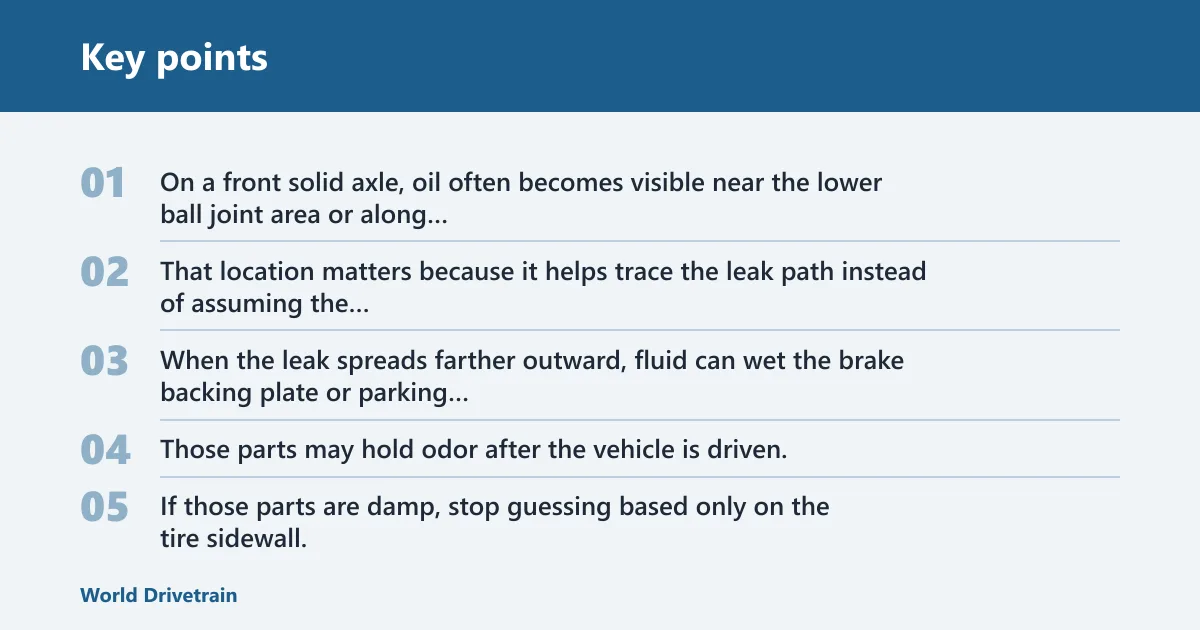
On a front solid axle, oil often becomes visible near the lower ball joint area or along the axle tube near the inner C. That location matters because it helps trace the leak path instead of assuming the outermost wet part is the failure point.
Brake backing plate and parking brake hardware
When the leak spreads farther outward, fluid can wet the brake backing plate or parking brake hardware. Those parts may hold odor after the vehicle is driven, which helps separate axle fluid from ordinary grime. If those parts are damp, stop guessing based only on the tire sidewall.
Why the visible spot can be misleading
Suppose the axle shaft seal fails inside the tube, but the housing angle, road airflow, or shaft rotation moves the oil outward. The first visible stain may be at the knuckle, not at the seal. That is why a leak trace needs cleaning and a close inspection of the full path.
How do you tell axle oil or CV boot grease?
Axle oil and CV boot grease can both leave messes, but they usually differ in smell, texture, and placement. Gear oil is thinner, often darker, and has a sharp sulfur odor. CV grease is thicker, tackier, and usually flung in a radial pattern around the boot and nearby parts.
Color, texture, and fling pattern
Gear oil often leaves a damp, dark residue rather than a clean drip. It may streak onto brake components, the axle tube, or the wheel well. CV boot grease tends to cling in strings or blobs near the torn boot, with a splatter pattern from spinning joints.
Why placement matters more than the wettest spot
A wet wheel does not automatically mean a wheel seal failed. If the mess starts at the inner C or axle tube and the boot is intact, axle oil is more likely. If grease is concentrated around a split boot and there is no sulfur smell, CV grease is the better fit.
A quick separation rule
Think location first, smell second, texture third. Grease on the inside of a torn boot points toward a CV problem. A dark, oily film with a sulfur odor around the axle housing points toward gear oil from the differential side, even if the streak ends at the wheel.
Can a clogged axle vent cause a front seal to leak?
Yes. A clogged axle vent can trap pressure inside the housing as fluid heats and expands, and that pressure can force oil past seals. Mud, rust flakes, or packed trail dust can block the vent, so check the vent before you replace the seal again.
How pressure builds
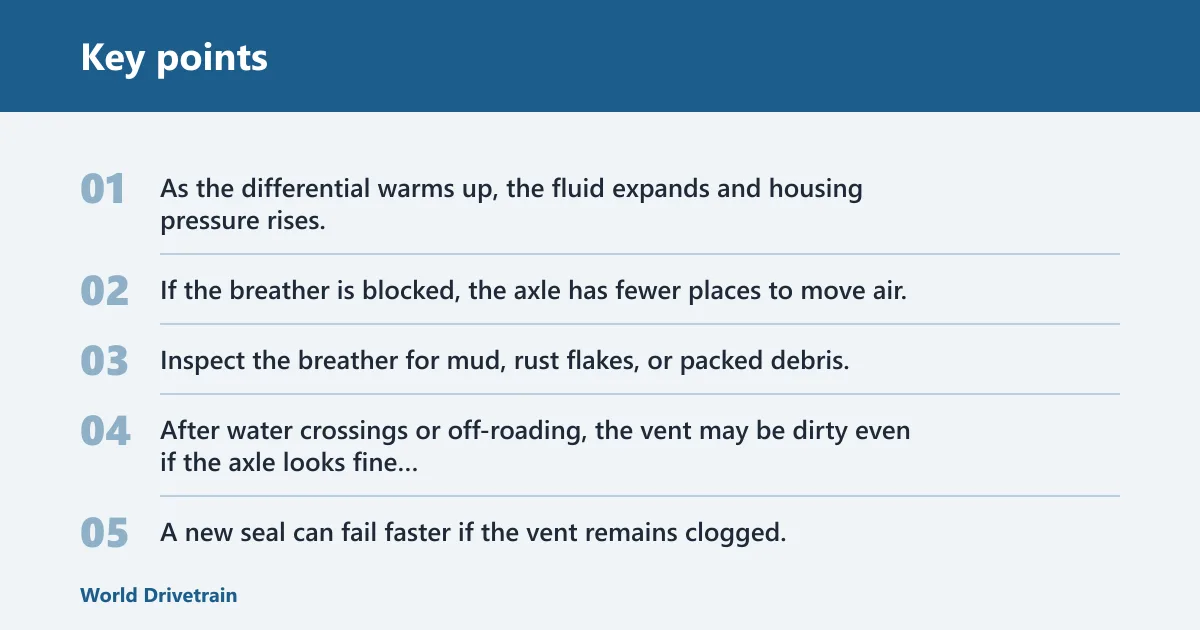
As the differential warms up, the fluid expands and housing pressure rises. The vent or breather relieves that pressure. If the breather is blocked, the axle has fewer places to move air, and the easiest path becomes the seal lip or another weak point in the housing.
What to look for at the vent
Inspect the breather for mud, rust flakes, or packed debris. After water crossings or off-roading, the vent may be dirty even if the axle looks fine from below. A new seal can fail faster if the vent remains clogged, because the pressure problem never went away.
Why this matters after washing or trail use
Post-off-road and post-wash checks matter because water, grit, and mud can settle into the vent area and stay there. That creates a repeat-leak pattern that looks like a bad seal but is really a pressure problem. Cleaning the vent is part of the diagnosis, not an afterthought.
What symptoms point to a bad bearing instead of just a seal?
Repeated leaks, wheel play, or noise may point toward bearing wear or axle-shaft movement rather than a seal-only failure. Bearing play can let the shaft move and wear the seal lip, so the leak returns even after a new seal goes in.
Wheel bearing play and seal lip wear
If the wheel or shaft has measurable movement, the seal lip can lose contact and start leaking again. That is why a recurring leak may need a bearing check, not just another seal. A seal repair on its own will not hold if the shaft keeps shifting.
Axle shaft movement or scoring
Inspect the axle shaft for scoring, grooves, or polished wear where the seal rides. Excess movement or wear can damage the seal lip and carry oil outward from the differential area. If the shaft surface is damaged, the new seal may fail early for the same reason.
Common repeat-leak pattern
Picture a front axle that gets a new seal, then starts weeping again after a short drive. If the vent is clear and the leak returns, bearing condition and shaft wear move to the top of the list. Replacing parts in the wrong order wastes time and does not fix the root cause.
Front axle leak diagnosis checklist
Use this checklist to map the symptom to the likely failure point before replacing parts. Clean the housing first, then inspect in order. The goal is to separate seal, vent, bearing, and shaft problems by where the residue starts and what it looks and smells like.
| Symptom location | Residue type and smell | Likely cause | Next inspection step |
|---|---|---|---|
| Inner C or axle tube near housing | Dark, damp film with sharp sulfur odor | Front axle inner seal | Inspect shaft seal surface; on many Dana front axles, remove the axle shafts to access the inner seals |
| Vent, breather, or top of housing | Wet dust, oily spray, pressure smell after drive | Axle vent / breather blockage | Clear mud, rust flakes, or packed debris; confirm the breather flows |
| Wheel well, lower ball joint area, or brake backing plate | Dark streaks or damp grime; odor holds after parking | Oil traveling outward from inner seal | Trace the path back along the axle tube and knuckle before replacing parts |
| Same corner returns after a new seal | Fresh seep, repeat odor, or recurring wet ring | Bearing play or axle shaft wear | Check wheel bearing looseness and inspect the shaft for scoring or movement |
| Boot area with thick fling pattern | Sticky grease, no sulfur odor | CV boot grease | Inspect boot tears, clamp condition, and joint contamination |
Inspection order that saves time
- Clean the axle tube, knuckle, wheel well, and brake backing plate.
- Check for fresh wetness after a short drive.
- Smell the residue for the sharp sulfur odor of gear oil.
- Inspect the vent for mud, rust flakes, and packed debris.
- Check bearing play and axle-shaft movement.
- Inspect the shaft surface where the seal lip rides.
- Only then decide whether the seal, vent, bearing, or shaft needs repair.
Is it safe to drive with a front axle seal leak?
It may be safe to drive a short distance for inspection, but a growing leak, noise, wobble, or strong odor means you should avoid long trips. Low fluid can damage the differential if ignored, and front axle fluid loss does not always trigger a dashboard warning.
When to inspect soon
If the leak is light, there is no noise, and the wheel does not wobble, schedule inspection soon and keep the trips short. Clean the area first so you can tell whether the leak is active. Do not assume a dry driveway means the problem fixed itself.
When to stop and avoid longer trips
If the leak seems heavy, the smell is strong, the brake area is wet, or there is bearing noise, the vehicle should probably not be treated as normal daily transport. A failing bearing or low differential level can turn a seal problem into a housing or gear failure quickly.
Why the differential matters
The differential housing is often sealed, and there may be no dashboard warning for low fluid. As fluid drops, lubrication and cooling can worsen. Pressure and heat changes can drive leaks, and that cycle gets worse the longer the axle runs low.
What should you inspect before replacing the seal again?
Before replacing the seal again, inspect the axle shaft, bearing condition, vent, and the seal ride surface. A seal-only repair can fail if the vent stays blocked, the bearing is loose, or the shaft is scored where the lip contacts it.
Axle shaft wear and seal lip damage
Look for grooves, rust, or a polished wear band on the shaft. That is where the seal lip rides. If the surface is damaged, oil can bypass the new seal even when the part is fresh. Shaft wear is one of the fastest ways to repeat the same leak.
Bearing condition and shaft play
Check whether the wheel bearing or shaft has side play or roughness. Bearing wear can move the shaft enough to wear the seal lip, which recreates the leak. If the leak keeps returning, the bearing deserves the same attention as the seal itself.
Vent condition after water crossings or off-roading
After mud, water crossings, or trail dust exposure, inspect the breather first. The vent can clog with debris that raises pressure in the housing. If that pressure remains, even a correctly installed seal can leak again because the force that pushed oil past the old seal is still there.
Why does oil appear near the wheel but the seal is inside the axle?
Oil appears near the wheel because the fluid can travel from the inner seal through the axle tube and then spread outward to the knuckle, brake backing plate, or wheel well. On many Dana front axles, the axle shafts must come out to access the inner seals, so the failure point is deeper than the visible stain.
How the path fools diagnosis
The visible spot often sits where airflow, gravity, and spinning parts deposit the fluid, not where the leak began. That is why the lower ball joint area or the axle tube near the inner C can look wet even when the leak starts inside the housing.
What a clean inspection should reveal
After cleaning, fresh oil should show the path. If the first new wetness appears near the vent, the breather deserves attention. If it starts at the inner C and follows the tube outward, the inner seal remains the stronger suspect.
What does gear oil smell like when it leaks at the axle?
Gear oil has a sharp sulfur odor that is often easiest to notice after driving and parking. A front axle differential fluid leak may announce itself through smell before a puddle appears, so odor at the wheel well or brake area is a real diagnostic clue.
How the smell helps
That odor is more specific than a general greasy smell. If the residue smells like sulfur and the film is dark and damp, axle oil is more likely than ordinary road grime. If there is no sulfur odor and the residue is thick and sticky, grease is more likely.
What parts should be checked after water crossings or off-roading?
After water crossings or off-roading, check the axle vent, the inner seal area, the axle tube near the inner C, the bearing, and the brake backing plate. Mud, rust flakes, and packed trail dust can block the vent, and that pressure can push oil past seals that were still usable before the trip.
Post-trail inspection order
Start at the vent, because a clogged breather can trigger the rest of the problem. Then inspect the knuckle and axle tube for fresh wetness, check the shaft for play, and look at the brake backing plate for odor or dampness. That order is more useful than starting at the dirtiest corner.
Frequently asked questions
What are the first signs of a front axle seal leak?
The first signs are usually a dark damp ring, a sulfur smell, or oily residue near the inner C, knuckle, or wheel well. A leak may appear far from the failed seal point, so the first visible spot is only a clue, not proof of the source.