Transmission Fluid Change vs Flush: Which Is Better?
A transmission fluid change is usually the better pick for routine maintenance and unknown service history; a flush fits best when the vehicle uses the correct fluid, the transmission is healthy, and the maker allows flushing. Done wrong, either service can worsen shift problems, clog a worn unit, or waste money. This guide compares change vs flush by service history, fluid condition, mileage, and symptoms.
| Factor | Transmission fluid change | flush | Winner |
|---|---|---|---|
| Fluid replacement depth | Usually replaces part of the fluid through drain-and-fill service | Replaces a larger share of the fluid with exchange equipment | flush |
| Equipment and service method | Often simple drain service; some vehicles also need pan removal | Machine-assisted exchange tied into cooler lines or service ports | Transmission fluid change |
| Risk on older or neglected units | Usually lower, because it is less aggressive | Can be riskier if sediment, wear, or wrong fluid is present | Transmission fluid change |
| Best fit | Routine maintenance, unknown history, cautious reset of fluid age | Well-maintained units that already follow the OEM schedule | Transmission fluid change |
| Cost pressure | Often lower labor and fewer add-ons | Often higher because of machine use and greater fluid volume | Transmission fluid change |
What a drain-fill and flush actually replace
Drain-and-fill versus machine exchange
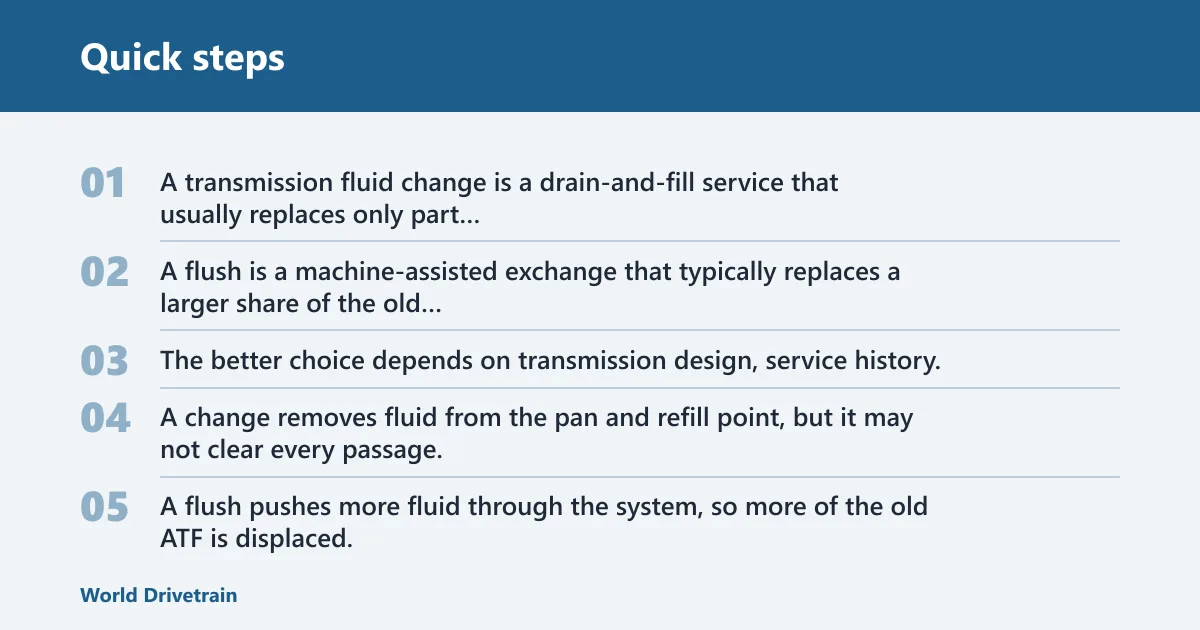
A transmission fluid change is a drain-and-fill service that usually replaces only part of the automatic transmission fluid. A flush is a machine-assisted exchange that typically replaces a larger share of the old fluid with new fluid. The better choice depends on transmission design, service history, and whether the unit can handle a deeper service.
What each service actually replaces
A change removes fluid from the pan and refill point, but it may not clear every passage, cooler line, or torque converter pocket. A flush pushes more fluid through the system, so more of the old ATF is displaced. That deeper exchange can help on a well-kept unit, but it is not automatically the safer option.
Side-by-side comparison
Automatic transmission fluid does two jobs at once: it carries hydraulic pressure and it lubricates internal parts. Because of that, service choice is not only about freshness. It is also about whether the transmission has wear, sediment, or a history that makes a deeper exchange a poor bet.
What the pan and filter change
The transmission pan holds the fluid reservoir and often collects sediment at the bottom. On some vehicles, a fluid change includes pan removal, gasket replacement, and filter replacement. The transmission filter catches debris, but its service interval depends on the transmission design. Some units use a serviceable filter; others do not.
When does the OEM schedule decide it?
The owner’s manual and OEM service schedule should be the first reference point. If the maker calls for fluid service at a specific interval, follow that before a shop’s preferred upsell. Normal use and severe use are not the same, and the severe-use interval is commonly shorter.
Normal use versus severe use
Normal use covers typical commuting and steady highway driving. Severe use usually means repeated towing, heavy loads, stop-and-go traffic, hot climates, or short trips that never fully warm the fluid. Those conditions age transmission fluid faster, so the schedule often moves up.
Why the schedule outranks shop preference
Some automatic transmissions are more sensitive than others. A maker that specifies a certain ATF type, service interval, or no-machine-exchange policy has already set the baseline. If the owner’s manual says drain-and-fill, that is the lower-risk path. If it allows a flush, that does not mean a flush is required.
Transmission fluid decision matrix
Use condition and history first. Mileage matters, but it does not decide the service by itself. A high-mileage transmission with documented fluid changes can sometimes be a better flush candidate than a lower-mileage unit with unknown history and dark fluid.
| Scenario | Recommended service choice | Risk level | What to inspect first |
|---|---|---|---|
| New vehicle under warranty | Transmission fluid change if the OEM schedule calls for it | Low | Owner’s manual interval and exact ATF spec |
| Regularly serviced vehicle | flush if the maker permits it; otherwise Transmission fluid change | Low to moderate | Service records, fluid spec, and transmission design |
| Unknown history vehicle | Transmission fluid change | Moderate | Fluid color, smell, pan debris, and scan for codes |
| High-mileage but shifting normally | Transmission fluid change | Moderate | Fluid condition, leaks, and whether the filter is serviceable |
| High-mileage with harsh shifting | Inspection first; service choice after diagnosis | High | Scan data, line pressure issues, pan debris, and fluid level |
| Visibly contaminated fluid | Inspection first; often Transmission fluid change, not flush, unless maker guidance supports otherwise | High | Burnt smell, metallic debris, clutch material, and filter condition |
New vehicle under warranty
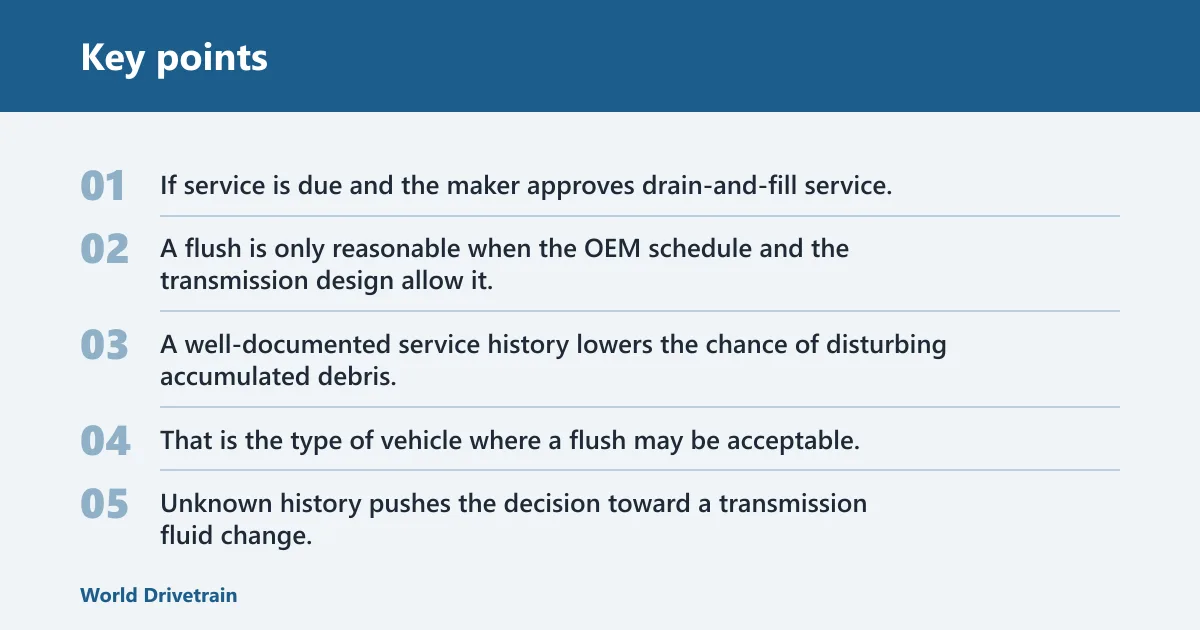
Follow the owner’s manual first. If service is due and the maker approves drain-and-fill service, that is usually the cleanest choice. A flush is only reasonable when the OEM schedule and the transmission design allow it.
Regularly serviced vehicle
A well-documented service history lowers the chance of disturbing accumulated debris. That is the type of vehicle where a flush may be acceptable, especially if the maker lists exchange service or the shop can match the exact ATF requirement.
Unknown history vehicle
Unknown history pushes the decision toward a transmission fluid change. A full exchange can move debris through a worn unit, and no one can assume the filter, seals, or clutch packs are in good shape. Start with inspection, not the machine.
High-mileage but shifting normally
High mileage alone does not ban service. If the transmission shifts normally and the fluid is not burnt or full of debris, a conservative drain-and-fill is usually the lower-risk move. This is where a partial refresh often makes more sense than a deeper exchange.
High-mileage with harsh shifting
Harsh shifts, delay on engagement, flare, or slipping are not proof that fluid service will fix the problem. They may point to worn clutches, a valve-body issue, low line pressure, or bad solenoids. In that case, diagnosis should come before any service choice.
Visibly contaminated fluid
Dark, burnt-smelling fluid or metal flakes on the dipstick or in the pan is a warning and can call for more caution before a flush. The transmission may already have internal wear. A pan inspection and filter check are safer first steps than forcing a machine exchange through a damaged unit.
Which service is safer for high-mileage units?
A transmission fluid change is usually safer for high-mileage units, especially when service history is unclear. That does not mean a flush is wrong in every older vehicle. It means the risk of moving sediment, exposing wear, or disturbing a marginal unit is higher when the transmission is already tired.
Wear, sludge, and sediment risk
High-mileage transmissions often carry more clutch material in the pan and more varnish on internal parts. A flush can move that material through passages that were not meant to see a sudden high-volume exchange. A drain-and-fill is less aggressive and gives the owner a smaller step toward fresher fluid.
Why history changes the decision
Documentation matters because it shows whether the fluid has been renewed on time. A unit with repeated OEM-specified service is a different case from one that has gone years without attention. The second case deserves more caution, not a deeper service by default.
When inspection comes first
If shifting has changed, the right move is diagnosis before service. Check fluid level, scan for codes, inspect the pan, and confirm the exact ATF spec. If the fluid is burnt or the pan shows heavy debris, service alone may not solve the problem.
What should you inspect before service?
Before deciding between a change and a flush, inspect the fluid, the pan, the filter plan, and the symptom pattern. That tells you whether the transmission looks serviceable or already compromised. A quick visual check is better than guessing from mileage alone.
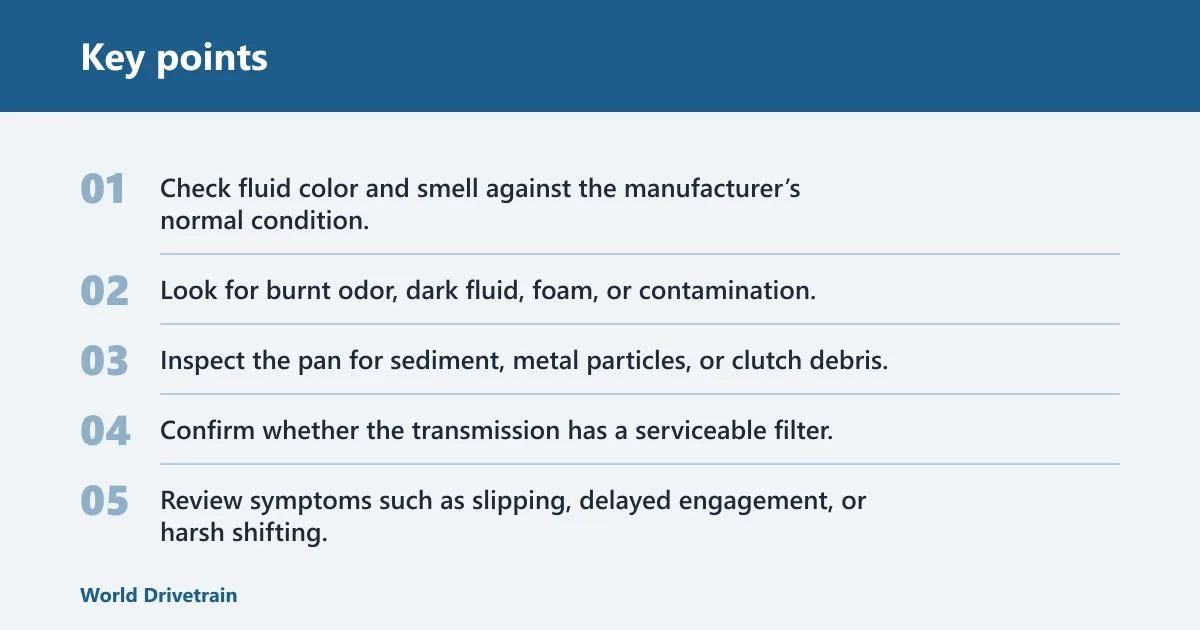
- Check fluid color and smell against the manufacturer’s normal condition.
- Look for burnt odor, dark fluid, foam, or contamination.
- Inspect the pan for sediment, metal particles, or clutch debris.
- Confirm whether the transmission has a serviceable filter.
- Review symptoms such as slipping, delayed engagement, or harsh shifting.
- Match the fluid to the OEM ATF specification before any refill.
Fluid color and smell
Fresh ATF is usually red or amber, depending on the formulation. Brown or black fluid, especially with a burnt smell, points to heat and wear. That does not automatically mean a flush is wrong, but it does mean the transmission needs a closer look.
Pan debris and sediment
The transmission pan is often the best clue to internal condition. A light coating of paste-like sediment can be normal wear. Heavy metal chips, clutch material, or sludge argue for inspection and filter service before any exchange.
Filter condition and service fit
If the filter is serviceable, replacing it during pan removal can improve the value of a drain-and-fill. If the design uses a sealed internal filter or a long-life unit, a flush will not replace that part. That is one reason “service included” varies so much from one vehicle to another.
Signs of slipping or delayed shifts
Slipping, shudder, delayed engagement, and flare between gears are symptoms, not diagnoses. They can come from fluid condition, but they can also come from worn clutches or control faults. Treat those signs as a reason to inspect first, not as a reason to pick flush by default.
Choose Transmission fluid change if… / Choose flush if…
Choose Transmission fluid change if the goal is routine maintenance, the service history is unknown, the transmission is high-mileage but still shifts normally, or the pan and fluid show only light wear. Choose flush if the OEM schedule allows it, the unit has documented service, the fluid spec is correct, and the transmission can handle a deeper exchange.
Choose Transmission fluid change if…
Choose a change if the owner’s manual calls for drain-and-fill, if the transmission has no clear service record, or if you want the lower-risk first step on an older unit. Choose it again if the pan likely needs inspection or the filter is due.
Choose flush if…
Choose a flush only when the maker permits it, the fluid is the correct ATF, and the transmission has a clean history with no warning signs. It is a better fit for supported, well-maintained systems than for neglected ones.
How much does each service cost?
Transmission fluid change vs flush cost depends on labor, fluid quantity, filter work, pan removal, and whether a machine exchange fee is added. A change usually costs less because it uses less fluid and less equipment. A flush often costs more because it replaces a larger share of the fluid and may require dedicated service equipment.
Fluid quantity and labor
A drain-and-fill uses less ATF and usually less shop time. A flush uses more fluid because more of the old fluid is displaced. The labor difference can be small or large depending on the transmission layout and access.
Pan removal and filter replacement
If service includes pan removal, gasket replacement, and a new filter, the price goes up. That extra work can be worthwhile when the pan needs cleaning, but it is not part of every fluid change. Ask exactly what is included before approving service.
Machine service fees and add-ons
A flush may carry a machine-use fee, plus extra fluid, plus disposal and shop supplies. Some shops also add a diagnostic check or fluid-condition inspection. Those charges are not automatically bad, but they should be explained up front.
Frequently asked questions
Transmission fluid change vs flush which is better
For most routine maintenance, a transmission fluid change is the better first choice because it is less aggressive and fits more vehicles with uncertain history. A flush is better only when the OEM schedule allows it, the transmission is healthy, and the fluid spec matches exactly. Condition decides the answer.
Is transmission fluid change or flush better?
Neither is universally better. A change is usually safer for older, unknown, or high-mileage units with no clear record. A flush can be appropriate on a well-maintained transmission that the maker approves for machine exchange service.
Transmission fluid change vs flush cost
A transmission fluid change usually costs less because it uses fewer quarts, less labor, and less equipment. A flush usually costs more because it replaces more fluid and may involve a machine fee. Pan removal, filter replacement, and diagnostic checks can raise either price.
What is the difference between flushing and changing transmission fluid?
A change, usually a drain-and-fill, replaces part of the fluid and may include pan removal and filter work. A flush uses exchange equipment to replace a larger share of the fluid through the transmission system. The deeper service is not automatically the better one.
Should I do a drain and fill instead of a flush?
Yes, if your history is unknown, your transmission is high-mileage, or you are following a conservative maintenance plan. A drain-and-fill is often the lower-risk move when you want to refresh fluid without forcing a full exchange through a worn or questionable unit.
Can a transmission flush damage an older transmission?
It can, if the transmission already has wear, heavy sediment, or the wrong fluid has been used before. A flush may move debris through passages and disturb a marginal unit. That is why inspection and OEM guidance should come before any exchange service.