Average Cost of Transmission Repair or Replacement
Transmission repair is commonly reported at about $300 to $1,500, while a rebuild or replacement often runs about $2,500 to $6,000 or more, and replacement can make more sense when the case, gears, or other hard parts are damaged. Skip diagnosis, and you can pay thousands for a repair that fails again. This guide explains repair, rebuild, remanufactured, and used transmission pricing and shows what every quote should include before you approve the work.
Is transmission repair expensive?
It can be, but not every transmission complaint means a full transmission bill. Fluid service, a solenoid issue, a sensor fault, seal leaks, or a TCM problem may stay in the low hundreds to low thousands. Once the case is damaged or teardown finds worn hard parts, the price usually jumps into rebuild or replacement territory.
What the low end usually covers
Low-end repair quotes often cover fluid service, external seals, a solenoid pack, a sensor, or a control-module fault. Fluid service can cost $210 to $690, solenoid pack repair is listed at $520 to $1,240, and TCM replacement is listed at $900 to $1,250. Those are repair-range jobs, not automatic replacement bids.
Why the bill jumps fast
Labor and diagnosis time drive much of the cost. Transmission work often requires scan-data review, pan removal, fluid inspection, teardown, reassembly, coding, and a road test. A quote can start as a repair estimate and turn into a rebuild estimate after the pan is opened and internal wear becomes visible.
When a repair quote is only a first pass
If the shop has not torn the unit down, the number is often a diagnosis-based estimate, not the final bill. A slipping automatic transmission may need only a valve body or torque converter, or it may reveal burnt clutches and metal in the pan. The difference can be thousands.
What is included in a transmission repair estimate?
A good estimate separates diagnosis from repair. It should show the scan results, fluid condition, likely fault area, labor for removal or access, any reprogramming or relearn work, and whether the quoted price includes road testing. If teardown is possible, the shop should say whether that step is billed separately.
Diagnosis fees, scan data, and fluid inspection
Diagnosis is not the same as repair. A technician may read transmission codes, check live data, inspect the fluid for odor or debris, and verify whether a problem is really inside the gearbox or coming from battery voltage, wiring, or the engine. A bad battery terminal can mimic a shift failure.
Parts that often stay in repair territory
Common repair items include solenoids, sensors, valve bodies, torque converters, seals, and fluid service. Those faults can create slipping, harsh shifts, delayed engagement, or limp mode without meaning the whole transmission is finished. The quote should name the part, not just say “internal failure.”
Labor, reprogramming, and road test charges
Electronic transmissions often need coding, adaptation, or a validation drive after parts are installed. That matters with TCMs, valve bodies, and some CVT repairs. Ask whether the labor figure includes relearn procedures, because a cheap parts number with extra labor can cost more than a complete installed quote elsewhere.
Transmission repair decision table
| Failure scenario | Likely cost band | Likely repair path | Question to ask before approval |
|---|---|---|---|
| Fluid service | $210 to $690 | Service, inspection, possible filter or pan work | Is this service correcting contamination, or is it only maintenance after a separate fault check? |
| Solenoid or valve body | $520 to $1,240 | Repair or replacement of the control assembly | Do the codes and live data point to the valve body, or could wiring or the TCM be the real cause? |
| TCM fault | $900 to $1,250 | Module replacement, coding, and validation | Has the module been tested, and will programming or relearn time be included in the quote? |
| Torque converter complaint | Low thousands | Transmission removal, converter replacement, fluid inspection | Is the converter the only failed part, or did debris spread through the unit? |
| Internal wear | $2,900 to $5,200 | Rebuild with teardown, worn parts replacement, reassembly | Which hard parts are worn, and what warranty applies after rebuild? |
| CVT failure | $3,000 to $8,000 | Replacement is common; rebuild is limited | Does this CVT have a repair path, or does the design and calibration requirement point to replacement? |
Is it cheaper to rebuild or replace a transmission?
Rebuilding is often cheaper on the invoice than a full replacement, but not always cheaper in the final total. A rebuild listed at about $2,900 to $5,200 can cost less than a full replacement listed at about $5,300 to $7,600, though labor time, reassembly, and warranty coverage can narrow the gap. Used units may look cheaper up front and cost more later.
Rebuild vs remanufactured unit
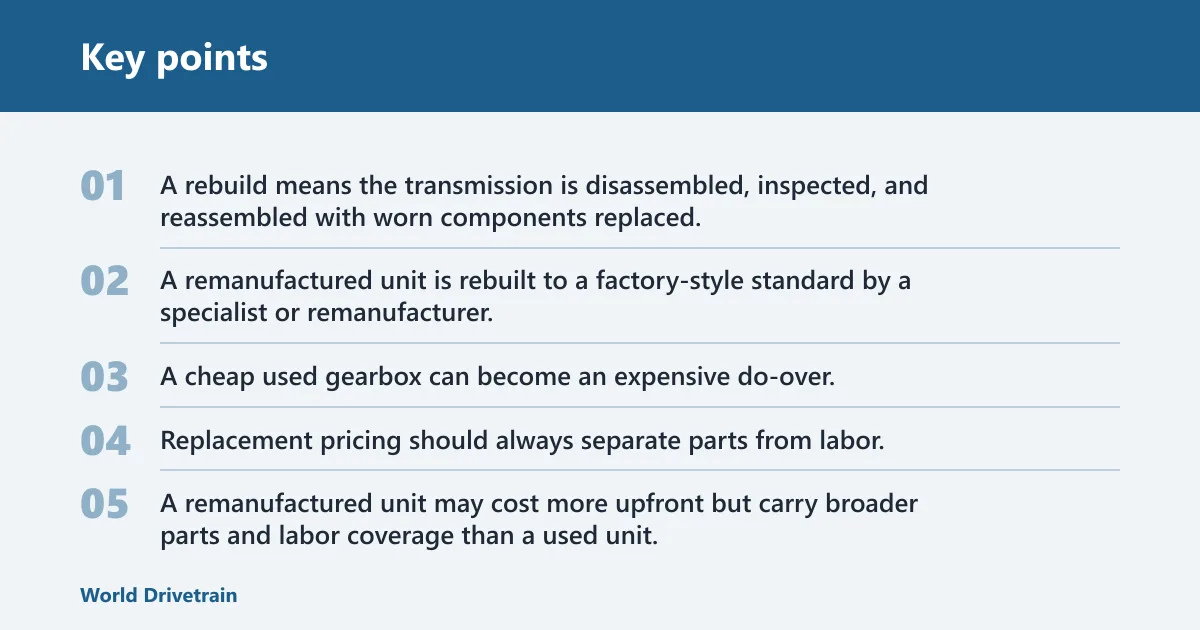
A rebuild means the transmission is disassembled, inspected, and reassembled with worn components replaced. A remanufactured unit is rebuilt to a factory-style standard by a specialist or remanufacturer. CostHelper says rebuilt or remanufactured transmissions typically cost $1,000 to $6,000 or more, depending on vehicle and scope.
Used units and why the sticker price can mislead
Used transmissions often have a lower parts-only price, but the installed total can rise once labor, fluid, seals, and programming are added. The risk is higher because the unit’s wear history is unknown, and warranty coverage is usually weaker than on a remanufactured unit. A cheap used gearbox can become an expensive do-over.
How labor and warranty change the real total
Replacement pricing should always separate parts from labor. A remanufactured unit may cost more upfront but carry broader parts and labor coverage than a used unit. That matters when the same model can need many hours of removal and installation, plus coding or relearn time after the swap.
How much do transmissions cost to replace?
Full replacement often lands between $5,300 and $7,600, but the installed price can move a lot by vehicle, region, and transmission type. The same source reports passenger-car transmission replacement averaging $2,324, pickup-truck replacement averaging $2,792, and SUV or minivan replacement averaging $3,090. Those averages are not the same as a quoted installed total.
Installed price vs parts-only price
Parts-only numbers can be misleading because the transmission itself is only one piece of the job. Removal, installation, fluids, seals, programming, and a road test all add labor. Ask the shop whether the quote includes the converter, fluid, and any programming needed for the replacement unit.
Dealer, independent, and remanufactured quote differences
Dealer quotes often use new or factory remanufactured units and may include model-specific programming. Independent shops may quote rebuilt or used units more often, which changes warranty and risk. Those quotes are not directly comparable unless the labor, unit source, converter, and programming scope are identical.
Why the same model can price very differently
Vehicle layout, drivetrain packaging, electronics, and parts availability all affect labor time. A transmission that is easy to remove in one chassis may take much longer in another. The same model year can also have different units by engine or drive configuration, so the exact VIN matters.
Why transmission repair so expensive?
Transmission repair is expensive because diagnosis takes time, parts can be specialized, and labor is heavy. Electronic-hydraulic controls add scan work and programming, while internal repairs require removal and teardown. On some vehicles, a minor symptom can require many hours before the actual failed component is identified.
Automatic transmission
Automatic transmissions have broader market coverage, but their electronic-hydraulic control systems add complexity. A fault in the valve body, solenoid pack, torque converter, or control module can mimic internal damage. That is why an automatic quote often changes after scan data and fluid inspection.
Manual transmission
Manual transmissions are generally the lower-cost baseline because their design is mechanically simpler. Even so, clutch-related repairs, bearings, seals, and synchronizers can still add up. A manual that will not move is not always a complete gearbox failure, especially if the clutch or hydraulics are the issue.
CVT and dual-clutch transmission
CVTs are usually more expensive and specialized. CVT replacement is listed at $3,000 to $8,000, CVT fluid maintenance is shown at $150 to $300, and CVTs are rarely rebuilt because they require specialized tooling and factory calibration. DCTs also need specialized diagnosis and labor, especially when mechatronic components fail.
Say your compact SUV has a shudder in third gear and the fluid looks clean, but the scan shows a TCM code and low battery voltage. That points first to electrical diagnosis, not a full transmission replacement. The wrong approval there could turn a modest fix into a major bill.
When repair becomes replacement
Repair becomes replacement when internal damage is broad enough that fixing one part will not restore reliability. High mileage alone does not force replacement, but burnt fluid, metal in the pan, broken hard parts, repeated failures, or a cracked case usually move the job past simple repair. In that stage, a rebuild or replacement is the safer call.
Mileage, symptom severity, and fluid condition
A single slip or shift flare does not equal a dead transmission. A unit with clean fluid, normal scan data, and one external fault may still be a repair. Burnt-smelling fluid, heavy debris, and long-term slipping point toward internal wear and a much larger repair scope.
When a TCM or electrical fault points away from the gearbox
A transmission code can come from the module, wiring, battery voltage, or engine data. That is why no-move, harsh-shift, or limp-mode complaints should not be treated as proof of mechanical failure. If the scan data shows a control problem, the shop should prove the gearbox itself is faulty before quoting a rebuild.
-
Request the diagnosis first.
Ask for the codes, fluid condition, and the likely fault area before approving any major work. If the shop cannot separate diagnosis from repair, the quote is too vague to compare.
-
Check the repair scope.
Confirm whether the estimate includes a solenoid, valve body, TCM, converter, seals, or fluid service. A parts list without labor, programming, and fluid can hide the true total.
-
Compare installed totals.
Line up installed prices, not just parts prices. A used unit with cheap parts can cost more than a remanufactured unit once labor and warranty risk are added.
-
Ask about coverage.
Get the warranty term, what parts it covers, and whether labor is included. Remanufactured units usually have stronger coverage than used units, while used units often carry the shortest protection.
Suppose a midsize sedan needs a torque converter and the shop also finds burnt fluid and metal. At that point, the quote should move from a single-part repair to a rebuild or replacement discussion, because the debris can contaminate the rest of the unit. One failed part can change the whole job.
Frequently asked questions
How much does a rebuild transmission cost?
A transmission rebuild is listed at $2,900 to $5,200. CostHelper also says rebuilt or remanufactured transmissions typically run $1,000 to $6,000 or more. The total depends on how much internal damage exists, how many hard parts need replacement, and whether the shop includes removal, installation, and programming.
Why is transmission repair so expensive?
Transmission repair is expensive because diagnosis is time-consuming and labor-heavy, and many failures sit inside sealed assemblies. Electronic controls, scan data, programming, and road testing add cost. If teardown reveals internal wear, the job can shift from a repair to a rebuild or replacement very quickly.
Is it worth replacing a transmission?
It is often worth replacing when the vehicle has enough remaining value and the transmission damage is broad, repeated, or structural. If the case, gears, or hard parts are compromised, a replacement can be the more sensible long-term choice. If the issue is a module or valve body, repair may still be the better path.