Is Clutch Replacement Worth It on an Older Car?
Clutch replacement is often worth considering on an older manual car when the repair cost stays well below the car’s post-repair value plus about a year of ownership; a common rule of thumb is to green-light it under about 30% to 40% of that total. Skip that math, and you can pour money into a car that still needs tires, brakes, or a transmission next. This guide shows how to compare the quote, the car’s value after repair, and the next 12 months of likely costs.
Should you replace the clutch or the car?
A high repair bill does not mean the car belongs in the scrapyard. Start with the car’s current private-sale or trade-in value, then compare the clutch quote against that number and against the next 12 months of ownership. A commonly used screening point is the 50% rule, but condition matters more than age alone.
Use current value, not purchase price
The comparison only works if you use what the car is worth today. Original purchase price is a sunk cost and says little about whether a clutch repair makes sense now. Base the decision on current market value after accounting for mileage, service history, rust, known faults, and the way the car actually drives.
Say your car is worth $4,000 in private-sale condition and the clutch quote is $1,200. That is 30% of value, which often sits in a repair zone if the rest of the car is sound. The same $1,200 job on a $1,800 car is a very different decision.
Why the 50% rule is only a screen
A commonly used guideline is the 50% rule for repair cost versus vehicle value. It is a screen, not a verdict. A repair at 25% of value can still be a poor call if the car has serious rust, weak brakes, or several overdue jobs. A repair above 50% can still make sense on a rare, safe, low-mileage car with a clean history.
One example shows a $2,000 repair on an $8,000 car equals 25%. Another example shows a $2,000 repair on a $3,000 car is about 67%. Those two numbers land in very different places because the baseline is different.
When repair still makes sense
Repair still makes sense when the clutch job restores dependable transport and the car is otherwise solid. That usually means no major rust, no safety defects, no long list of overdue maintenance, and no signs that the transmission or flywheel needs major extra work. The car should still have real use left after the job.
How do you compare a clutch repair quote to value?
Break the quote into labour, parts, hydraulics, any flywheel charge, and the diagnostic fee before you compare it to vehicle value. Then add the likely cost of owning the car for the next 12 months. A clutch bill that looks manageable on its own can become hard to justify once the rest of the year is priced in.
Separate the quote into its parts
A proper quote should show more than a single total. Ask what is included for labour, clutch kit parts, hydraulic components such as the master cylinder or slave cylinder, flywheel replacement if needed, and diagnosis. Labour times and prices vary by vehicle, and Bosch notes clutch replacement is often completed within 4 to 8 hours.
-
Ask for a line-item quote.
Request the labour hours, parts list, hydraulic components, flywheel price if needed, and any diagnostic fee. This tells you whether the quote is for a clutch-only job or a wider repair. -
Check what is still uncertain.
Ask whether the shop has confirmed the clutch is the fault or is only responding to symptoms. A symptom alone does not confirm which part should be replaced. -
Compare the total to value.
Divide the repair total by the car’s current value to get the repair-to-value ratio. Use that ratio as one filter, then add the next 12 months of ownership costs.
Calculate the repair-to-value ratio
The repair-to-value ratio is repair cost divided by vehicle value. If the repair-to-value ratio is near or above about 50%, the job deserves closer scrutiny. A ratio near 25% often points to repair if the car is otherwise in good shape, while a ratio around 67% needs strong reasons to proceed.
Suppose the car is worth $6,000 and the clutch quote is $1,500. The ratio is 25%. If the quote rises to $3,000 because the flywheel and hydraulics are also needed, the ratio jumps to 50%, and the decision becomes much tighter.
Add the next 12 months of ownership costs
Do not compare the clutch bill with only the sticker price of another car. Compare it with the full cost of replacing the car for the next 12 to 24 months. That includes monthly payment if you finance, sales tax, registration, insurance, maintenance, and depreciation. A cheaper car can still cost more over the year if it needs immediate work of its own.
| Cost item | Repairing the older car | Replacing the older car |
|---|---|---|
| Up-front repair or down payment | Clutch bill, diagnostic fee, possible flywheel or hydraulic parts | Down payment or purchase price |
| Monthly cost | Usually lower if the car is already owned outright | Loan payment if financed |
| Taxes and registration | Usually lower in the short term | Sales tax and registration can be significant |
| Insurance | Often unchanged or lower for an older car | May rise with a newer or financed vehicle |
| Maintenance and depreciation | May stay manageable if the car is otherwise sound | Newer car depreciation can be a major cost |
What should a clutch diagnostic check confirm?
A diagnostic inspection should confirm the clutch is actually the fault before you spend money. It should sort out slipping clutch symptoms from hydraulic failure, check whether the flywheel is part of the job, and look for signs of gearbox-adjacent trouble. If the diagnosis is incomplete, the quote can grow after teardown.
Slipping clutch versus hydraulic fault
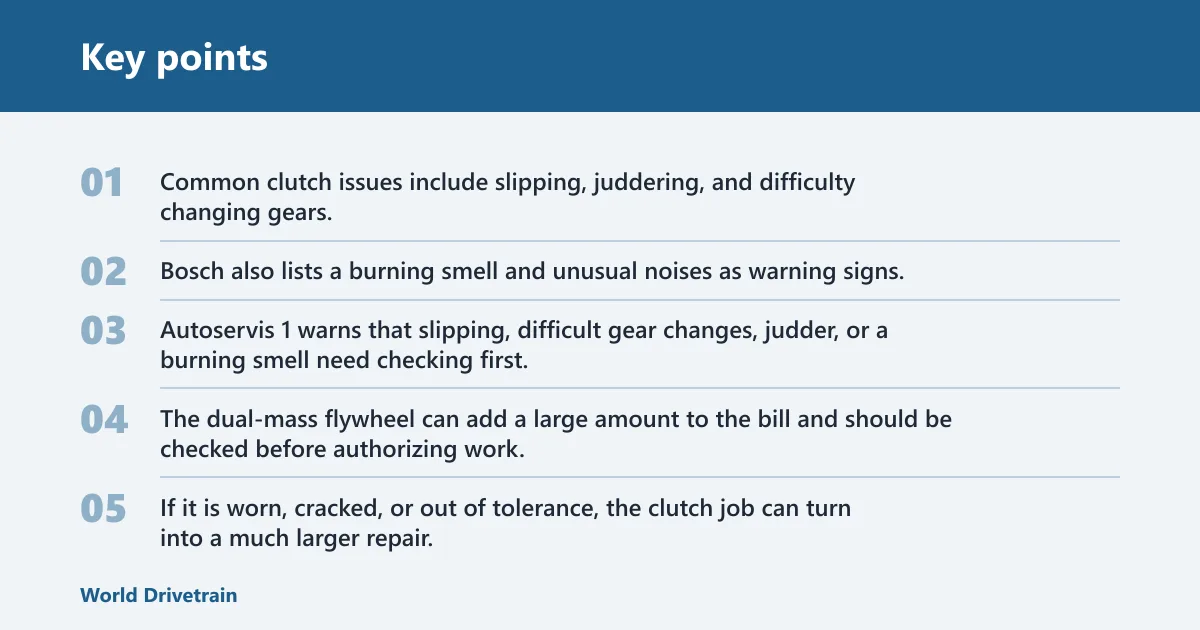
Common clutch issues include slipping, juddering, and difficulty changing gears. Bosch also lists a burning smell and unusual noises as warning signs. Those symptoms can point to clutch wear, but they can also come from the hydraulic system, including the master cylinder and slave cylinder, which can change how the pedal feels and how the clutch disengages.
Autoservis 1 warns that slipping, difficult gear changes, judder, or a burning smell need checking first. It also notes that a symptom alone does not confirm which part should be replaced. That matters because replacing the whole clutch assembly will not fix a failed hydraulic component.
When the flywheel changes the job
The dual-mass flywheel can add a large amount to the bill and should be checked before authorizing work. If it is worn, cracked, or out of tolerance, the clutch job can turn into a much larger repair. Bosch says many clutches last around 60,000 to 100,000 miles on average, but wear patterns vary with use, so the flywheel condition must be judged on the car in front of you.
Signs the transmission may need more attention
If the gearbox grinds, jumps out of gear, or the car shows signs beyond clutch slip, the scope may extend beyond the clutch assembly. That does not automatically mean the car is done. It does mean you should pause, get the fault confirmed, and avoid approving a clutch-only repair for a deeper drivetrain issue.
Clutch replacement decision table
This table turns the repair-to-value ratio into a practical screen. Use the ratio first, then adjust for rust, safety condition, and pending maintenance. The same percentage can land in different buckets depending on what the car still needs.
| Repair-to-value ratio | Safety condition | Rust | Pending maintenance | Recommended action | Worked example |
|---|---|---|---|---|---|
| 25% | Solid brakes, steering, tires, and lights | No structural rust | Minor items only | Repair | A $1,000 clutch quote on a $4,000 car is 25%. If the car is mechanically sound, the repair often makes sense. |
| 50% | Acceptable but not perfect | Some surface rust, no major structural concern | One or two jobs due soon | Repair with caution | A $2,000 quote on a $4,000 car is 50%. Proceed only if the car has a good safety record and no big near-term repairs. |
| 75% | Mixed or weak | Rust affecting structure or mounts | Several overdue repairs | Replace | A $2,250 quote on a $3,000 car is 75%. If the car also needs tires, suspension work, and brakes, replacement is usually the better call. |
A common first-timer mistake is treating the ratio as the whole decision. Picture a $3,500 car with a $1,700 clutch quote. That is about 49%, which looks borderline, but the car also needs tires and a rear brake job within months. The ratio alone would miss that extra cost.
What else can turn a repair into a replace decision?
Rust, safety condition, reliability history, downtime risk, and other overdue repairs can flip the answer even when the clutch quote seems fair. A car with a decent ratio can still be a bad buy if it is already stacking up faults. The same is true if the car cannot stay available while you wait for parts or shop time.
Rust and safety condition
Body rust is one thing. Structural rust is another. If the car has corrosion around subframes, suspension pickup points, brake lines, or mounts, the clutch bill should not distract from a larger safety problem. A clutch repair cannot fix a car that is no longer structurally sound.
Other pending maintenance
Look at what else is due in the next 12 months. Tires, brakes, suspension joints, timing belt service, cooling system work, and exhaust repairs all matter. If several of those are overdue, the repair-to-value ratio should be judged more harshly because the clutch bill is only one piece of a larger spending wave.
Downtime and reliability history
If the car has a long record of repeat failures, then another major repair can be a warning sign rather than a fresh start. A clutch job should buy dependable transport. If it likely buys only a short stay before the next breakdown, replacement starts to look stronger even when the quote is not extreme.
When is a clutch repair still the better call?
Clutch repair is still the better call when the ratio is low, the car is otherwise sound, and the job restores low-cost transport for months or years. It is also easier to justify when the vehicle has a known maintenance history, no major rust, and no sign that the flywheel or hydraulics will multiply the bill.
Low repair-to-value ratio
If the repair sits well below 50% of value and the rest of the car is in good shape, repair is usually the practical move. That is especially true when the diagnosis is clean and the quote already covers the likely parts, labour, and hydraulics.
Car is otherwise sound
An older car with a good body, healthy brakes, predictable maintenance, and no major drivetrain warning signs can still be worth fixing. Age alone should not decide the answer. Condition and the next 12 months of costs matter more.
Repair buys low-cost transport
If fixing the clutch keeps the car on the road at a lower monthly cost than replacing it, the repair can be the smarter financial choice. That is most convincing when the car is already paid for and the alternative would mean a loan payment, taxes, registration, insurance changes, and new depreciation.
Frequently asked questions
Is it worth replacing the clutch on an older car?
It is worth replacing the clutch when the quote is modest relative to the car’s current value, the diagnosis is solid, and the car has little else wrong with it. A common screening point is the 50% rule, but a cleaner answer comes from the next 12 months of ownership costs and the car’s condition.
How do I compare a clutch repair quote to my car’s value?
Use the car’s present private-sale or trade-in value, not what you paid for it. Then divide the repair total by that value. Include labour, parts, hydraulics, any flywheel charge, and diagnosis. If the ratio is near 50%, add the next year of ownership costs before deciding.
What percentage of car value is too much for a clutch repair?
There is no universal cutoff, but around 50% is commonly used as a screening point. A repair near 25% often looks reasonable if the car is otherwise sound. A repair around 67% usually needs a strong case, especially if rust, safety issues, or other overdue maintenance are also waiting.
Should I replace the car instead of paying for a clutch job?
Replace the car when the clutch quote is high relative to value, the car needs several other repairs soon, or structural rust and safety issues are present. Also compare the repair with the real cost of replacing the car, including financing, tax, registration, insurance, maintenance, and depreciation for about 12 to 24 months.
What else should I check before authorizing clutch replacement?
Ask for a diagnostic inspection that confirms the clutch is the fault and not a hydraulic issue or related drivetrain problem. Check whether the flywheel needs replacement, and review rust, safety condition, and other pending repairs. A symptom alone does not prove that the clutch assembly is the only bad part.
Does a slipping clutch always mean the whole clutch needs replacing?
No. Slipping is a common clutch symptom, but it does not always mean the whole assembly is the problem. Hydraulics, release components, or the flywheel can contribute to the symptom. That is why the fault should be confirmed before you approve a full clutch job.
How much does the flywheel add to a clutch replacement?
The flywheel can add a significant amount to the bill, especially on cars with a dual-mass flywheel. The exact increase depends on the vehicle and parts prices, so ask for it as a separate line item before authorizing work. If the flywheel is worn, the final total can change fast.
Can I keep driving if the clutch is badly worn?
Driving on a badly worn clutch is risky because the car may slip more, shift poorly, or fail to move at all. The same source lists slipping, juddering, and difficulty changing gears as common issues, and also notes burning smell and unusual noises as warning signs. If those symptoms are severe, get it inspected promptly.