Why Is Transmission Fluid Leaking From the Bellhousing?
A transmission fluid leak from the bellhousing usually starts at the front seal area: an automatic transmission’s torque-converter front pump seal or seal surface, or a manual transmission’s input shaft seal, clutch hydraulic slave, or rear main engine seal. Ignore it and you can lose fluid, contaminate the clutch, and damage the transmission or engine. This guide shows how to trace the leak path, separate transmission, engine, and hydraulic sources, and decide what repair each failure point usually means.
Bellhousing leak basics
The bellhousing sits between the engine and transmission, so fluid found there can come from more than one source. It is a leak location indicator, not proof of the failed part. Fluid can exit from the lower opening, the inspection cover, or the dust shield and then drip from the bottom edge.
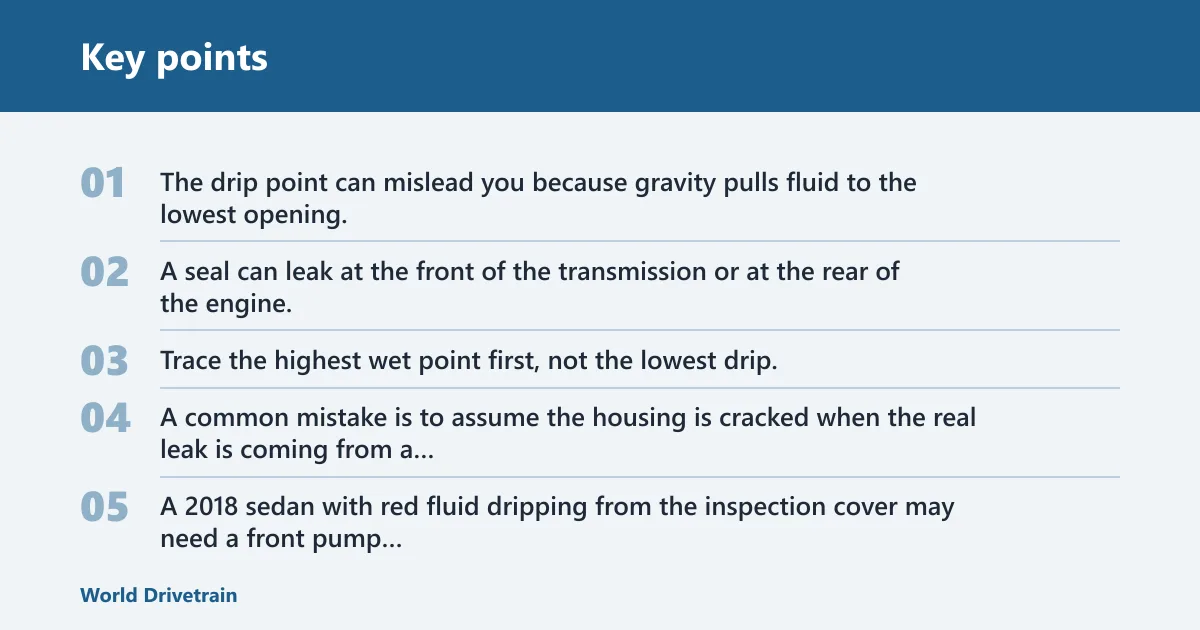
The drip point can mislead you because gravity pulls fluid to the lowest opening. A seal can leak at the front of the transmission or at the rear of the engine, then the fluid spreads across the inside of the bellhousing before it shows up outside. Trace the highest wet point first, not the lowest drip.
A common mistake is to assume the housing is cracked when the real leak is coming from a failed front pump seal. A 2018 sedan with red fluid dripping from the inspection cover may need a front pump seal, while a manual car with oily wetness around the clutch fork opening may point to an input shaft seal or a rear main seal. The fix depends on the path the fluid took.
Why fluid appears at the opening
Inside the bellhousing, the rotating parts fling fluid around. If a seal lets go, ATF or engine oil can coat the inner case, then run down the inside wall until it reaches the bottom opening. A small seep may only wet the lower edge, while a larger leak can wet the cover and stream from the drain points.
Automatic transmission leak sources
On an automatic transmission, the most common bellhousing leak point is the front pump seal. It surrounds the torque converter hub and keeps ATF inside the pump area. When that seal hardens, wears, or gets cut, ATF often shows up at the bellhousing and may drip from the dust shield or inspection opening.
Front pump seal failure
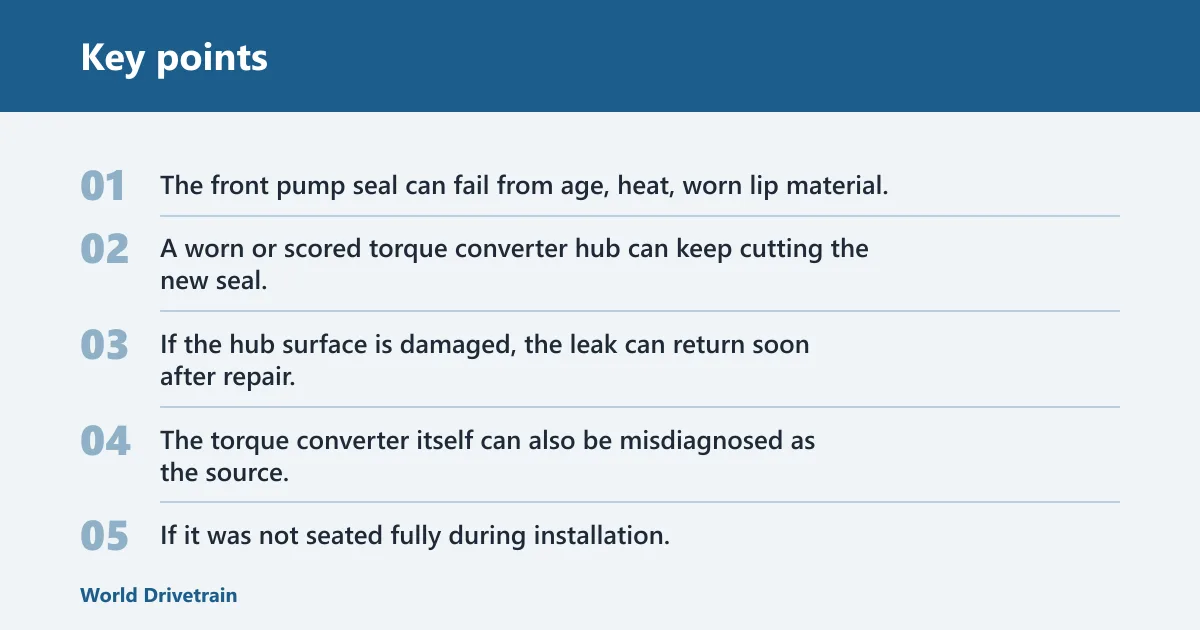
The front pump seal can fail from age, heat, worn lip material, or damage during transmission work. A worn or scored torque converter hub can keep cutting the new seal, so a replacement seal alone may not stop the leak. If the hub surface is damaged, the leak can return soon after repair.
The torque converter itself can also be misdiagnosed as the source. If it was not seated fully during installation, it can damage the front pump components or the torque converter seal lip on assembly. Incorrect alignment can cut the seal lip before the vehicle ever moves.
Torque converter hub wear
The torque converter hub rides through the front seal area. If the hub surface is grooved, pitted, or rough, it can score the seal lip and create a repeat leak. That is one reason a front seal replacement may not solve a leak unless the hub condition is checked at the same time.
Torque converter seal lip damage
The torque converter seal lip is the flexible edge that keeps fluid in while the converter turns. It can be cut during installation if the converter is forced past the seal, tilted, or installed with poor alignment. Correct seating matters, and so does proper fluid level before the unit is run again.
Manual transmission leak sources
On a manual transmission, the bellhousing often points to the input shaft seal or a rear engine leak, not a front pump seal. The input shaft seal seals the rotating input shaft where it enters the transmission case. When it fails, oil can get into the bellhousing and onto the clutch assembly.
Input shaft seal failure
A manual input shaft seal leak often leaves gear oil near the clutch area. The smell is usually sharper than ATF, and the fluid may appear darker or more amber-brown depending on age. The fluid still tends to collect at the bottom opening, so the bellhousing is again the symptom location, not the source by default.
Some transaxles place the same seal path in a tighter space, so fluid can move quickly from the shaft area to the bellhousing opening. On a manual setup, you usually need to separate the transmission from the engine to inspect the seal, clutch, and mating surfaces directly.
How manual leaks differ from automatic leaks
Manual leaks usually involve gear oil at the input shaft area, while automatic leaks are more often ATF from the front pump and converter hub area. The color, smell, and wetness pattern help, but they do not replace inspection. A rear main seal can still mimic either one if it is oiling the same opening.
Is it ATF or engine oil?
You can often separate ATF from engine oil by color, smell, and where the wetness starts. Fresh ATF is usually red or amber and often has a sweet petroleum smell. Engine oil is usually brown to black and smells more like burnt oil or fuel contamination. That clue helps, but fluid condition is only a clue.
Color and smell clues
Red or amber fluid near the bellhousing usually points toward automatic transmission fluid, especially if it smells sweet and feels slick. Dark brown or black fluid points more toward engine oil, though old ATF can also darken. If the fluid is milky or foamy, check for contamination before assuming the source.
Wetness pattern on the bellhousing
Wetness concentrated around the inspection cover or lower opening often means the fluid started higher inside the bellhousing and worked downward. Wetness that begins near the top seam and runs down can point to an engine rear main seal. Wetness inside the clutch housing on a manual can contaminate the clutch and cause slip.
Rear main seal versus transmission fluid
The engine rear main seal sits between the engine and transmission, so it can mimic a transmission leak at the bellhousing. If the fluid is engine oil, the transmission may be fine, but the transmission still has to come out for a proper inspection on many vehicles. That makes source tracing important before ordering parts.
Bellhousing diagnosis table
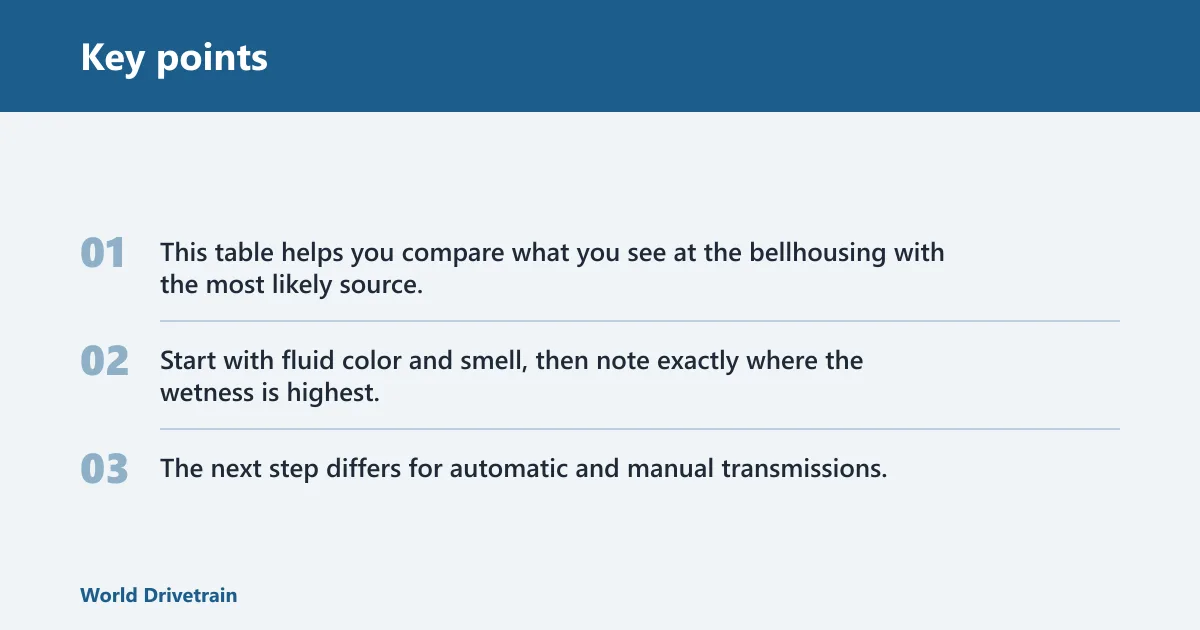
This table helps you compare what you see at the bellhousing with the most likely source. Start with fluid color and smell, then note exactly where the wetness is highest. The next step differs for automatic and manual transmissions.
| What you see | Likely source | Fluid type | Where it wets first | Next inspection step |
|---|---|---|---|---|
| Red or amber drip from lower bellhousing opening | Automatic front pump seal or torque converter hub area | ATF | Inside front of bellhousing, then the bottom opening | Remove the inspection cover or dust shield and look for wetness around the converter hub and pump area |
| Fresh red fluid on the dust shield with converter area wet | Torque converter seal lip cut or displaced during installation | ATF | Front seal area near the converter hub | Check converter seating, pump seal lip, and hub surface before replacing the seal again |
| Dark, oily film inside the bellhousing on a manual transmission | Transmission input shaft seal | Gear oil | Input shaft area and clutch side of the bellhousing | Inspect the input shaft seal and related bearing area after transmission removal |
| Engine oil smell with wetness higher on the engine side of the opening | Engine rear main seal | Engine oil | Rear of engine, then down into the bellhousing | Check the rear main seal path and crankcase ventilation condition before removing the transmission |
| Wet clutch dust and oil at a manual bellhousing | Rear main seal or input shaft seal | Engine oil or gear oil | Clutch housing surfaces | Separate the transmission and inspect both seals, since either one can contaminate the clutch |
How to inspect the leak safely
Check the inspection cover or dust shield first. If the vehicle has a lower access opening, remove it and look for the highest wet point inside the bellhousing. That point is more useful than the puddle on the floor because it shows where the fluid path started.
- Park on level ground and let the engine cool enough to inspect safely.
- Check the fluid level for the correct system, transmission or engine oil.
- Look for fresh wetness inside the lower bellhousing opening.
- Trace upward from the lowest drip to the highest wet surface.
- Compare color and smell before assuming the source.
- Do not keep driving if the level is low or the leak is heavy.
Say your automatic car leaves red droplets after a short drive and the lower dust shield is wet, but the top of the bellhousing is dry. That pattern points more toward the front pump seal area than the rear main seal. If the leak returns right after a seal replacement, the converter hub or installation depth needs another look.
Suppose a manual truck leaves dark oily streaks on the bellhousing and the clutch starts to chatter. That pattern points away from ATF and toward a seal that is contaminating the clutch side. In that case, removing the transmission is usually part of the inspection, not an optional extra.
What the repair usually involves
The repair depends on the source path, not the bellhousing opening itself. Many bellhousing leaks require separating the transmission from the engine to inspect the front seal, converter hub, input shaft seal, clutch, or rear main seal directly. On many vehicles, that is the only reliable way to confirm the fault.
When the transmission must come out
If the leak source is the front pump seal, input shaft seal, or rear main seal, the transmission usually has to come out. That is why repair cost can change a lot between a simple seal job and a job that also needs a converter, hub, clutch, or rear seal inspection. The labor is tied to access, not the fluid itself.
Why converter hub condition matters
A new front seal can fail again if the torque converter hub is worn or if the seal lip was cut during installation. Before replacing the seal a second time, the hub surface should be checked for grooves and the converter should be fully seated. Otherwise, the same leak path can return.
Why seal replacement alone may fail
If the converter, pump, or input shaft surface is damaged, seal replacement alone may not hold. That is the key reason a bellhousing leak should be traced by source path. The visible drip may disappear for a short time, then come back because the mating surface was never corrected.
Should you keep driving?
If the leak is heavy, or if the fluid level is already low, stop driving and get the vehicle checked. Low ATF can damage an automatic transmission quickly, and low engine oil can damage the engine. A bellhousing leak can start as a seep, then turn into a drip or stream without much warning.
Low-fluid warning signs
Watch for slipping, delayed engagement, shudder, warning lights, burnt odor, or a visible trail under the vehicle. Any of those signs mean the leak is no longer just a stain problem. If fluid is dropping fast enough to leave fresh spots after every drive, towing makes more sense than risking more damage.
When towing makes sense
Towing is the better choice when the leak is streaming, the transmission is slipping, or the engine oil light is on. A vehicle with a heavily leaking bellhousing should not be treated as safe just because it still moves. The damage can climb fast once fluid level falls below the working range.
Frequently asked questions
Why would transmission fluid leak from bellhousing?
Transmission fluid leaks from the bellhousing because the front seal area at the transmission or the engine rear seal is failing, and the fluid runs to the lower opening. On automatics, the front pump seal and torque converter hub area are commonly reported leak sources. On manuals, the input shaft seal is often reported more commonly than the front pump seal.
Can transmission fluid leak from the bell housing?
Yes. Fluid can show up at the bellhousing even when the source is higher or deeper inside the engine-transmission joint. The bellhousing often acts as the exit point, not the failure point. Trace the highest wet area and identify whether the fluid is ATF or engine oil.
How do I tell if the leak is engine oil or transmission fluid?
Fresh ATF is usually red or amber and often has a sweet petroleum smell. Engine oil is usually brown to black and smells more like burned oil. Check where the wetness begins too. Fluid at the top rear of the engine side points more toward a rear main seal than a transmission front seal.
Is a front pump seal leak expensive to fix?
It can be, because the transmission often has to come out to reach the front pump seal. Cost rises further if the torque converter hub is scored, the converter was installed wrong, or the pump area is damaged. A seal alone is cheaper than a seal plus converter or pump work.
Can a torque converter seal cause fluid at the bellhousing?
Yes. A cut or displaced torque converter seal lip can put ATF inside the bellhousing, especially if the converter was not seated correctly during installation. A worn converter hub can also keep damaging the seal. If the leak returns after a new seal, the hub and pump area need inspection.
Where would my transmission be leaking?
If the fluid is at the bellhousing, the transmission may be leaking from the front pump seal on an automatic or the input shaft seal on a manual. A rear main seal on the engine can mimic both. Start with fluid type, then inspect the highest wet point inside the bellhousing opening.