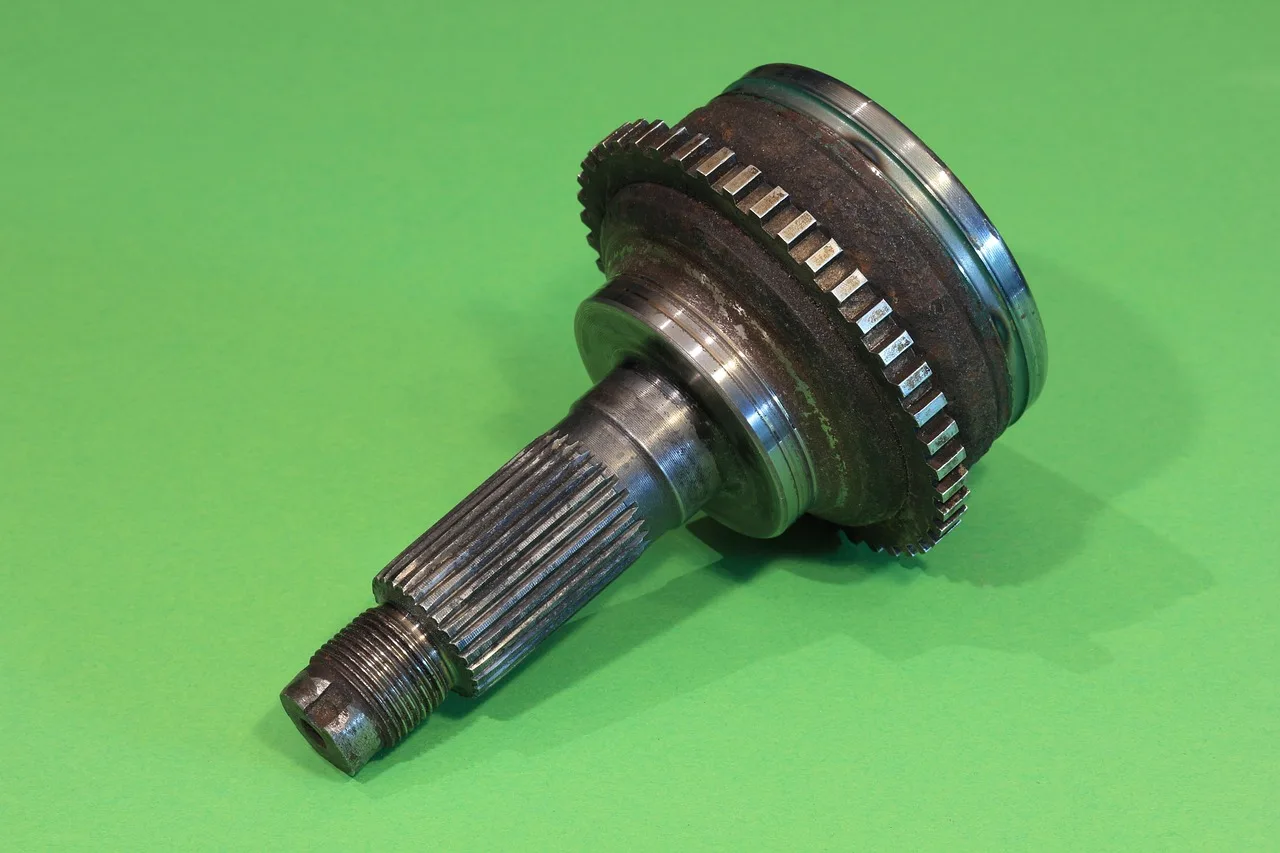
CV Axle vs CV Joint: What’s the Difference?
A CV axle is the full shaft assembly. A CV joint is the flexible coupling at each end. You usually replace the axle assembly when the shaft, boot, or multiple parts are worn. If you ignore the wrong part, the same noise can come back, grease can keep leaking, or the shaft can fail and leave the car stranded. This guide separates the parts, shows how to find the failed component, and explains when to replace the joint or the full axle.
| Decision factor | CV axle | CV joint | Winner |
|---|---|---|---|
| What it is | Full shaft assembly that carries power to the wheel and often includes inner and outer CV joints | Single coupling that lets the shaft transmit power at an angle | tie |
| Best repair scope | Best when the shaft, spline, boot damage, or multiple parts are worn | Best when the shaft is sound and the failure is limited to one joint | tie |
| Ease of replacement | Usually faster as a unit swap on many front-wheel-drive cars | More labor to disassemble and rebuild the shaft when joint-only replacement is possible | CV axle |
| Common failure pattern | Can fail from shaft play, damaged splines, or repeated joint wear | Common source of clicking, binding, or vibration when the cage, balls, or races wear | tie |
| Inspection focus | Shaft runout, axle play, torn boots, and movement at the shaft or hub | Grease loss, clicking on turns, and angle-related noise from the inner or outer joint | tie |
How a front-wheel-drive axle uses inner and outer joints
A CV axle is the full driveline shaft assembly. A CV joint is one part of that assembly, and on many front-wheel-drive cars there is an inner CV joint and an outer CV joint on the same axle shaft.
How the parts relate in a front-wheel-drive axle
In a front-wheel-drive layout, the transmission sends power through the axle shaft to the wheel. The inner CV joint is commonly described as allowing plunge and suspension movement near the transaxle, while the outer CV joint handles steering angle at the wheel end. That is why the axle and the joint are linked, but not the same part.
The quick difference in one sentence
If the axle is the whole shaft, the CV joint is the flex point on that shaft. A bad joint can make a good axle assembly noisy, and a damaged shaft can make a joint replacement pointless.
How a CV axle is built
A CV axle is usually a shaft with one or two CV joints, protective rubber boots, and grease packed into the joint housings. On many front-wheel-drive applications, the complete assembly is called a CV axle or half shaft.
Axle shaft and half shaft terminology
Axle shaft and half shaft are often used for the same basic part in front-wheel-drive service language. The shaft is the metal link between the transmission and the wheel hub, while the CV joints let that shaft work at changing angles without binding.
Inner CV joint
The inner CV joint is usually on the transmission side. It handles suspension travel and allows axial movement, often called plunge, as the suspension moves up and down.
Outer CV joint
The outer CV joint is usually on the wheel side. It lets the wheel steer while still sending power, so it sees a larger articulation angle than the inner joint.
CV boots and grease
The CV boot keeps grease in and dirt and moisture out. Once a boot splits, grease loss starts, contamination follows, and joint wear speeds up fast.
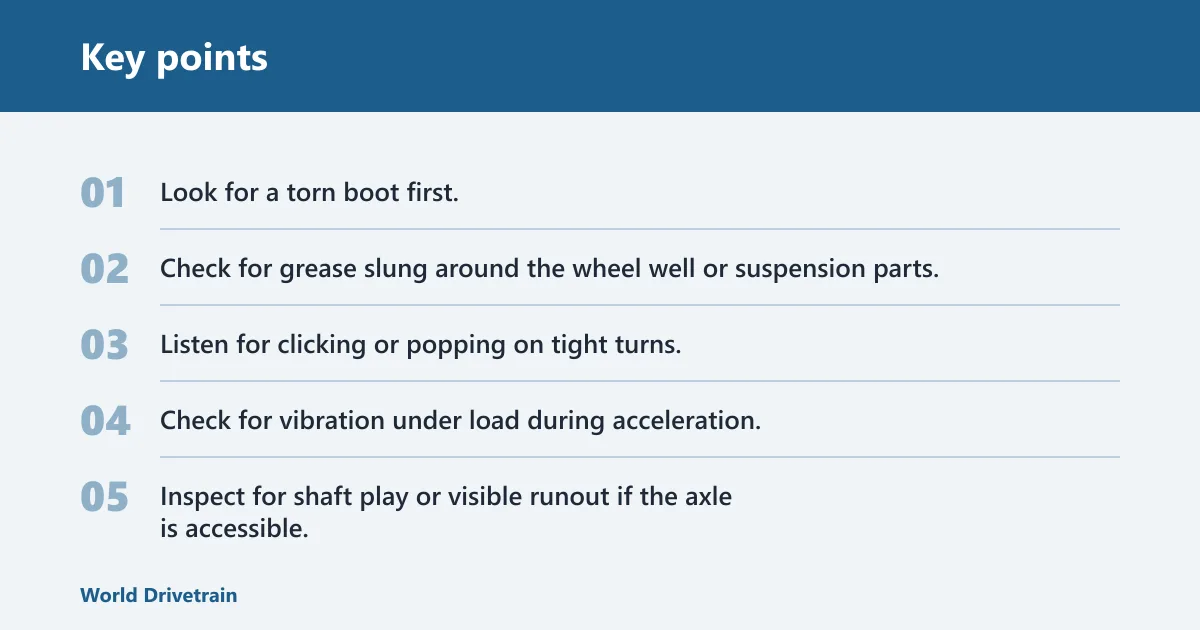
- Look for a torn boot first.
- Check for grease slung around the wheel well or suspension parts.
- Listen for clicking or popping on tight turns.
- Check for vibration under load during acceleration.
- Inspect for shaft play or visible runout if the axle is accessible.
What a CV joint does
A CV joint transfers power from the transmission to the wheels while allowing axle movement. It keeps rotational speed smooth as the shaft changes angle, which is why it is common on driven steer wheels in front-wheel-drive vehicles.
Constant velocity joint design
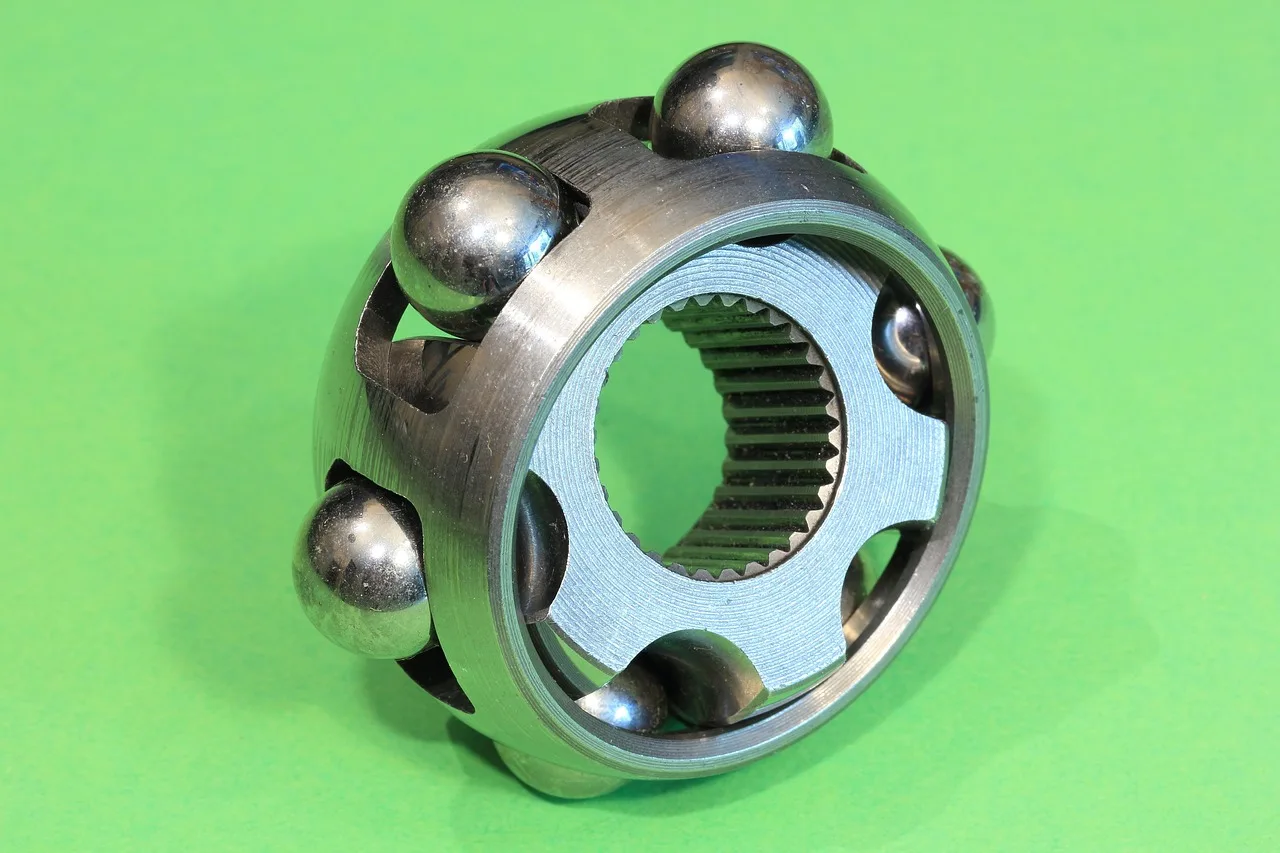
Most CV joints use a ball cage, steel balls, and inner and outer races. That ball-type layout lets the joint keep power flow even as the angle changes. A Rzeppa joint is the ball-type layout commonly used where high operating angles are needed, while a tripod joint gives greater axial movement.
Why angle matters
CV joints can operate at angles up to 45–50 degrees. That angle range is one reason they are used instead of a universal joint in many front-wheel-drive drivetrains, where steering and suspension movement happen at the same time.
Why CV joints are used on driven steer wheels
Front-wheel-drive cars need a joint that can send torque while the wheel steers left and right and moves up and down. The outer joint handles the steering angle, and the inner joint handles movement from suspension travel.
CV axle vs CV joint: side-by-side
The core trade-off is simple: a CV axle is the full assembly, while a CV joint is only one load-carrying part inside that assembly. If the damage is limited to grease loss and an early joint symptom, joint repair can make sense. If the shaft, splines, or both joints are worn, the full axle is usually the cleaner fix.
Location on the vehicle
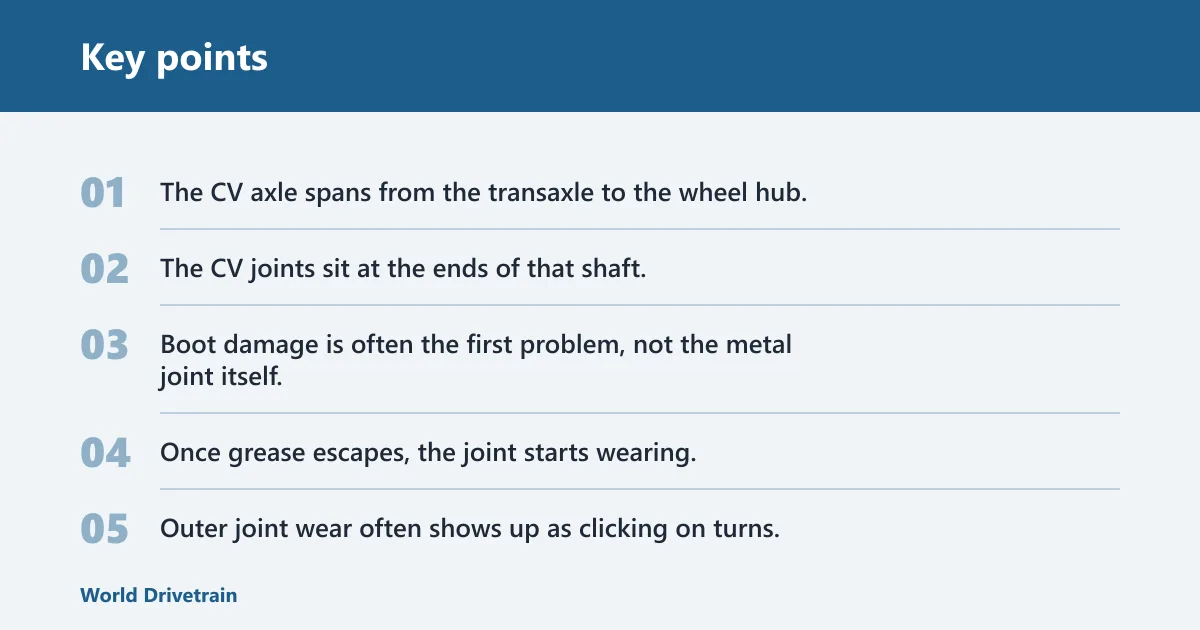
The CV axle spans from the transaxle to the wheel hub. The CV joints sit at the ends of that shaft, with the inner joint near the transmission and the outer joint near the wheel.
What fails most often
Boot damage is often the first problem, not the metal joint itself. Once grease escapes, the joint starts wearing, and the wear pattern is what usually causes clicking, vibration, or binding.
Typical symptoms
Outer joint wear often shows up as clicking on turns. Inner joint wear is often reported as vibration under load or a shudder during acceleration. A shaft problem is more likely to show play, wobble, or runout.
Repair scope
Joint-only repair can work when the shaft is straight and undamaged and the rest of the assembly is in good condition. Full axle replacement is usually the better choice when multiple wear points exist or when the joint and shaft are both questionable.
Which part is actually bad?
The symptom usually points you toward the failed part. Clicking on turns suggests an outer CV joint. Vibration under acceleration often points to the inner CV joint. A torn boot with grease loss may still be a repairable joint, but only if the joint has not been contaminated long enough to wear out.
Clicking on turns
Clicking that gets louder in tight turns usually points to the outer CV joint. That joint works at the highest steering angle, so it wears first when grease is lost or the cage and balls develop play.
Torn boot with grease loss
A torn boot means the joint has lost its seal. If the boot damage is caught early, a boot replacement and regrease may save the joint; if dirt and moisture have already entered, the joint may need replacement too.
Vibration under load
Vibration that shows up during hard acceleration often points to the inner CV joint or the axle assembly as a whole. The inner joint handles plunge, so wear there can create shudder before it makes obvious noise.
Axle shaft play or runout
Visible shaft wobble, looseness at the hub, or excessive play suggests the shaft or the complete axle assembly may be the issue. That kind of damage is not a joint-only problem.
CV axle vs CV joint: which part is actually bad?
Use the symptom, then confirm with a quick inspection. Clicking on turns usually means the outer CV joint. A torn boot with fresh grease can still be a joint problem in the making. Vibration under load often points to the inner joint, while shaft play or runout pushes the diagnosis toward the CV axle assembly.
| Symptom | Likely component | Quick inspection | Typical repair path |
|---|---|---|---|
| Clicking on turns | Outer CV joint | Turn full lock in a parking lot and listen for rhythmic clicks that get louder under power | Replace the outer joint or the complete axle if the shaft or other joint is worn |
| Torn boot with grease loss | CV joint and boot | Inspect for split rubber, grease sling, and contamination around the joint housing | Boot-only repair if caught early; joint or axle replacement if contamination or wear is present |
| Vibration under load | Inner CV joint or axle assembly | Accelerate in a straight line and note whether the vibration appears only under torque | Replace the inner joint or the full axle if play is present |
| Axle shaft runout or play | CV axle | Check for visible wobble, looseness at the hub, or movement in the shaft itself | If the shaft has noticeable play or runout, a common rule of thumb is to replace the complete axle assembly. |
Say your compact sedan starts clicking only when you turn left out of a parking space. That points to the outer joint on the loaded side, and a straight-line road test usually stays quiet. If the clicking becomes constant or the boot is split with grease thrown across the rim, the axle assembly may be the smarter replacement.
Suppose a front-wheel-drive hatchback shudders during a hard merge onto the highway, but the noise disappears once you lift off the throttle. That pattern fits an inner joint problem better than an outer one, especially if the boots still look intact and the shaft does not wobble.
Choose CV joint repair if… / Choose CV axle replacement if…
Choose CV joint repair if the shaft is straight, the damage is isolated to one joint, and the boot failure was caught early enough that the joint has not been contaminated. Choose CV axle replacement if the shaft has play or runout, both joints show wear, or you want the cleaner fix on a high-mileage front-wheel-drive axle.
Choose CV joint repair if the shaft is sound
A joint-only repair makes sense when the axle shaft is still in good shape and the failure is limited to one end. That can save parts cost, but it only pays off when the rest of the assembly is truly usable.
Choose CV axle replacement if the shaft or both joints are worn
A full axle replacement is the better call when the shaft itself is compromised or when the inner and outer joints both have wear. It also avoids opening up a tired assembly that may fail again soon.
When a boot-only issue changes the plan
If you catch a torn boot before the joint starts clicking or vibrating, a boot replacement and fresh grease may be enough. Once the joint has already started making noise, the repair usually needs to go farther than the rubber boot.
Frequently asked questions
Axle vs CV axle
An axle is a general term for the shaft that carries load and power. A CV axle is the front-wheel-drive style shaft assembly that uses CV joints at one or both ends so the wheel can steer and move with the suspension while still receiving torque.
Axle shaft vs CV axle
An axle shaft is the metal shaft itself. A CV axle usually means the full assembly, including the shaft, CV joints, and boots on many front-wheel-drive vehicles. If only the shaft is damaged, the repair may still involve the whole assembly because the joints and boots come with it.
What’s a CV joint
A CV joint is the coupling that lets a driveline transmit power while changing angle. It uses a ball cage, steel balls, and inner and outer races in many designs, and it is typically sealed and packed with grease to keep contamination out.
What are CV joints?
CV joints are the moving ends of a CV axle. The inner joint handles plunge and suspension movement, while the outer joint handles the larger steering angle at the wheel. Together they keep the shaft turning smoothly through suspension and steering travel.
Is a CV joint part of the CV axle?
Yes. On many front-wheel-drive axles, the CV axle assembly includes an inner CV joint and an outer CV joint. That is the main source of confusion: the axle is the full assembly, and the joint is one component within it.
Can you replace just the CV joint instead of the whole axle?
Yes, if the shaft is still sound and the damage is limited to one joint. The catch is that joint-only replacement makes sense only when the rest of the assembly has no play, no shaft damage, and no contamination from a failed boot.
How do I know if my CV axle or CV joint is bad?
Start with the symptom. Clicking on turns points to the outer CV joint, vibration under load points to the inner joint, and shaft play or visible runout points to the CV axle assembly. A torn boot with grease loss is a warning sign that can become any of those failures if ignored.